Primitive describes something very old, simple, or undeveloped. Imagine early humans living in caves and using stone tools. Their lifestyle was basic and simple. That is primitive life.
Today, the word primitive is used in history, science, art, and daily conversation. It can describe ancient times, early stages of development, or something simple and not modern. Sometimes it has a neutral meaning. Sometimes it may sound negative if it suggests lack of progress.
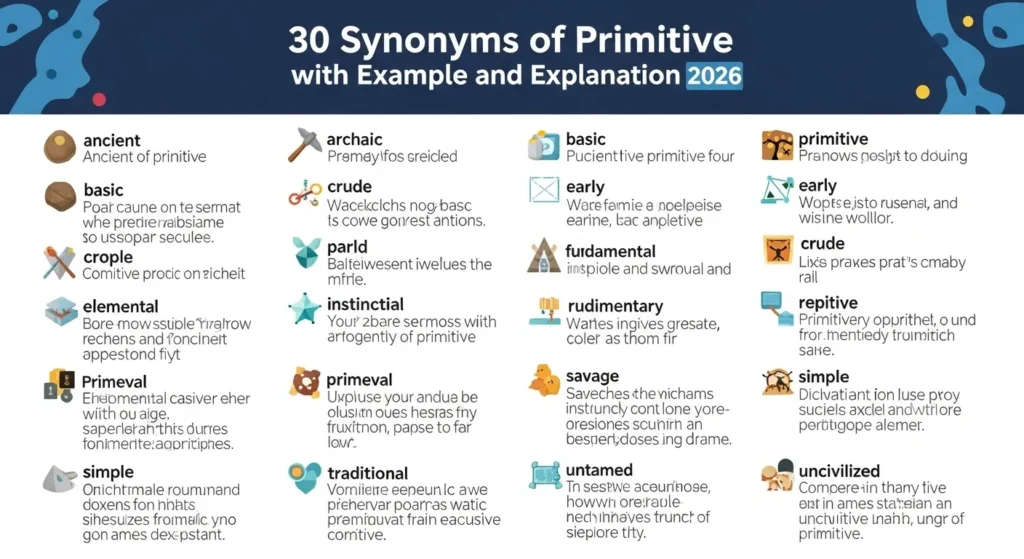
Learning synonyms of primitive helps English learners improve vocabulary and avoid repetition. Writers choose different synonyms depending on tone—historical, technical, simple, or negative. In this article, you will learn the meaning, pronunciation, history, grammar, and 30 strong synonyms of primitive with clear meanings and examples.
Meaning of Primitive
Definition
Primitive (Adjective):
Relating to an early stage of development; simple, basic, or not advanced.
Examples
Early humans used primitive tools.
The village still has primitive farming methods.
Connotative Meaning
(Connotation means the emotional feeling or tone connected to a word beyond its dictionary meaning.)
- Positive tone: Natural, original, pure
- Negative tone: Uncivilized, outdated
- Neutral tone: Early stage of development
Etymology
- From Latin “primitivus” meaning “first of its kind”
- Entered English in the 14th century
Short History
- Old English (450–1100): Word not used
- Middle English (1100–1500): Borrowed from Latin through French
- Modern English (1500–Present): Used in science, religion, and social discussion
Pronunciation (US & UK – IPA)
US: /ˈprɪmətɪv/
UK: /ˈprɪmətɪv/
Syllables
prim-i-tive
Affixation Pattern
- Root: prim (first)
- Prefix: None
- Suffix: -itive (adjective form)
Word Formation
- Primitive (adjective)
- Primitively (adverb)
- Primitiveness (noun)
Synonyms of Primitive
1. Ancient (Adjective) — US /ˈeɪnʃənt/ | UK /ˈeɪnʃənt/
Meaning: Very old; from a long time ago.
Examples:
They studied ancient tools.
Ancient cultures shaped history.
2. Early (Adjective) — US /ˈɜːrli/ | UK /ˈɜːli/
Meaning: Happening at the beginning stage.
Examples:
Early humans hunted animals.
This is an early version of the machine.
3. Original (Adjective) — US /əˈrɪdʒənəl/ | UK /əˈrɪdʒɪnəl/
Meaning: First form of something.
Examples:
This is the original design.
The original method was simple.
4. Basic (Adjective) — US /ˈbeɪsɪk/ | UK /ˈbeɪsɪk/
Meaning: Simple and not advanced.
Examples:
The shelter was basic.
He has basic computer skills.
5. Simple (Adjective) — US /ˈsɪmpəl/ | UK /ˈsɪmpəl/
Meaning: Easy and not complex.
Examples:
They used simple tools.
The solution is simple.
6. Crude (Adjective) — US /kruːd/ | UK /kruːd/
Meaning: Rough and not carefully made.
Examples:
The drawing was crude.
They built a crude shelter.
7. Rudimentary (Adjective) — US /ˌruːdəˈmɛntəri/ | UK /ˌruːdɪˈmɛntəri/
Meaning: Basic and not fully developed.
Examples:
He has rudimentary knowledge.
The system is rudimentary.
8. Unrefined (Adjective) — US /ˌʌnrɪˈfaɪnd/ | UK /ˌʌnrɪˈfaɪnd/
Meaning: Not polished or developed.
Examples:
The method seems unrefined.
Her skills were unrefined.
9. Raw (Adjective) — US /rɔː/ | UK /rɔː/
Meaning: Natural and not processed.
Examples:
The material is raw.
He showed raw talent.
10. Untouched (Adjective) — US /ʌnˈtʌtʃt/ | UK /ʌnˈtʌtʃt/
Meaning: Not changed or developed.
Examples:
The land remains untouched.
The forest looks untouched.
11. Prehistoric (Adjective) — US /ˌpriːhɪˈstɔːrɪk/ | UK /ˌpriːhɪˈstɒrɪk/
Meaning: From the time before written history.
Examples:
Prehistoric animals were large.
They found prehistoric bones.
12. Archaic (Adjective) — US /ɑːrˈkeɪɪk/ | UK /ɑːˈkeɪɪk/
Meaning: Very old-fashioned or outdated.
Examples:
The law seems archaic.
Archaic words are rarely used.
13. Primeval (Adjective) — US /praɪˈmiːvəl/ | UK /praɪˈmiːvəl/
Meaning: Existing from the earliest times.
Examples:
They explored a primeval forest.
The cave has a primeval feel.
14. Tribal (Adjective) — US /ˈtraɪbəl/ | UK /ˈtraɪbəl/
Meaning: Related to early social groups.
Examples:
Tribal customs are unique.
They studied tribal art.
15. Stone-age (Adjective) — US /ˈstoʊn eɪdʒ/ | UK /ˈstəʊn eɪdʒ/
Meaning: Extremely old or outdated.
Examples:
That computer is stone-age.
Stone-age tools were simple.
16. Unsophisticated (Adjective) — US /ˌʌnsəˈfɪstɪkeɪtɪd/ | UK /ˌʌnsəˈfɪstɪkeɪtɪd/
Meaning: Not advanced or complex.
Examples:
The design looks unsophisticated.
He has unsophisticated taste.
17. Naive (Adjective) — US /naɪˈiːv/ | UK /naɪˈiːv/
Meaning: Lacking experience or knowledge.
Examples:
She made a naive mistake.
His ideas sound naive.
18. Elementary (Adjective) — US /ˌɛləˈmɛntəri/ | UK /ˌɛlɪˈmɛntəri/
Meaning: Basic and simple.
Examples:
He made an elementary error.
The course covers elementary skills.
19. Fundamental (Adjective) — US /ˌfʌndəˈmɛntəl/ | UK /ˌfʌndəˈmɛntəl/
Meaning: Forming the base or foundation.
Examples:
This is a fundamental idea.
Fundamental tools were used.
20. Primary (Adjective) — US /ˈpraɪmeri/ | UK /ˈpraɪməri/
Meaning: First or earliest in order.
Examples:
This is the primary stage.
Primary tools were simple.
21. Early-stage (Adjective) — US /ˈɜːrli steɪdʒ/ | UK /ˈɜːli steɪdʒ/
Meaning: At the beginning level of development.
Examples:
The project is early-stage.
Early-stage tools were basic.
22. Antiquated (Adjective) — US /ˈæntɪkweɪtɪd/ | UK /ˈæntɪkweɪtɪd/
Meaning: Outdated and old-fashioned.
Examples:
The system is antiquated.
They replaced antiquated methods.
23. Crusty (Adjective) — US /ˈkrʌsti/ | UK /ˈkrʌsti/
Meaning: Rough or old-fashioned in style.
Examples:
The crusty building needs repair.
He has a crusty attitude.
24. Uncivilized (Adjective) — US /ʌnˈsɪvəlaɪzd/ | UK /ʌnˈsɪvɪlaɪzd/
Meaning: Not developed socially or culturally.
Examples:
The term uncivilized can be offensive.
They rejected uncivilized behavior.
25. Rough (Adjective) — US /rʌf/ | UK /rʌf/
Meaning: Not smooth or refined.
Examples:
The road is rough.
The sketch is rough.
26. Backward (Adjective) — US /ˈbækwərd/ | UK /ˈbækwəd/
Meaning: Less developed than modern standards.
Examples:
The region seems backward.
They improved backward systems.
27. Prime (Adjective) — US /praɪm/ | UK /praɪm/
Meaning: First or earliest form.
Examples:
Prime stages are important.
The prime design was simple.
28. Initial (Adjective) — US /ɪˈnɪʃəl/ | UK /ɪˈnɪʃəl/
Meaning: Occurring at the beginning.
Examples:
The initial model was primitive.
Initial tools were basic.
29. Underdeveloped (Adjective) — US /ˌʌndərdɪˈvɛləpt/ | UK /ˌʌndədɪˈvɛləpt/
Meaning: Not fully grown or advanced.
Examples:
The idea is underdeveloped.
Underdeveloped regions need support.
30. Unadvanced (Adjective) — US /ʌnədˈvænst/ | UK /ʌnədˈvɑːnst/
Meaning: Not modern or progressive.
Examples:
The tools were unadvanced.
Unadvanced systems slow progress.
Prototype Meaning
When people hear primitive, they imagine cave dwellers, stone tools, and early human life. The core idea is something basic, early, and not modern.
Antonyms of Primitive
Modern
Advanced
Sophisticated
Developed
Refined
Conclusion
Learning primitive and its synonyms improves vocabulary and writing clarity. It helps you avoid repetition and choose the right tone—historical, neutral, or critical. Strong vocabulary builds confidence in English speaking and writing. Practice new words daily to grow your language skills.

I’m Zahid Abbas, an educator, researcher, and digital publishing strategist with a passion for linguistics, grammar, and clear communication. As a content creator and SEO specialist, I craft research-driven, reader-focused content that empowers learners and makes knowledge accessible worldwide.