The word structure means the way something is built, arranged, or organized. Imagine a student writing an essay with a clear beginning, middle, and ending. That essay has a good structure. A building also has a structure that keeps it strong and stable.
People use this word in education, business, science, architecture, and daily conversation. It is common because many things in life need order and organization. However, repeating the same word many times can make writing sound dull.
Learning synonyms of structure helps English learners improve vocabulary and communicate more clearly. It also helps writers choose the best word for different situations. In this article, you will learn the meaning of structure, its pronunciation, history, grammar, and 30 useful synonyms with meanings and examples. You will also explore semantic categories, antonyms, and simple questions to improve your English communication skills.
Meaning of Structure
Definition
Structure (noun/verb): the arrangement, organization, or framework of something.
Examples
- The building has a strong structure.
- Her essay needs better structure.
Connotative Meaning
- Positive tone: organized, stable, strong
- Negative tone: rigid, strict, limiting
- Neutral tone: arrangement or framework
Etymology
- From Latin structura meaning “building” or “arrangement”
- Derived from the Latin verb struere, meaning “to build”
Short History:
- Old English (450–1100): similar ideas described building and arrangement
- Middle English (1100–1500): structure entered through Latin and French influence
- Modern English (1500–Present): widely used in science, writing, and architecture
Pronunciation (US & UK – IPA)
- US: /ˈstrʌktʃər/
- UK: /ˈstrʌktʃə/
Syllables
- struc-ture
Affixation Pattern of Structure
- Root: struct
- Prefix: none
- Suffix: -ure
Word Formation:
- structure (noun/verb)
- structural (adjective)
- structurally (adverb)
- restructuring (noun/verb)
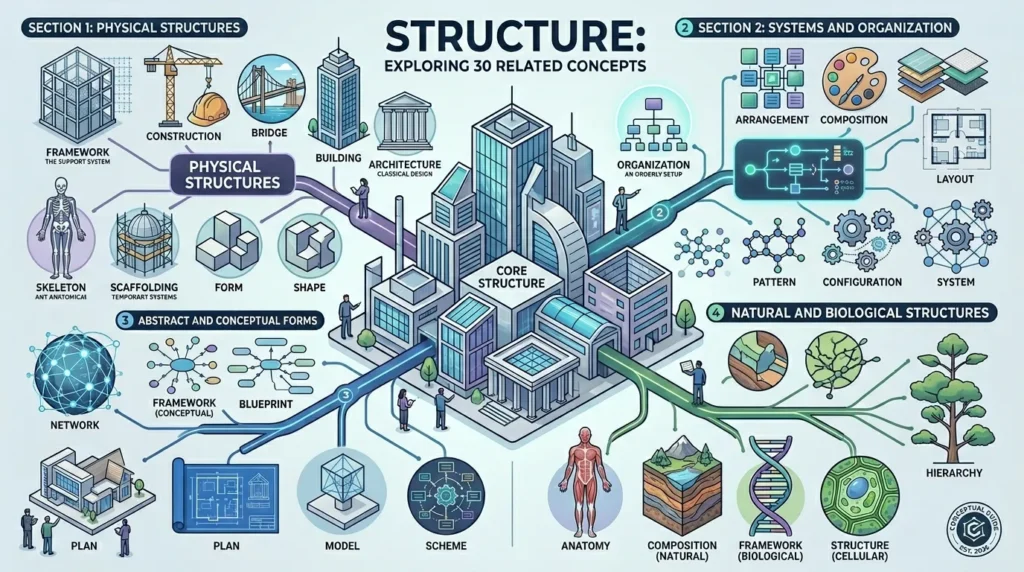
30 Synonyms of Structure
1. Framework (noun)
US: /ˈfreɪmˌwɜːrk/ | UK: /ˈfreɪmwɜːk/
Meaning: a basic supporting system or arrangement
Examples:
- The company created a new framework.
- The bridge has a steel framework.
2. Organization (noun)
US: /ˌɔːrɡənəˈzeɪʃən/ | UK: /ˌɔːɡənaɪˈzeɪʃən/
Meaning: the way parts are arranged
Examples:
- Good organization improves learning.
- The office lacks proper organization.
3. Arrangement (noun)
US: /əˈreɪndʒmənt/ | UK: /əˈreɪndʒmənt/
Meaning: the order or position of parts
Examples:
- The flower arrangement looked beautiful.
- The seating arrangement changed.
4. System (noun)
US: /ˈsɪstəm/ | UK: /ˈsɪstəm/
Meaning: a connected set of parts working together
Examples:
- The school uses a new system.
- The computer system failed.
5. Formation (noun)
US: /fɔːrˈmeɪʃən/ | UK: /fɔːˈmeɪʃən/
Meaning: the way something is formed
Examples:
- Rock formation takes years.
- The team stood in a circle formation.
6. Design (noun)
US: /dɪˈzaɪn/ | UK: /dɪˈzaɪn/
Meaning: the planned arrangement of something
Examples:
- The house has a modern design.
- Her website design looks simple.
7. Construction (noun)
US: /kənˈstrʌkʃən/ | UK: /kənˈstrʌkʃən/
Meaning: the act or result of building
Examples:
- The bridge is under construction.
- Strong construction prevents damage.
8. Shape (noun)
US: /ʃeɪp/ | UK: /ʃeɪp/
Meaning: the outer form of something
Examples:
- The cloud had a strange shape.
- The box kept its shape.
9. Layout (noun)
US: /ˈleɪaʊt/ | UK: /ˈleɪaʊt/
Meaning: the arrangement of parts or objects
Examples:
- The room layout feels comfortable.
- The page layout is clean.
10. Pattern (noun)
US: /ˈpætərn/ | UK: /ˈpætən/
Meaning: a repeated arrangement or design
Examples:
- The rug has a colorful pattern.
- Weather follows a seasonal pattern.
11. Composition (noun)
US: /ˌkɑːmpəˈzɪʃən/ | UK: /ˌkɒmpəˈzɪʃən/
Meaning: the arrangement of parts in a whole
Examples:
- The painting has a balanced composition.
- Music students study song composition.
12. Configuration (noun)
US: /kənˌfɪɡjəˈreɪʃən/ | UK: /kənˌfɪɡəˈreɪʃən/
Meaning: the arrangement of elements in a system
Examples:
- The computer needs a new configuration.
- The seating configuration changed.
13. Build (noun/verb)
US: /bɪld/ | UK: /bɪld/
Meaning: the physical form or construction of something
Examples:
- He has a strong build.
- Workers will build the bridge.
14. Anatomy (noun)
US: /əˈnætəmi/ | UK: /əˈnætəmi/
Meaning: the internal structure of something
Examples:
- Students studied human anatomy.
- The book explains flower anatomy.
15. Architecture (noun)
US: /ˈɑːrkɪtektʃər/ | UK: /ˈɑːkɪtektʃə/
Meaning: the design and structure of buildings
Examples:
- Paris is famous for its architecture.
- She studies modern architecture.
16. Skeleton (noun)
US: /ˈskelətən/ | UK: /ˈskelɪtən/
Meaning: the supporting framework of something
Examples:
- The body’s skeleton supports movement.
- The tent has a metal skeleton.
17. Foundation (noun)
US: /faʊnˈdeɪʃən/ | UK: /faʊnˈdeɪʃən/
Meaning: the base that supports something
Examples:
- The building needs a strong foundation.
- Trust is the foundation of friendship.
18. Base (noun)
US: /beɪs/ | UK: /beɪs/
Meaning: the bottom support of something
Examples:
- The lamp has a heavy base.
- Education forms the base of success.
19. Order (noun)
US: /ˈɔːrdər/ | UK: /ˈɔːdə/
Meaning: a proper arrangement of things
Examples:
- The teacher likes order in class.
- The files are in alphabetical order.
20. Network (noun)
US: /ˈnetwɜːrk/ | UK: /ˈnetwɜːk/
Meaning: a connected system of parts
Examples:
- The city has a large transport network.
- Computers share a secure network.
21. Blueprint (noun)
US: /ˈbluːprɪnt/ | UK: /ˈbluːprɪnt/
Meaning: a detailed plan or design
Examples:
- The architect showed the blueprint.
- The manager created a business blueprint.
22. Matrix (noun)
US: /ˈmeɪtrɪks/ | UK: /ˈmeɪtrɪks/
Meaning: an organized arrangement of elements
Examples:
- The company uses a decision matrix.
- Scientists studied the data matrix.
23. Grid (noun)
US: /ɡrɪd/ | UK: /ɡrɪd/
Meaning: a framework of crossing lines
Examples:
- The city follows a street grid.
- The graph uses a square grid.
24. Scheme (noun)
US: /skiːm/ | UK: /skiːm/
Meaning: a planned arrangement or system
Examples:
- The color scheme looks bright.
- The government announced a new scheme.
25. Model (noun)
US: /ˈmɑːdəl/ | UK: /ˈmɒdəl/
Meaning: a representation or example of structure
Examples:
- The class built a bridge model.
- This business model works well.
26. Fabric (noun)
US: /ˈfæbrɪk/ | UK: /ˈfæbrɪk/
Meaning: the basic structure of society or system
Examples:
- Trust is part of social fabric.
- Education shapes cultural fabric.
27. Edifice (noun)
US: /ˈedɪfɪs/ | UK: /ˈedɪfɪs/
Meaning: a large building or complex structure
Examples:
- The ancient edifice attracted tourists.
- Workers repaired the old edifice.
28. Edging (noun)
US: /ˈedʒɪŋ/ | UK: /ˈedʒɪŋ/
Meaning: the border structure around something
Examples:
- The garden has stone edging.
- Wooden edging lined the path.
29. Formation Plan (noun)
US: /fɔːrˈmeɪʃən plæn/ | UK: /fɔːˈmeɪʃən plæn/
Meaning: a planned arrangement of parts
Examples:
- The coach explained the formation plan.
- Engineers followed the formation plan.
30. Scaffolding (noun)
US: /ˈskæfəldɪŋ/ | UK: /ˈskæfəldɪŋ/
Meaning: a temporary supporting structure
Examples:
- Workers climbed the scaffolding.
- The building was covered with scaffolding.
Prototype Meaning
The most common meaning of structure is the organized arrangement of parts that form a whole. People usually imagine buildings, systems, essays, or frameworks that provide strength, order, and support.
Prototype Categorization
- Building and support: framework, foundation, scaffolding
- Organization and order: system, arrangement, layout
- Design and planning: blueprint, configuration, model
- Patterns and connections: network, grid, matrix.
Antonyms of Structure
- Chaos (noun): complete disorder
- Disorder (noun): lack of organization
- Confusion (noun): unclear arrangement
- Mess (noun): untidy condition
- Randomness (noun): lack of pattern or system
Short Questions and Answers
What does structure mean?
- It means the arrangement or organization of something.
When should structure be used?
- Use it when discussing systems, buildings, writing, or organization.
Is structure positive or negative?
- It is usually positive because it suggests order and stability.
How is it different from similar words?
- “Structure” focuses on arrangement and support, while “design” mainly focuses on appearance and planning.
Conclusion
Learning synonyms of structure and synonyms of structure improves vocabulary and communication skills. It helps English learners describe organization, systems, and arrangements more clearly in speaking and writing. Using different synonyms also avoids repetition and makes communication more professional and natural. These words are useful in education, architecture, business, science, and daily conversation. They help writers explain ideas with better clarity and precision. Practice learning and using new vocabulary every day. Small vocabulary habits can build stronger English confidence and improve fluency over time.

I’m Zahid Abbas, an educator, researcher, and digital publishing strategist with a passion for linguistics, grammar, and clear communication. As a content creator and SEO specialist, I craft research-driven, reader-focused content that empowers learners and makes knowledge accessible worldwide.