The word wrong means not correct, not true, or not morally right. Imagine a student solving a math problem in class. The student gives an answer, but the teacher says it is wrong. This simple word appears in school, work, conversations, and daily life.
People use the word wrong very often because it helps describe mistakes, errors, bad actions, and incorrect ideas. However, repeating the same word again and again can make writing dull and weak.
Learning synonyms of wrong helps English learners improve vocabulary and express ideas more clearly. It also helps writers and speakers choose better words for different situations. In this article, you will learn the meaning of wrong, its pronunciation, grammar, history, and 30 useful synonyms with examples. You will also explore antonyms, semantic categories, and simple questions to strengthen your English communication skills.
Meaning of Wrong
Definition
Wrong (adjective/noun/adverb): not correct, not true, or morally bad.
Examples
- Your answer is wrong.
- It is wrong to lie to people.
Connotative Meaning
- Positive tone: sometimes suggests learning from mistakes
- Negative tone: incorrect, unfair, dishonest, bad
- Neutral tone: simply not correct
Etymology
- From Old English wrang meaning “crooked” or “not right”
- Related to Old Norse and Germanic language roots
Short History:
- Old English (450–1100): used for injustice and crookedness
- Middle English (1100–1500): used for mistakes and moral errors
- Modern English (1500–Present): widely used for incorrect actions and ideas
Pronunciation (US & UK – IPA)
- US: /rɔːŋ/
- UK: /rɒŋ/
Syllables
- wrong
Affixation Pattern of Wrong
- Root: wrong
- Prefix: none
- Suffix: none
Word Formation:
- wrong (adjective)
- wrongly (adverb)
- wrongness (noun)
- wrongdoing (noun)
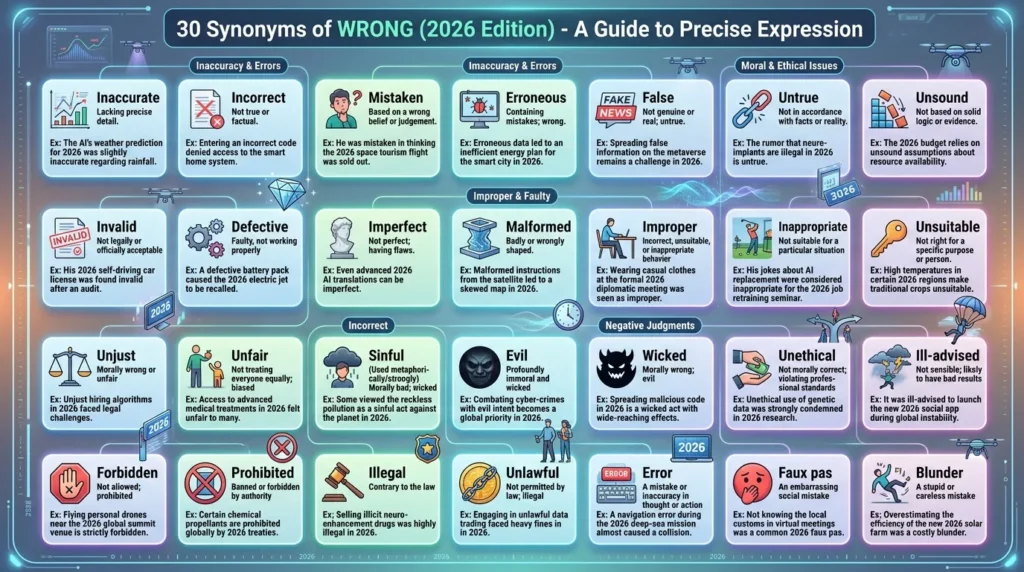
30 Synonyms of Wrong
1. Incorrect (adjective)
US: /ˌɪnkəˈrɛkt/ | UK: /ˌɪnkəˈrekt/
Meaning: not correct or accurate
Examples:
- Your answer is incorrect.
- The report contains incorrect details.
2. Mistaken (adjective)
US: /mɪˈsteɪkən/ | UK: /mɪˈsteɪkən/
Meaning: based on an error
Examples:
- I was mistaken about the date.
- She made a mistaken assumption.
3. False (adjective)
US: /fɔːls/ | UK: /fɒls/
Meaning: not true
Examples:
- The statement is false.
- He gave false information.
4. Inaccurate (adjective)
US: /ɪnˈækjərət/ | UK: /ɪnˈækjərət/
Meaning: not exact or correct
Examples:
- The numbers were inaccurate.
- His description sounded inaccurate.
5. Erroneous (adjective)
US: /ɪˈroʊniəs/ | UK: /ɪˈrəʊniəs/
Meaning: containing mistakes
Examples:
- The article included erroneous facts.
- She made an erroneous judgment.
6. Faulty (adjective)
US: /ˈfɔːlti/ | UK: /ˈfɔːlti/
Meaning: having problems or defects
Examples:
- The machine is faulty.
- They used faulty equipment.
7. Improper (adjective)
US: /ɪmˈprɑːpər/ | UK: /ɪmˈprɒpə/
Meaning: not suitable or correct
Examples:
- His behavior was improper.
- That is an improper method.
8. Untrue (adjective)
US: /ʌnˈtruː/ | UK: /ʌnˈtruː/
Meaning: not true
Examples:
- The rumor was untrue.
- She told an untrue story.
9. Invalid (adjective)
US: /ɪnˈvælɪd/ | UK: /ɪnˈvælɪd/
Meaning: not legally or logically acceptable
Examples:
- Your ticket is invalid.
- The argument became invalid.
10. Unsound (adjective)
US: /ʌnˈsaʊnd/ | UK: /ʌnˈsaʊnd/
Meaning: weak or unreliable
Examples:
- The theory is unsound.
- That decision seems unsound.
11. Defective (adjective)
US: /dɪˈfɛktɪv/ | UK: /dɪˈfektɪv/
Meaning: damaged or not working properly
Examples:
- The phone was defective.
- They returned the defective product.
12. Flawed (adjective)
US: /flɔːd/ | UK: /flɔːd/
Meaning: having mistakes or weaknesses
Examples:
- The plan is flawed.
- His logic was flawed.
13. Misleading (adjective)
US: /mɪsˈliːdɪŋ/ | UK: /mɪsˈliːdɪŋ/
Meaning: giving the wrong idea
Examples:
- The advertisement was misleading.
- Her words sounded misleading.
14. Corrupt (adjective)
US: /kəˈrʌpt/ | UK: /kəˈrʌpt/
Meaning: dishonest or morally bad
Examples:
- The official was corrupt.
- They exposed corrupt practices.
15. Immoral (adjective)
US: /ɪˈmɔːrəl/ | UK: /ɪˈmɒrəl/
Meaning: against moral principles
Examples:
- Cheating is immoral.
- The act seemed immoral.
16. Wicked (adjective)
US: /ˈwɪkɪd/ | UK: /ˈwɪkɪd/
Meaning: morally bad or evil
Examples:
- The villain was wicked.
- That was a wicked action.
17. Dishonest (adjective)
US: /dɪsˈɑːnɪst/ | UK: /dɪsˈɒnɪst/
Meaning: not truthful
Examples:
- He gave a dishonest answer.
- Dishonest people lose trust.
18. Unjust (adjective)
US: /ʌnˈdʒʌst/ | UK: /ʌnˈdʒʌst/
Meaning: unfair or not right
Examples:
- The law seemed unjust.
- It was an unjust punishment.
19. Unacceptable (adjective)
US: /ˌʌnəkˈsɛptəbəl/ | UK: /ˌʌnəkˈseptəbəl/
Meaning: not allowed or approved
Examples:
- His behavior was unacceptable.
- The mistake is unacceptable.
20. Improperly (adverb)
US: /ɪmˈprɑːpərli/ | UK: /ɪmˈprɒpəli/
Meaning: in the wrong way
Examples:
- The machine was used improperly.
- She acted improperly.
21. Off-base (adjective)
US: /ˌɔːf ˈbeɪs/ | UK: /ˌɒf ˈbeɪs/
Meaning: completely incorrect
Examples:
- Your guess is off-base.
- His opinion sounded off-base.
22. Misty (adjective)
US: /ˈmɪsti/ | UK: /ˈmɪsti/
Meaning: unclear or confused
Examples:
- Her memory became misty.
- The explanation sounded misty.
23. Misjudged (adjective)
US: /mɪsˈdʒʌdʒd/ | UK: /mɪsˈdʒʌdʒd/
Meaning: wrongly understood or decided
Examples:
- The situation was misjudged.
- He felt misjudged.
24. Crooked (adjective)
US: /ˈkrʊkɪd/ | UK: /ˈkrʊkɪd/
Meaning: dishonest or bent
Examples:
- The deal looked crooked.
- He worked with crooked people.
25. Miscalculated (adjective)
US: /ˌmɪsˈkælkjəˌleɪtɪd/ | UK: /ˌmɪsˈkælkjʊleɪtɪd/
Meaning: wrongly estimated
Examples:
- They made a miscalculated choice.
- The costs were miscalculated.
26. Faulted (adjective)
US: /ˈfɔːltɪd/ | UK: /ˈfɔːltɪd/
Meaning: criticized as incorrect
Examples:
- The design was faulted.
- His methods were faulted.
27. Misty-headed (adjective)
US: /ˈmɪsti ˌhɛdɪd/ | UK: /ˈmɪsti ˌhedɪd/
Meaning: confused in thinking
Examples:
- I felt misty-headed after work.
- She sounded misty-headed.
28. Sinful (adjective)
US: /ˈsɪnfəl/ | UK: /ˈsɪnfəl/
Meaning: morally wrong
Examples:
- They called the act sinful.
- Lying is considered sinful.
29. Bad (adjective)
US: /bæd/ | UK: /bæd/
Meaning: not good or right
Examples:
- That was a bad decision.
- He made a bad choice.
30. Evil (adjective)
US: /ˈiːvəl/ | UK: /ˈiːvəl/
Meaning: morally very wrong
Examples:
- The story described an evil king.
- They fought against evil actions.
Prototype Meaning
The most typical meaning of wrong is something that is not correct, accurate, or morally right. People usually imagine mistakes, incorrect answers, unfair actions, or dishonest behavior when hearing this word.
Prototype Categorization
- Incorrect information: false, inaccurate, erroneous
- Moral problems: immoral, corrupt, sinful
- Weak or defective things: faulty, flawed, defective
- Unfair actions: unjust, dishonest, improper
Antonyms of Wrong
- Correct (adjective): accurate or true
- Right (adjective): morally good or correct
- Accurate (adjective): exact and free from mistakes
- Honest (adjective): truthful and fair
- Valid (adjective): legally or logically acceptable
Short Questions and Answers
What does wrong mean?
- It means not correct, not true, or morally bad.
When should wrong be used?
- Use it when describing mistakes, incorrect answers, or unfair actions.
Is wrong positive or negative?
- It is usually negative because it describes errors or bad behavior.
How is it different from similar words?
- “Wrong” is general, while words like “false” focus on truth and “immoral” focuses on ethics.
Conclusion
Learning synonyms of wrong and synonyms of wrong improves vocabulary and communication skills. It helps English learners describe mistakes, unfair actions, and incorrect ideas more clearly. Using different synonyms also avoids repetition and makes speaking and writing stronger and more natural. These words are useful in school, work, storytelling, and everyday conversations. They help people explain truth, morality, accuracy, and behavior with greater precision. Practice learning and using new vocabulary daily. Small vocabulary habits can build stronger English confidence and fluency over time.

I’m Zahid Abbas, an educator, researcher, and digital publishing strategist with a passion for linguistics, grammar, and clear communication. As a content creator and SEO specialist, I craft research-driven, reader-focused content that empowers learners and makes knowledge accessible worldwide.