The word same means being identical, equal, or not different from something else. Imagine two friends wearing matching shirts to school. People may say, “They are wearing the same shirt.” This simple word appears in everyday conversations, books, emails, and social media posts because it helps us compare people, things, ideas, and situations.
Learning synonyms of same is important for English learners because using the same word repeatedly can make writing sound dull. Synonyms help speakers and writers express ideas more clearly and naturally. They also improve communication skills and make content more engaging. In this article, you will learn the meaning of same, its pronunciation, history, grammar, connotations, and thirty useful synonyms with examples. You will also discover categories of synonyms, antonyms, and common questions about the word.
Meaning of Same
Same (Adjective):
Something that is exactly like another thing; not different.
Examples
- We go to the same school.
- They chose the same answer.
Connotative Meaning
- Positive tone: consistency, agreement, harmony
- Negative tone: lack of variety, repetition
- Neutral tone: identical, unchanged
Etymology
- Origin: Old Norse
- Original word: sami
- Original meaning: identical or alike
Short History of the Keyword
- Old English (450–1100): Similar forms existed meaning identical.
- Middle English (1100–1500): The word was influenced by Old Norse forms.
- Modern English (1500–Present): Same became a common adjective meaning identical or unchanged.
Pronunciation (US & UK – IPA)
US: /seɪm/
UK: /seɪm/
Syllables
same
Affixation Pattern of Same
Root: same
Prefix: none
Suffix: none
Word Formation of Same
- Same (Adjective)
- Sameness (Noun)
- Selfsame (Adjective)
- Likewise (Adverb, related in meaning)
- Similarly (Adverb, related in meaning)
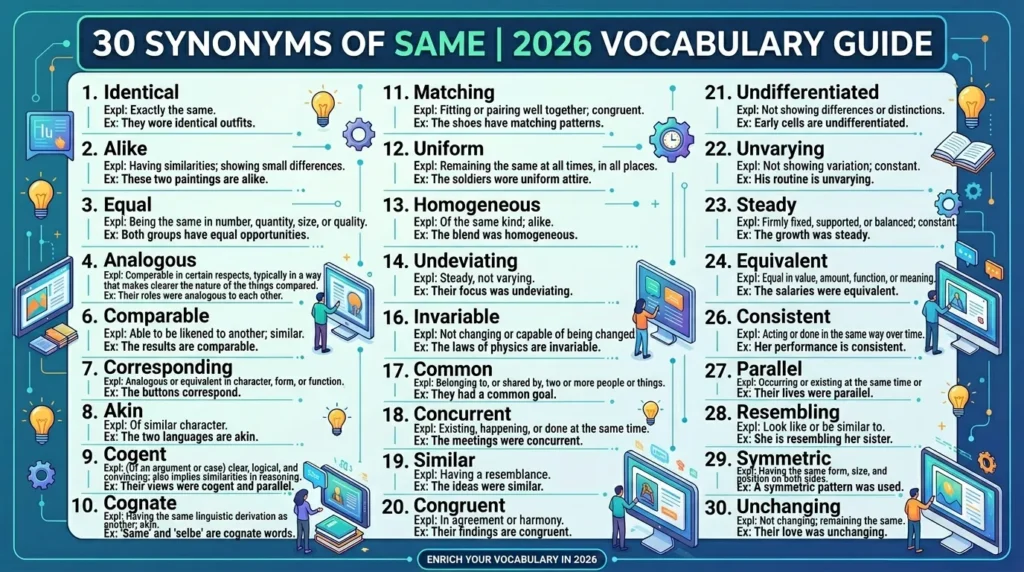
30 Synonyms of Same
1. Identical (Adjective)
US IPA: /aɪˈdɛn.tɪ.kəl/ | UK IPA: /aɪˈden.tɪ.kəl/
Meaning: Exactly alike in every detail.
Examples:
- The twins wore identical clothes.
- Both reports are identical.
2. Equal (Adjective)
US IPA: /ˈiː.kwəl/ | UK IPA: /ˈiː.kwəl/
Meaning: Having the same value, amount, or status.
Examples:
- The two sides are equal.
- Everyone deserves equal treatment.
3. Alike (Adjective)
US IPA: /əˈlaɪk/ | UK IPA: /əˈlaɪk/
Meaning: Similar in appearance or nature.
Examples:
- The sisters look alike.
- Their ideas are alike.
4. Similar (Adjective)
US IPA: /ˈsɪm.ə.lɚ/ | UK IPA: /ˈsɪm.ɪ.lə/
Meaning: Nearly the same but not exactly.
Examples:
- We have similar interests.
- The designs are similar.
5. Equivalent (Adjective)
US IPA: /ɪˈkwɪv.ə.lənt/ | UK IPA: /ɪˈkwɪv.ə.lənt/
Meaning: Having the same effect or value.
Examples:
- One dollar is equivalent to many cents.
- The qualifications are equivalent.
6. Matching (Adjective)
US IPA: /ˈmætʃ.ɪŋ/ | UK IPA: /ˈmætʃ.ɪŋ/
Meaning: Looking good together because they are alike.
Examples:
- They bought matching shoes.
- We wore matching uniforms.
7. Uniform (Adjective)
US IPA: /ˈjuː.nə.fɔːrm/ | UK IPA: /ˈjuː.nɪ.fɔːm/
Meaning: The same throughout.
Examples:
- The color is uniform.
- The rules are uniform.
8. Comparable (Adjective)
US IPA: /ˈkɑːm.pər.ə.bəl/ | UK IPA: /ˈkɒm.pər.ə.bəl/
Meaning: Similar enough to compare.
Examples:
- The products are comparable.
- Their results are comparable.
9. Corresponding (Adjective)
US IPA: /ˌkɔːr.əˈspɑːn.dɪŋ/ | UK IPA: /ˌkɒr.ɪˈspɒn.dɪŋ/
Meaning: Matching in position or function.
Examples:
- Check the corresponding page.
- The numbers are corresponding.
10. Consistent (Adjective)
US IPA: /kənˈsɪs.tənt/ | UK IPA: /kənˈsɪs.tənt/
Meaning: Remaining the same over time.
Examples:
- Her work is consistent.
- The quality stayed consistent.
11. Unchanged (Adjective)
US IPA: /ʌnˈtʃeɪndʒd/ | UK IPA: /ʌnˈtʃeɪndʒd/
Meaning: Not altered.
Examples:
- The price remained unchanged.
- His opinion stayed unchanged.
12. Duplicate (Adjective)
US IPA: /ˈduː.plɪ.kət/ | UK IPA: /ˈdjuː.plɪ.kət/
Meaning: An exact copy.
Examples:
- This is a duplicate file.
- She received a duplicate document.
13. Carbon-Copy (Adjective)
US IPA: /ˈkɑːr.bən ˌkɑː.pi/ | UK IPA: /ˈkɑː.bən ˌkɒ.pi/
Meaning: Exactly the same as another.
Examples:
- The house is a carbon-copy design.
- His style is a carbon-copy of his father.
14. Parallel (Adjective)
US IPA: /ˈpær.ə.lel/ | UK IPA: /ˈpær.ə.lel/
Meaning: Similar and developing together.
Examples:
- Their careers are parallel.
- The stories are parallel.
15. Analogous (Adjective)
US IPA: /əˈnæl.ə.ɡəs/ | UK IPA: /əˈnæl.ə.ɡəs/
Meaning: Similar in important ways.
Examples:
- The situations are analogous.
- The systems are analogous.
16. Resembling (Adjective)
US IPA: /rɪˈzem.blɪŋ/ | UK IPA: /rɪˈzem.blɪŋ/
Meaning: Looking like something else.
Examples:
- The child is resembling her mother.
- The shape is resembling a star.
17. Twin (Adjective)
US IPA: /twɪn/ | UK IPA: /twɪn/
Meaning: Nearly identical.
Examples:
- They built twin towers.
- The plans are twin designs.
18. Interchangeable (Adjective)
US IPA: /ˌɪn.tɚˈtʃeɪn.dʒə.bəl/ | UK IPA: /ˌɪn.təˈtʃeɪn.dʒə.bəl/
Meaning: Able to replace one another.
Examples:
- The parts are interchangeable.
- These terms are interchangeable.
19. Coinciding (Adjective)
US IPA: /ˌkoʊ.ɪnˈsaɪ.dɪŋ/ | UK IPA: /ˌkəʊ.ɪnˈsaɪ.dɪŋ/
Meaning: Happening at the same time.
Examples:
- The events are coinciding.
- Their schedules are coinciding.
20. Homogeneous (Adjective)
US IPA: /ˌhoʊ.məˈdʒiː.ni.əs/ | UK IPA: /ˌhɒ.məˈdʒiː.ni.əs/
Meaning: Consisting of similar parts.
Examples:
- The mixture is homogeneous.
- The group is homogeneous.
21. Indistinguishable (Adjective)
US IPA: /ˌɪn.dɪˈstɪŋ.ɡwɪ.ʃə.bəl/ | UK IPA: /ˌɪn.dɪˈstɪŋ.ɡwɪ.ʃə.bəl/
Meaning: Impossible to tell apart.
Examples:
- The copies are indistinguishable.
- The voices are indistinguishable.
22. Like (Adjective)
US IPA: /laɪk/ | UK IPA: /laɪk/
Meaning: Similar to another thing.
Examples:
- Their opinions are like mine.
- The colors are like each other.
23. Congruent (Adjective)
US IPA: /ˈkɑːŋ.ɡru.ənt/ | UK IPA: /ˈkɒŋ.ɡru.ənt/
Meaning: Matching exactly.
Examples:
- The shapes are congruent.
- Their goals are congruent.
24. Harmonized (Adjective)
US IPA: /ˈhɑːr.mə.naɪzd/ | UK IPA: /ˈhɑː.mə.naɪzd/
Meaning: Made consistent with each other.
Examples:
- The policies were harmonized.
- Their plans are harmonized.
25. Correspondent (Adjective)
US IPA: /ˌkɔːr.əˈspɑːn.dənt/ | UK IPA: /ˌkɒr.ɪˈspɒn.dənt/
Meaning: Similar or matching.
Examples:
- The figures are correspondent.
- The details are correspondent.
26. Related (Adjective)
US IPA: /rɪˈleɪ.tɪd/ | UK IPA: /rɪˈleɪ.tɪd/
Meaning: Connected in some way.
Examples:
- The topics are related.
- These ideas are related.
27. Compatible (Adjective)
US IPA: /kəmˈpæt.ə.bəl/ | UK IPA: /kəmˈpæt.ə.bəl/
Meaning: Able to exist together successfully.
Examples:
- The devices are compatible.
- Their personalities are compatible.
28. Correspondent-like (Adjective)
US IPA: /ˌkɔːr.əˈspɑːn.dənt laɪk/ | UK IPA: /ˌkɒr.ɪˈspɒn.dənt laɪk/
Meaning: Closely matching.
Examples:
- The patterns are correspondent-like.
- The results appear correspondent-like.
29. Consimilar (Adjective)
US IPA: /kənˈsɪm.ə.lɚ/ | UK IPA: /kənˈsɪm.ɪ.lə/
Meaning: Similar in nature.
Examples:
- The objects are consimilar.
- Their methods are consimilar.
30. Selfsame (Adjective)
US IPA: /ˈself.seɪm/ | UK IPA: /ˈself.seɪm/
Meaning: Exactly the very same.
Examples:
- He returned to the selfsame place.
- It happened on the selfsame day.
Prototype Meaning
The prototype meaning of same is “not different.” When people hear this word, they usually imagine two objects, people, or ideas that are identical or equal in some way. It is the most common meaning used in everyday English.
Prototype Categorization
Synonyms can be grouped into categories:
- Exact Identity: identical, duplicate, selfsame, congruent
- General Similarity: similar, alike, like, analogous
- Equal Value: equal, equivalent, comparable
- Consistency: consistent, unchanged, uniform
- Matching Appearance: matching, twin, corresponding
- Compatibility and Connection: compatible, related, harmonized
Antonyms of Same
- Different (Adjective) — not the same
- Distinct (Adjective) — clearly separate
- Dissimilar (Adjective) — unlike in nature
- Unique (Adjective) — one of a kind
- Opposite (Adjective) — completely contrary
- Unrelated (Adjective) — having no connection
- Variable (Adjective) — likely to change
- Diverse (Adjective) — showing variety
- Contrasting (Adjective) — noticeably different
- Individual (Adjective) — separate and independent
Short Questions and Answers
- What does same mean?
Same means identical, equal, or not different from something else. - When should same be used?
Use it when comparing things that are identical or very similar. - Is same positive or negative?
It is usually neutral, but context can make it positive or negative. - How is it different from similar words?
Same means no difference, while words like similar mean nearly alike but not exactly identical.
Conclusion
Learning the Synonyms of Same and Synonyms of Same is a simple way to strengthen your English vocabulary. Instead of repeating one word, you can choose from many alternatives such as identical, equal, similar, and matching. This improves writing quality, makes speaking more natural, and helps readers stay interested. Understanding pronunciation, history, meaning, and connotations also builds deeper language knowledge. The more synonyms you learn, the easier it becomes to express ideas accurately and confidently. Make vocabulary practice a daily habit, and soon you will notice better communication skills in both writing and speaking.

I’m Zahid Abbas, an educator, researcher, and digital publishing strategist with a passion for linguistics, grammar, and clear communication. As a content creator and SEO specialist, I craft research-driven, reader-focused content that empowers learners and makes knowledge accessible worldwide.