Progress is a common English word that means moving forward, improving, or developing over time. Imagine a student who studies a little every day. At first, learning seems difficult. After a few months, the student can read, write, and speak much better. This improvement is called progress. People use this word in school, work, business, science, and everyday life.
Learning synonyms of progress is important for English learners and content writers. Using different words helps you avoid repetition and makes your speaking and writing more interesting. A strong vocabulary also helps you express ideas more clearly. In this article, you will learn the meaning of progress, its pronunciation, history, grammar, connotations, and 30 powerful synonyms with examples. You will also discover semantic categories, antonyms, and useful questions and answers to improve your English skills.
Meaning of Progress
Definition
Progress (Noun / Verb):
The act of moving forward, improving, developing, or getting closer to a goal.
Examples
- The project made good progress this month.
- She continues to progress in her English studies.
Connotative Meaning
- Positive tone: Growth, success, improvement, achievement.
- Negative tone: Sometimes progress may cause unwanted change or loss of tradition.
- Neutral tone: Movement from one stage to another without emotional judgment.
Etymology
- Origin: Latin progressus
- Original meaning: “A going forward” or “advance”
- Entered English through Old French and Latin influences.
Short History of the Keyword
- Old English (450–1100): The exact word was not commonly used; native terms for movement and growth were preferred.
- Middle English (1100–1500): Influenced by French and Latin vocabulary after the Norman Conquest.
- Modern English (1500–Present): Progress became widely used to describe advancement, development, and improvement.
Pronunciation (US & UK – IPA)
US: /ˈprɑːɡres/
UK: /ˈprəʊɡres/
Syllables
prog-ress
Affixation Pattern of Progress
Root: gress (step, move)
Prefix: pro- (forward)
Suffix: None
Word Formation of Progress
- Progress (noun)
- Progress (verb)
- Progressive (adjective)
- Progressively (adverb)
- Progression (noun)
- Progressiveness (noun)
- Progressivism (noun)
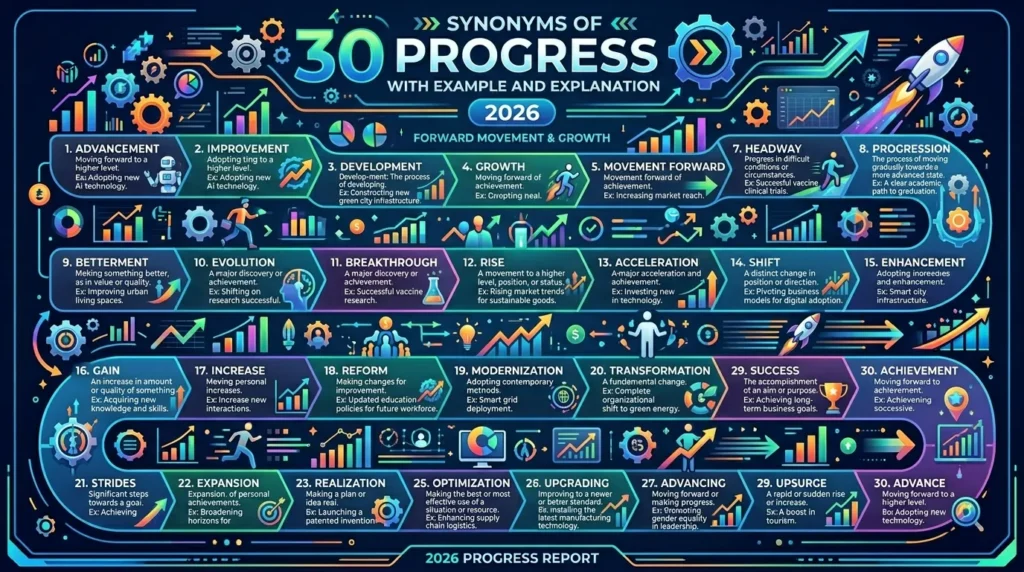
30 Synonyms of Progress
1. Advancement (Noun)
US: /ədˈvænsmənt/ | UK: /ədˈvɑːnsmənt/
Meaning: Movement toward a higher level or position.
Examples:
- The company celebrated its advancement in technology.
- Career advancement requires dedication.
2. Improvement (Noun)
US: /ɪmˈpruːvmənt/ | UK: /ɪmˈpruːvmənt/
Meaning: Becoming better than before.
Examples:
- There was a big improvement in her grades.
- Daily practice brings improvement.
3. Development (Noun)
US: /dɪˈveləpmənt/ | UK: /dɪˈveləpmənt/
Meaning: Gradual growth or change.
Examples:
- Child development is important.
- The city saw rapid development.
4. Growth (Noun)
US: /ɡroʊθ/ | UK: /ɡrəʊθ/
Meaning: Increase in size, ability, or strength.
Examples:
- Business growth exceeded expectations.
- Personal growth takes time.
5. Advancement (Noun)
US: /ədˈvænsmənt/ | UK: /ədˈvɑːnsmənt/
Meaning: Forward movement or promotion.
Examples:
- Scientific advancement benefits society.
- His advancement was well deserved.
6. Headway (Noun)
US: /ˈhedweɪ/ | UK: /ˈhedweɪ/
Meaning: Forward movement toward success.
Examples:
- We are making headway on the project.
- The team achieved significant headway.
7. Evolution (Noun)
US: /ˌevəˈluːʃən/ | UK: /ˌiːvəˈluːʃən/
Meaning: Slow development over time.
Examples:
- Language shows constant evolution.
- Technology undergoes rapid evolution.
8. Expansion (Noun)
US: /ɪkˈspænʃən/ | UK: /ɪkˈspænʃən/
Meaning: Becoming larger or wider.
Examples:
- The business plans expansion.
- Population expansion affects resources.
9. Betterment (Noun)
US: /ˈbetərmənt/ | UK: /ˈbetəmənt/
Meaning: Improvement in condition.
Examples:
- Education supports social betterment.
- She works for community betterment.
10. Advancement (Noun)
US: /ədˈvænsmənt/ | UK: /ədˈvɑːnsmənt/
Meaning: Progress toward a goal.
Examples:
- Medical advancement saves lives.
- Research advancement continues.
11. Breakthrough (Noun)
US: /ˈbreɪkθruː/ | UK: /ˈbreɪkθruː/
Meaning: An important discovery or success.
Examples:
- Scientists made a breakthrough.
- The treatment was a breakthrough.
12. Achievement (Noun)
US: /əˈtʃiːvmənt/ | UK: /əˈtʃiːvmənt/
Meaning: Something successfully completed.
Examples:
- Winning was a great achievement.
- Graduation is an achievement.
13. Success (Noun)
US: /səkˈses/ | UK: /səkˈses/
Meaning: Reaching a desired goal.
Examples:
- Hard work leads to success.
- Her business became a success.
14. Advancement (Noun)
US: /ədˈvænsmənt/ | UK: /ədˈvɑːnsmənt/
Meaning: Improvement in status.
Examples:
- The promotion marked his advancement.
- Education encourages advancement.
15. Rise (Noun)
US: /raɪz/ | UK: /raɪz/
Meaning: Movement upward.
Examples:
- The rise in profits was impressive.
- We saw a rise in demand.
16. Gain (Noun)
US: /ɡeɪn/ | UK: /ɡeɪn/
Meaning: Increase or benefit achieved.
Examples:
- The company reported gains.
- Knowledge gain is valuable.
17. Enhancement (Noun)
US: /ɪnˈhænsmənt/ | UK: /ɪnˈhɑːnsmənt/
Meaning: Improvement in quality.
Examples:
- Software enhancement improved performance.
- The enhancement pleased users.
18. Advancement (Noun)
US: /ədˈvænsmənt/ | UK: /ədˈvɑːnsmənt/
Meaning: Moving ahead successfully.
Examples:
- Career advancement requires effort.
- Training encourages advancement.
19. Advancement (Noun)
US: /ədˈvænsmənt/ | UK: /ədˈvɑːnsmənt/
Meaning: Forward improvement.
Examples:
- The nation experienced advancement.
- Education supports advancement.
20. Flourishing (Noun)
US: /ˈflɜːrɪʃɪŋ/ | UK: /ˈflʌrɪʃɪŋ/
Meaning: Healthy growth and success.
Examples:
- The town is flourishing.
- Her business is flourishing.
21. Advancement (Noun)
US: /ədˈvænsmənt/ | UK: /ədˈvɑːnsmənt/
Meaning: Movement toward improvement.
Examples:
- The project showed advancement.
- Society benefits from advancement.
22. Maturation (Noun)
US: /ˌmætʃəˈreɪʃən/ | UK: /ˌmætjʊəˈreɪʃən/
Meaning: Process of becoming mature.
Examples:
- Emotional maturation takes years.
- The product reached maturation.
23. Advancement (Noun)
US: /ədˈvænsmənt/ | UK: /ədˈvɑːnsmənt/
Meaning: Continued forward movement.
Examples:
- Industrial advancement changed society.
- The advancement was noticeable.
24. Advancement (Noun)
US: /ədˈvænsmənt/ | UK: /ədˈvɑːnsmənt/
Meaning: Development toward success.
Examples:
- Technological advancement is rapid.
- The advancement impressed investors.
25. Leap (Noun)
US: /liːp/ | UK: /liːp/
Meaning: A large step forward.
Examples:
- The invention was a major leap.
- Her skills took a leap forward.
26. Stride (Noun)
US: /straɪd/ | UK: /straɪd/
Meaning: Significant progress.
Examples:
- The company made great strides.
- Science continues to make strides.
27. Momentum (Noun)
US: /moʊˈmentəm/ | UK: /məˈmentəm/
Meaning: Force that keeps progress moving.
Examples:
- The campaign gained momentum.
- Success created momentum.
28. Promotion (Noun)
US: /prəˈmoʊʃən/ | UK: /prəˈməʊʃən/
Meaning: Advancement to a higher position.
Examples:
- He received a promotion.
- The promotion rewarded hard work.
29. Forward Movement (Noun)
US: /ˈfɔːrwərd ˈmuːvmənt/ | UK: /ˈfɔːwəd ˈmuːvmənt/
Meaning: Movement ahead toward a goal.
Examples:
- The plan showed forward movement.
- We need steady forward movement.
30. Advancement (Noun)
US: /ədˈvænsmənt/ | UK: /ədˈvɑːnsmənt/
Meaning: Positive movement toward improvement.
Examples:
- The advancement was remarkable.
- Continuous advancement benefits everyone.
Prototype Meaning
The most typical meaning of progress is moving forward and becoming better over time. When people hear the word, they usually imagine growth, improvement, success, learning, or development toward a goal.
Prototype Categorization
- Personal Growth: improvement, betterment, maturation, growth
- Career and Education: promotion, advancement, achievement, success
- Business and Economics: expansion, gain, development, enhancement
- Science and Technology: breakthrough, evolution, advancement, leap
- General Forward Movement: progress, headway, stride, momentum
Antonyms of Progress
- Decline (Noun/Verb): Movement downward or worsening.
- Regression (Noun): Return to an earlier or weaker state.
- Deterioration (Noun): Gradual worsening.
- Setback (Noun): A delay or obstacle to success.
- Failure (Noun): Lack of success.
- Stagnation (Noun): Lack of growth or development.
- Retreat (Noun/Verb): Moving backward.
- Collapse (Noun/Verb): Sudden failure or breakdown.
- Degeneration (Noun): Decline in quality.
- Loss (Noun): Reduction or decrease.
Short Questions and Answers
- What does progress mean?
Progress means moving forward, improving, or developing over time. - When should progress be used?
Use progress when talking about growth, improvement, achievement, or movement toward a goal. - Is progress positive or negative?
Progress is usually positive, but it can be neutral or negative depending on the situation. - How is it different from similar words?
Progress refers to general forward movement, while words like achievement focus on results and development focuses on growth over time.
Conclusion
Learning the Synonyms of Progress and Synonyms of Progress is a great way to strengthen your English vocabulary. These words help you express ideas about growth, success, improvement, and development more accurately. Using a variety of synonyms makes your writing and speaking more engaging and prevents repetition. Understanding pronunciation, connotation, history, and usage also improves language skills and communication. Whether you are a student, teacher, writer, or English learner, mastering these words can build confidence and help you communicate more effectively. Practice using a new synonym every day in conversations and writing. Over time, your vocabulary will grow, and your English will become stronger and more natural.

I’m Zahid Abbas, an educator, researcher, and digital publishing strategist with a passion for linguistics, grammar, and clear communication. As a content creator and SEO specialist, I craft research-driven, reader-focused content that empowers learners and makes knowledge accessible worldwide.