The word should is one of the most common words in English. It is used to give advice, make recommendations, express duty, or show what is right or expected. For example, a teacher may say, “You should study every day,” or a friend may say, “You should try this restaurant.”
People use should in daily conversations, writing, business communication, and education. Because it appears so often, English learners and writers may repeat it too much. Learning synonyms helps improve vocabulary, makes writing more interesting, and allows speakers to express ideas more accurately.
In this article, you will learn the meaning of should, its pronunciation, history, grammar, and 30 useful synonyms. You will also see examples, semantic categories, antonyms, and practical usage tips that can help strengthen your English skills.
Meaning of Should
Should (Modal Verb):
A word used to express advice, duty, expectation, recommendation, or something that is the right thing to do.
Examples
- You should drink more water every day.
- We should leave before the traffic starts.
Connotative Meaning
- Positive tone: Giving helpful advice, guidance, or encouragement.
- Negative tone: Expressing criticism or disappointment when someone fails to do something.
- Neutral tone: Stating an expectation or recommendation without emotion.
Etymology
- Origin: Old English
- Derived from: sceolde
- Original meaning: “owed,” “was obliged to,” or “had a duty to”
Short History of the Keyword
- Old English (450–1100): Used as sceolde to express obligation and duty.
- Middle English (1100–1500): Became sholde and was widely used to indicate responsibility.
- Modern English (1500–Present): Developed into should, expressing advice, expectation, and recommendation.
Pronunciation (US & UK – IPA)
US: /ʃʊd/
UK: /ʃʊd/
Syllables
should
Affixation Pattern of Should
Root: should
Prefix: None
Suffix: None
Word Formation of the Keyword
- Should (Modal Verb)
- Shouldn’t (Modal Verb – Negative Form)
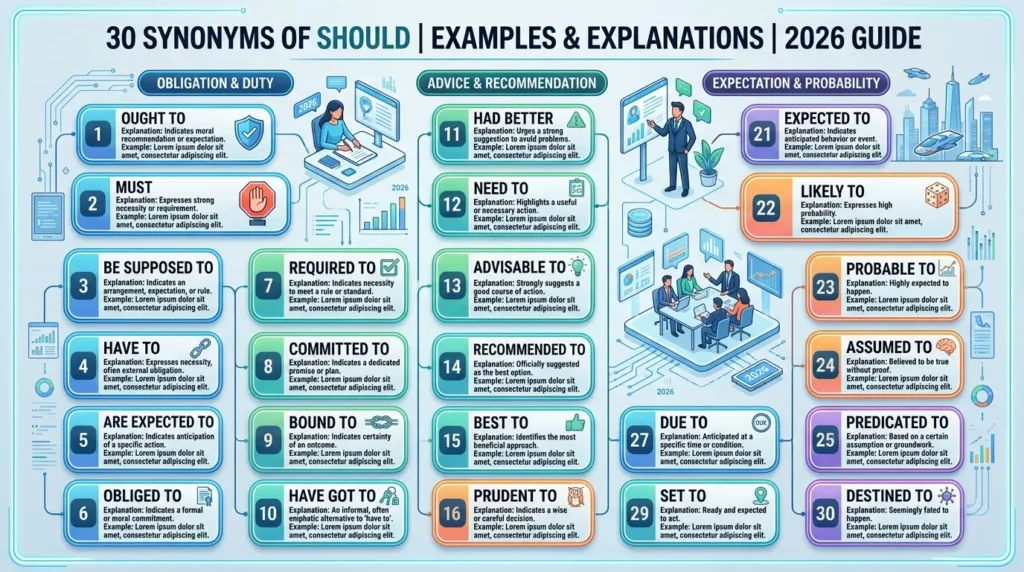
30 Synonyms of Should
1. Ought To (Modal Verb)
US IPA: /ɔːt tə/
UK IPA: /ɔːt tə/
Meaning: Used to express duty, advice, or what is morally right.
Examples:
- You ought to finish your homework.
- We ought to help our neighbors.
2. Must (Modal Verb)
US IPA: /mʌst/
UK IPA: /mʌst/
Meaning: Shows strong necessity or obligation.
Examples:
- You must wear a seatbelt.
- Students must follow the rules.
3. Need To (Verb Phrase)
US IPA: /niːd tuː/
UK IPA: /niːd tuː/
Meaning: Indicates necessity.
Examples:
- I need to call my friend.
- You need to sleep early.
4. Have To (Verb Phrase)
US IPA: /hæv tuː/
UK IPA: /hæv tə/
Meaning: Expresses obligation.
Examples:
- We have to leave now.
- She has to attend the meeting.
5. Be Supposed To (Verb Phrase)
US IPA: /bi səˈpoʊzd tuː/
UK IPA: /bi səˈpəʊzd tuː/
Meaning: Means expected or required.
Examples:
- You are supposed to arrive on time.
- They are supposed to finish today.
6. Required To (Verb Phrase)
US IPA: /rɪˈkwaɪərd tuː/
UK IPA: /rɪˈkwaɪəd tuː/
Meaning: Officially necessary.
Examples:
- Employees are required to wear badges.
- Students are required to register.
7. Obliged To (Adjective Phrase)
US IPA: /əˈblaɪdʒd tuː/
UK IPA: /əˈblaɪdʒd tuː/
Meaning: Bound by duty.
Examples:
- We are obliged to follow the law.
- She felt obliged to help.
8. Expected To (Verb Phrase)
US IPA: /ɪkˈspektɪd tuː/
UK IPA: /ɪkˈspektɪd tuː/
Meaning: Anticipated or required.
Examples:
- You are expected to behave politely.
- Workers are expected to cooperate.
9. Advised To (Verb Phrase)
US IPA: /ədˈvaɪzd tuː/
UK IPA: /ədˈvaɪzd tuː/
Meaning: Recommended by someone.
Examples:
- Patients are advised to rest.
- We were advised to wait.
10. Recommended To (Verb Phrase)
US IPA: /ˌrekəˈmendɪd tuː/
UK IPA: /ˌrekəˈmendɪd tuː/
Meaning: Suggested as a good idea.
Examples:
- Visitors are recommended to book early.
- You are recommended to read this book.
11. Encouraged To (Verb Phrase)
US IPA: /ɪnˈkɜːrɪdʒd tuː/
UK IPA: /ɪnˈkʌrɪdʒd tuː/
Meaning: Motivated to do something.
Examples:
- Students are encouraged to ask questions.
- Employees are encouraged to learn new skills.
12. Wise To (Adjective Phrase)
US IPA: /waɪz tuː/
UK IPA: /waɪz tuː/
Meaning: Sensible or smart to do.
Examples:
- It is wise to save money.
- It is wise to plan ahead.
13. Best To (Adjective Phrase)
US IPA: /best tuː/
UK IPA: /best tuː/
Meaning: Most suitable action.
Examples:
- It is best to leave early.
- It is best to stay calm.
14. Appropriate To (Adjective Phrase)
US IPA: /əˈproʊpriət tuː/
UK IPA: /əˈprəʊpriət tuː/
Meaning: Suitable in a situation.
Examples:
- It is appropriate to thank guests.
- It is appropriate to be respectful.
15. Proper To (Adjective Phrase)
US IPA: /ˈprɑːpər tuː/
UK IPA: /ˈprɒpə tuː/
Meaning: Correct or suitable.
Examples:
- It is proper to apologize.
- It is proper to follow etiquette.
16. Necessary To (Adjective Phrase)
US IPA: /ˈnesəseri tuː/
UK IPA: /ˈnesəsəri tuː/
Meaning: Needed or essential.
Examples:
- It is necessary to study.
- It is necessary to prepare.
17. Essential To (Adjective Phrase)
US IPA: /ɪˈsenʃəl tuː/
UK IPA: /ɪˈsenʃəl tuː/
Meaning: Extremely important.
Examples:
- It is essential to stay healthy.
- It is essential to communicate clearly.
18. Important To (Adjective Phrase)
US IPA: /ɪmˈpɔːrtənt tuː/
UK IPA: /ɪmˈpɔːtənt tuː/
Meaning: Having great value.
Examples:
- It is important to listen carefully.
- It is important to be honest.
19. Bound To (Adjective Phrase)
US IPA: /baʊnd tuː/
UK IPA: /baʊnd tuː/
Meaning: Certain or obliged.
Examples:
- You are bound to succeed.
- We are bound to follow the agreement.
20. Duty-Bound To (Adjective Phrase)
US IPA: /ˈduːti baʊnd tuː/
UK IPA: /ˈdjuːti baʊnd tuː/
Meaning: Required by duty.
Examples:
- Officers are duty-bound to serve.
- Parents are duty-bound to care for children.
21. Compelled To (Verb Phrase)
US IPA: /kəmˈpeld tuː/
UK IPA: /kəmˈpeld tuː/
Meaning: Forced by circumstances.
Examples:
- He was compelled to act.
- They were compelled to respond.
22. Urged To (Verb Phrase)
US IPA: /ɜːrdʒd tuː/
UK IPA: /ɜːdʒd tuː/
Meaning: Strongly encouraged.
Examples:
- Citizens were urged to vote.
- We were urged to remain calm.
23. Called Upon To (Verb Phrase)
US IPA: /kɔːld əˈpɑːn tuː/
UK IPA: /kɔːld əˈpɒn tuː/
Meaning: Asked or expected to act.
Examples:
- She was called upon to speak.
- Leaders were called upon to help.
24. Meant To (Verb Phrase)
US IPA: /ment tuː/
UK IPA: /ment tuː/
Meaning: Intended or expected.
Examples:
- This tool is meant to help.
- We are meant to learn from mistakes.
25. Fit To (Adjective Phrase)
US IPA: /fɪt tuː/
UK IPA: /fɪt tuː/
Meaning: Suitable for a purpose.
Examples:
- The candidate is fit to lead.
- The room is fit to use.
26. Apt To (Adjective Phrase)
US IPA: /æpt tuː/
UK IPA: /æpt tuː/
Meaning: Likely or suitable.
Examples:
- He is apt to forget names.
- She is apt to arrive early.
27. Prudent To (Adjective Phrase)
US IPA: /ˈpruːdənt tuː/
UK IPA: /ˈpruːdənt tuː/
Meaning: Wise and careful.
Examples:
- It is prudent to save money.
- It is prudent to check details.
28. Sensible To (Adjective Phrase)
US IPA: /ˈsensəbəl tuː/
UK IPA: /ˈsensəbəl tuː/
Meaning: Based on good judgment.
Examples:
- It is sensible to exercise.
- It is sensible to plan ahead.
29. Advisable To (Adjective Phrase)
US IPA: /ədˈvaɪzəbəl tuː/
UK IPA: /ədˈvaɪzəbəl tuː/
Meaning: Worth recommending.
Examples:
- It is advisable to arrive early.
- It is advisable to read instructions.
30. Preferable To (Adjective Phrase)
US IPA: /ˈprefərəbəl tuː/
UK IPA: /ˈprefərəbəl tuː/
Meaning: Better than another option.
Examples:
- It is preferable to avoid waste.
- It is preferable to stay organized.
Prototype Meaning
The most typical meaning of should is giving advice or suggesting the best action. When people hear the word, they usually think about guidance, recommendations, or doing what is right in a situation.
Prototype Categorization
- Advice and Recommendation: ought to, advised to, recommended to, urged to, advisable to.
- Duty and Obligation: must, have to, obliged to, duty-bound to, required to.
- Expectation: expected to, supposed to, meant to, called upon to.
- Wisdom and Good Judgment: wise to, prudent to, sensible to, best to.
- Necessity and Importance: necessary to, essential to, important to, need to.
- Suitability: appropriate to, proper to, fit to, preferable to.
Antonyms of Should
- May (Modal Verb): Expresses permission or possibility.
- Can (Modal Verb): Expresses ability.
- Optional (Adjective): Not required.
- Unnecessary (Adjective): Not needed.
- Forbidden (Adjective): Not allowed.
- Prohibited (Adjective): Officially banned.
- Need Not (Modal Verb Phrase): No obligation exists.
- Must Not (Modal Verb Phrase): Indicates something should not be done.
Short Questions and Answers
- What does should mean?
It means giving advice, expressing duty, or suggesting the best action. - When should should be used?
It is used when giving recommendations, expressing expectations, or discussing responsibilities. - Is should positive or negative?
It is usually neutral or positive, but it can sound negative when criticizing someone. - How is it different from similar words?
Should gives advice, while must shows stronger obligation and may shows permission or possibility.
Conclusion
Learning the Synonyms of Should and Synonyms of Should can greatly improve your English vocabulary. These alternatives help you express advice, duty, recommendations, expectations, and necessity with greater accuracy. Using a variety of synonyms makes writing and speaking more interesting while reducing repetition. It also helps learners understand subtle differences in meaning and tone. As your vocabulary grows, your confidence in English communication grows as well. Practice using one or two new synonyms each day in conversations, emails, essays, and social media posts. Over time, these words will become a natural part of your language skills and help you communicate more clearly and effectively using Synonyms of Should.

I’m Zahid Abbas, an educator, researcher, and digital publishing strategist with a passion for linguistics, grammar, and clear communication. As a content creator and SEO specialist, I craft research-driven, reader-focused content that empowers learners and makes knowledge accessible worldwide.