The word ocean means a very large body of salt water that covers most of the Earth. Imagine standing on a beach at sunset. You see water stretching far beyond the horizon. The sound of waves fills the air. That endless water is the ocean.
This word is common in daily speech, travel stories, geography, science, and poetry. Because it is used so often, writers and learners need more words with similar meanings. Learning synonyms helps you avoid repetition. It makes your writing richer and more expressive.
In this article, you will learn the meaning of ocean, its pronunciation, grammar, history, tone, and 30 powerful synonyms. Each synonym includes simple meanings and examples. You will also see how these words are grouped into categories to help you choose the right one for every situation.
Meaning of Ocean
Ocean (Noun):
A very large area of salt water that covers most of the Earth’s surface.
Examples:
- The ocean looks calm today.
- Many animals live deep in the ocean.
Connotative Meaning
Connotation (the emotional meaning a word suggests beyond its dictionary meaning):
- Positive tone: Vast, beautiful, powerful, peaceful
- Negative tone: Dangerous, stormy, overwhelming
- Neutral tone: A large saltwater body on Earth
Etymology
- From Latin oceanus
- From Greek ōkeanos meaning “great river around the world”
Short History
- Old English (450–1100): Rare; people mostly used “sea.”
- Middle English (1100–1500): Borrowed from Latin and French texts.
- Modern English (1500–Present): Standard word in geography and science.
Pronunciation (US & UK – IPA)
- US: /ˈoʊʃən/
- UK: /ˈəʊʃən/
Syllables: o-cean
Affixation Pattern of Ocean
- Root: ocean
- Prefix: none
- Suffix: none
Word Formation
From ocean, we form:
- Oceanic (adjective)
- Oceangoing (adjective)
- Oceanside (noun/adjective)
- Oceanaut (noun)
Synonyms of Ocean
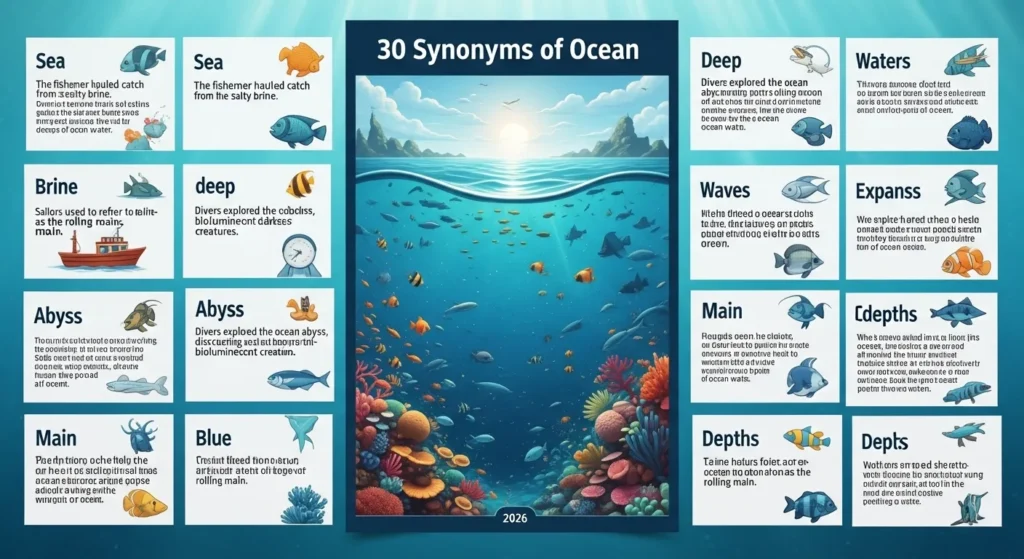
1. Sea (Noun) — US: /siː/ | UK: /siː/
Meaning: A large body of salt water, smaller than an ocean.
Examples:
- The sea was quiet at dawn.
- Fishermen sailed into the sea.
2. Deep (Noun) — US: /diːp/ | UK: /diːp/
Meaning: The deepest part of the ocean.
Examples:
- Strange creatures live in the deep.
- The ship sank into the deep.
3. Main (Noun, poetic) — US: /meɪn/ | UK: /meɪn/
Meaning: An old poetic word for the open ocean.
Examples:
- Sailors crossed the main.
- The storm hit the main hard.
4. Brine (Noun) — US: /braɪn/ | UK: /braɪn/
Meaning: Salty sea water.
Examples:
- The air smelled of brine.
- Fish swim in the cold brine.
5. Waters (Noun) — US: /ˈwɔːtərz/ | UK: /ˈwɔːtəz/
Meaning: Large areas of water.
Examples:
- Ships travel these waters.
- The waters were rough.
6. High Seas (Noun phrase) — US: /haɪ siːz/ | UK: /haɪ siːz/
Meaning: The open ocean away from land.
Examples:
- Pirates sailed the high seas.
- The boat drifted on the high seas.
7. Open Sea (Noun phrase) — US: /ˈoʊpən siː/ | UK: /ˈəʊpən siː/
Meaning: The part of the ocean far from shore.
Examples:
- They reached the open sea.
- The ship entered the open sea.
8. Blue (Noun, poetic) — US: /bluː/ | UK: /bluː/
Meaning: The ocean, because of its color.
Examples:
- He stared at the endless blue.
- Waves rolled across the blue.
9. Abyss (Noun) — US: /əˈbɪs/ | UK: /əˈbɪs/
Meaning: A very deep part of the ocean.
Examples:
- The submarine explored the abyss.
- Darkness fills the ocean abyss.
10. Expanse (Noun) — US: /ɪkˈspæns/ | UK: /ɪkˈspæns/
Meaning: A wide, open area.
Examples:
- The ocean is a vast expanse.
- We saw an endless expanse of water.
11. Marine (Adjective) — US: /məˈriːn/ | UK: /məˈriːn/
Meaning: Related to the sea.
Examples:
- Marine life is diverse.
- She studies marine biology.
12. Pelagic (Adjective) — US: /pəˈlædʒɪk/ | UK: /pəˈlædʒɪk/
Meaning: Relating to the open ocean.
Examples:
- Pelagic fish swim far from shore.
- The pelagic zone is deep.
13. Offshore (Adjective/Adverb) — US: /ˌɔːfˈʃɔːr/ | UK: /ˌɒfˈʃɔː/
Meaning: Away from the land, in the sea.
Examples:
- They built an offshore platform.
- The wind blew offshore.
14. Surf (Noun) — US: /sɜːrf/ | UK: /sɜːf/
Meaning: Waves of the sea.
Examples:
- The surf was strong today.
- Surfers love high surf.
15. Tide (Noun) — US: /taɪd/ | UK: /taɪd/
Meaning: The rise and fall of ocean water.
Examples:
- The tide is coming in.
- Boats move with the tide.
16. Gulf (Noun) — US: /ɡʌlf/ | UK: /ɡʌlf/
Meaning: A large part of the ocean partly enclosed by land.
Examples:
- They sailed across the gulf.
- Oil ships crossed the gulf.
17. Bay (Noun) — US: /beɪ/ | UK: /beɪ/
Meaning: A wide inlet of the sea.
Examples:
- The boat rested in the bay.
- The bay was peaceful.
18. Channel (Noun) — US: /ˈtʃænəl/ | UK: /ˈtʃænəl/
Meaning: A narrow part of the sea.
Examples:
- Ships pass through the channel.
- The channel connects two seas.
19. Strait (Noun) — US: /streɪt/ | UK: /streɪt/
Meaning: A narrow waterway connecting seas.
Examples:
- The ship crossed the strait.
- The strait is busy with traffic.
20. Lagoon (Noun) — US: /ləˈɡuːn/ | UK: /ləˈɡuːn/
Meaning: Shallow water separated from the ocean.
Examples:
- The island has a clear lagoon.
- Fish swim in the warm lagoon.
21. Pacific (Proper Noun) — US: /pəˈsɪfɪk/ | UK: /pəˈsɪfɪk/
Meaning: The largest ocean on Earth, between Asia, Australia, and the Americas.
Examples:
- They sailed across the Pacific for months.
- Many islands are located in the Pacific.
22. Atlantic (Proper Noun) — US: /ətˈlæntɪk/ | UK: /ətˈlæntɪk/
Meaning: The ocean between the Americas and Europe/Africa.
Examples:
- The ship crossed the Atlantic safely.
- Storms often form in the Atlantic.
23. Indian Ocean (Proper Noun) — US: /ˈɪndiən ˈoʊʃən/ | UK: /ˈɪndiən ˈəʊʃən/
Meaning: The ocean between Africa, Asia, and Australia.
Examples:
- Trade routes once passed through the Indian Ocean.
- The Indian Ocean is rich in marine life.
24. Arctic Ocean (Proper Noun) — US: /ˈɑːrktɪk ˈoʊʃən/ | UK: /ˈɑːktɪk ˈəʊʃən/
Meaning: The smallest and coldest ocean, near the North Pole.
Examples:
- Ice covers much of the Arctic Ocean.
- Scientists study climate change in the Arctic Ocean.
25. Southern Ocean (Proper Noun) — US: /ˈsʌðərn ˈoʊʃən/ | UK: /ˈsʌðən ˈəʊʃən/
Meaning: The ocean surrounding Antarctica.
Examples:
- Penguins live near the Southern Ocean.
- The Southern Ocean has strong currents.
26. Seven Seas (Noun phrase) — US: /ˈsevən siːz/ | UK: /ˈsevən siːz/
Meaning: A poetic phrase meaning all the world’s oceans.
Examples:
- Sailors once explored the Seven Seas.
- He dreamed of traveling across the Seven Seas.
27. Briny Deep (Noun phrase, poetic) — US: /ˈbraɪni diːp/ | UK: /ˈbraɪni diːp/
Meaning: A poetic term for the salty ocean.
Examples:
- The treasure sank into the briny deep.
- Ships disappeared in the briny deep.
28. Watery Expanse (Noun phrase) — US: /ˈwɔːtəri ɪkˈspæns/ | UK: /ˈwɔːtəri ɪkˈspæns/
Meaning: A large, wide area of water.
Examples:
- We saw a vast watery expanse before us.
- Birds flew over the watery expanse.
29. Sea Expanse (Noun phrase) — US: /siː ɪkˈspæns/ | UK: /siː ɪkˈspæns/
Meaning: A wide stretch of sea water.
Examples:
- The ship crossed the endless sea expanse.
- The sun reflected on the sea expanse.
30. Ocean Blue (Noun phrase, poetic) — US: /ˈoʊʃən bluː/ | UK: /ˈəʊʃən bluː/
Meaning: A poetic way to describe the blue color of the ocean.
Examples:
- She painted the sky in ocean blue.
- The water shimmered in ocean blue light.
Prototype Meaning
When people hear the word ocean, they imagine a huge body of blue salt water with waves, ships, beaches, and sea animals. It suggests size, power, and endless space.
Prototype Categorization
- General terms: sea, waters, expanse
- Poetic words: blue, briny deep, main
- Scientific words: marine, pelagic
- Geographic forms: gulf, bay, strait, channel
- Named oceans: Pacific, Atlantic, Indian, Arctic, Southern
Grouping words helps writers choose formal, poetic, scientific, or geographic terms correctly.
Antonyms: lake, pond, river, stream
Short Questions and Answers
- What does ocean mean?
A very large body of salt water. - When should ocean be used?
When talking about Earth’s largest saltwater areas. - Is ocean positive or negative?
It can be positive (beautiful) or negative (dangerous storms). - How is it different from sea?
An ocean is larger than a sea.
Conclusion
Learning the word ocean and its synonyms expands your vocabulary and improves your writing. Instead of repeating one simple word, you can choose terms that match your tone and purpose. Scientific writing may use “marine” or “pelagic.” Poetry may use “blue” or “briny deep.” Geography may use “gulf” or “strait.”When you practice these synonyms daily, your English becomes richer and more expressive. You gain confidence in speaking and writing. A strong vocabulary helps you communicate ideas clearly and creatively. Keep learning new words, and your language skills will grow like the vast ocean itself.

I’m Zahid Abbas, an educator, researcher, and digital publishing strategist with a passion for linguistics, grammar, and clear communication. As a content creator and SEO specialist, I craft research-driven, reader-focused content that empowers learners and makes knowledge accessible worldwide.