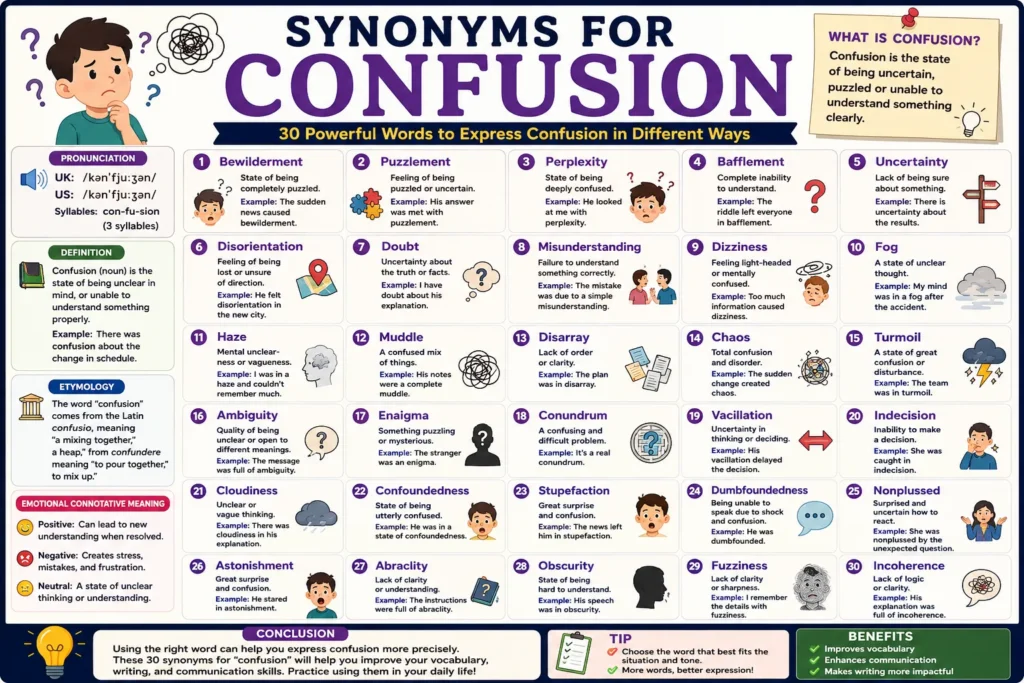
The word confusion refers to a state of feeling unclear, mixed up, or unsure about what is happening. Imagine standing at a crossroads where all the road signs point in different directions. That feeling of not knowing which way to turn is confusion.
We use synonyms for confusion to describe mixed-up feelings during a hard math lesson. Also a messy room where everything is out of order or a noisy crowd where no one knows what to do next. Learning new ways to say confusion and synonyms for confusion helps learners make their story writing engaging.
This guide gives you 30 simple synonyms for confusion. Along with easy sentences, word origins, pronunciation guides, and clear categories.
Meaning of Confusion
Definition
Confusion (Noun): A state of being uncertain, mixed up, or unable to think clearly; a chaotic or disorganized condition.
Examples
- The hard math riddle caused a lot of confusion among the students.
- There was complete confusion at the bus stop when two buses arrived at the exact same time.
Connotative Meaning
- Positive tone: Rarely positive, but can suggest a fun puzzle or mystery to solve.
- Negative tone: Expresses stress, disorder, misunderstanding, or helplessness.
- Neutral tone: Simply describes a state where things are not clear or organized.
Etymology
- Source language: Came from Old French and Latin.
- Latin: Confundere (from com- meaning “together” and fundere meaning “to pour”).
- Modern English: Literally means “pouring things together” so they get all mixed up.
Also, get further information https://synonymhubb.com/synonyms-for-proper/
Pronunciation
- US: /kənˈfjuːʒn/
- UK: /kənˈfjuːʒn/
Syllables
con-fu-sion (3 parts)
Affixation Pattern of Confusion
- Root: Confuse (verb meaning to mix up)
- Suffix: -ion (makes a verb into a noun)
- Word Formation:
- Noun: Confusion
- Verb: Confuse
- Adjective: Confused / Confusing
- Adverb: Confusingly
Synonyms for Confusion
1. Puzzlement (Noun) — US: /ˈpʌzlmənt/ | UK: /ˈpʌzlmənt/
Meaning: A state of feeling confused because something is hard to understand.
Examples:
She looked at the strange map with clear puzzlement.
The magic trick left the audience in total puzzlement.
2. Uncertainty (Noun) — US: /ənˈsɜːrtnti/ | UK: /ənˈsɜːtnti/
Meaning: Not being sure about what will happen or what to do.
Examples:
Dark clouds brought uncertainty about our weekend picnic.
He felt a bit of uncertainty before stepping onto the stage.
3. Disarray (Noun) — US: /ˌdɪsəˈreɪ/ | UK: /ˌdɪsəˈreɪ/
Meaning: A messy state where things are out of proper order.
Examples:
Her bedroom was in complete disarray after packing her bags.
The sudden gust of wind left the paper sheets in disarray.
4. Disorder (Noun) — US: /dɪsˈɔːrdər/ | UK: /dɪsˈɔːdə/
Meaning: A lack of structure, neatness, or organization.
Examples:
The playground fell into disorder when the whistle blew.
Tidying up your desk helps prevent messy disorder.
5. Mix-up (Noun) — US: /ˈmɪks ʌp/ | UK: /ˈmɪks ʌp/
Meaning: An informal word for a mistake or misunderstanding.
Examples:
A simple schedule mix-up caused us to arrive early.
There was a mix-up with our lunch orders at the counter.
6. Chaos (Noun) — US: /ˈkeɪɑːs/ | UK: /ˈkeɪɒs/
Meaning: Complete disorder and total confusion.
Examples:
The excited puppies caused wild chaos in the living room.
Traffic turned into chaos when the streetlights stopped working.
7. Muddle (Noun) — US: /ˈmʌdl/ | UK: /ˈmʌdl/
Meaning: A confused or untidy collection of things or ideas.
Examples:
His notes were in a complete muddle before the exam.
She sorted out the muddle of colored threads in her basket.
8. Bewilderment (Noun) — US: /bɪˈwɪldərmənt/ | UK: /bɪˈwɪldəmənt/
Meaning: Deep confusion caused by something unusual or unexpected.
Examples:
The dog blinked in bewilderment at the floating balloon.
He stared in bewilderment at the tricky puzzle box.
9. Perplexity (Noun) — US: /pərˈplɛksəti/ | UK: /pəˈpleksəti/
Meaning: The state of feeling complicatedly confused or baffled.
Examples:
The complex riddle filled the whole class with perplexity.
She scratched her head in perplexity over the clue.
10. Clutter (Noun) — US: /ˈklʌtər/ | UK: /ˈklʌtə/
Meaning: A crowded collection of things scattered in a messy way.
Examples:
Please clear the clutter off your study desk.
The attic was filled with old boxes and dusty clutter.
11. Commotion (Noun) — US: /kəˈmoʊʃn/ | UK: /kəˈməʊʃn/
Meaning: A noisy, confused disturbance or busy activity.
Examples:
A loud cheer caused a commotion in the hallway.
The barking dogs created a sudden commotion outside.
12. Turmoil (Noun) — US: /ˈtɜːrmɔɪl/ | UK: /ˈtɜːmɔɪl/
Meaning: A state of great disturbance, unrest, or mental confusion.
Examples:
Her thoughts were in turmoil before making the big choice.
The stormy weather put the entire town in turmoil.
13. Agitation (Noun) — US: /ˌædʒɪˈteɪʃn/ | UK: /ˌædʒɪˈteɪʃn/
Meaning: A feeling of nervous excitement, worry, or confusion.
Examples:
He paces the floor in agitation while waiting for news.
Deep breaths help calm down feelings of agitation.
14. Doubt (Noun) — US: /daʊt/ | UK: /daʊt/
Meaning: A feeling of not being sure or believing in something.
Examples:
She had no doubt that her team would win the race.
A moment of doubt made him stop before taking the jump.
15. Hesitation (Noun) — US: /ˌhɛzɪˈteɪʃn/ | UK: /ˌhezɪˈteɪʃn/
Meaning: Pausing before doing something due to uncertainty.
Examples:
After a brief hesitation, she stepped onto the stage.
He answered the teacher’s question without any hesitation.
16. Disorientation (Noun) — US: /dɪsˌɔːriənˈteɪʃn/ | UK: /dɪsˌɔːriənˈteɪʃn/
Meaning: Feeling lost or confused about where you are.
Examples:
Spinning in circles fast causes temporary disorientation.
Walking out of the dark maze gave him a moment of disorientation.
17. Jam (Noun) — US: /dʒæm/ | UK: /dʒæm/
Meaning: A crowded or blocked state where movement becomes hard.
Examples:
The narrow hallway suffered a big traffic jam of students.
We were stuck in a gridlock jam near the bridge.
18. Jumble (Noun) — US: /ˈdʒʌmbl/ | UK: /ˈdʒʌmbl/
Meaning: An untidy collection of different items mixed together.
Examples:
The toy box held a colorful jumble of blocks and cars.
Her thoughts felt like a giant jumble of ideas.
19. Untidiness (Noun) — US: /ʌnˈtaɪdinəs/ | UK: /ʌnˈtaɪdinəs/
Meaning: The quality of being messy and not neat.
Examples:
The untidiness of the art room was fixed after clean-up time.
Mom asked us to fix the untidiness in our bookshelf.
20. Tangled state (Noun) — US: /ˈtæŋɡld steɪt/ | UK: /ˈtæŋɡld steɪt/
Meaning: Being knotted together in a confused or messy way.
Examples:
The shoelaces were pulled into a tricky, tangled state.
The yarn ended up in a tangled state after the kitten played with it.
21. Pandemonium (Noun) — US: /ˌpændəˈmoʊniəm/ | UK: /ˌpændəˈməʊniəm/
Meaning: Wild and noisy disorder or confusion.
Examples:
There was pandemonium when the favorite team scored the goal.
The surprise visit brought complete pandemonium to the class.
22. Uproar (Noun) — US: /ˈʌprɔːr/ | UK: /ˈʌprɔː/
Meaning: A public state of noisy noise, excitement, or confusion.
Examples:
The sudden news created a huge uproar in the school yard.
The monkeys made an uproar in their zoo habitat.
23. Disturbance (Noun) — US: /dɪˈstɜːrbəns/ | UK: /dɪˈstɜːbəns/
Meaning: Something that interrupts peace, quiet, or order.
Examples:
The loud siren caused a minor disturbance during reading time.
A fallen tree created a traffic disturbance on Main Street.
24. Misunderstanding (Noun) — US: /ˌmɪsʌndərˈstændɪŋ/ | UK: /ˌmɪsʌndəˈstændɪŋ/
Meaning: A failure to understand something correctly.
Examples:
A quick talk resolved the misunderstanding between friends.
The misunderstanding happened because of a blurry sign.
25. Blur (Noun) — US: /blɜːr/ | UK: /blɜː/
Meaning: A state where things are unclear, fuzzy, or hard to see.
Examples:
The fast passing landscape became a colorful blur.
Without his glasses, the printed words were a total blur.
26. Haze (Noun) — US: /heɪz/ | UK: /heɪz/
Meaning: Foggy air, or a state of mental vagueness and confusion.
Examples:
He woke up early with his mind in a sleepy haze.
Morning haze covered the distant hills in the valley.
27. Fog (Noun) — US: /fɔːɡ/ | UK: /fɒɡ/
Meaning: Thick mist, or feeling unable to think clearly.
Examples:
A heavy mental fog made it tough to solve the puzzle.
The early morning fog rolled across the cold river.
28. Daze (Noun) — US: /deɪz/ | UK: /deɪz/
Meaning: A stunned or bewildered condition.
Examples:
He walked around in a happy daze after winning first prize.
The loud noise left everyone in a temporary daze.
29. Ambiguity (Noun) — US: /ˌæmbɪˈɡjuːəti/ | UK: /ˌæmbɪˈɡjuːəti/
Meaning: Being open to more than one meaning; unclarity.
Examples:
Clear rules help remove any ambiguity during a sports game.
The poem had a sense of ambiguity that made people think.
30. Mystery (Noun) — US: /ˈmɪstri/ | UK: /ˈmɪstri/
Meaning: Something that is secret, unknown, or hard to explain.
Examples:
The missing key remained a complete mystery to the detectives.
She loved solving a good book mystery on rainy afternoons.
Prototype Meaning
When children hear confusion, they picture a messy pile of unsorted toys on the floor. A student scratching their head over a tricky riddle, or a crowd of people looking around trying to figure out which direction to walk.
Prototype Categorization
- Mental Unclarity & Puzzlement: Puzzlement, Bewilderment, Perplexity, Daze, Haze, Fog, Blur, Disorientation.
- Messiness & Physical Disorder: Disarray, Disorder, Clutter, Untidiness, Jumble, Muddle, Tangled state.
- Noisy Disturbances & Chaos: Chaos, Commotion, Pandemonium, Uproar, Disturbance, Turmoil.
- Doubts & Misunderstandings: Uncertainty, Doubt, Hesitation, Mix-up, Misunderstanding, Ambiguity, Mystery, Jam, Agitation.
Antonyms of Confusion
- Clarity
- Order
- Understanding
- Certainty
- Organization
- Peace
Short Questions and Answers
- What does confusion mean?
- It means feeling uncertain, mixed up, or being in a messy, disorganized state.
- When should I use confusion?
- Use it when writing about hard puzzles, messy rooms, noisy crowds, or uncertain choices.
- Is confusion a noun or an adjective?
- It is a noun! The adjective form is confused or confusing.
- What is the difference between confusion and chaos?
- Confusion can be a quiet feeling in your head, while chaos usually means wild, noisy, and active disorder all around you!
Conclusion
Synonyms for confusion helps you express unclear thoughts, difficult situations, and uncertainty accurately. Words such as bewilderment, uncertainty, puzzlement, doubt, disorder, and perplexity can be used in different contexts and tones. Understanding synonyms for confusion helps you avoid repetition. Choose the right word for your writing or conversation. Keep practicing synonyms for confusion with simple examples to improve your vocabulary.

I’m Zahid Abbas, an educator, researcher, and digital publishing strategist with a passion for linguistics, grammar, and clear communication. As a content creator and SEO specialist, I craft research-driven, reader-focused content that empowers learners and makes knowledge accessible worldwide.