The word imperative means something that is vital, urgent, or demands immediate attention or action. Imagine a fire alarm ringing inside a building. Getting outside safely is not optional or something to do later it is imperative.
We use imperative as an adjective to describe urgent needs, or as a noun to mean a essential duty. Learning new ways to say imperative helps learners make their story writing clear. English learners and content writers need synonyms for imperative too.
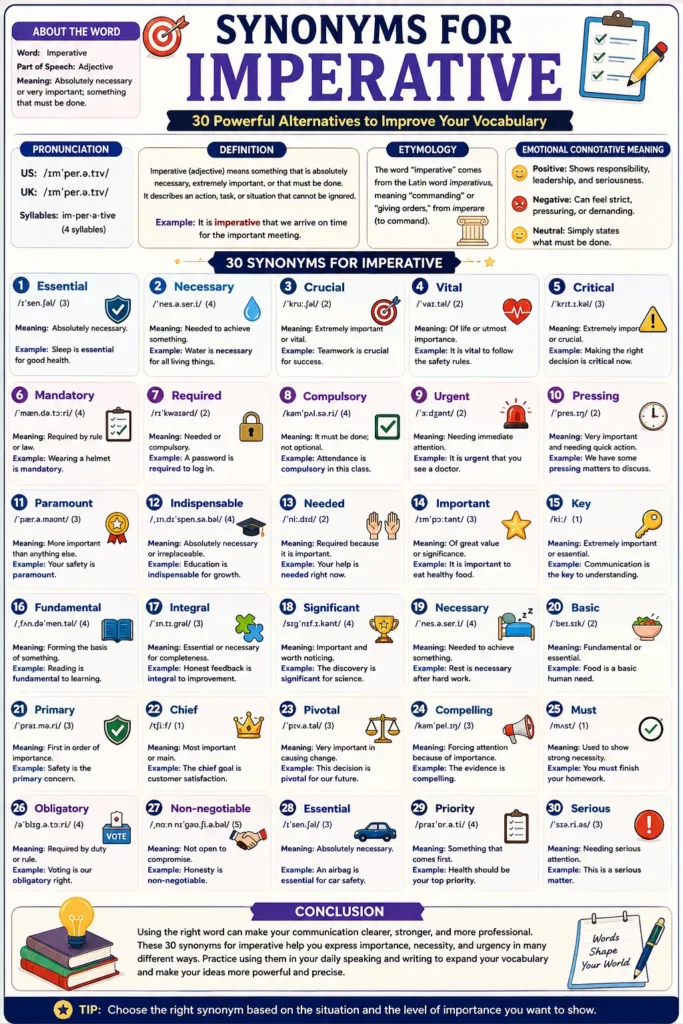
This guide gives you 30 simple synonyms for imperative. Along with easy sentences, word origins, pronunciation guides, and clear categories.
Meaning of Imperative
Definition
- Adjective: Crucial, urgent, or impossible to avoid; expressing a command.
- Noun: An essential duty, requirement, or priority.
Examples
- It is imperative that you finish your homework before going outside.
- Protecting our water supply is a major environmental imperative.
Connotative Meaning
- Positive tone: Expresses high importance, clear direction, and strong leadership.
- Negative tone: Can feel pushy, strict, or demanding when overused.
- Neutral tone: States an urgent requirement or grammatical command.
Etymology
- Source language: Came from Latin.
- Latin: Imperativus (from imperare, meaning “to command” or “to order”).
- Modern English: Means an urgent order, duty, or vital requirement.
Also, get more information https://synonymhubb.com/synonyms-for-proper/
Pronunciation
- US: /ɪmˈpɛrətɪv/
- UK: /ɪmˈperətɪv/
Syllables
im-per-a-tive (4 parts)
Affixation Pattern of Imperative
- Root: Imper (from imperare, means command)
- Suffix: -ative (makes an adjective or noun)
- Word Formation:
- Noun: Imperative / Imperativeness
- Adjective: Imperative
- Adverb: Imperatively
Synonyms of Imperative
1. Urgent (Adjective) — US: /ˈɜːrdʒənt/ | UK: /ˈɜːdʒənt/
Meaning: Requiring immediate action or attention.
Examples:
The doctor received an urgent call from the hospital.
We need to make an urgent decision today.
2. Vital (Adjective) — US: /ˈvaɪtl/ | UK: /ˈvaɪtl/
Meaning: Absolutely necessary or essential for life and success.
Examples:
Water is vital for all living plants and animals.
Getting enough sleep is vital for good health.
3. Essential (Adjective) — US: /ɪˈsɛnʃl/ | UK: /ɪˈsenʃl/
Meaning: Completely necessary and basic to a situation.
Examples:
Pencils are essential tools for schoolwork.
Fresh air is essential for a healthy home.
4. Crucial (Adjective) — US: /ˈkruːʃl/ | UK: /ˈkruːʃl/
Meaning: Extremely important, especially in deciding the outcome.
Examples:
The goalie made a crucial save in the final minute.
Listening carefully is a crucial part of learning.
5. Necessary (Adjective) — US: /ˈnɛsəsɛri/ | UK: /ˈnesəsəri/
Meaning: Needed to achieve a result or goal.
Examples:
It is necessary to wear a helmet while riding a bike.
Warm clothes are necessary in the cold winter.
6. Critical (Adjective) — US: /ˈkrɪtɪkl/ | UK: /ˈkrɪtɪkl/
Meaning: Having decisive importance at a time of danger or crisis.
Examples:
Rain is critical for crops during a dry summer.
The team faced a critical moment in the game.
7. Mandatory (Adjective) — US: /ˈmændətɔːri/ | UK: /ˈmændətəri/
Meaning: Required by law or rules; compulsory.
Examples:
Wearing seatbelts in a car is mandatory.
The school has a mandatory uniform policy.
8. Compulsory (Adjective) — US: /kəmˈpʌlsəri/ | UK: /kəmˈpʌlsəri/
Meaning: Required by a system or authority without choice.
Examples:
Math is a compulsory subject in primary school.
Safety drills are compulsory for all workers.
9. Obligatory (Adjective) — US: /əˈblɪɡətɔːri/ | UK: /əˈblɪɡətəri/
Meaning: Required because of a legal, moral, or official rule.
Examples:
Filing your tax papers is obligatory for adults.
It is obligatory to follow traffic lights.
10. Required (Adjective) — US: /rɪˈkwaɪərd/ | UK: /rɪˈkwaɪəd/
Meaning: Needed or set as a rule by someone in authority.
Examples:
A hall pass is required to walk in the corridors.
Good conduct is required on the school bus.
11. Binding (Adjective) — US: /ˈbaɪndɪŋ/ | UK: /ˈbaɪndɪŋ/
Meaning: Must be obeyed because of an official promise or contract.
Examples:
The two leaders signed a binding agreement.
A promise made in court is legally binding.
12. Pressing (Adjective) — US: /ˈprɛsɪŋ/ | UK: /ˈpresɪŋ/
Meaning: Needing quick action because it is immediate and serious.
Examples:
Repairing the leaky roof was a pressing task.
They discussed the most pressing issues in the meeting.
13. Exigent (Adjective) — US: /ˈɛksɪdʒənt/ | UK: /ˈeksɪdʒənt/
Meaning: Demanding immediate action or aid; urgent.
Examples:
The rescue crew responded to the exigent emergency.
He managed the exigent needs of his family.
14. Indispensable (Adjective) — US: /ˌɪndɪˈspɛnsəbl/ | UK: /ˌɪndɪˈspensəbl/
Meaning: Too important to be without; cannot be replaced.
Examples:
A good map is indispensable on a long trek.
She is an indispensable member of the science team.
15. Paramount (Adjective) — US: /ˈpærəmaʊnt/ | UK: /ˈpærəmaʊnt/
Meaning: More important than anything else; supreme.
Examples:
Student safety is of paramount importance at school.
Honesty is a principle of paramount value.
16. Chief (Adjective) — US: /tʃiːf/ | UK: /tʃiːf/
Meaning: Most important or main in rank or importance.
Examples:
Her chief goal was to master the piano.
The chief reason for the delay was heavy snow.
17. Priority (Noun) — US: /praɪˈɔːrəti/ | UK: /praɪˈɒrəti/
Meaning: Something that is regarded as more important than others.
Examples:
Finishing the report is my top priority today.
Safety must always be our main priority.
18. Duty (Noun) — US: /ˈduːti/ | UK: /ˈdjuːti/
Meaning: A moral or legal obligation that you must perform.
Examples:
It is our duty to keep our park clean.
The guard performed his duty with care.
19. Requirement (Noun) — US: /rɪˈkwaɪərmənt/ | UK: /rɪˈkwaɪəmənt/
Meaning: Something that is needed or wanted by law or rule.
Examples:
A library card is a requirement to borrow books.
Passing the eye test is a requirement for driving.
20. Command (Noun) — US: /kəˈmænd/ | UK: /kəˈmɑːnd/
Meaning: An authoritative order given to be obeyed.
Examples:
The dog obeyed its trainer’s clear command.
The captain issued a command to turn the ship.
21. Order (Noun) — US: /ˈɔːrdər/ | UK: /ˈɔːdə/
Meaning: An instruction given by an authority that must be followed.
Examples:
The officer gave an order to clear the road.
Students followed the order to line up quietly.
22. Dictate (Noun) — US: /ˈdɪkteɪt/ | UK: /ˈdɪkteɪt/
Meaning: An authoritative rule, order, or guiding principle.
Examples:
Follow the dictates of your conscience when choosing right.
They strictly followed the dictates of the safety manual.
23. Behest (Noun) — US: /bɪˈhɛst/ | UK: /bɪˈhest/
Meaning: A person’s command, order, or urgent request.
Examples:
The hall was decorated at the king’s behest.
She joined the project at the manager’s behest.
24. Charge (Noun) — US: /tʃɑːrdʒ/ | UK: /tʃɑːdʒ/
Meaning: An official task, instruction, or duty assigned to someone.
Examples:
The teacher gave him the charge of guiding new students.
She took care of her charge with great devotion.
25. Mandate (Noun) — US: /ˈmændeɪt/ | UK: /ˈmændeɪt/
Meaning: An official order or authority given to carry out a policy.
Examples:
The government issued a mandate to plant more trees.
The leader received a clear mandate from the voters.
26. Obligation (Noun) — US: /ˌɑːblɪˈɡeɪʃn/ | UK: /ˌɒblɪˈɡeɪʃn/
Meaning: A state of being forced to do something due to duty or rules.
Examples:
Parents have an obligation to protect their children.
We have a moral obligation to help those in need.
27. Need (Noun) — US: /niːd/ | UK: /niːd/
Meaning: A situation in which something is necessary or required.
Examples:
There is an urgent need for fresh water in the village.
She expressed a clear need for extra study time.
28. Insistent (Adjective) — US: /ɪnˈsɪstənt/ | UK: /ɪnˈsɪstənt/
Meaning: Demanding attention, action, or obedience continuously.
Examples:
The clock made an insistent ticking sound.
She was insistent that we check the answers twice.
29. Demanding (Adjective) — US: /dɪˈmændɪŋ/ | UK: /dɪˈmɑːndɪŋ/
Meaning: Requiring a lot of time, energy, focus, or attention.
Examples:
Solving complex math puzzles is a demanding task.
The coach was demanding, but fair with every player.
30. Direct (Adjective) — US: /dəˈrɛkt/ | UK: /daɪˈrekt/
Meaning: Clear, straightforward, and leaving no doubt about a command.
Examples:
The captain gave a direct order to drop the anchor.
She gave direct instructions on how to set up the tent.
Prototype Meaning
When children hear imperative, they picture a doctor calling for an emergency room doctor. A safety sign commanding “STOP”, or a referee blowing a whistle to enforce a crucial rule.
Prototype Categorization
- Urgent & Vital Needs: Urgent, Vital, Essential, Crucial, Necessary, Critical, Pressing, Exigent, Insistent.
- Rules & Mandatory Actions: Mandatory, Compulsory, Obligatory, Required, Binding, Paramount, Chief, Indispensable, Demanding.
- Orders & Direct Commands: Command, Order, Dictate, Behest, Charge, Mandate, Direct.
- Duties & Priorities: Priority, Duty, Requirement, Obligation, Need.
Antonyms of Imperative
- Optional
- Voluntary
- Unnecessary
- Optional
- Minor
- Avoidable
Short Questions and Answers
- What does imperative mean?
- It means something that is vital, urgent, or required by command.
- When should I use imperative?
- Use it when writing about urgent situations, strict rules, essential duties, or direct commands.
- Is imperative an adjective or a noun?
- It can be both! It acts as an adjective (an imperative task) and as a noun (a moral imperative).
- What is the difference between imperative and optional?
- Imperative means it must be done without choice, while optional means you can choose whether to do it or not.
Conclusion
Synonyms for imperative helps you express ideas with greater clarity and precision. Words such as essential, necessary, urgent, compulsory, mandatory, and crucial can be used in different situations and tones. Some suggest importance, while others show that something must be done. Understanding synonyms for imperative helps you avoid repetition. Also choose the right synonyms for imperative for your writing or conversation. Keep practicing these synonyms with examples to build a stronger vocabulary and writing.

I’m Zahid Abbas, an educator, researcher, and digital publishing strategist with a passion for linguistics, grammar, and clear communication. As a content creator and SEO specialist, I craft research-driven, reader-focused content that empowers learners and makes knowledge accessible worldwide.