The word proper means correct, suitable, polite, or right for a specific purpose. Imagine putting on your running shoes before gym instead of wearing heavy winter boots. Wearing the right shoes for sports is what we call proper.
We use synonyms for proper to describe polite manners, correct answers on a test, neat organization, or the right tools for a job. Learning new ways to say proper learners make their story writing clear.
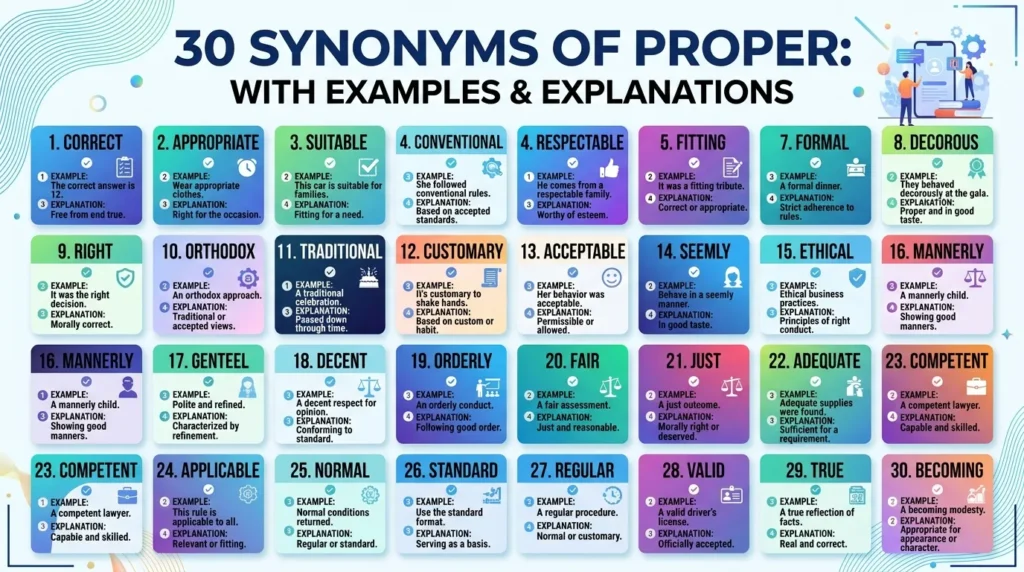
This guide gives you 30 simple synonyms for proper. Along with easy sentences, word origins, pronunciation guides, and clear categories.
Meaning of Proper
Definition
Proper (Adjective): Correct, suitable, polite, or fitting for a particular condition, rule, or occasion.
Examples
- Make sure to wear proper clothes for the rainy weather.
- Raising your hand before speaking is the proper way to ask a question.
Connotative Meaning
- Positive tone: Represents correctness, good manners, accuracy, order, and high standards.
- Negative tone: Can sometimes mean being too strict, overly formal, or stiff.
- Neutral tone: Simply describes something that fits specific rules or requirements.
Etymology
- Source language: Came from Latin through Old French.
- Latin: Proprius (meaning “one’s own” or “particular”).
- Old French: Propre (meaning “fitting”, “clean”, or “suitable”).
- Modern English: Literally means belonging naturally to a person, role, or occasion in the right way.
Pronunciation
- US: /ˈprɑːpər/
- UK: /ˈprɒpə/
Syllables
prop-er (2 parts)
Affixation Pattern of Proper
- Root: Proper (means correct or fitting)
- Word Formation:
- Noun: Properness / Propriety
- Adjective: Proper / Improper
- Adverb: Properly
For further detail https://synonymhubb.com/synonyms-for-ethical/
Synonyms for Proper
1. Correct (Adjective) — US: /kəˈrɛkt/ | UK: /kəˈrekt/
Meaning: Free from errors or mistakes; right.
Examples:
She gave the correct answer to the math problem.
Check your paper to make sure your spelling is correct.
2. Suitable (Adjective) — US: /ˈsuːtəbl/ | UK: /ˈsjuːtəbl/
Meaning: Right or appropriate for a particular person, purpose, or situation.
Examples:
Warm jackets are suitable for cold winter mornings.
This book is very suitable for young readers.
3. Polite (Adjective) — US: /pəˈlaɪt/ | UK: /pəˈlaɪt/
Meaning: Showing good manners and respect for others.
Examples:
Saying “please” and “thank you” is very polite.
He gave a polite nod when entering the room.
4. Fitting (Adjective) — US: /ˈfɪtɪŋ/ | UK: /ˈfɪtɪŋ/
Meaning: Appropriate or right for a special occasion or role.
Examples:
A golden trophy was a fitting reward for the winner.
It was a fitting end to a wonderful story.
5. Accurate (Adjective) — US: /ˈækjərət/ | UK: /ˈækjərət/
Meaning: Exact, truthful, and without any mistakes.
Examples:
Use a ruler to get an accurate measurement.
His drawing gave an accurate picture of the castle.
6. Appropriate (Adjective) — US: /əˈproʊpriət/ | UK: /əˈprəʊpriət/
Meaning: Suitable or right for a particular place, time, or group.
Examples:
Wear appropriate shoes for running on the track.
Her quiet tone was appropriate for the library.
7. Decent (Adjective) — US: /ˈdiːsnt/ | UK: /ˈdiːsnt/
Meaning: Good, respectable, and following fair social rules.
Examples:
He is a decent person who always helps his neighbors.
Make sure you eat a decent breakfast before school.
8. Neat (Adjective) — US: /niːt/ | UK: /niːt/
Meaning: Clean, tidy, and arranged in an organized way.
Examples:
Keep your desk neat and free of clutter.
She wrote her homework in neat handwriting.
9. Orderly (Adjective) — US: /ˈɔːrdərli/ | UK: /ˈɔːdəli/
Meaning: Well-arranged, peaceful, and obeying rules.
Examples:
The students formed an orderly line for lunch.
He kept his books in an orderly stack on the shelf.
10. Respectable (Adjective) — US: /rɪˈspɛktəbl/ | UK: /rɪˈspektəbl/
Meaning: Considered good, honest, and proper by society.
Examples:
They come from a very respectable family in town.
He earned a respectable grade on his project.
11. Rightful (Adjective) — US: /ˈraɪtfl/ | UK: /ˈraɪtfl/
Meaning: Belonging to someone by law, fairness, or rule.
Examples:
The crown was returned to its rightful king.
Put the toy back in its rightful box after playing.
12. Well-mannered (Adjective) — US: /wɛl ˈmænərd/ | UK: /wel ˈmænəd/
Meaning: Having and showing polite behavior toward others.
Examples:
The well-mannered children thanked their teacher.
Her dog is very well-mannered around strangers.
13. Exact (Adjective) — US: /ɪɡˈzækt/ | UK: /ɪɡˈzækt/
Meaning: Completely accurate and precise in every detail.
Examples:
Tell me the exact time the bus arrives.
Follow the recipe with exact measurements.
14. Formal (Adjective) — US: /ˈfɔːrml/ | UK: /ˈfɔːml/
Meaning: Following official rules, traditions, or serious customs.
Examples:
He wore a formal suit to the wedding ceremony.
The principal gave a formal announcement.
15. Standard (Adjective) — US: /ˈstændərd/ | UK: /ˈstændəd/
Meaning: Matching the regular, accepted rule or model.
Examples:
A standard pencil is fine for taking the quiz.
This is the standard procedure for fire drills.
16. Well-behaved (Adjective) — US: /wɛl bɪˈheɪvd/ | UK: /wel bɪˈheɪvd/
Meaning: Acting in a quiet, polite, and proper way.
Examples:
The class was well-behaved during the assembly.
She praised the well-behaved puppy.
17. Precise (Adjective) — US: /prɪˈsaɪs/ | UK: /prɪˈsaɪs/
Meaning: Strictly stated or done with great clarity and accuracy.
Examples:
Give precise directions so nobody gets lost.
Her precise cuts made the paper star look perfect.
18. Apt (Adjective) — US: /æpt/ | UK: /æpt/
Meaning: Quick, clever, and very suitable for a situation.
Examples:
“Bright” is an apt word to describe that smart student.
He made an apt choice by bringing an umbrella today.
19. Civil (Adjective) — US: /ˈsɪvl/ | UK: /ˈsɪvl/
Meaning: Polite in a peaceful, formal way toward others.
Examples:
Even when they disagree, they stay civil to each other.
Always give a civil answer when someone asks for help.
20. Conventional (Adjective) — US: /kənˈvɛnʃənl/ | UK: /kənˈvenʃənl/
Meaning: Following traditional, expected ways of doing things.
Examples:
She chose a conventional birthday cake with pink icing.
He followed conventional rules while playing chess.
21. Seemly (Adjective) — US: /ˈsiːmli/ | UK: /ˈsiːmli/
Meaning: Socially proper and fitting for good manners.
Examples:
It is not seemly to shout across a quiet restaurant.
She behaved with seemly grace at the ceremony.
22. Just (Adjective) — US: /dʒʌst/ | UK: /dʒʌst/
Meaning: Fair, right, and morally proper.
Examples:
The judge made a just decision for both sides.
He received a just reward for his honesty.
23. True (Adjective) — US: /truː/ | UK: /truː/
Meaning: Real, accurate, and faithful to facts or standards.
Examples:
He is a true friend who stays by your side.
The compass showed the true direction to the north.
24. Becoming (Adjective) — US: /bɪˈkʌmɪŋ/ | UK: /bɪˈkʌmɪŋ/
Meaning: Looking good or fitting nicely on a person.
Examples:
That blue sweater is very becoming on you.
Her becoming smile brightened the entire room.
25. Orthodox (Adjective) — US: /ˈɔːrθədɑːks/ | UK: /ˈɔːθədɒks/
Meaning: Following accepted, traditional beliefs or methods.
Examples:
He used orthodox scientific methods to test the water.
Her cooking relies on orthodox family recipes.
26. Reasonable (Adjective) — US: /ˈriːznəbl/ | UK: /ˈriːznəbl/
Meaning: Fair, sensible, and showing good judgment.
Examples:
Asking for ten minutes of quiet time is very reasonable.
The store offers toys at reasonable prices.
27. Corrective (Adjective) — US: /kəˈrɛktɪv/ | UK: /kəˈrektɪv/
Meaning: Intended to fix something and make it right or proper again.
Examples:
Glasses are corrective lenses that help you see clearly.
The teacher gave corrective notes on his essay.
28. Prim (Adjective) — US: /prɪm/ | UK: /prɪm/
Meaning: Very neat, formal, and easily shocked by improper things.
Examples:
She sat with a prim and straight posture at her desk.
Her prim outfit looked spotless and ironed.
29. Genuine (Adjective) — US: /ˈdʒɛnjuɪn/ | UK: /ˈdʒenjuɪn/
Meaning: Real, honest, and not fake or copied.
Examples:
She gave a genuine smile when she saw her friends.
This ring is made of genuine silver.
30. Fit (Adjective) — US: /fɪt/ | UK: /fɪt/
Meaning: Qualified, appropriate, or healthy enough for a purpose.
Examples:
Filtered water is clean and fit for drinking.
He worked hard to stay fit for the soccer season.
Prototype Meaning
When people hear proper, they picture sitting up straight in a dining chair with good table manners, using a fork and napkin correctly, or wearing the right uniform to school.
Prototype Categorization
- Good Manners & Politeness: Polite, Well-mannered, Well-behaved, Civil, Decent, Respectable, Seemly, Prim.
- Accuracy & Truth: Correct, Accurate, Exact, Precise, True, Genuine.
- Suitable & Right for Purpose: Suitable, Fitting, Appropriate, Apt, Rightful, Fit, Becoming.
- Order & Rules: Neat, Orderly, Formal, Standard, Conventional, Orthodox, Reasonable, Just, Corrective.
Antonyms of Proper
- Improper
- Incorrect
- Rude
- Unsuitable
- Inaccurate
- Untidy
Short Questions and Answers
- What does proper mean?
- It means correct, suitable, polite, or right for a situation.
- When should I use proper?
- Use it when writing about good manners, exact answers, neat organization, or the right outfit/tools.
- Is proper an adjective or a noun?
- It is an adjective! (The related adverb is properly).
- How is proper different from polite?
- Polite specifically describes nice manners toward people, while proper can describe manners, correct tools, exact answers, or neat arrangement
Conclusion
Synonyms for proper can help you describe things that are correct, suitable, or done in the right way. Words such as correct, suitable, appropriate, right, fitting, decent, and orderly can make your English natural. Each word has a slightly different meaning, so it is important to choose the right synonym for each situation. For English learners, synonyms for proper can improve speaking, writing, reading, and everyday communication. They can also help you avoid repeating the word proper too often. Practice synonyms for proper in simple sentences about school, family, work, and daily life. With regular practice, you can build a stronger vocabulary .

I’m Zahid Abbas, an educator, researcher, and digital publishing strategist with a passion for linguistics, grammar, and clear communication. As a content creator and SEO specialist, I craft research-driven, reader-focused content that empowers learners and makes knowledge accessible worldwide.