Conservative means preferring old ways, careful choices, and slow change instead of fast change. Think about a man who still writes letters by hand instead of using new apps. His friends say, “You are so conservative about technology!” He likes what feels safe and tested. People use synonyms for conservative a lot. We use it for politics, fashion, money choices, and daily habits. New synonyms for conservative help you talk better. Synonyms for conservative help you write better too. You will not repeat the same word. Your writing will be more fun to read. This article will teach you the word “conservative.” You will learn 30 other words like it. We will see easy examples. You will learn how to say each word. You will learn some history too.
Meaning of Conservative
Definition
Conservative (adjective): preferring old or traditional ways, and careful about fast change.
Examples
- She has conservative views on spending money.
- He wore a conservative black suit to the interview.
Connotative Meaning
- Positive tone: careful, steady, respectful of tradition
- Negative tone: can feel closed-minded or too slow to change
- Neutral tone: just describes a careful or traditional choice
Etymology
- This word comes from the Latin word conservare. It means “to keep safe” or “to preserve.”
- Conservare comes from con- (together) and servare (to keep or guard).
- The word moved into English through French in the 1400s.
- Old English (450–1100): This word did not exist yet. People used simple words for “careful” or “safe,” like wær.
- Middle English (1100–1500): The word “conserve” came into English through French. It meant “to keep safe” or “to protect.”
- Modern English (1500–Present): “Conservative” grew from “conserve” in the 1800s. It first meant someone who wanted to keep old systems and traditions. It later became common in politics, fashion, and daily speech.
Pronunciation (US & UK — IPA)
- US: /kənˈsɝː.və.tɪv/
- UK: /kənˈsɜː.və.tɪv/
Syllables
con-ser-va-tive (4 parts)
Affixation Pattern of Conservative
- Root: serv- (from Latin servare, meaning “to keep”)
- Prefix: con- (means “together” or “fully”)
- Suffix: -ative (turns the word into an adjective)
- Word formation: This root makes many words. We get conserve (verb), conservation (noun), conservative (adjective/noun), conservatively (adverb), and conservatism (noun). That is five related words.
Explore related words https://synonymhubb.com/synonyms-for-specialize/
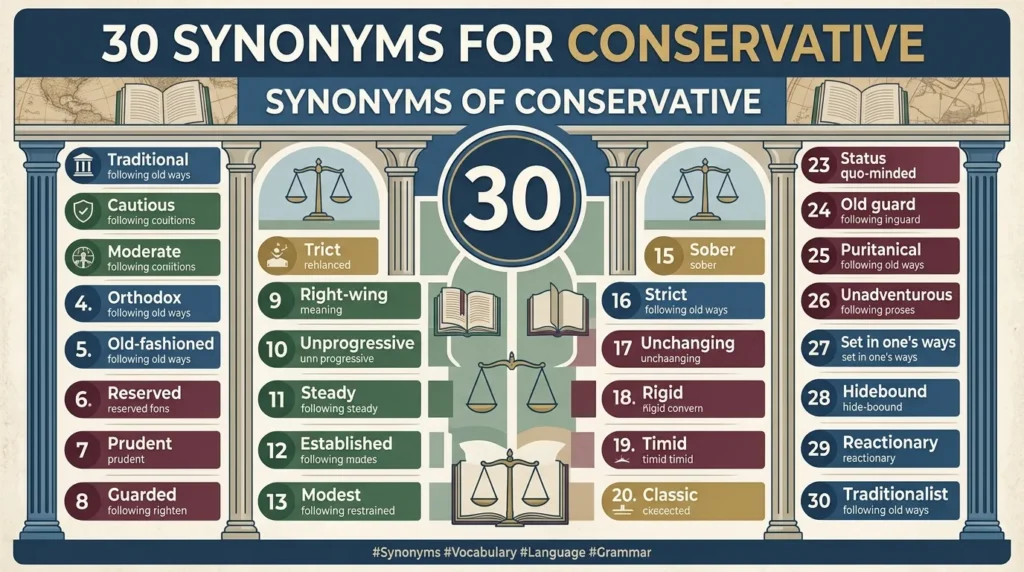
Synonyms of Conservative
1. Traditional (adjective) — US /trəˈdɪʃ.ən.əl/ | UK /trəˈdɪʃ.ən.əl/
Meaning: following old customs and ways.
Examples:
- They had a traditional wedding.
- She prefers traditional cooking methods.
2. Cautious (adjective) — US /ˈkɔː.ʃəs/ | UK /ˈkɔː.ʃəs/
Meaning: careful and avoiding risk.
Examples:
- He gave a cautious answer to the question.
- She is cautious with her money.
3. Moderate (adjective) — US /ˈmɑː.dɚ.ət/ | UK /ˈmɒd.ər.ət/
Meaning: not extreme, staying in the middle.
Examples:
- He holds moderate political views.
- She took a moderate approach to the plan.
4. Orthodox (adjective) — US /ˈɔːr.θə.dɑːks/ | UK /ˈɔː.θə.dɒks/
Meaning: following accepted or usual beliefs and rules.
Examples:
- He follows an orthodox way of teaching.
- Her views on marriage are quite orthodox.
5. Old-fashioned (adjective) — US /oʊldˈfæʃ.ənd/ | UK /əʊldˈfæʃ.ənd/
Meaning: liking ways from the past, not modern styles.
Examples:
- Grandpa has old-fashioned manners.
- The shop has an old-fashioned feel.
6. Reserved (adjective) — US /rɪˈzɝːvd/ | UK /rɪˈzɜːvd/
Meaning: quiet and careful, not showing strong feelings or taking risks.
Examples:
- He stayed reserved during the meeting.
- She has a reserved personality.
7. Prudent (adjective) — US /ˈpruː.dənt/ | UK /ˈpruː.dənt/
Meaning: careful and wise in making choices.
Examples:
- It was a prudent financial decision.
- She made a prudent choice to save money.
8. Guarded (adjective) — US /ˈɡɑːr.dɪd/ | UK /ˈɡɑː.dɪd/
Meaning: careful and not open to quick change or risk.
Examples:
- He gave a guarded response to the news.
- She remained guarded about her plans.
9. Right-wing (adjective) — US /raɪt wɪŋ/ | UK /raɪt wɪŋ/
Meaning: holding political views that favor tradition and less government change.
Examples:
- The right-wing party won the election.
- He holds right-wing political beliefs.
10. Unprogressive (adjective) — US /ˌʌn.prəˈɡres.ɪv/ | UK /ˌʌn.prəˈɡres.ɪv/
Meaning: not wanting or favoring new change.
Examples:
- Critics called the policy unprogressive.
- The old system felt slow and unprogressive.
11. Steady (adjective) — US /ˈsted.i/ | UK /ˈsted.i/
Meaning: firm and not easily changed.
Examples:
- He gave a steady, careful answer.
- Her steady approach calmed the team.
12. Established (adjective) — US /ɪˈstæb.lɪʃt/ | UK /ɪˈstæb.lɪʃt/
Meaning: accepted and used for a long time.
Examples:
- They followed established rules closely.
- It is an established way of farming.
13. Modest (adjective) — US /ˈmɑː.dɪst/ | UK /ˈmɒd.ɪst/
Meaning: simple, careful, and not showy.
Examples:
- She lives a modest lifestyle.
- He made a modest and careful choice.
14. Restrained (adjective) — US /rɪˈstreɪnd/ | UK /rɪˈstreɪnd/
Meaning: controlled and careful, not extreme.
Examples:
- He kept a restrained tone in the debate.
- Her restrained style suits formal events.
15. Formal (adjective) — US /ˈfɔːr.məl/ | UK /ˈfɔː.məl/
Meaning: following proper and traditional manners or rules.
Examples:
- He wore a formal suit to the event.
- The meeting had a formal tone.
16. Strict (adjective) — US /strɪkt/ | UK /strɪkt/
Meaning: following firm rules without much change.
Examples:
- The school has strict dress codes.
- Her parents were strict about bedtime.
17. Unchanging (adjective) — US /ʌnˈtʃeɪn.dʒɪŋ/ | UK /ʌnˈtʃeɪn.dʒɪŋ/
Meaning: staying the same over time.
Examples:
- The town kept its unchanging charm.
- His unchanging habits surprised no one.
18. Rigid (adjective) — US /ˈrɪdʒ.ɪd/ | UK /ˈrɪdʒ.ɪd/
Meaning: fixed and unwilling to change easily.
Examples:
- He has rigid rules about manners.
- Her rigid schedule left no room for change.
19. Timid (adjective) — US /ˈtɪm.ɪd/ | UK /ˈtɪm.ɪd/
Meaning: careful and a little fearful of risk.
Examples:
- He gave a timid answer about the plan.
- Her timid approach slowed the project.
20. Classic (adjective) — US /ˈklæs.ɪk/ | UK /ˈklæs.ɪk/
Meaning: traditional in style, lasting over time.
Examples:
- She wore a classic black dress.
- The house has a classic design.
21. Sober (adjective) — US /ˈsoʊ.bɚ/ | UK /ˈsəʊ.bə/
Meaning: serious, calm, and careful.
Examples:
- He gave a sober view of the risks.
- Her sober judgment helped the team.
22. Protective (adjective) — US /prəˈtek.tɪv/ | UK /prəˈtek.tɪv/
Meaning: wanting to guard and keep safe what already exists.
Examples:
- She is protective of old family customs.
- He felt protective of the old building.
23. Status quo-minded (phrase) — US /ˈsteɪ.təs kwoʊ ˈmaɪn.dɪd/ | UK /ˈsteɪ.təs kwəʊ ˈmaɪn.dɪd/
Meaning: preferring things to stay as they already are.
Examples:
- The board was very status quo-minded.
- He stayed status quo-minded during the talks.
24. Old guard (phrase) — US /oʊld ɡɑːrd/ | UK /əʊld ɡɑːd/
Meaning: people who hold onto old ways and resist change.
Examples:
- The old guard resisted the new rules.
- She was seen as part of the old guard.
25. Puritanical (adjective) — US /ˌpjʊr.əˈtæn.ɪ.kəl/ | UK /ˌpjʊə.rɪˈtæn.ɪ.kəl/
Meaning: very strict, especially about morals and behavior.
Examples:
- His puritanical views shocked the group.
- The rules felt puritanical to the students.
26. Unadventurous (adjective) — US /ˌʌn.ədˈven.tʃɚ.əs/ | UK /ˌʌn.ədˈven.tʃər.əs/
Meaning: not willing to try new or risky things.
Examples:
- His unadventurous choices kept things simple.
- She stayed unadventurous with her food choices.
27. Set in one’s ways (phrase) — US /set ɪn wʌnz weɪz/ | UK /set ɪn wʌnz weɪz/
Meaning: firmly used to doing things a certain way.
Examples:
- My uncle is set in his ways.
- She is quite set in her ways about chores.
28. Hidebound (adjective) — US /ˈhaɪd.baʊnd/ | UK /ˈhaɪd.baʊnd/
Meaning: unwilling to change old habits or beliefs.
Examples:
- The hidebound rules slowed the business.
- He was too hidebound to try new ideas.
29. Reactionary (adjective) — US /riˈæk.ʃə.ner.i/ | UK /riˈæk.ʃən.ri/
Meaning: strongly against change, often wanting to return to older ways.
Examples:
- His reactionary views surprised the group.
- The reactionary policy undid recent changes.
30. Traditionalist (noun) — US /trəˈdɪʃ.ən.əl.ɪst/ | UK /trəˈdɪʃ.ən.əl.ɪst/
Meaning: a person who strongly follows old customs and beliefs.
Examples:
- He is a traditionalist about family roles.
- She is known as a traditionalist in fashion.
Prototype Meaning
People hear “conservative.” They think of someone who likes old ways, careful choices, and slow change. They picture steady habits, formal manners, and a wish to protect what already works. This is the main picture the word gives us.
Prototype Categorization
- Careful and cautious words: cautious, prudent, guarded, restrained, timid, sober
- Traditional and old-style words: traditional, old-fashioned, classic, orthodox, established, traditionalist
- Strict and fixed words: strict, rigid, unchanging, hidebound, puritanical
- Political words: right-wing, reactionary, status quo-minded, old guard
- Personality words: reserved, modest, steady, formal, protective, unadventurous
- Phrase-based words: set in one’s ways
Antonyms of Conservative
- Liberal
- Progressive
- Modern
- Radica,
- Open-minded
Short Questions and Answers
- What does conservative mean? It means preferring old or traditional ways and being careful about fast change.
- When should conservative be used? Use it when talking about traditions, careful choices, politics, or a cautious attitude.
- Is conservative positive or negative? It depends on context. It can feel positive, like steady and careful, or negative, like closed-minded or slow to change.
- How is it different from similar words? “Conservative” is a general word for preferring tradition. “Rigid” suggests a stronger, less flexible attitude. “Cautious” focuses only on avoiding risk, not tradition. “Reactionary” often means strongly resisting or reversing change.
Conclusion
Synonyms for conservative helps you build a stronger vocabulary. It improves both your writing and speaking, helps you avoid repeating the same word again and again, and builds real confidence in English. Synonyms for conservative “traditional,” “cautious,” “orthodox,” and “old-fashioned” each carry a slightly different shade of meaning, and knowing when to use read new synonyms for conservative, try them in sentences, and notice how skilled writers vary their word choice. Small daily habits lead to big improvement over time.

I’m Zahid Abbas, an educator, researcher, and digital publishing strategist with a passion for linguistics, grammar, and clear communication. As a content creator and SEO specialist, I craft research-driven, reader-focused content that empowers learners and makes knowledge accessible worldwide.