Antagonize means to cause someone to feel angry or hostile toward you, often through unfriendly words or actions. Think about a boy who keeps teasing his sister about her drawing, even after she asks him to stop. He does not realize he is starting to antagonize her until she finally shouts back in frustration. This word describes actions that stir up anger or push someone into a fight, sometimes without even meaning to. People use synonyms for antagonize a lot when talking about arguments, teasing, and difficult relationships. Learning new words like this helps English learners speak and write with more variety. Synonyms for antagonize also helps writers avoid using the same word again and again. This article explains the meaning of antagonize, its history, and how to say it. It also shares 30 synonyms for antagonize that mean almost the same thing.
Meaning of Antagonize
Definition
Antagonize (Verb):
To cause someone to feel angry or hostile toward you, through unfriendly actions or words.
Examples
- He didn’t mean to antagonize his coworker with the joke.
- Constant teasing will only antagonize your little brother.
Connotative Meaning
- Positive tone:
- This word almost never feels positive, since it describes actions that create conflict.
- Negative tone:
- This word feels tense and unpleasant, showing that someone is stirring up anger.
- Neutral tone:
- In psychology or business writing, it can describe a factual pattern of behavior without strong judgment.
Etymology
- This word comes from the Greek word “antagonizesthai,” meaning “to struggle against.”
- That word joined “anti-” (meaning “against”) and “agonizesthai” (meaning “to contend for a prize”).
- The word entered English in the 17th century, related to the older word “antagonist.”
Short History
- Old English (450–1100): This word did not exist yet. People used simpler words to describe anger or conflict.
- Middle English (1100–1500): This word had not yet entered English during this period either.
- Modern English (1500–Present):
- The word “antagonize” began developing in English in the 1600s from Greek roots. Over time, it became common in psychology, sports, and everyday speech. To describe actions that stir up anger, conflict, or hostility.
Pronunciation (US & UK – IPA)
- US: /ænˈtæɡəˌnaɪz/
- UK: /ænˈtæɡənaɪz/
Syllables
an-tag-o-nize (4 syllables)
Affixation Pattern of Antagonize
- Root: agon (from Greek “agon,” meaning “contest” or “struggle”)
- Prefix: anti- (meaning “against”)
- Suffix: -ize (turns the word into a verb)
Word Formation
The word family includes antagonize (verb), antagonist (noun), antagonism (noun), and antagonistic (adjective). All these words come from the same root and are related to conflict, or causing trouble.
Also get more information about https://synonymhubb.com/synonyms-for-tyrant/
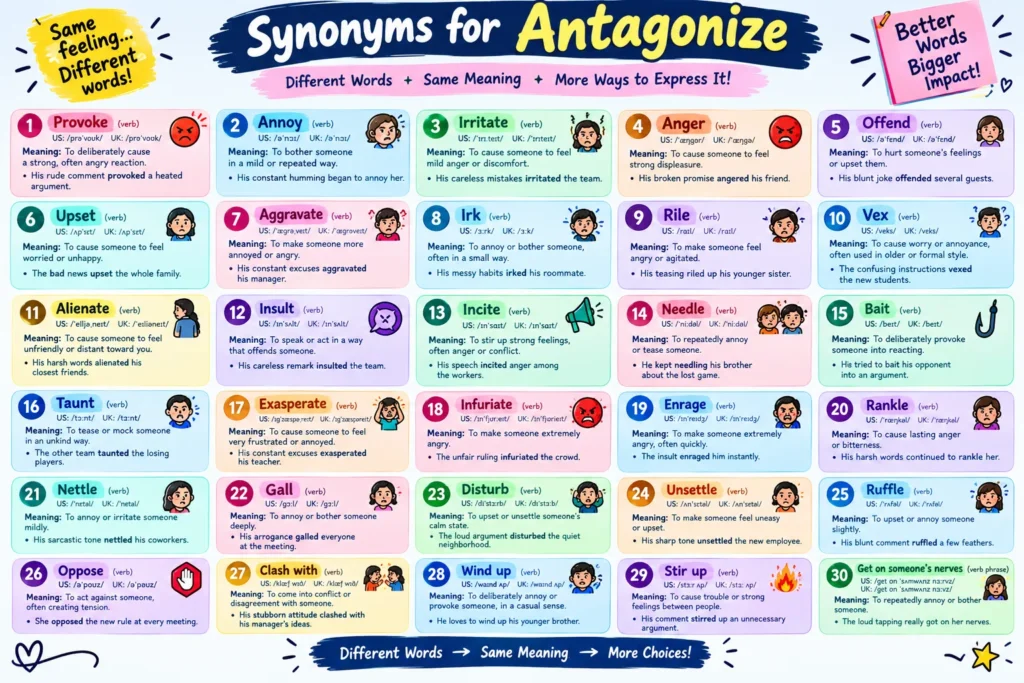
Synonyms for Antagonize
1. Provoke (Verb) — US: /prəˈvoʊk/ | UK: /prəˈvəʊk/
Meaning: To deliberately cause a strong, often angry reaction.
Examples:
- His rude comment provoked a heated argument.
- She provoked her brother until he finally snapped.
2. Annoy (Verb) — US: /əˈnɔɪ/ | UK: /əˈnɔɪ/
Meaning: To bother someone in a mild or repeated way.
Examples:
- His constant humming began to annoy her.
- The loud music annoyed the neighbors.
3. Irritate (Verb) — US: /ˈɪrɪˌteɪt/ | UK: /ˈɪrɪteɪt/
Meaning: To cause someone to feel mild anger or discomfort.
Examples:
- His careless mistakes irritated the whole team.
- The constant noise irritated her all day.
4. Anger (Verb) — US: /ˈæŋɡər/ | UK: /ˈæŋɡə/
Meaning: To cause someone to feel strong displeasure.
Examples:
- His broken promise angered his best friend.
- The unfair decision angered many workers.
5. Offend (Verb) — US: /əˈfɛnd/ | UK: /əˈfɛnd/
Meaning: To hurt someone’s feelings or upset them.
Examples:
- His blunt joke offended several guests.
- She didn’t mean to offend anyone with her question.
6. Upset (Verb) — US: /ʌpˈsɛt/ | UK: /ʌpˈsɛt/
Meaning: To cause someone to feel worried or unhappy.
Examples:
- The bad news upset the whole family.
- His sharp tone upset his coworker.
7. Aggravate (Verb) — US: /ˈæɡrəˌveɪt/ | UK: /ˈæɡrəveɪt/
Meaning: To make someone more annoyed or angry.
Examples:
- His constant excuses aggravated his manager.
- The delay aggravated the tired passengers.
8. Irk (Verb) — US: /ɜːrk/ | UK: /ɜːk/
Meaning: To annoy or bother someone, often in a small way.
Examples:
- His messy habits irked his roommate.
- It irked her when he arrived late again.
9. Rile (Verb) — US: /raɪl/ | UK: /raɪl/
Meaning: To make someone feel angry or agitated.
Examples:
- His teasing riled up his younger sister.
- The unfair call riled the whole crowd.
10. Vex (Verb) — US: /vɛks/ | UK: /vɛks/
Meaning: To cause worry or annoyance, often used in older or formal style.
Examples:
- The confusing instructions vexed the new students.
- His stubbornness vexed his patient teacher.
11. Alienate (Verb) — US: /ˈeɪljəˌneɪt/ | UK: /ˈeɪliəneɪt/
Meaning: To cause someone to feel unfriendly or distant toward you.
Examples:
- His harsh words alienated his closest friends.
- The new policy alienated many loyal customers.
12. Insult (Verb) — US: /ɪnˈsʌlt/ | UK: /ɪnˈsʌlt/
Meaning: To speak or act in a way that offends someone.
Examples:
- His careless remark insulted the whole team.
- She felt insulted by his rude comment.
13. Incite (Verb) — US: /ɪnˈsaɪt/ | UK: /ɪnˈsaɪt/
Meaning: To stir up strong feelings, often anger or conflict.
Examples:
- His speech incited anger among the workers.
- The rumor incited fear throughout the town.
14. Needle (Verb) — US: /ˈniːdəl/ | UK: /ˈniːdəl/
Meaning: To repeatedly annoy or tease someone. Examples:
- He kept needling his brother about the lost game.
- She needled him until he finally lost his temper.
15. Bait (Verb) — US: /beɪt/ | UK: /beɪt/
Meaning: To deliberately provoke someone into reacting.
Examples:
- He tried to bait his opponent into an argument.
- She refused to let his comments bait her.
16. Taunt (Verb) — US: /tɔːnt/ | UK: /tɔːnt/
Meaning: To tease or mock someone in an unkind way.
Examples:
- The other team taunted the losing players.
- He taunted his sister about her mistake.
17. Exasperate (Verb) — US: /ɪɡˈzæspəˌreɪt/ | UK: /ɪɡˈzæspəreɪt/
Meaning: To cause someone to feel very frustrated or annoyed.
Examples:
- His constant excuses exasperated his teacher.
- The long delay exasperated everyone in line.
18. Infuriate (Verb) — US: /ɪnˈfjʊriˌeɪt/ | UK: /ɪnˈfjʊərieɪt/
Meaning: To make someone extremely angry.
Examples:
- The unfair ruling infuriated the whole crowd.
- His careless mistake infuriated his boss.
19. Enrage (Verb) — US: /ɛnˈreɪdʒ/ | UK: /ɪnˈreɪdʒ/
Meaning: To make someone extremely angry, often quickly.
Examples:
- The insult enraged him instantly.
- Her betrayal enraged her closest friends.
20. Rankle (Verb) — US: /ˈræŋkəl/ | UK: /ˈræŋkəl/
Meaning: To cause lasting anger or bitterness.
Examples:
- His harsh words continued to rankle her for weeks.
- The unfair decision still rankles the whole team.
21. Nettle (Verb) — US: /ˈnɛtəl/ | UK: /ˈnɛtəl/
Meaning: To annoy or irritate someone mildly.
Examples:
- His sarcastic tone nettled his coworkers.
- The small comment nettled her more than expected.
22. Gall (Verb) — US: /ɡɔːl/ | UK: /ɡɔːl/
Meaning: To annoy or bother someone deeply.
Examples:
- His arrogance galled everyone at the meeting.
- It galled her to admit that he was right.
23. Disturb (Verb) — US: /dɪˈstɜːrb/ | UK: /dɪˈstɜːb/
Meaning: To upset or unsettle someone’s calm state.
Examples:
- The loud argument disturbed the quiet neighborhood.
- His strange behavior disturbed his classmates.
24. Unsettle (Verb) — US: /ʌnˈsɛtəl/ | UK: /ʌnˈsɛtəl/
Meaning: To make someone feel uneasy or upset.
Examples:
- The sudden change unsettled the whole team.
- His sharp tone unsettled the new employee.
25. Ruffle (Verb) — US: /ˈrʌfəl/ | UK: /ˈrʌfəl/
Meaning: To upset or annoy someone slightly. Examples:
- His blunt comment ruffled a few feathers.
- The surprise question ruffled her calm mood.
26. Oppose (Verb) — US: /əˈpoʊz/ | UK: /əˈpəʊz/
Meaning: To act against someone, often creating tension.
Examples:
- His loud objections opposed the whole group’s plan.
- She opposed the new rule at every meeting.
27. Clash with (Verb) — US: /klæʃ wɪð/ | UK: /klæʃ wɪð/
Meaning: To come into conflict or disagreement with someone.
Examples:
- His stubborn attitude clashed with his manager’s ideas.
- The two leaders often clashed with each other.
28. Wind up (Verb) — US: /waɪnd ʌp/ | UK: /waɪnd ʌp/
Meaning: To deliberately annoy or provoke someone, in a casual sense.
Examples:
- He loves to wind up his younger brother.
- She was only trying to wind him up for fun.
29. Stir up (Verb) — US: /stɜːr ʌp/ | UK: /stɜː ʌp/
Meaning: To cause trouble or strong feelings between people.
Examples:
- His comment stirred up an unnecessary argument.
- The rumor stirred up fear in the small town.
30. Get on someone’s nerves (Verb phrase) — US: /ɡɛt ɒn ˈsʌmwʌnz nɜːrvz/ | UK: /ɡɛt ɒn ˈsʌmwʌnz nɜːvz/
Meaning: To repeatedly annoy or bother someone.
Examples:
- His constant complaining got on everyone’s nerves.
- The loud tapping really got on her nerves.
Prototype Meaning
When people hear the word antagonize, they often think of someone causing conflict. It can mean teasing, or upsetting someone until they become frustrated or hostile.
Prototype Categorization
- Mild annoyance: annoy, irritate, irk, nettle, ruffle
- Strong anger: infuriate, enrage, anger, exasperate, rankle, gall
- Deliberate provoking: provoke, taunt, bait, needle, incite
- Causing conflict: oppose, clash with, alienate, stir up
- Upsetting someone’s peace: upset, disturb, unsettle, vex
- Casual or everyday teasing: wind up, get on someone’s nerves, offend, insult, aggravate
Antonyms of Antagonize
- befriend
- calm
- soothe
- comfort
- please
Short Questions and Answers
- What does antagonize mean? It means to cause someone to feel angry or hostile toward you, through unfriendly words.
- When should antagonize be used? Use it when describing behavior that stirs up anger, conflict, or opposition in someone.
- Is antagonize positive or negative? It is almost always negative, showing tension, conflict, or unwanted hostility.
- How is it different from similar words? “Annoy” often describes a mild, everyday bother. “Antagonize” usually shows a stronger, more deliberate act that turns someone into an opponent.
Conclusion
Synonyms for antagonize helps you build a stronger, more precise vocabulary. It strengthens your writing and speaking by giving you many ways to describe conflict, teasing, and tension between people. Synonyms for antagonize also helps you avoid repeating the same word again and again. Synonyms for antagonize keeps your writing clearer and more expressive. Most importantly, learning new synonyms for antagonize builds your confidence as an English speaker and writer. Try learning one new synonyms for antagonize from this list each day, and watch your vocabulary grow steadily over time.

I’m Zahid Abbas, an educator, researcher, and digital publishing strategist with a passion for linguistics, grammar, and clear communication. As a content creator and SEO specialist, I craft research-driven, reader-focused content that empowers learners and makes knowledge accessible worldwide.