Underscore means to emphasize or draw attention to the importance of something. Think about a coach giving a pep talk before a big game. He says, “I want to underscore how important teamwork is tonight.” His words make sure the players truly understand what matters most. Synonyms for underscore helps writers and speakers show that one idea deserves extra attention compared to others. People use synonyms for underscore a lot in speeches, reports, and news articles. Learning new synonyms for underscore helps English learners speak and write with more variety. It also helps writers avoid using the same word again and again. This article explains the meaning of underscore, its history, and how to say it. It also shares 30 words that mean almost the same thing.
Meaning of Underscore
Definition
Underscore (Verb): To emphasize or draw attention to the importance of something.
Examples
- Her speech underscored the need for clean water.
- The report underscores a growing problem in the industry.
Connotative Meaning
- Positive tone:
- This word often feels thoughtful and serious, showing that something truly matters.
- Negative tone:
- This word rarely feels negative, though it can highlight a problem or warning.
- Neutral tone:
- In reports and academic writing, it is often used in a plain, factual way to point out importance.
Etymology
- This word comes from joining “under” and “score.”
- “Score” came from the Old Norse word “skor,” meaning “a notch” or “a mark.”
- The word originally meant “to draw a line under text,” which later grew into a figurative meaning of emphasis.
Short History
- Old English (450–1100): The word under was already used in English. The word score had not yet entered the language.
- Middle English (1100–1500): Score entered English from Old Norse. It meant a mark or a count.
- Modern English (1500–Present): Underscore later became a verb. It first meant drawing a line under words. Later, it also came to mean emphasizing an idea.
Pronunciation (US & UK – IPA)
- US: /ˈʌndərˌskɔːr/
- UK: /ˈʌndəskɔː/
Syllables
un-der-score (3 syllables)
Affixation Pattern of Underscore
- Root: score (from Old Norse “skor,” meaning “a notch” or “mark”)
- Prefix: under- (meaning “beneath”)
- Suffix: none
Explore related topics https://synonymhubb.com/synonyms-for-trusting/
Word Formation:
Underscore (verb/noun), underscored (adjective/past tense), and underscoring (noun/verb form) all come from this root.
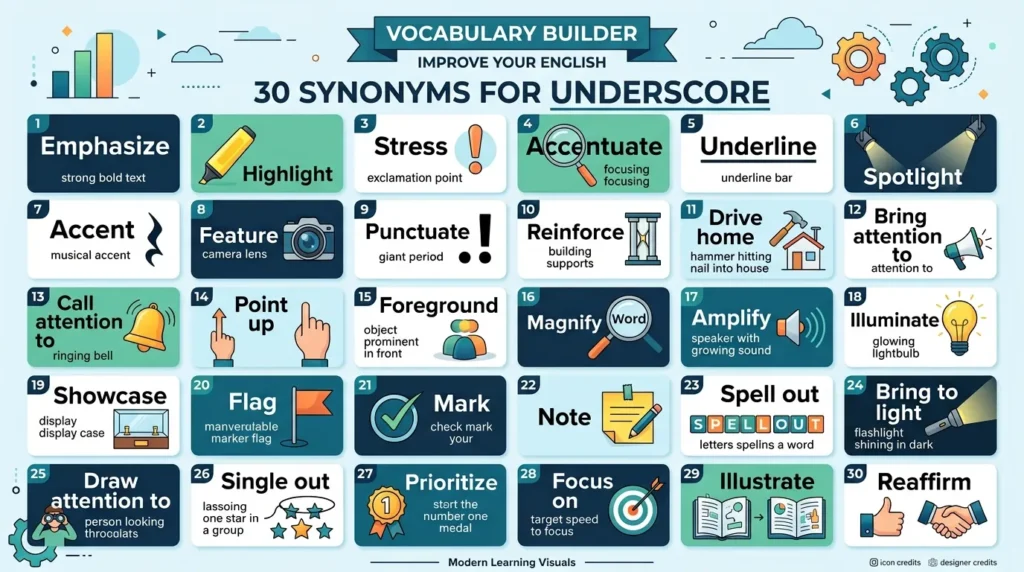
Synonyms for Underscore
1. Emphasize (Verb) — US: /ˈɛmfəˌsaɪz/ | UK: /ˈɛmfəsaɪz/
Meaning: To give special importance to something.
Examples:
- The teacher emphasized the value of daily practice.
- Her speech emphasized the need for kindness.
2. Highlight (Verb) — US: /ˈhaɪˌlaɪt/ | UK: /ˈhaɪlaɪt/
Meaning: To draw attention to something important.
Examples:
- The report highlighted several key findings.
- She highlighted the main points in her presentation.
3. Stress (Verb) — US: /strɛs/ | UK: /strɛs/
Meaning: To place strong importance on an idea.
Examples:
- He stressed the importance of arriving on time.
- The coach stressed safety during practice.
4. Accentuate (Verb) — US: /əkˈsɛntʃuˌeɪt/ | UK: /əkˈsɛntʃueɪt/
Meaning: To make something more noticeable or important.
Examples:
- The bright colors accentuate the painting’s mood.
- Her tone accentuated the seriousness of the issue.
5. Underline (Verb) — US: /ˈʌndərˌlaɪn/ | UK: /ˈʌndəlaɪn/
Meaning: To emphasize the importance of something clearly.
Examples:
- The results underline the need for more research.
- Her comment underlined the team’s strong effort.
6. Spotlight (Verb) — US: /ˈspɑːtˌlaɪt/ | UK: /ˈspɒtlaɪt/
Meaning: To focus attention directly on something.
Examples:
- The article spotlighted a local hero’s story.
- Her project spotlighted the importance of recycling.
7. Accent (Verb) — US: /ˈæksɛnt/ | UK: /ˈæksɛnt/
Meaning: To emphasize a specific detail or feature.
Examples:
- The dress design accents her natural style.
- His speech accented the value of hard work.
8. Feature (Verb) — US: /ˈfiːtʃər/ | UK: /ˈfiːtʃə/
Meaning: To give special attention or focus to something.
Examples:
- The magazine featured the town’s history.
- Her talk featured examples from real life.
9. Punctuate (Verb) — US: /ˈpʌŋktʃuˌeɪt/ | UK: /ˈpʌŋktʃueɪt/
Meaning: To emphasize or interrupt with importance at key moments.
Examples:
- Applause punctuated each part of her speech.
- His pauses punctuated the seriousness of the news.
10. Reinforce (Verb) — US: /ˌriːɪnˈfɔːrs/ | UK: /ˌriːɪnˈfɔːs/
Meaning: To strengthen or emphasize an existing point.
Examples:
- The example reinforced her main argument.
- His actions reinforced his words of support.
11. Drive home (Verb phrase) — US: /draɪv hoʊm/ | UK: /draɪv həʊm/
Meaning: To make a point very clear and memorable.
Examples:
- The coach’s story drove home the value of teamwork.
- Her final sentence drove home the whole message.
12. Bring attention to (Verb phrase) — US: /brɪŋ əˈtɛnʃən tuː/ | UK: /brɪŋ əˈtɛnʃən tuː/
Meaning: To make people notice something important.
Examples:
- The report brought attention to the water shortage.
- Her post brought attention to the local charity.
13. Call attention to (Verb phrase) — US: /kɔːl əˈtɛnʃən tuː/ | UK: /kɔːl əˈtɛnʃən tuː/
Meaning: To point out something clearly to others.
Examples:
- The teacher called attention to a common mistake.
- Her essay called attention to the issue of waste.
14. Point up (Verb phrase) — US: /pɔɪnt ʌp/ | UK: /pɔɪnt ʌp/
Meaning: To make a fact or issue clearly noticeable.
Examples:
- The study points up the need for better roads.
- Her comment pointed up a gap in the plan.
15. Foreground (Verb) — US: /ˈfɔːrˌɡraʊnd/ | UK: /ˈfɔːɡraʊnd/
Meaning: To make something the main focus of attention.
Examples:
- The film foregrounds the value of family.
- Her essay foregrounds the topic of fairness.
16. Magnify (Verb) — US: /ˈmæɡnɪˌfaɪ/ | UK: /ˈmæɡnɪfaɪ/
Meaning: To make something seem larger or more important.
Examples:
- The news magnified the small mistake.
- His concern magnified after hearing the rumor.
17. Amplify (Verb) — US: /ˈæmplɪˌfaɪ/ | UK: /ˈæmplɪfaɪ/
Meaning: To increase the strength or importance of something.
Examples:
- Social media amplified her message quickly.
- The silence amplified the tension in the room.
18. Illuminate (Verb) — US: /ɪˈluːmɪˌneɪt/ | UK: /ɪˈluːmɪneɪt/
Meaning: To make something clearer or more understood.
Examples:
- Her example illuminated the whole problem.
- The report illuminated a hidden issue.
19. Showcase (Verb) — US: /ˈʃoʊˌkeɪs/ | UK: /ˈʃəʊkeɪs/
Meaning: To display or highlight something in a clear way.
Examples:
- The event showcased local artists’ work.
- Her portfolio showcased years of hard effort.
20. Flag (Verb) — US: /flæɡ/ | UK: /flæɡ/
Meaning: To point out something for special attention.
Examples:
- The editor flagged an error in the article.
- She flagged the issue before the meeting.
21. Mark (Verb) — US: /mɑːrk/ | UK: /mɑːk/
Meaning: To note or highlight something as important.
Examples:
- The teacher marked the key sentence in the text.
- His speech marked a turning point in the campaign.
22. Note (Verb) — US: /noʊt/ | UK: /nəʊt/
Meaning: To mention or point out something important.
Examples:
- She noted the importance of staying calm.
- The report noted a rise in sales.
23. Spell out (Verb phrase) — US: /spɛl aʊt/ | UK: /spɛl aʊt/
Meaning: To explain something clearly, emphasizing key details.
Examples:
- The manager spelled out the new rules clearly.
- Her letter spelled out the reasons for the delay.
24. Bring to light (Verb phrase) — US: /brɪŋ tuː laɪt/ | UK: /brɪŋ tuː laɪt/
Meaning: To reveal or emphasize something previously unnoticed.
Examples:
- The investigation brought new facts to light.
- Her question brought the real issue to light.
25. Draw attention to (Verb phrase) — US: /drɔː əˈtɛnʃən tuː/ | UK: /drɔː əˈtɛnʃən tuː/
Meaning: To make people notice something specific.
Examples:
- The sign draws attention to the exit route.
- Her essay draws attention to a common mistake.
26. Single out (Verb phrase) — US: /ˈsɪŋɡəl aʊt/ | UK: /ˈsɪŋɡəl aʊt/
Meaning: To choose one thing for special attention.
Examples:
- The coach singled out her effort during practice.
- The report singled out one major concern.
27. Prioritize (Verb) — US: /praɪˈɔːrɪˌtaɪz/ | UK: /praɪˈɒrɪtaɪz/
Meaning: To treat something as more important than other things.
Examples:
- The team prioritized safety above speed.
- She prioritized her health during the busy month.
28. Focus on (Verb phrase) — US: /ˈfoʊkəs ɒn/ | UK: /ˈfəʊkəs ɒn/
Meaning: To give full attention to a certain idea.
Examples:
- The meeting focused on next year’s budget.
- Her book focuses on the value of patience.
29. Illustrate (Verb) — US: /ˈɪləˌstreɪt/ | UK: /ˈɪləstreɪt/
Meaning: To show or explain the importance of something clearly.
Examples:
- The story illustrates the value of honesty.
- Her example illustrated the main point well.
30. Reaffirm (Verb) — US: /ˌriːəˈfɜːrm/ | UK: /ˌriːəˈfɜːm/
Meaning: To state again clearly, emphasizing its importance.
Examples:
- The leader reaffirmed her commitment to the plan.
- His words reaffirmed the team’s shared goal.
Prototype Meaning
When people hear the word underscore, they think of making an idea clear and important by giving it extra attention. It can describe a speaker stressing a point or a report highlighting an important fact that readers should notice.
Prototype Categorization
- Simple emphasis words: emphasize, stress, highlight, note, mark
- Making something stand out: spotlight, showcase, feature, accent, accentuate
- Strengthening a point: reinforce, drive home, reaffirm, amplify, magnify
- Pointing out clearly: flag, point up, single out, spell out, illustrate
- Bringing awareness: bring attention to, call attention to, draw attention to, bring to light, illuminate
- Focus and priority: focus on, prioritize, foreground, underline, punctuate
Antonyms of Underscore:
- Downplay
- Ignore
- Overlook
- Minimize
- Disregard
Short Questions and Answers
- What does underscore mean? It means to emphasize or draw attention to the importance of something.
- When should underscore be used? Use it when pointing out that an idea, fact, or issue deserves extra attention.
- Is underscore positive or negative? It is usually neutral, though it can feel serious when pointing out a problem.
- How is it different from similar words? “Mention” simply means to bring something up. “Underscore” shows that the idea deserves special, strong attention compared to other points.
Conclusion
Synonyms for underscore helps you build a stronger, more precise vocabulary. It strengthens your writing and speaking by giving you many ways to highlight important ideas and facts. It also helps you avoid repeating the same word again and again. Synonyms for underscore keeps your writing clearer and more effective. Most importantly, learning synonyms for underscore like this builds your confidence as an English speaker and writer. Try learning one new word from this list each day, and watch your vocabulary grow steadily over time.

I’m Zahid Abbas, an educator, researcher, and digital publishing strategist with a passion for linguistics, grammar, and clear communication. As a content creator and SEO specialist, I craft research-driven, reader-focused content that empowers learners and makes knowledge accessible worldwide.