The word numerous means existing in large numbers or consisting of a great many individual things. Imagine stepping outside on a clear, dark night and looking up at the sky. You see bright stars twinkling everywhere you look—so many that you could never count them all! That grand feeling of having a huge count of something is what we call numerous.
We use synonyms for numerous every day to talk about crowds of people, sea shells on a beach, books in a library. Learning new ways to say numerous helps students make their writing lively, detailed, and expressive.
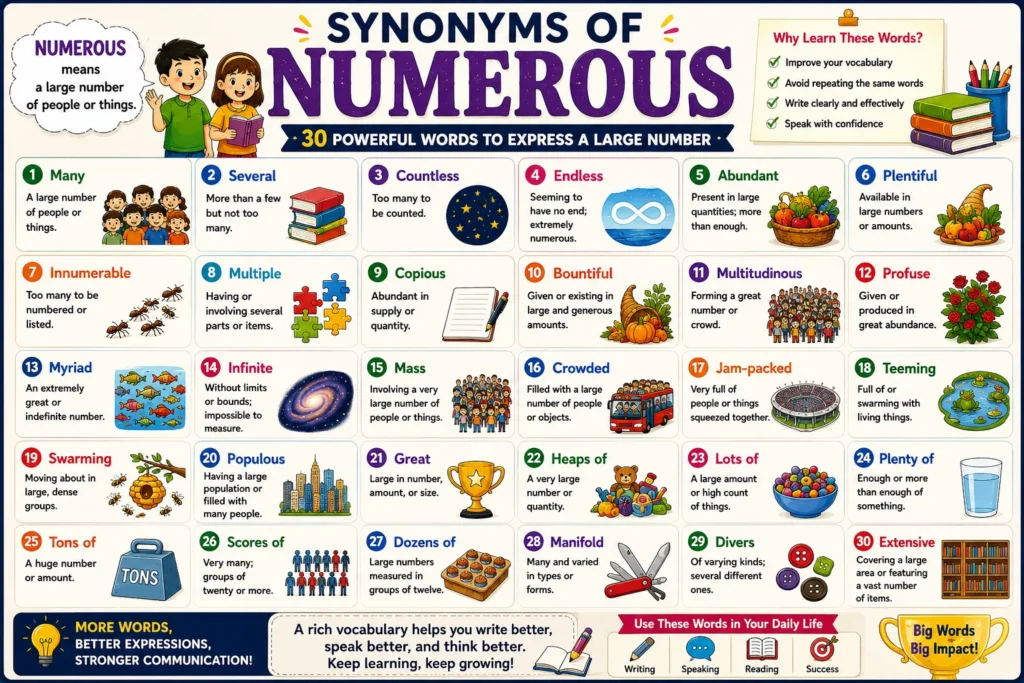
This guide gives you 30 simple synonyms for numerous. Along with easy sentences, word origins, pronunciation guides, and clear categories.
Meaning of Numerous
Definition
Numerous (Adjective): Great in number; consisting of many individual items or people.
Examples
- There are numerous fish swimming in the ocean.
- She received numerous birthday cards from her friends.
Connotative Meaning
- Positive tone: Shows abundance, variety, wealth, and exciting possibilities.
- Negative tone: Points to overwhelming amounts, heavy crowds, or chaotic clutter.
- Neutral tone: Describes high counts, mathematical totals, or general data.
Etymology
- Source language: Came from the Latin word numerosus (meaning populous, manifold, or rhythmic).
- Latin: Made from numerus (meaning a number).
- Middle French (1350–1600): Adapted into French as numéreux.
- Modern English (1500–Present): Entered English to describe anything that exists in large quantities!
Pronunciation
- US: /ˈnuːmərəs/
- UK: /ˈnjuːmərəs/
Syllables
nu-mer-ous (3 parts)
Affixation Pattern of Numerous
- Root: Numer / Number
- Prefix: None
- Suffix: -ous (makes an adjective meaning full of)
- Word Formation:
- Noun: Number, Numerosity, Numerousness
- Verb: Number, Enumerate
- Adjective: Numerous, Numerical
- Adverb: Numerously
Also read more about https://synonymhubb.com/synonyms-for-convince/
Synonyms for Numerous
1. Many (Adjective) — US: /ˈmɛni/ | UK: /ˈmeni/
Meaning: Consisting of a large number of items or people.
Examples:
There are many trees in the forest.
He collected many colorful stamps.
2. Several (Adjective) — US: /ˈsɛvrəl/ | UK: /ˈsevrəl/
Meaning: More than two or three, but not a huge number.
Examples:
She read several books over the weekend.
They visited several places on their trip.
3. Countless (Adjective) — US: /ˈkaʊntləs/ | UK: /ˈkaʊntləs/
Meaning: Too many to be counted.
Examples:
There are countless stars in the universe.
He made countless attempts before succeeding.
4. Endless (Adjective) — US: /ˈɛndləs/ | UK: /ˈendləs/
Meaning: Seeming to have no end; extremely numerous.
Examples:
The beach had endless rows of sand dunes.
She answered endless questions from the curious kids.
5. Abundant (Adjective) — US: /əˈbʌndənt/ | UK: /əˈbʌndənt/
Meaning: Present in large quantities; more than enough.
Examples:
The orchard had an abundant harvest of apples.
Fresh water was abundant near the river.
6. Plentiful (Adjective) — US: /ˈplɛntɪfl/ | UK: /ˈplentɪfl/
Meaning: Available in large numbers or amounts.
Examples:
Berries were plentiful in the garden this summer.
They had a plentiful supply of art paper.
7. Innumerable (Adjective) — US: /ɪˈnuːmərəbl/ | UK: /ɪˈnjuːmərəbl/
Meaning: Too many to be numbered or listed.
Examples:
An innumerable crowd of ants worked on the hill.
She has innumerable ideas for her new story.
8. Multiple (Adjective) — US: /ˈmʌltɪpl/ | UK: /ˈmʌltɪpl/
Meaning: Having or involving several parts or items.
Examples:
The test had multiple choice questions.
He made multiple trips to carry the groceries.
9. Copious (Adjective) — US: /ˈkoʊpiəs/ | UK: /ˈkəʊpiəs/
Meaning: Abundant in supply or quantity.
Examples:
She took copious notes during the lesson.
The farm yielded copious crops of corn.
10. Bountiful (Adjective) — US: /ˈbaʊntɪfl/ | UK: /ˈbaʊntɪfl/
Meaning: Given or existing in large and generous amounts.
Examples:
They enjoyed a bountiful feast at Thanksgiving.
The rain brought a bountiful growth of flowers.
11. Multitudinous (Adjective) — US: /ˌmʌltɪˈtuːdənəs/ | UK: /ˌmʌltɪˈtjuːdɪnəs/
Meaning: Forming a great number or crowd.
Examples:
The night sky showed multitudinous twinkling lights.
The city has multitudinous tall buildings.
12. Profuse (Adjective) — US: /prəˈfjuːs/ | UK: /prəˈfjuːs/
Meaning: Given or produced in great abundance.
Examples:
He offered profuse thanks for the gift.
The bush was covered in profuse red roses.
13. Myriad (Adjective/Noun) — US: /ˈmɪriəd/ | UK: /ˈmɪriəd/
Meaning: An extremely great or indefinite number.
Examples:
The tropical sea is home to a myriad of sea creatures.
She enjoys a myriad of fun hobbies.
14. Infinite (Adjective) — US: /ˈɪnfɪnət/ | UK: /ˈɪnfɪnət/
Meaning: Without limits or bounds; impossible to measure.
Examples:
Space seems to have an infinite number of galaxies.
A mother has infinite love for her children.
15. Mass (Adjective/Noun) — US: /mæs/ | UK: /mæs/
Meaning: Involving a very large number of people or things.
Examples:
The park hosted a mass gathering of sports fans.
They witnessed a mass migration of birds.
16. Crowded (Adjective) — US: /ˈkraʊdəd/ | UK: /ˈkraʊdɪd/
Meaning: Filled with a large number of people or objects.
Examples:
The crowded bus moved slowly down the street.
Her desk was crowded with paints and brushes.
17. Jam-packed (Adjective) — US: /ˈdʒæm pækt/ | UK: /ˈdʒæm pækt/
Meaning: Very full of people or things squeezed together.
Examples:
The stadium was jam-packed with excited viewers.
Her schedule was jam-packed with fun activities.
18. Teeming (Adjective) — US: /ˈtiːmɪŋ/ | UK: /ˈtiːmɪŋ/
Meaning: Full of or swarming with living things.
Examples:
The pond was teeming with tiny tadpoles.
The marketplace was teeming with busy shoppers.
19. Swarming (Adjective) — US: /ˈswɔːrmɪŋ/ | UK: /ˈswɔːmɪŋ/
Meaning: Moving about in large, dense groups.
Examples:
We saw swarming bees around the hive.
Kids were swarming the playground at recess.
20. Populous (Adjective) — US: /ˈpɑːpjələs/ | UK: /ˈpɒpjələs/
Meaning: Having a large population or filled with many people.
Examples:
Tokyo is one of the most populous cities in the world.
The populous neighborhood was full of energy.
21. Great (Adjective) — US: /ɡreɪt/ | UK: /ɡreɪt/
Meaning: Large in number, amount, or size.
Examples:
A great number of visitors came to the museum.
She showed great care when handling the puppy.
22. Heaps of (Informal Adjective Phrase) — US: /hiːps ʌv/ | UK: /hiːps ɒv/
Meaning: A very large number or quantity of something.
Examples:
There were heaps of toys scattered on the rug.
They had heaps of fun playing in the snow.
23. Lots of (Informal Adjective Phrase) — US: /lɑːts ʌv/ | UK: /lɒts ɒv/
Meaning: A large amount or high count of things.
Examples:
She brought lots of snacks for the party.
We saw lots of colorful birds in the park.
24. Plenty of (Adjective Phrase) — US: /ˈplɛnti ʌv/ | UK: /ˈplenti ɒv/
Meaning: Enough or more than enough of something.
Examples:
There are plenty of seats available in the hall.
Drink plenty of water on hot summer days.
25. Tons of (Informal Adjective Phrase) — US: /tʌnz ʌv/ | UK: /tʌnz ɒv/
Meaning: A huge number or amount.
Examples:
The library has tons of interesting comic books.
We have tons of time before the train arrives.
26. Scores of (Adjective Phrase) — US: /skɔːrz ʌv/ | UK: /skɔːz ɒv/
Meaning: Very many; groups of twenty or more.
Examples:
Scores of people waited outside for the store to open.
He found scores of shiny shells along the shore.
27. Dozens of (Adjective Phrase) — US: /ˈdʌznz ʌv/ | UK: /ˈdʌznz ɒv/
Meaning: Large numbers measured in groups of twelve.
Examples:
She baked dozens of delicious chocolate cookies.
Dozens of butterflies fluttered over the garden.
28. Manifold (Adjective) — US: /ˈmænɪfoʊld/ | UK: /ˈmænɪfəʊld/
Meaning: Many and varied in types or forms.
Examples:
The new computer has manifold uses.
She faced manifold challenges with a smile.
29. Divers (Adjective) — US: /ˈdaɪvərz/ | UK: /ˈdaɪvəz/
Meaning: Of varying kinds; several different ones.
Examples:
The box contained divers buttons of all shapes.
They discussed divers topics during the meeting.
30. Extensive (Adjective) — US: /ɪkˈstɛnsɪv/ | UK: /ɪkˈstensɪv/
Meaning: Covering a large area or featuring a vast number of items.
Examples:
The school has an extensive collection of storybooks.
He did extensive research for his science report.
Prototype Meaning
When children hear numerous, they picture huge groups of things. Like a sky full of twinkling stars, a giant pile of LEGO bricks spread on the floor, or a sea of faces cheering in a stadium.
Prototype Categorization
- Everyday Large Numbers: Many, Several, Multiple, Great, Lots of, Plenty of, Dozens of, Scores of.
- Extremely Large & Uncountable: Countless, Endless, Innumerable, Multitudinous, Myriad, Infinite.
- Rich & Generous Amounts: Abundant, Plentiful, Copious, Bountiful, Profuse, Extensive.
- Packed Groups & Crowds: Mass, Crowded, Jam-packed, Teeming, Swarming, Populous.
- Fun Informal Phrases: Heaps of, Tons of, Manifold, Divers.
Antonyms of Numerous
- Few
- Scarcity
- Rare
- Sparse
- Limited
- Single
Short Questions and Answers
- What does numerous mean?
- It means existing in large numbers or consisting of a great many things.
- When should I use numerous?
- Use it when writing about large groups of people, big collections, or high counts of objects.
- Is numerous a good or bad word?
- It is mostly a neutral and helpful word that shows size, quantity, and scale.
- How is it different from similar words?
- Numerous means a high number, several means a smaller group of a few items, and countless means so many that counting is impossible.
Conclusion
Synonyms of numerous can help you describe a large number of people, things, or events in a clearer and more interesting way. Words like many, countless, several, abundant, plentiful, and multiple can make your writing less repetitive. Each synonym has a slightly different meaning, so choosing the right word helps you express your idea clearly. For English learners, practicing synonyms for numerous words can improve vocabulary, speaking, and writing skills. Content writers can also use them to make articles more natural and engaging. Try to learn one or two synonyms each day and use them in simple sentences. With regular practice, you can build confidence and use numerous and its synonyms correctly in everyday English.

I’m Zahid Abbas, an educator, researcher, and digital publishing strategist with a passion for linguistics, grammar, and clear communication. As a content creator and SEO specialist, I craft research-driven, reader-focused content that empowers learners and makes knowledge accessible worldwide.