Convince means to make someone believe something or agree with an idea. Imagine that your friend does not want to join a school game. You tell your friend that the game will be fun and safe. After hearing you, your friend agrees to play. You convinced your friend. We use convince in daily English when we talk about ideas, choices, and decisions. Learning synonyms for convince helps students use different words instead of repeating the same word. Synonyms for convince also makes speaking and writing more interesting. In this article, you will learn 30 synonyms of convince with easy meanings and examples. You will also learn their pronunciation, word history, grammar, and different meanings.
Definition
Convince (Verb): To make someone believe something or agree with you.
Examples
- I tried to convince my brother to play outside.
- She convinced her mother to buy the book.
Connotative Meaning
- Positive tone: Convince can sound helpful when you use good reasons.
- Negative tone: It can sound negative if someone tries to force another person to agree.
- Neutral tone: It can simply mean making someone believe or agree.
Etymology of Convince
- Source: The word convince comes from Latin.
- Original meaning: The Latin word convincere meant “to prove” or “show clearly.”
- The word later entered English through French and Latin use.
- Today, convince means to make someone believe or agree.
Short History
- Old English (450–1100): The modern word convince was not commonly used. People used other words for showing or proving something.
- Middle English (1100–1500): Many Latin and French words entered English. Words related to convince became more common.
- Modern English (1500–Present): Convince became a common word for making someone believe or agree.
Pronunciation
- US: /kənˈvɪns/
- UK: /kənˈvɪns/
Syllables
con-vince
Affixation Pattern of Convince
- Root: vinc — connected with the idea of proving or winning.
- Prefix: con-
- Suffix: None in the basic word.
- Word forms: convince (verb), convinced (verb/adjective), convincing (adjective), and convincingly (adverb).
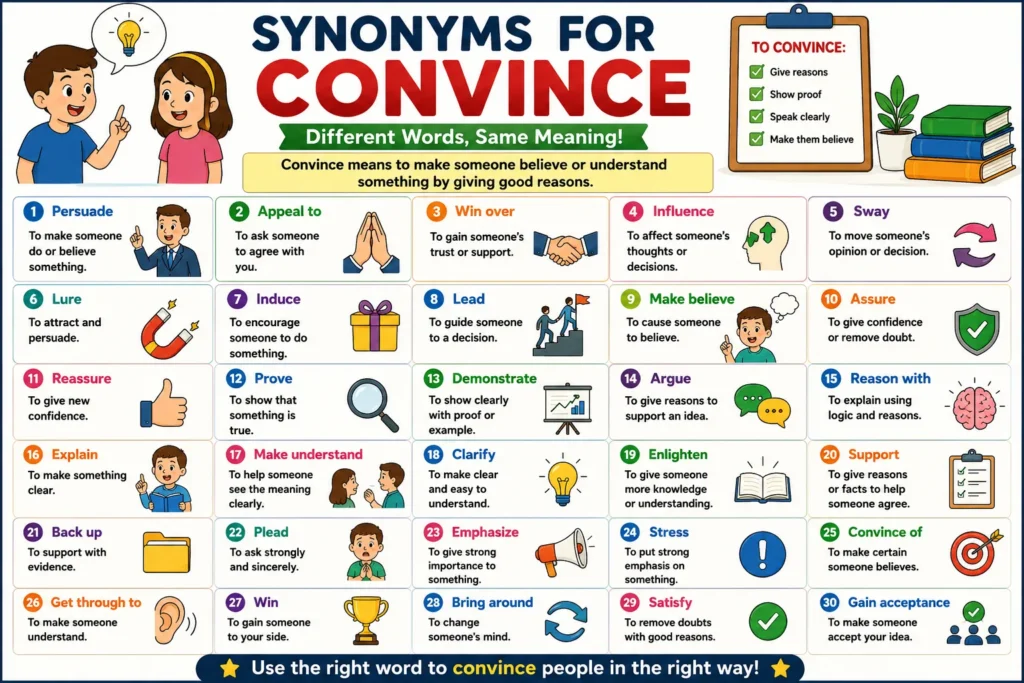
Synonyms of Convince
1. Persuade (Verb) — US /pərˈsweɪd/ | UK /pəˈsweɪd/
Meaning: To make someone agree with you.
Examples:
- I persuaded my friend to play with us.
- She persuaded her brother to share his toy.
2. Assure (Verb) — US /əˈʃʊr/ | UK /əˈʃʊə/
Meaning: To tell someone that something is true or safe.
Examples:
- Mom assured me that I was safe.
- The teacher assured us that the test was easy.
3. Sway (Verb) — US /sweɪ/ | UK /sweɪ/
Meaning: To change someone’s mind or choice.
Examples:
- His kind words swayed my choice.
- The story swayed her opinion.
4. Influence (Verb) — US /ˈɪnfluəns/ | UK /ˈɪnfluəns/
Meaning: To affect what someone thinks or does.
Examples:
- My teacher influenced me to read more.
- Friends can influence our choices.
5. Satisfy (Verb) — US /ˈsætɪsfaɪ/ | UK /ˈsætɪsfaɪ/
Meaning: To give enough proof to make someone believe you.
Examples:
- His answer satisfied the teacher.
- The facts satisfied my question.
6. Induce (Verb) — US /ɪnˈduːs/ | UK /ɪnˈdjuːs/
Meaning: To make someone do something.
Examples:
- The prize induced him to work hard.
- The gift induced her to help.
7. Win Over (Phrasal Verb) — US /wɪn ˈoʊvər/ | UK /wɪn ˈəʊvə/
Meaning: To make someone like or support you.
Examples:
- Her smile won over the new students.
- The team won over the crowd.
8. Coax (Verb) — US /koʊks/ | UK /kəʊks/
Meaning: To gently persuade someone.
Examples:
- I coaxed my brother to eat his lunch.
- She coaxed the cat out of the box.
9. Encourage (Verb) — US /ɪnˈkɜːrɪdʒ/ | UK /ɪnˈkʌrɪdʒ/
Meaning: To give someone support to do something.
Examples:
- My teacher encouraged me to try again.
- Mom encouraged me to read the book.
10. Urge (Verb) — US /ɜːrdʒ/ | UK /ɜːdʒ/
Meaning: To strongly ask someone to do something.
Examples:
- Dad urged me to wear my helmet.
- The coach urged us to keep running.
11. Motivate (Verb) — US /ˈmoʊtɪveɪt/ | UK /ˈməʊtɪveɪt/
Meaning: To give someone a reason to work or act.
Examples:
- The prize motivated me to study.
- Her kind words motivated him to practice.
12. Reason With (Verb Phrase) — US /ˈriːzən wɪð/ | UK /ˈriːzən wɪð/
Meaning: To talk calmly and give good reasons.
Examples:
- Mom tried to reason with the child.
- I reasoned with my brother about the game.
13. Talk Into (Phrasal Verb) — US /tɔːk ˈɪntuː/ | UK /tɔːk ˈɪntuː/
Meaning: To persuade someone to do something.
Examples:
- My friend talked me into joining the club.
- She talked him into trying the game.
14. Get Across (Phrasal Verb) — US /ɡet əˈkrɔːs/ | UK /ɡet əˈkrɒs/
Meaning: To make an idea clear.
Examples:
- The teacher used a picture to get the idea across.
- He spoke slowly to get his message across.
15. Prove (Verb) — US /pruːv/ | UK /pruːv/
Meaning: To show that something is true.
Examples:
- Can you prove your answer?
- The test proved that she was right.
16. Demonstrate (Verb) — US /ˈdemənstreɪt/ | UK /ˈdemənstreɪt/
Meaning: To show something clearly.
Examples:
- The teacher demonstrated the easy way to solve it.
- He demonstrated how the toy works.
17. Explain (Verb) — US /ɪkˈspleɪn/ | UK /ɪkˈspleɪn/
Meaning: To make something clear by giving information.
Examples:
- Please explain your answer.
- She explained why she was late.
18. Justify (Verb) — US /ˈdʒʌstəfaɪ/ | UK /ˈdʒʌstəfaɪ/
Meaning: To give a good reason for something.
Examples:
- He justified his choice with a good reason.
- She justified her answer.
19. Impress (Verb) — US /ɪmˈpres/ | UK /ɪmˈpres/
Meaning: To make someone admire something.
Examples:
- Her drawing impressed the teacher.
- His hard work impressed everyone.
20. Reassure (Verb) — US /ˌriːəˈʃʊr/ | UK /ˌriːəˈʃʊə/
Meaning: To make someone feel safe or less worried.
Examples:
- Dad reassured me that everything was okay.
- The teacher reassured the nervous student.
21. Lead (Verb) — US /liːd/ | UK /liːd/
Meaning: To guide someone toward an idea or choice.
Examples:
- The clues led me to the right answer.
- His advice led her to a good choice.
22. Prompt (Verb) — US /prɑːmpt/ | UK /prɒmpt/
Meaning: To make someone want to do something.
Examples:
- The question prompted him to think.
- The bell prompted us to go inside.
23. Bring Around (Phrasal Verb) — US /brɪŋ əˈraʊnd/ | UK /brɪŋ əˈraʊnd/
Meaning: To make someone change their mind.
Examples:
- We brought Dad around to our idea.
- Her kind words brought him around.
24. Convert (Verb) — US /kənˈvɜːrt/ | UK /kənˈvɜːt/
Meaning: To change someone to a new belief or choice.
Examples:
- The speaker converted some people to his idea.
- The lesson converted him into a fan of science.
25. Talk Around (Phrasal Verb) — US /tɔːk əˈraʊnd/ | UK /tɔːk əˈraʊnd/
Meaning: To persuade someone through talking.
Examples:
- We talked her around to our plan.
- Dad talked me around to trying it.
26. Move (Verb) — US /muːv/ | UK /muːv/
Meaning: To affect someone’s feelings.
Examples:
- Her story moved everyone.
- His kind words moved me to help.
27. Prevail Upon (Verb Phrase) — US /prɪˈveɪl əˈpɑːn/ | UK /prɪˈveɪl əˈpɒn/
Meaning: To persuade someone after trying for some time.
Examples:
- We prevailed upon him to stay.
- She prevailed upon her friend to help.
28. Advocate (Verb) — US /ˈædvəkeɪt/ | UK /ˈædvəkeɪt/
Meaning: To speak in favor of an idea.
Examples:
- She advocated for more books in the library.
- He advocated for clean school grounds.
29. Appeal To (Verb Phrase) — US /əˈpiːl tuː/ | UK /əˈpiːl tuː/
Meaning: To attract or persuade someone by using something they like or care about.
Examples:
- The bright colors appealed to the children.
- The new game appealed to many students.
30. Inspire (Verb) — US /ɪnˈspaɪər/ | UK /ɪnˈspaɪə/
Meaning: To make someone want to do something good or useful.
Examples:
- Her story inspired me to work hard.
- The teacher inspired us to learn more.
Prototype Meaning
The most common meaning of convince is to make someone believe something or agree with an idea. When people hear this word, they often think of a person giving reasons. Facts, examples until another person changes their mind.
Prototype Categorization
- Persuasion: persuade, convince, sway, influence — used when someone changes another person’s mind.
- Gentle persuasion: coax, encourage, reassure — used when someone uses kind or friendly words.
- Giving reasons: explain, justify, reason with — used when someone gives clear reasons.
- Showing proof: prove, demonstrate — used when facts or evidence help someone believe.
- Encouraging action: urge, motivate, prompt, inspire — used when someone helps another person take action.
- Changing opinions: win over, bring around, talk into — used when someone changes another person’s choice or opinion.
Antonyms of Convince
- Dissuade: To make someone decide not to do something.
- Discourage: To make someone less willing to do something.
- Confuse: To make something hard to understand.
- Doubt: To feel unsure about something.
- Disbelieve: To not believe something.
- Mislead: To give someone the wrong idea.
Also read more about https://synonymhubb.com/synonyms-for-persistent/
Short Questions and Answers
- What does convince mean? It means to make someone believe something or agree with you.
- When should convince be used? Use it when someone changes their mind because of your reasons or information.
- Is convince positive or negative? It is usually neutral. The feeling depends on how someone tries to convince another person.
- How is convince different from persuade? Convince often means making someone believe something. Persuade often means getting someone to do something.
- How is convince different from prove? Prove means showing that something is true. Convince means making someone believe it.
- How is convince different from influence? Influence means affecting someone’s thoughts or actions. Convince usually means changing someone’s belief or decision.
Conclusion
Synonyms for convince can help you build a stronger English vocabulary. Words like persuade, assure, sway, influence, coax, encourage, urge, prove, explain, and inspire give you more ways to share your ideas. Each word has a slightly different use. Some words are best for friendly talks, while others are better for facts, or advice. The best way to learn synonyms for convince is to use them in short sentences. Try learning three or four words each day. Use synonyms for convince when you speak, write, or read. Regular practice will help you avoid repeating the same word . And also make your English clearer. Most importantly, learning new words can make you feel more confident when speaking and writing in English.

I’m Zahid Abbas, an educator, researcher, and digital publishing strategist with a passion for linguistics, grammar, and clear communication. As a content creator and SEO specialist, I craft research-driven, reader-focused content that empowers learners and makes knowledge accessible worldwide.