The word cognitive is often used when talking about thinking, learning, understanding, memory, and mental abilities. Imagine a student solving a difficult math problem. The student uses cognitive skills to analyze information, remember facts, and find the correct answer. In everyday life, people use cognitive abilities when making decisions, learning a language, reading a book, or solving problems.
The word is common in education, psychology, medicine, and everyday communication. Learning synonyms of cognitive helps English learners express ideas more clearly and avoid repeating the same word. It also helps content writers create richer and more engaging content. In this article, you will learn the meaning of cognitive, its pronunciation, history, grammar, and 30 useful synonyms with examples. You will also discover antonyms, semantic categories, and practical usage tips to strengthen your English vocabulary.
Meaning of Cognitive
Cognitive (Adjective):
Relating to thinking, learning, understanding, remembering, and processing information in the mind.
Examples
- Cognitive skills help children learn new subjects.
- Reading regularly can improve cognitive development.
Connotative Meaning
- Positive tone: Intelligent, thoughtful, knowledgeable, capable.
- Negative tone: Can suggest overthinking or excessive mental effort in some contexts.
- Neutral tone: Related to mental processes and thinking abilities.
Etymology
- Origin: Latin
- Source word: cognoscere
- Original meaning: “to know,” “to learn,” or “to recognize”
Short History of the Keyword
- Old English (450–1100): The exact word did not exist in Old English.
- Middle English (1100–1500): Latin-based learning terms began entering English through French influence.
- Modern English (1500–Present): Cognitive became widely used in psychology, education, and science to describe mental processes.
Pronunciation (US & UK – IPA)
- US: /ˈkɑːɡ.nə.tɪv/
- UK: /ˈkɒɡ.nə.tɪv/
Syllables
cog-ni-tive
Affixation Pattern of Cognitive
- Root: cogn (know)
- Prefix: None
- Suffix: -itive
Word Formation of the Keyword
- Cognition (Noun) – the process of thinking and knowing
- Cognitively (Adverb) – in a mental or thinking manner
- Recognize (Verb) – to identify or know
- Recognition (Noun) – identification or acknowledgment
- Cognizance (Noun) – awareness or knowledge
- Recognizable (Adjective) – easy to identify
- Recognizer (Noun) – one who recognizes
- Recognized (Adjective) – officially accepted or known
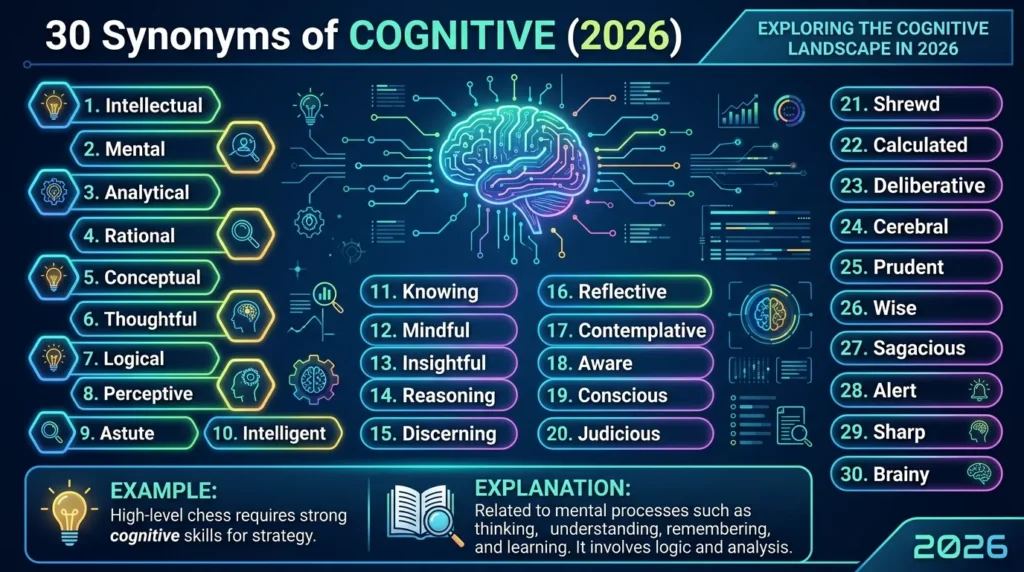
30 Synonyms of Cognitive
1. Intellectual (Adjective)
US: /ˌɪn.təˈlek.tʃu.əl/ | UK: /ˌɪn.təˈlek.tʃu.əl/
Meaning: Related to intelligence and reasoning.
Examples:
- She enjoys intellectual discussions.
- The course encourages intellectual growth.
2. Mental (Adjective)
US: /ˈmen.təl/ | UK: /ˈmen.təl/
Meaning: Related to the mind.
Examples:
- Exercise supports mental health.
- Mental focus is important during exams.
3. Analytical (Adjective)
US: /ˌæn.əˈlɪt̬.ɪ.kəl/ | UK: /ˌæn.əˈlɪt.ɪ.kəl/
Meaning: Skilled at examining details carefully.
Examples:
- He has an analytical mind.
- Analytical thinking helps solve problems.
4. Rational (Adjective)
US: /ˈræʃ.ən.əl/ | UK: /ˈræʃ.ən.əl/
Meaning: Based on logic and reason.
Examples:
- She made a rational decision.
- Rational thinking reduces mistakes.
5. Logical (Adjective)
US: /ˈlɑː.dʒɪ.kəl/ | UK: /ˈlɒdʒ.ɪ.kəl/
Meaning: Following clear reasoning.
Examples:
- His explanation was logical.
- Logical arguments are convincing.
6. Intelligent (Adjective)
US: /ɪnˈtel.ə.dʒənt/ | UK: /ɪnˈtel.ɪ.dʒənt/
Meaning: Having a high ability to learn and understand.
Examples:
- She is an intelligent student.
- Intelligent planning saves time.
7. Perceptive (Adjective)
US: /pərˈsep.tɪv/ | UK: /pəˈsep.tɪv/
Meaning: Quick to notice and understand things.
Examples:
- He made a perceptive comment.
- Perceptive people notice details.
8. Thoughtful (Adjective)
US: /ˈθɔːt.fəl/ | UK: /ˈθɔːt.fəl/
Meaning: Showing careful consideration.
Examples:
- She gave a thoughtful answer.
- Thoughtful analysis improves decisions.
9. Reflective (Adjective)
US: /rɪˈflek.tɪv/ | UK: /rɪˈflek.tɪv/
Meaning: Thinking deeply about things.
Examples:
- He became reflective after the meeting.
- Reflective writing develops learning.
10. Reasoning (Adjective)
US: /ˈriː.zən.ɪŋ/ | UK: /ˈriː.zən.ɪŋ/
Meaning: Connected with logical thought.
Examples:
- Reasoning skills are valuable.
- The test measures reasoning ability.
11. Judicious (Adjective)
US: /dʒuːˈdɪʃ.əs/ | UK: /dʒuːˈdɪʃ.əs/
Meaning: Showing wise judgment.
Examples:
- She made a judicious choice.
- Judicious thinking prevents errors.
12. Wise (Adjective)
US: /waɪz/ | UK: /waɪz/
Meaning: Having good judgment and knowledge.
Examples:
- The teacher offered wise advice.
- Wise decisions require thought.
13. Insightful (Adjective)
US: /ˈɪn.saɪt.fəl/ | UK: /ˈɪn.saɪt.fəl/
Meaning: Showing deep understanding.
Examples:
- He gave an insightful presentation.
- Insightful observations help learning.
14. Discerning (Adjective)
US: /dɪˈsɝː.nɪŋ/ | UK: /dɪˈsɜː.nɪŋ/
Meaning: Able to judge well.
Examples:
- She is a discerning reader.
- Discerning thinkers evaluate evidence.
15. Knowledgeable (Adjective)
US: /ˈnɑː.lɪ.dʒə.bəl/ | UK: /ˈnɒl.ɪ.dʒə.bəl/
Meaning: Having a lot of knowledge.
Examples:
- He is knowledgeable about science.
- Knowledgeable experts help students.
16. Educated (Adjective)
US: /ˈedʒ.ə.keɪ.t̬ɪd/ | UK: /ˈedʒ.ʊ.keɪ.tɪd/
Meaning: Having received education.
Examples:
- She is highly educated.
- Educated opinions are respected.
17. Scholarly (Adjective)
US: /ˈskɑː.lɚ.li/ | UK: /ˈskɒl.ə.li/
Meaning: Related to academic study.
Examples:
- The article is scholarly.
- Scholarly work requires research.
18. Academic (Adjective)
US: /ˌæk.əˈdem.ɪk/ | UK: /ˌæk.əˈdem.ɪk/
Meaning: Related to education and study.
Examples:
- Academic success requires effort.
- Academic skills support learning.
19. Cerebral (Adjective)
US: /ˈser.ə.brəl/ | UK: /ˈser.ɪ.brəl/
Meaning: Involving serious thought.
Examples:
- The book is highly cerebral.
- Cerebral discussions are stimulating.
20. Brainy (Adjective)
US: /ˈbreɪ.ni/ | UK: /ˈbreɪ.ni/
Meaning: Very intelligent.
Examples:
- She is a brainy student.
- Brainy children enjoy challenges.
21. Smart (Adjective)
US: /smɑːrt/ | UK: /smɑːt/
Meaning: Intelligent and quick-thinking.
Examples:
- He is a smart learner.
- Smart solutions save money.
22. Astute (Adjective)
US: /əˈstuːt/ | UK: /əˈstjuːt/
Meaning: Clever and perceptive.
Examples:
- She made an astute observation.
- Astute leaders notice opportunities.
23. Shrewd (Adjective)
US: /ʃruːd/ | UK: /ʃruːd/
Meaning: Showing sharp judgment.
Examples:
- He is a shrewd businessman.
- Shrewd decisions increase success.
24. Observant (Adjective)
US: /əbˈzɝː.vənt/ | UK: /əbˈzɜː.vənt/
Meaning: Good at noticing things.
Examples:
- Observant students learn quickly.
- She is observant of details.
25. Mindful (Adjective)
US: /ˈmaɪnd.fəl/ | UK: /ˈmaɪnd.fəl/
Meaning: Carefully aware and attentive.
Examples:
- Be mindful of your actions.
- Mindful thinking improves focus.
26. Conscious (Adjective)
US: /ˈkɑːn.ʃəs/ | UK: /ˈkɒn.ʃəs/
Meaning: Aware of thoughts and surroundings.
Examples:
- He remained conscious of risks.
- Conscious choices shape habits.
27. Attentive (Adjective)
US: /əˈten.tɪv/ | UK: /əˈten.tɪv/
Meaning: Paying close attention.
Examples:
- Attentive listeners learn more.
- She stayed attentive throughout class.
28. Understanding (Adjective)
US: /ˌʌn.dɚˈstæn.dɪŋ/ | UK: /ˌʌn.dəˈstæn.dɪŋ/
Meaning: Able to comprehend things well.
Examples:
- He is understanding and patient.
- Understanding learners ask questions.
29. Comprehending (Adjective)
US: /ˌkɑːm.prɪˈhen.dɪŋ/ | UK: /ˌkɒm.prɪˈhen.dɪŋ/
Meaning: Able to understand fully.
Examples:
- The child is comprehending new ideas.
- Comprehending readers remember details.
30. Thought-processing (Adjective)
US: /ˈθɔːt ˌprɑː.ses.ɪŋ/ | UK: /ˈθɔːt ˌprəʊ.ses.ɪŋ/
Meaning: Related to mental processing.
Examples:
- The activity supports thought-processing skills.
- Games can improve thought-processing ability.
Prototype Meaning
The most typical meaning of cognitive relates to the mental activities people use to think, learn, remember, understand, analyze, and solve problems. When people hear the word cognitive, they usually imagine the brain working to process information and make decisions.
Prototype Categorization
- Intelligence-focused: intelligent, brainy, smart, astute, wise
- Logic-focused: logical, rational, analytical, reasoning
- Learning-focused: academic, scholarly, educated, knowledgeable
- Awareness-focused: conscious, mindful, attentive, observant
- Understanding-focused: insightful, perceptive, discerning, understanding
- Deep-thinking-focused: cerebral, reflective, thoughtful, judicious
Antonyms of Cognitive
- Unthinking (Adjective) — acting without thought
- Ignorant (Adjective) — lacking knowledge
- Mindless (Adjective) — showing little thought
- Unaware (Adjective) — not conscious of something
- Inattentive (Adjective) — not paying attention
- Irrational (Adjective) — not based on reason
- Illogical (Adjective) — lacking logical structure
- Forgetful (Adjective) — often unable to remember
- Uneducated (Adjective) — lacking formal education
- Confused (Adjective) — unable to think clearly
Short Questions and Answers
- What does cognitive mean?
Cognitive means related to thinking, learning, understanding, memory, and mental processes. - When should cognitive be used?
Use cognitive when discussing mental skills, learning ability, reasoning, memory, or brain functions. - Is cognitive positive or negative?
Cognitive is usually neutral, but it often carries a positive meaning when describing intelligence and learning abilities. - How is it different from similar words?
Cognitive is a broad term for mental processes, while words like intelligent, analytical, or logical focus on specific aspects of thinking.
Conclusion
Learning the Synonyms of Cognitive and Synonyms of Cognitive can greatly improve your English vocabulary. These words help you describe thinking, learning, reasoning, awareness, and intelligence with greater accuracy. Using a variety of synonyms strengthens both writing and speaking by making communication more interesting and precise. It also helps writers avoid repetition and select the best word for different contexts. Understanding pronunciation, history, connotation, and usage gives deeper knowledge of the language. By practicing cognitive and its related words regularly, you can build confidence, express ideas more effectively, and continue expanding your vocabulary every day.

I’m Zahid Abbas, an educator, researcher, and digital publishing strategist with a passion for linguistics, grammar, and clear communication. As a content creator and SEO specialist, I craft research-driven, reader-focused content that empowers learners and makes knowledge accessible worldwide.