Imagine sitting in English class while your teacher reads a poem out loud. You look at the page and see a small group of lines separated by a blank space. That little group of lines is called a stanza. A stanza works like a paragraph in a poem. People use synonyms for stanza often because poets, songwriters, and teachers need a clear way to talk about the parts of a verse.
Learning synonyms for stanza is very important for English learners and writers who want to grow their vocabulary. Using different synonyms for stanza helps you talk about music, books, and poetry without repeating yourself. This article discusses the meaning of stanza and 30 related synonyms through easy definitions, natural example sentences, emotional tones, word history, clear pronunciations, and useful categories written in smooth, connected sentences.
Meaning of Stanza
Definition
Stanza (Noun): A group of lines forming a basic unit in a poem or song.
Examples
- The student read the first stanza of the poem to the class.
- Each stanza in the song tells a different part of the story.
Connotative Meaning
- Positive tone: Feels artistic, creative, beautiful, and full of musical rhythm.
- Negative tone: Can feel rigid, strict, or confusing if a poem is hard to read.
- Neutral tone: Simply describes a structural group of lines on a page.
Etymology
- Source:
- Comes from the Italian word stanza, which means a standing place, room, or stopping place.
- Old English (450–1100):
- English speakers used words like fers or cwide for verses because the word stanza was not used yet.
- Middle English (1100–1500):
- English borrowed words from French and Latin as written poetry became more popular.
- Modern English (1500–Present):
- English adopted stanza from Italian during the Renaissance to describe organized groups of poetic lines.
Pronunciation
- US: /ˈstæn.zə/
- UK: /ˈstæn.zə/
Syllables
stan-za
Affixation Pattern
- Root: Stanza
- Prefix: None
- Suffix: None
Word Formation:
- Stanza (Noun)
- Stanzas (Noun – plural)
- Stanzaic (Adjective)
Explore related topics https://synonymhubb.com/synonyms-for-epiphany/
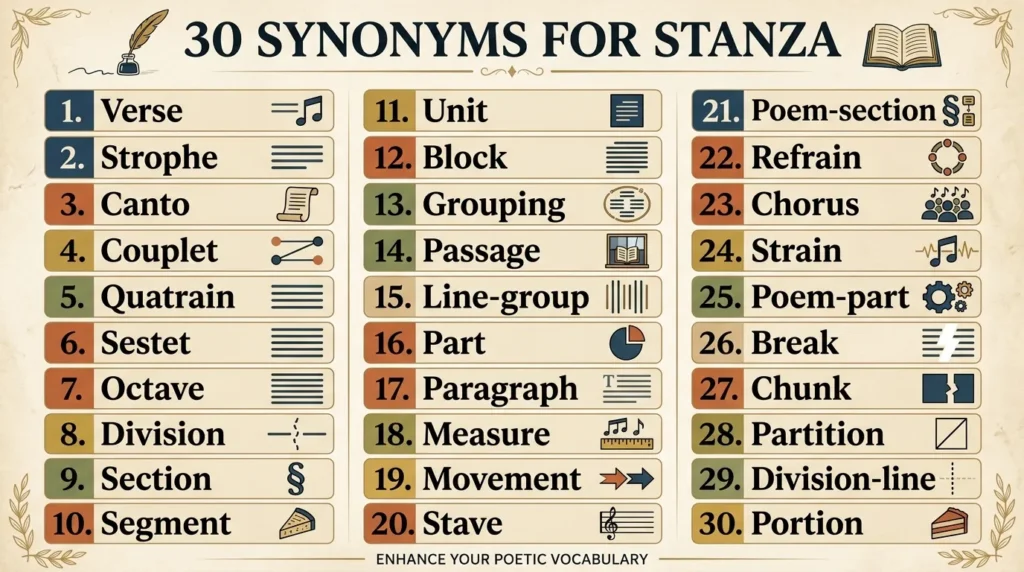
30 Synonyms for Stanza
1. Verse (Noun) — US: /vɝːs/ | UK: /vɜːs/
Meaning: A single line or a short section of a poem or song.
- Example 1: She wrote a lovely verse for her mother’s birthday card.
- Example 2: The singer sang the second verse very softly.
2. Strophe (Noun) — US: /ˈstroʊ.fi/| UK: /ˈstrəʊ.fi/
Meaning: A group of lines forming a section of a poem.
- Example 1: The poet recited the first strophe with great emotion.
- Example 2: Each strophe in the Greek poem followed a special pattern.
3. Canto (Noun) — US: /ˈkæn.toʊ/ | UK: /ˈkæn.təʊ/
Meaning: A main section of a long poem.
- Example 1: The long story poem is divided into ten short canto parts.
- Example 2: We read the third canto during reading time today.
4. Couplet (Noun) — US: /ˈkʌp.lət/ | UK: /ˈkʌp.lɪt/
Meaning: A pair of two rhyming lines of poetry that go together.
- Example 1: The poem ends with a sweet rhyming couplet.
- Example 2: He wrote a simple couplet on his bookmark.
5. Quatrain (Noun) — US: /ˈkwɑː.treɪn/ | UK: /ˈkwɒt.reɪn/
Meaning: A four-line unit or stanza in a poem.
- Example 1: Most rhyming nursery rhymes use a simple quatrain.
- Example 2: She organized her poem into three four-line quatrain sections.
6. Sestet (Noun) — US: /sɛsˈtɛt/ | UK: /sɛsˈtɛt/
Meaning: A six-line section or stanza of a poem.
- Example 1: The sonnet finishes with a thoughtful sestet.
- Example 2: The author added a sestet to complete the verse.
7. Octave (Noun) — US: /ˈɑːk.tɪv/ | UK: /ˈɒk.tɪv/
Meaning: A group of eight lines of poetry.
- Example 1: The opening octave sets a mysterious mood for the story.
- Example 2: He practiced reading the eight-line octave aloud.
8. Division (Noun) — US: /dɪˈvɪʒ.ən/ | UK: /dɪˈvɪʒ.ən/
Meaning: A section or part that separates a long work.
- Example 1: This long poem has a clear division after every four lines.
- Example 2: Look at the first division on page ten.
9. Section (Noun) — US: /ˈsɛk.ʃən/ | UK: /ˈsek.ʃən/
Meaning: A distinct part of a piece of writing or music.
- Example 1: Read the top section of the page to find the answer.
- Example 2: The music teacher played the next section of the song.
10. Segment (Noun) — US: /ˈsɛɡ.mənt/ | UK: /ˈseg.mənt/
Meaning: One of the parts into which something is divided.
- Example 1: The middle segment of the poem talks about spring flowers.
- Example 2: Each segment contains four lines.
11. Unit (Noun) — US: /ˈjuː.nɪt/ | UK: /ˈjuː.nɪt/
Meaning: A single complete part within a larger group.
- Example 1: Every unit in the poem holds a complete thought.
- Example 2: The four lines act as one single unit.
12. Block (Noun) — US: /blɑːk/ | UK: /blɒk/
Meaning: A solid group of text lines separated by spaces.
- Example 1: The paper shows a neat block of text in the middle.
- Example 2: Separate each verse into its own clear block.
13. Grouping (Noun) — US: /ˈɡruː.pɪŋ/ | UK: /ˈɡruː.pɪŋ/
Meaning: A set of words or lines gathered together.
- Example 1: The page has a small grouping of three lines.
- Example 2: This grouping forms a soft rhyme.
14. Passage (Noun) — US: /ˈpæs.ɪdʒ/ | UK: /ˈpæs.ɪdʒ/
Meaning: A short section of a written text or book.
- Example 1: She shared a lovely passage from her favorite story.
- Example 2: The passage describes a quiet night.
15. Line-group (Noun) — US: /laɪn ɡruːp/ | UK: /laɪn ɡruːp/
Meaning: A set of lines put together on a page.
- Example 1: The author made a short line-group for the ending.
- Example 2: Look at the second line-group on the paper.
16. Part (Noun) — US: /pɑːrt/ | UK: /pɑːt/
Meaning: A piece or section of a whole thing.
- Example 1: My favorite part of the poem is the end.
- Example 2: This part talks about a funny cat.
17. Paragraph (Noun) — US: /ˈpær.ə.ɡræf/ | UK: /ˈpær.ə.ɡrɑːf/
Meaning: A section of writing focused on one main idea.
- Example 1: Write a short paragraph about your pet.
- Example 2: A stanza is like a paragraph for poetry.
18. Measure (Noun) — US: /ˈmɛʒ.ɚ/ | UK: /ˈmeʒ.ər/
Meaning: A rhythmic unit in poetry or music.
- Example 1: The poet kept a steady measure in every line.
- Example 2: Count the beats in each musical measure.
19. Movement (Noun) — US: /ˈmuːv.mənt/ | UK: /ˈmuːv.mənt/
Meaning: A main section of a longer poem or song.
- Example 1: The first movement of the poem sounds happy.
- Example 2: The orchestra played the final movement.
20. Stave (Noun) — US: /steɪv/ | UK: /steɪv/
Meaning: A verse or stanza of a poem or song.
- Example 1: The carolers sang a cheerful stave near the door.
- Example 2: He wrote a short stave in his journal.
21. Poem-section (Noun) — US: /ˈpoʊ.əm ˈsɛk.ʃən/ | UK: /ˈpəʊ.ɪm ˈsek.ʃən/
Meaning: A distinct piece of a poem.
- Example 1: Color the first poem-section with your red crayon.
- Example 2: This poem-section tells us who is speaking.
22. Refrain (Noun) — US: /rɪˈfreɪn/ | UK: /rɪˈfreɪn/
Meaning: A phrase or verse that repeats at regular intervals.
- Example 1: We sang the catchiest refrain together.
- Example 2: The main refrain comes after every verse.
23. Chorus (Noun) — US: /ˈkɔːr.əs/ | UK: /ˈkɔː.rəs/
Meaning: The main part of a song that repeats several times.
- Example 1: Everyone knows the words to the song’s chorus.
- Example 2: Sing the chorus loud and proud!
24. Strain (Noun) — US: /streɪn/ | UK: /streɪn/
Meaning: A short musical phrase or piece of verse.
- Example 1: We heard a sweet strain of music from the window.
- Example 2: The soft strain of the poem made us sleep.
25. Poem-part (Noun) — US: /ˈpoʊ.əm pɑːrt/ | UK: /ˈpəʊ.ɪm pɑːt/
Meaning: One portion of a full poem.
- Example 1: The teacher read a small poem-part to us.
- Example 2: Every poem-part fits together like a puzzle.
26. Break (Noun) — US: /breɪk/ | UK: /breɪk/
Meaning: A blank space that divides sections of text.
- Example 1: Put a small break between your lines.
- Example 2: The text break shows a new idea is starting.
27. Chunk (Noun) — US: /tʃʌŋk/ | UK: /tʃʌŋk/
Meaning: A solid piece or group of things together.
- Example 1: Read this small chunk of text first.
- Example 2: A stanza is a neat chunk of lines.
28. Partition (Noun) — US: /pɑːrˈtɪʃ.ən/ | UK: /pɑːˈtɪʃ.ən/
Meaning: A division that separates one area or text from another.
- Example 1: The white space works as a partition on the page.
- Example 2: Each partition holds four rhyming words.
29. Division-line (Noun) — US: /dɪˈvɪʒ.ən laɪn/ | UK: /dɪˈvɪʒ.ən laɪn/
Meaning: A space or line that separates parts of writing.
- Example 1: Draw a division-line after the first four lines.
- Example 2: The division-line marks the next verse.
30. Portion (Noun) — US: /ˈpɔːr.ʃən/ | UK: /ˈpɔː.ʃən/
Meaning: A limited part or share of a whole text.
- Example 1: She read a small portion of the story out loud.
- Example 2: This portion of the verse rhymes nicely.
Prototype Meaning
The typical meaning of stanza is a neat group of poetic lines set apart by blank space on a page. When people hear this word, they picture a short block of four or six lines in a poem that rhymes and shares a single creative thought.
Prototype Categorization
- Exact Line-Count Terms:
- Couplet, quatrain, sestet, octave. Use these words when you need to state the exact number of lines in a poetic section.
- General Text Divisions:
- Verse, strophe, canto, section, segment, division, partition, passage. Perfect for general literary writing and dividing long poems into parts.
- Song & Rhythm Terms:
- Chorus, refrain, measure, movement, strain, stave. Best used when talking about music, rhyming carols, or singing rhythm.
- Simple Building-Block Words:
- Unit, block, grouping, line-group, part, paragraph, chunk, portion, poem-section, poem-part, break, division-line. Great for beginner-friendly descriptions and simple classroom instructions.
Antonyms of Stanza
- Whole poem
- Prose
- Continuous text
- Entire book
- Essay
Short Questions and Answers
- What does stanza mean?
- A stanza is a group of lines that forms a basic section in a poem or song.
- When should stanza be used?
- Use it when discussing poetry layout, rhyming songs, or English literature assignments.
- Is stanza positive or negative?
- It is a neutral word used to describe how writing is built, but it often carries a creative and artistic feel.
- How is it different from similar words?
- A stanza is a section of a poem, while a paragraph is used in story prose, and a verse can mean just one line or the whole section.
Conclusion
Synonyms for stanza helps you talk about poetry, music, and writing structure with great accuracy. Expanding your vocabulary makes your writing more interesting. Synonyms for stanza also improves your speaking skills, and stops you from repeating basic terms. Understanding Synonyms for stanza builds English confidence for reading and school projects. Try using these fresh new words in your daily practice today.

I’m Zahid Abbas, an educator, researcher, and digital publishing strategist with a passion for linguistics, grammar, and clear communication. As a content creator and SEO specialist, I craft research-driven, reader-focused content that empowers learners and makes knowledge accessible worldwide.