The word systemic means relating to or affecting an entire system rather than just one part. Think of a computer virus that affects every program on a laptop, or blood flowing through your entire body rather than just one arm. Something that spreads everywhere and touches the whole structure is systemic.
We use systemic to talk about body-wide health, big company rules, or overall plans. Learning new ways to say systemic helps build strong writing skills.
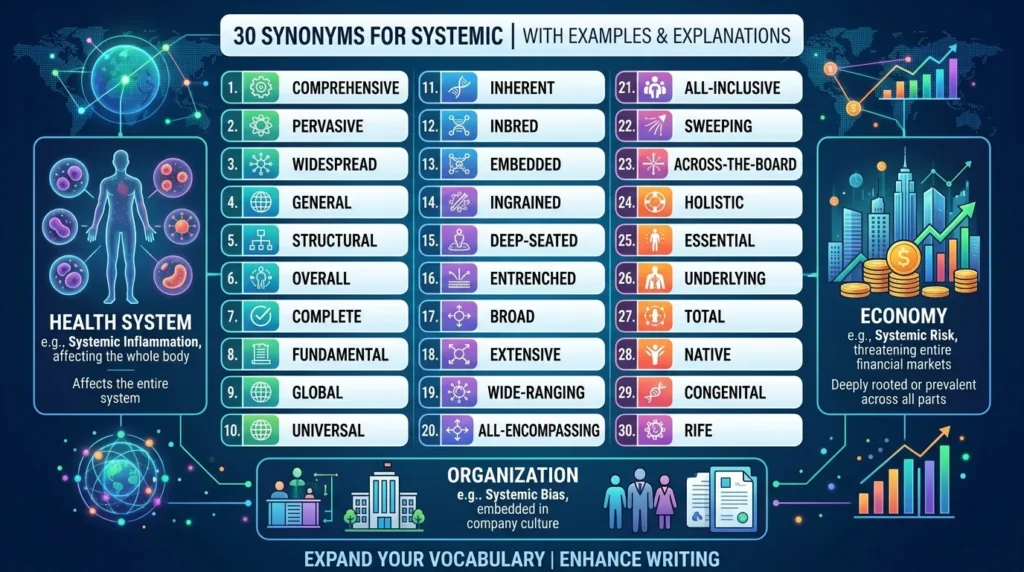
This guide gives you 30 simple synonyms for systemic. Along with easy sentences, word origins, pronunciation guides, and helpful categories.
Meaning of Systemic
Definition
Systemic (Adjective): Affecting an entire system, body, or organization as a whole.
Examples
- The doctor gave him medicine to treat a systemic infection.
- The school made systemic changes to help every student succeed.
Connotative Meaning
- Positive tone: Means total, complete, and well-organized care or planning.
- Negative tone: Often used for widespread problems, flaws, or illness.
- Neutral tone: Simply describes something that affects an entire system.
Etymology
- Source language: Comes from Greek systēmatikos, meaning “organized in a whole system.”
- History: Used in medicine in the 1800s to describe diseases affecting the whole body.
- Modern English: Used for health, plant care, business, and big plans!
Pronunciation
- US: /sɪˈstɛmɪk/
- UK: /sɪˈstemɪk/
Syllables
sys-tem-ic (3 parts)
Affixation Pattern of Systemic
- Root: System (noun)
- Suffix: -ic (adjective maker)
- Word Formation:
- Noun: System / Systemicness
- Adverb: Systemically
Explore our guide to https://synonymhubb.com/synonyms-for-proprietary/
Synonyms for Systemic
1. Widespread (Adjective) — US: /ˈwaɪdˌsprɛd/ | UK: /ˈwaɪdˌspred/
Meaning: Found or distributed over a large area or among many people.
Examples:
The rain caused widespread flooding in the valley.
There is widespread agreement on the new game rules.
2. Universal (Adjective) — US: /ˌjuːnɪˈvɜːrsəl/ | UK: /ˌjuːnɪˈvɜːsl/
Meaning: Involving or affecting everyone or everything in a group.
Examples:
Music is a universal language that brings people together.
The rule gained universal support from the team.
3. Pervasive (Adjective) — US: /pərˈveɪsɪv/ | UK: /pəˈveɪsɪv/
Meaning: Spreading widely throughout an area or group of people.
Examples:
The pervasive smell of flowers filled the garden.
Fear became pervasive during the dark storm.
4. Comprehensive (Adjective) — US: /ˌkɑːmprɪˈhɛnsɪv/ | UK: /ˌkɒmprɪˈhensɪv/
Meaning: Including or dealing with all or nearly all elements.
Examples:
She gave a comprehensive report on the school trip.
We did a comprehensive search for the missing key.
5. Global (Adjective) — US: /ˈɡloʊbəl/ | UK: /ˈɡləʊbl/
Meaning: Relating to the whole world or a complete system.
Examples:
Clean water is a global need for all living things.
The company took a global view of its sales.
6. Whole (Adjective) — US: /hoʊl/ | UK: /həʊl/
Meaning: Full, complete, or undivided.
Examples:
He ate the whole apple in three big bites.
The whole class clapped for the winner.
7. Complete (Adjective) — US: /kəmˈpliːt/ | UK: /kəmˈpliːt/
Meaning: Having all necessary parts, skills, or elements.
Examples:
This puzzle is finally complete with the last piece.
We have a complete set of colorful markers.
8. Total (Adjective) — US: /ˈtoʊtəl/ | UK: /ˈtəʊtl/
Meaning: Comprising the whole number or amount.
Examples:
The total score was five to three.
Silence fell over the total room.
9. All-inclusive (Adjective) — US: /ˌɔːl ɪnˈkluːsɪv/ | UK: /ˌɔːl ɪnˈkluːsɪv/
Meaning: Including everything expected or required.
Examples:
The trip included an all-inclusive meal plan.
We wrote an all-inclusive list of games to play.
10. Broad (Adjective) — US: /brɔːd/ | UK: /brɔːd/
Meaning: Covering a wide range or many things.
Examples:
He has a broad knowledge of sea animals.
The sign gave a broad warning to visitors.
11. General (Adjective) — US: /ˈdʒɛnərəl/ | UK: /ˈdʒenrəl/
Meaning: Affecting or concerning most people or things.
Examples:
The general consensus was to go to the park.
He gave a general idea of how the machine works.
12. Systematic (Adjective) — US: /ˌsɪstəˈmætɪk/ | UK: /ˌsɪstəˈmætɪk/
Meaning: Done according to a fixed plan or system.
Examples:
They did a systematic check of all the doors.
Her desk had a systematic layout for work.
13. Structural (Adjective) — US: /ˈstrʌktʃərəl/ | UK: /ˈstrʌktʃərəl/
Meaning: Relating to the basic structure of something.
Examples:
The builders fixed the structural wood of the house.
The team made structural updates to the plan.
14. Inherent (Adjective) — US: /ɪnˈhɪrənt/ | UK: /ɪnˈhɪərənt/
Meaning: Existing in something as a permanent or basic feature.
Examples:
Curiosity is an inherent trait in cats.
There is an inherent risk in climbing tall trees.
15. Deep-rooted (Adjective) — US: /ˌdiːp ˈruːtɪd/ | UK: /ˌdiːp ˈruːtɪd/
Meaning: Firmly established and hard to change.
Examples:
The tree has deep-rooted parts in the soil.
They share a deep-rooted love for music.
16. Deep-seated (Adjective) — US: /ˌdiːp ˈsiːtɪd/ | UK: /ˌdiːp ˈsiːtɪd/
Meaning: Fixed firmly and deeply within something.
Examples:
She has a deep-seated wish to explore space.
The belief was deep-seated in their culture.
17. Body-wide (Adjective) — US: /ˈbɑːdi waɪd/ | UK: /ˈbɒdi waɪd/
Meaning: Spreading across or affecting the entire body.
Examples:
The medicine brings body-wide relief from aches.
Rashes can sometimes be a body-wide symptom.
18. Organizational (Adjective) — US: /ˌɔːrɡənəˈzeɪʃənəl/ | UK: /ˌɔːɡənaɪˈzeɪʃənl/
Meaning: Relating to the structure of a group or company.
Examples:
Good organizational skills help you finish homework.
The club made organizational changes this year.
19. Institutional (Adjective) — US: /ˌɪnstɪˈtuːʃənəl/ | UK: /ˌɪnstɪˈtjuːʃənl/
Meaning: Established as a common practice in an organization.
Examples:
The library followed institutional rules for borrowing books.
We observed the institutional traditions of the school.
20. Sweeping (Adjective) — US: /ˈswiːpɪŋ/ | UK: /ˈswiːpɪŋ/
Meaning: Wide in range or effect; taking in many things.
Examples:
The mayor announced sweeping changes for the town.
The camera took a sweeping shot of the mountains.
21. Extensive (Adjective) — US: /ɪkˈstɛnsɪv/ | UK: /ɪkˈstensɪv/
Meaning: Covering a large area or amount.
Examples:
The farm covers an extensive piece of land.
She has an extensive collection of storybooks.
22. Far-reaching (Adjective) — US: /ˌfɑːr ˈriːtʃɪŋ/ | UK: /ˌfɑː ˈriːtʃɪŋ/
Meaning: Having important or wide-ranging effects.
Examples:
The new discovery will have far-reaching results.
Kind actions can have far-reaching impacts.
23. All-encompassing (Adjective) — US: /ˌɔːl ɪnˈkʌmpəsɪŋ/ | UK: /ˌɔːl ɪnˈkʌmpəsɪŋ/
Meaning: Including every part or aspect of something.
Examples:
The museum had an all-encompassing display on dinosaurs.
His love for science was all-encompassing.
24. Endemic (Adjective) — US: /ɛnˈdɛmɪk/ | UK: /enˈdemɪk/
Meaning: Found regularly among particular people or in a certain area.
Examples:
That plant species is endemic to rain forests.
Good cheer seems endemic in our classroom.
25. Omnipresent (Adjective) — US: /ˌɑːmnɪˈprɛzənt/ | UK: /ˌɒmnɪˈpreznt/
Meaning: Present everywhere at the same time.
Examples:
The sun felt omnipresent during the hot summer day.
Fresh air is omnipresent near the mountains.
26. Complete-system (Adjective) — US: /kəmˈpliːt ˈsɪstəm/ | UK: /kəmˈpliːt ˈsɪstəm/
Meaning: Affecting or applying to an entire setup.
Examples:
The computer ran a complete-system update.
The factory did a complete-system check today.
27. Internal (Adjective) — US: /ɪnˈtɜːrnəl/ | UK: /ɪnˈtɜːnl/
Meaning: Located on the inside or within a system.
Examples:
Fruits have internal seeds for growing new plants.
The car needed an internal engine repair.
28. Built-in (Adjective) — US: /ˌbɪlt ˈɪn/ | UK: /ˌbɪlt ˈɪn/
Meaning: Formed as an essential part of something.
Examples:
The coat has a built-in hood for rainy days.
Laptops come with a built-in camera.
29. Constitutive (Adjective) — US: /kənˈstɪtjuːtɪv/ | UK: /kənˈstɪtjʊtɪv/
Meaning: Having the power to form or establish a system.
Examples:
Water is a constitutive part of human life.
Rules are constitutive parts of playing games fairly.
30. Integral (Adjective) — US: /ˈɪntɪɡrəl/ | UK: /ˈɪntɪɡrəl/
Meaning: Necessary to make a whole complete; essential.
Examples:
Wheels are an integral part of a bicycle.
Practice is integral to learning to play piano.
Prototype Meaning
When you hear systemic, picture water flowing through every pipe in a house. Blood circulating through your whole body from head to toe.
Prototype Categorization
- Everywhere & Complete: Widespread, Universal, Pervasive, Global, Whole, Complete, Total, All-inclusive, Sweeping, Extensive, Far-reaching, All-encompassing, Omnipresent.
- Basic & Built-In Parts: Systematic, Structural, Inherent, Deep-rooted, Deep-seated, Internal, Built-in, Constitutive, Integral.
- Group & Body Systems: Broad, General, Body-wide, Organizational, Institutional, Endemic, Complete-system.
Antonyms of Systemic
- Local
- Partial
- Isolated
- Limited
- External
- Surface-level
Short Questions and Answers
- What does systemic mean?
- It means affecting an entire system, body, or structure as a whole.
- When should I use systemic?
- Use it when writing about health issues affecting the whole body, big plans touching a whole school, or rules built into an entire system.
- Is systemic an adjective or a noun?
- It is an adjective (a systemic problem, systemic care).
- What is the difference between systemic and local?
- Systemic affects the entire system or body, while local affects only one small spot.
Conclusion
Synonyms for systemic can help you describe issues, changes, or effects that involve an entire system. Words such as structural, widespread, comprehensive, organizational, and fundamental can fit different contexts. Understanding synonyms for systemic helps you choose the right word. Also avoid repetition, and make your writing clearer and more precise. Regular practice can also strengthen your vocabulary and improve everyday communication.

I’m Zahid Abbas, an educator, researcher, and digital publishing strategist with a passion for linguistics, grammar, and clear communication. As a content creator and SEO specialist, I craft research-driven, reader-focused content that empowers learners and makes knowledge accessible worldwide.