The word modern means something that belongs to the present time or uses the newest ideas, styles, or technology. Imagine buying a new smartphone with advanced features. You may describe it as a modern device because it looks new and works with the latest technology. We use this word every day when talking about homes, fashion, education, art, business, and many other topics.
Learning synonyms of modern helps English learners understand different meanings and express ideas more clearly. It also helps writers avoid repeating the same word again and again. A rich vocabulary makes writing more interesting and professional. In this article, you will learn the meaning of modern, its pronunciation, grammar, history, connotation, word formation, and thirty useful synonyms with simple meanings and examples. You will also discover antonyms, semantic categories, and practical questions that improve your English skills.
Meaning of Modern
Definition
Modern (Adjective):
Something that belongs to the present time or uses the latest ideas, methods, technology, or style.
Examples
- The school has a modern science laboratory.
- She lives in a modern apartment with smart devices.
Connotative Meaning
- Positive tone: New, advanced, stylish, innovative, efficient.
- Negative tone: Too new, lacking tradition, overly technological.
- Neutral tone: Existing in the present time.
Etymology
- Origin: Late Latin modernus
- Source language: Latin
- Original meaning: Belonging to the present or just now.
Short History of the Keyword
- Old English (450–1100): The word modern did not exist. People used words meaning “new” or “present.”
- Middle English (1100–1500): The word entered English from French and Latin, referring to present times.
- Modern English (1500–Present): It became common for describing current styles, technology, architecture, education, literature, and society.
Pronunciation (US & UK – IPA)
US: /ˈmɑːdərn/
UK: /ˈmɒdən/
Syllables
mod-ern
Affixation Pattern of Modern
Root: modern
Prefix: None
Suffix: None
Word Formation of Modern
- modern (adjective)
- modernity (noun)
- modernism (noun)
- modernist (noun)
- modernize (verb)
- modernization (noun)
- modernizing (verb)
- modernized (adjective/verb participle)
- modernly (adverb – uncommon)
- postmodern (adjective)
- postmodernism (noun)
- postmodernist (noun)
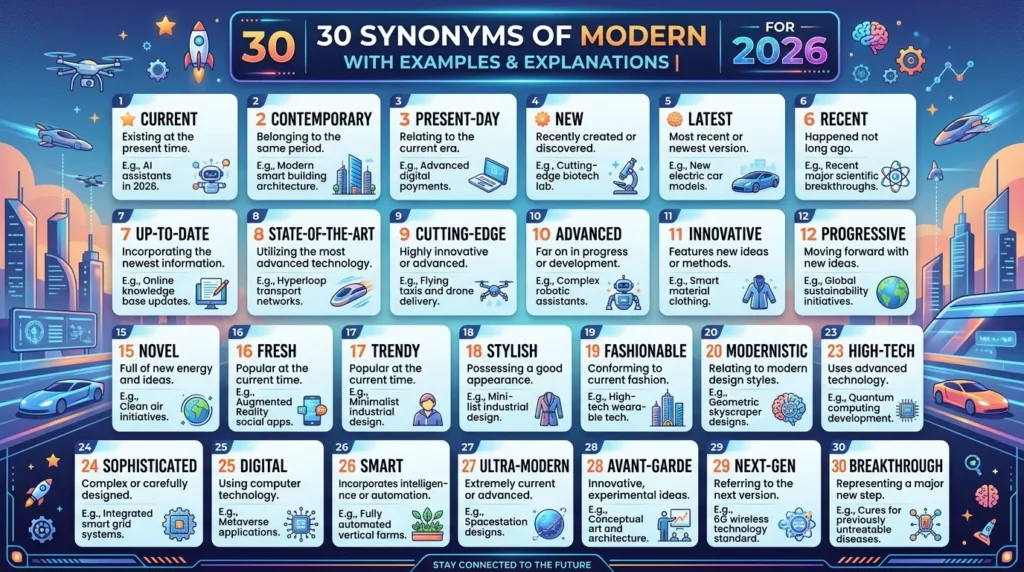
30 Synonyms of Modern
1. Contemporary (Adjective)
US: /kənˈtempəˌreri/ | UK: /kənˈtemprəri/
Meaning: Existing or happening in the present time.
Examples
- The museum displays contemporary art.
- Contemporary buildings often use glass and steel.
2. Current (Adjective)
US: /ˈkɜːrənt/ | UK: /ˈkʌrənt/
Meaning: Existing or happening now.
Examples
- Current trends change quickly.
- Please use the current version.
3. Up-to-date (Adjective)
US: /ˌʌp tə ˈdeɪt/ | UK: /ˌʌp tə ˈdeɪt/
Meaning: Having the newest information or features.
Examples
- The website is up-to-date.
- Our records are up-to-date.
4. Innovative (Adjective)
US: /ˈɪnəˌveɪtɪv/ | UK: /ˈɪnəvətɪv/
Meaning: Introducing new ideas or methods.
Examples
- The company created an innovative product.
- Innovative thinking solves problems.
5. Advanced (Adjective)
US: /ədˈvænst/ | UK: /ədˈvɑːnst/
Meaning: Highly developed or improved.
Examples
- The hospital has advanced equipment.
- Advanced technology saves time.
6. New (Adjective)
US: /nuː/ | UK: /njuː/
Meaning: Recently made or introduced.
Examples
- She bought a new laptop.
- New ideas improve business.
7. Fresh (Adjective)
US: /freʃ/ | UK: /freʃ/
Meaning: New and original.
Examples
- We need fresh ideas.
- The designer introduced a fresh style.
8. Progressive (Adjective)
US: /prəˈɡresɪv/ | UK: /prəˈɡresɪv/
Meaning: Supporting improvement and development.
Examples
- The school follows progressive teaching.
- Progressive policies encourage growth.
9. Futuristic (Adjective)
US: /ˌfjuːtʃəˈrɪstɪk/ | UK: /ˌfjuːtʃərˈɪstɪk/
Meaning: Looking like something from the future.
Examples
- The car has a futuristic design.
- Their office looks futuristic.
10. Cutting-edge (Adjective)
US: /ˌkʌtɪŋ ˈedʒ/ | UK: /ˌkʌtɪŋ ˈedʒ/
Meaning: Using the newest and most advanced ideas.
Examples
- The company develops cutting-edge software.
- Cutting-edge research benefits medicine.
11. State-of-the-art (Adjective)
US: /ˌsteɪt əv ði ˈɑːrt/ | UK: /ˌsteɪt əv ði ˈɑːt/
Meaning: Using the most recent and advanced technology or design.
Examples
- The hospital has state-of-the-art medical equipment.
- They work in a state-of-the-art office building.
12. Stylish (Adjective)
US: /ˈstaɪlɪʃ/ | UK: /ˈstaɪlɪʃ/
Meaning: Fashionable and attractive in appearance.
Examples
- She decorated her home with stylish furniture.
- He wore a stylish black jacket.
13. Trendy (Adjective)
US: /ˈtrɛndi/ | UK: /ˈtrendi/
Meaning: Following the latest fashion or popular style.
Examples
- That café is very trendy.
- Teenagers enjoy wearing trendy clothes.
14. Fashionable (Adjective)
US: /ˈfæʃənəbəl/ | UK: /ˈfæʃənəbl/
Meaning: Popular because it matches current fashion.
Examples
- She bought fashionable shoes.
- The restaurant has a fashionable design.
15. Chic (Adjective)
US: /ʃiːk/ | UK: /ʃiːk/
Meaning: Elegant, stylish, and fashionable.
Examples
- The hotel has a chic interior.
- Her outfit looked simple but chic.
16. Sophisticated (Adjective)
US: /səˈfɪstɪkeɪtɪd/ | UK: /səˈfɪstɪkeɪtɪd/
Meaning: Highly developed, refined, or advanced.
Examples
- The software uses sophisticated technology.
- They designed a sophisticated security system.
17. High-tech (Adjective)
US: /ˌhaɪ ˈtek/ | UK: /ˌhaɪ ˈtek/
Meaning: Using advanced technology.
Examples
- The factory uses high-tech machines.
- They built a high-tech classroom.
18. Revolutionary (Adjective)
US: /ˌrevəˈluːʃəneri/ | UK: /ˌrevəˈluːʃənəri/
Meaning: Bringing major positive changes.
Examples
- The invention was revolutionary.
- Scientists made a revolutionary discovery.
19. Novel (Adjective)
US: /ˈnɑːvəl/ | UK: /ˈnɒvəl/
Meaning: New, original, and different.
Examples
- She suggested a novel solution.
- The company introduced a novel product.
20. Original (Adjective)
US: /əˈrɪdʒənəl/ | UK: /əˈrɪdʒənəl/
Meaning: New and unlike anything before.
Examples
- His original idea impressed everyone.
- The artist created an original design.
21. Updated (Adjective)
US: /ʌpˈdeɪtɪd/ | UK: /ʌpˈdeɪtɪd/
Meaning: Changed to include the newest information or features.
Examples
- We downloaded the updated software.
- The guidebook has updated facts.
22. Renewed (Adjective)
US: /rɪˈnuːd/ | UK: /rɪˈnjuːd/
Meaning: Made new again or improved.
Examples
- The renewed building looks beautiful.
- They showed renewed interest in the project.
23. Refreshed (Adjective)
US: /rɪˈfreʃt/ | UK: /rɪˈfreʃt/
Meaning: Made new, cleaner, or more attractive.
Examples
- The website has a refreshed design.
- The office received a refreshed appearance.
24. Streamlined (Adjective)
US: /ˈstriːmlaɪnd/ | UK: /ˈstriːmlaɪnd/
Meaning: Designed to work more simply and efficiently.
Examples
- The company created a streamlined process.
- The new system is streamlined and easy to use.
25. Efficient (Adjective)
US: /ɪˈfɪʃənt/ | UK: /ɪˈfɪʃənt/
Meaning: Working well without wasting time or effort.
Examples
- The modern engine is efficient.
- Efficient tools save time.
26. Refined (Adjective)
US: /rɪˈfaɪnd/ | UK: /rɪˈfaɪnd/
Meaning: Improved and polished.
Examples
- The product has a refined design.
- Her refined writing style is easy to read.
27. Urban (Adjective)
US: /ˈɝːbən/ | UK: /ˈɜːbən/
Meaning: Related to cities and modern city life.
Examples
- Urban living offers many opportunities.
- Urban architecture continues to change.
28. Digital (Adjective)
US: /ˈdɪdʒɪtəl/ | UK: /ˈdɪdʒɪtl/
Meaning: Using computer or electronic technology.
Examples
- Digital communication is fast.
- Schools use digital learning tools.
29. Twenty-first-century (Adjective)
US: /ˌtwen.ti ˈfɝːst ˈsen.tʃə.ri/ | UK: /ˌtwen.ti ˈfɜːst ˈsen.tʃər.i/
Meaning: Belonging to the present century or reflecting today’s world.
Examples
- The company has a twenty-first-century workplace.
- Students need twenty-first-century skills.
30. Present-day (Adjective)
US: /ˈprezənt deɪ/ | UK: /ˈpreznt deɪ/
Meaning: Existing in the current period.
Examples
- Present-day society depends on technology.
- Present-day education uses online learning.
Prototype Meaning
The prototype meaning of modern is something that belongs to the present time and reflects the newest ideas, technology, design, or ways of living. When people hear the word modern, they often imagine smart homes, advanced technology, stylish buildings, fast transportation, digital communication, and innovative products. The word usually suggests progress, improvement, and change from older or traditional methods.
Prototype Categorization
- General present-time words: contemporary, current, present-day, new
- Technology-related words: advanced, high-tech, digital, state-of-the-art, cutting-edge
- Fashion and design words: stylish, trendy, fashionable, chic
- Innovation words: innovative, revolutionary, novel, original
- Improvement words: updated, renewed, refreshed, streamlined, refined, efficient
- Future-focused words: futuristic, progressive, twenty-first-century
- City and lifestyle words: urban, sophisticated
Antonyms of Modern
- Ancient (Adjective): Very old and from the distant past.
- Old (Adjective): Existing for a long time.
- Traditional (Adjective): Based on long-established customs.
- Historic (Adjective): Connected with history.
- Outdated (Adjective): No longer useful or fashionable.
- Old-fashioned (Adjective): Belonging to an earlier style.
- Obsolete (Adjective): No longer used because something better exists.
- Medieval (Adjective): Relating to the Middle Ages.
- Classical (Adjective): Based on ancient traditions or styles.
Short Questions and Answers
- What does modern mean? Modern means belonging to the present time or using the newest ideas, technology, or style.
- When should modern be used? Use modern when describing current technology, buildings, fashion, education, ideas, methods, or lifestyles.
- Is modern positive or negative? It is usually positive because it suggests improvement and progress, but it can be negative if someone dislikes new styles or prefers tradition.
- How is it different from similar words? Modern is a broad word for the present time. Contemporary emphasizes the same period, innovative highlights new ideas, trendy focuses on fashion, and cutting-edge refers to the newest technology.
Conclusion
Learning the Synonyms of Modern and Synonyms of Modern is an excellent way to build a stronger English vocabulary. Knowing many related words allows you to describe technology, fashion, architecture, education, and everyday life more accurately. It also makes your writing and speaking more interesting by reducing repetition. Understanding pronunciation, history, connotation, and usage helps you choose the best word for every situation. Whether you are an English learner, student, teacher, blogger, or content writer, practicing these synonyms every day will improve your communication skills and increase your confidence. Continue learning one new word daily, use it in conversations and writing, and your vocabulary will grow naturally over time using Synonyms of Modern.

I’m Zahid Abbas, an educator, researcher, and digital publishing strategist with a passion for linguistics, grammar, and clear communication. As a content creator and SEO specialist, I craft research-driven, reader-focused content that empowers learners and makes knowledge accessible worldwide.