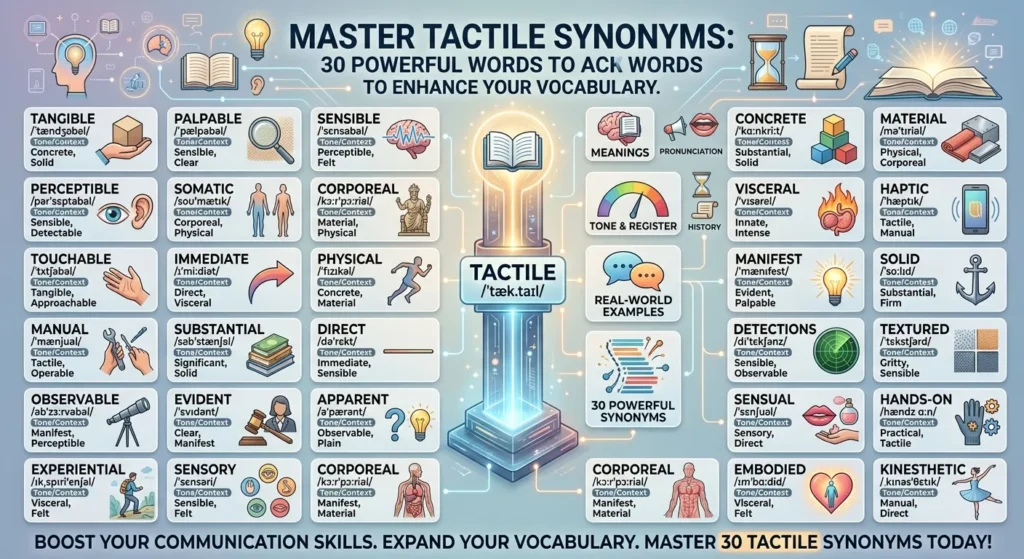
Tactile means related to the sense of touch. Picture Mia in a shop. She runs her hand over a soft wool scarf. Then she feels a rough linen one. The feel helps her choose. That is a tactile experience. People use synonyms for tactile for toys, art, design, and teaching, because touch is a big part of how we learn. But writing tactile again and again can feel flat. That is why synonyms matter. English learners get more synonyms for tactile to choose from. Content writers sound fresh and exact. In this article, you will learn the meaning of tactile and its tone. You will see where it comes from and how to say it. You will study how synonyms for tactile is built. Then you will meet 30 synonyms with examples, grouped by meaning.
Meaning of Tactile
Definition
Tactile (adjective): Related to the sense of touch, or able to be felt by touching.
Examples
- The baby loves tactile toys with soft and bumpy parts.
- Braille is a tactile way of reading.
Connotative Meaning
- Positive tone: Warm, rich, and hands-on. “The tactile fabric felt warm and rich.”
- Negative tone: Rare. It can be awkward when it describes a person who touches others a lot. “He is very tactile, and some people find it too much.”
- Neutral tone: Plain facts in science and design. “The phone has tactile buttons.”
Etymology
- Source language: Latin tactilis, meaning “able to be touched.” It comes from the Latin verb tangere, “to touch.”
- Original meaning: Something that can be touched.
- How it changed: English kept the touch meaning. Over time, it also came to describe the feel of surfaces and hands-on learning.
Short History of the Word
- Old English (450–1100): The word tactile did not exist yet. People used words like hrinan (to touch) and felan (to feel).
- Middle English (1100–1500): English took in touchen from Old French. The word tactile had not yet arrived.
- Modern English (1500–present): Around the early 1600s, English borrowed tactile from Latin. Later it spread to design, tech, and teaching.
Pronunciation (US & UK – IPA)
- US: /ˈtæk.t̬əl/
- UK: /ˈtæk.taɪl/
Syllables
tac-tile
Affixation Pattern of Tactile
- Root: tact (from Latin tangere, “to touch”)
- Prefix: none
- Suffix: -ile (means “able to be” or “related to”)
Word formation
At least seven words grow from this Latin family.
- tactile (adjective)
- tactilely (adverb)
- tactility (noun)
- tactual (adjective)
- tact (noun)
- contact (noun, verb)
- tangible (adjective)
Also learn more about https://synonymhubb.com/synonyms-for-charismatic/
Synonyms for Tactile
1. Touchable (adjective) — US /ˈtʌtʃ.ə.bəl/ | UK /ˈtʌtʃ.ə.bəl/
Meaning: Able to be felt by touch.
Examples:
- Kids love touchable exhibits.
- The statue is touchable, so you may pat it.
2. Tactual (adjective) — US /ˈtæk.tʃu.əl/ | UK /ˈtæk.tʃu.əl/
Meaning: Relating to the sense of touch, in a formal way.
Examples:
- The test checks tactual skill.
- She noticed tactual differences between the fabrics.
3. Haptic (adjective) — US /ˈhæp.tɪk/ | UK /ˈhæp.tɪk/
Meaning: Relating to touch, often used in technology.
Examples:
- The phone gives haptic feedback when you tap.
- Haptic gloves let gamers feel virtual objects.
4. Tangible (adjective) — US /ˈtæn.dʒə.bəl/ | UK /ˈtæn.dʒɪ.bəl/
Meaning: Real and able to be touched.
Examples:
- The tangible result was a new bridge.
- A tangible prize sat on the table.
5. Palpable (adjective) — US /ˈpæl.pə.bəl/ | UK /ˈpæl.pə.bəl/
Meaning: So strong that you can almost feel it.
Examples:
- The tension in the room was palpable.
- The excitement was palpable before the show.
6. Physical (adjective) — US /ˈfɪz.ɪ.kəl/ | UK /ˈfɪz.ɪ.kəl/
Meaning: Real and made of things you can touch.
Examples:
- The book is a physical copy, not a file.
- Physical objects help kids learn.
7. Hands-on (adjective) — US /ˌhændzˈɑːn/ | UK /ˌhændzˈɒn/
Meaning: Learned or done by using your hands, not just by reading.
Examples:
- The class gives hands-on practice.
- It is a hands-on museum.
8. Manual (adjective) — US /ˈmæn.ju.əl/ | UK /ˈmæn.ju.əl/
Meaning: Done with the hands.
Examples:
- She does manual work in the garden.
- He prefers a manual typewriter.
9. Sensory (adjective) — US /ˈsen.sɚ.i/ | UK /ˈsen.sər.i/
Meaning: Related to the senses, such as touch, sight, or smell.
Examples:
- The room has a sensory corner for kids.
- Sensory play helps toddlers learn.
10. Perceptible (adjective) — US /pɚˈsep.tə.bəl/ | UK /pəˈsep.tɪ.bəl/
Meaning: Able to be noticed by the senses.
Examples:
- There was a perceptible change in the air.
- The small bump was barely perceptible to the touch.
11. Concrete (adjective) — US /ˈkɑːn.kriːt/ | UK /ˈkɒŋ.kriːt/
Meaning: Real and solid, not just an idea.
Examples:
- The artist made a concrete model of the idea.
- Give me a concrete example I can hold.
12. Material (adjective) — US /məˈtɪr.i.əl/ | UK /məˈtɪə.ri.əl/
Meaning: Made of matter that can be touched.
Examples:
- Wood is a material thing.
- The shop sells material goods.
13. Solid (adjective) — US /ˈsɑː.lɪd/ | UK /ˈsɒl.ɪd/
Meaning: Firm, and not liquid or hollow.
Examples:
- The table felt solid under his hands.
- She tapped the solid wall.
14. Touch-sensitive (adjective) — US /ˈtʌtʃ ˌsen.sə.t̬ɪv/ | UK /ˈtʌtʃ ˌsen.sə.tɪv/
Meaning: Reacting when someone touches it.
Examples:
- The lamp is touch-sensitive.
- Her phone has a touch-sensitive screen.
15. Interactive (adjective) — US /ˌɪn.t̬ɚˈæk.tɪv/ | UK /ˌɪn.təˈræk.tɪv/
Meaning: Letting you touch and act to learn or play.
Examples:
- The museum has interactive displays.
- We built an interactive toy.
16. Textural (adjective) — US /ˈteks.tʃɚ.əl/ | UK /ˈteks.tʃər.əl/
Meaning: Relating to the feel of a surface.
Examples:
- The painting has textural depth.
- She loved the textural details of the rug.
17. Textured (adjective) — US /ˈteks.tʃɚd/ | UK /ˈteks.tʃəd/
Meaning: Having a surface you can feel.
Examples:
- He chose a textured wall paint.
- The textured cover felt nice.
18. Embossed (adjective) — US /ɪmˈbɑːst/ | UK /ɪmˈbɒst/
Meaning: Marked with a raised pattern or letters.
Examples:
- The card has an embossed gold name.
- Braille is embossed on the sign.
19. Raised (adjective) — US /reɪzd/ | UK /reɪzd/
Meaning: Lifted up from a surface so you can feel it.
Examples:
- The map has raised lines.
- She traced the raised letters with her finger.
20. Smooth (adjective) — US /smuːð/ | UK /smuːð/
Meaning: Even and flat, without bumps.
Examples:
- The stone felt smooth.
- He ran his hand over the smooth table.
21. Rough (adjective) — US /rʌf/ | UK /rʌf/
Meaning: Not smooth, with a bumpy surface.
Examples:
- The wall was rough to the touch.
- The rope felt rough in his hands.
22. Soft (adjective) — US /sɑːft/ | UK /sɒft/
Meaning: Gentle and easy to press.
Examples:
- The blanket is soft and warm.
- She loves the soft fur of her cat.
23. Silky (adjective) — US /ˈsɪl.ki/ | UK /ˈsɪl.ki/
Meaning: Smooth and soft like silk.
Examples:
- Her hair felt silky.
- The silky scarf slid through his fingers.
24. Velvety (adjective) — US /ˈvel.vɪ.t̬i/ | UK /ˈvel.vɪ.ti/
Meaning: Soft and smooth like velvet.
Examples:
- The peach has a velvety skin.
- She wore a velvety dress.
25. Bumpy (adjective) — US /ˈbʌm.pi/ | UK /ˈbʌm.pi/
Meaning: Having lumps or raised spots.
Examples:
- The road was bumpy.
- The toy has a bumpy surface for baby fingers.
26. Grainy (adjective) — US /ˈɡreɪ.ni/ | UK /ˈɡreɪ.ni/
Meaning: Rough with tiny bits.
Examples:
- The sand felt grainy under her feet.
- The bread has a grainy crust.
27. Coarse (adjective) — US /kɔːrs/ | UK /kɔːs/
Meaning: Rough and not fine.
Examples:
- The cloth was coarse and scratchy.
- He wore a coarse wool coat.
28. Gritty (adjective) — US /ˈɡrɪt̬.i/ | UK /ˈɡrɪt.i/
Meaning: Full of tiny hard bits, like sand.
Examples:
- The gritty dust stuck to his hands.
- The floor felt gritty after the storm.
29. Fuzzy (adjective) — US /ˈfʌz.i/ | UK /ˈfʌz.i/
Meaning: Covered with soft, short hair.
Examples:
- The puppy has fuzzy ears.
- She wore a fuzzy sweater.
30. Spongy (adjective) — US /ˈspʌn.dʒi/ | UK /ˈspʌn.dʒi/
Meaning: Soft and springy like a sponge.
Examples:
- The cake was light and spongy.
- The moss felt spongy underfoot.
Prototype Meaning
When people hear tactile, most picture fingers brushing a surface. Think of soft fabric, a bumpy toy, a Braille page, or a phone screen. The most typical meaning is something related to touch and how it feels. It is a calm, neutral word used in science, design, and teaching.
Prototype Categorization
- Touch and feel: touchable, tactual, haptic, tangible, palpable, sensory, perceptible
- Real and physical: physical, concrete, material, solid
- Hands and use: hands-on, manual, interactive, touch-sensitive
- Surface and texture: textural, textured, embossed, raised
- Smooth feels: smooth, soft, silky, velvety
- Rough feels: rough, bumpy, grainy, coarse, gritty, fuzzy, spongy
Antonyms of tactile
- intangible
- abstract
- visual
- imaginary
- unreal
- impalpable
Short Questions and Answers
- What does tactile mean? It means related to the sense of touch, or able to be felt by touching.
- When should tactile be used? Use it for things you feel with your hands, like fabric, toys, buttons, and Braille. It also fits learning that uses touch.
- Is tactile positive or negative? It is mostly neutral or positive. It can feel negative when it describes a person who touches others a lot.
- How is it different from similar words? Tangible means real and able to be touched, or clear in effect. Haptic is often used for touch in technology. Tactual is a more formal twin. Textured describes a surface. Sensory covers all the senses, not only touch.
Conclusion
Synonyms for tactile makes your vocabulary bigger and stronger. You now know that one word can have many shades. Haptic fits technology. Tangible fits real results. Silky fits fabric. Rough fits a wall. With the right word, your writing becomes clear and sharp. Your speaking sounds more natural too. You also avoid repeating the same word again and again, which keeps readers interested. Every new synonyms for tactile you learn builds your English confidence. So don’t stop here. Pick three synonyms for tactile from this list today. Use them in an email, a short essay, or a blog post. Say them out loud to practice the sounds. Review them tomorrow and again next week. A little daily practice turns new words into words you own.

I’m Zahid Abbas, an educator, researcher, and digital publishing strategist with a passion for linguistics, grammar, and clear communication. As a content creator and SEO specialist, I craft research-driven, reader-focused content that empowers learners and makes knowledge accessible worldwide.