The word trash refers to things that are no longer useful, wanted, or needed. Imagine cleaning out your bedroom closet and putting broken toys or torn papers into a bin that unwanted waste is trash. We use synonyms for trash every day because cleaning, recycling, and managing waste are part of daily life. Learning new synonyms for trash helps English learners and writers describe different kinds of waste accurately. . This complete guide covers the full meaning of trash. Its history, pronunciations, grammar rules, and thirty useful synonyms with example sentences and helpful categories.
Meaning of Trash
Definition
Trash (Noun / Verb): Waste material, refuse, or discarded items. As a verb to ruin, damage, or throw something away.
Examples
- Please throw your food wrappers in the trash.
- Rain will trash those paper decorations if you leave them outside.
Connotative Meaning
- Positive tone: Trash is not usually positive, but cleaning it up can show care for cleanliness.
- Negative tone: Trash can suggest dirt, waste, poor quality, or something unwanted.
- Neutral tone: Trash can simply mean unwanted things that are thrown away. Such as paper, plastic, or food waste.
Etymology
- Source language:
- The word trash may come from Scandinavian words linked to rubbish, fallen twigs, and small pieces of waste.
- Old English (450–1100):
- People used words such as dros and wāst to talk about waste or unwanted material.
- Middle English (1100–1500):
- The word appeared as trasshe and referred to fallen twigs, leaves, and broken sticks.
- Modern English (1500–Present):
- In American English, trash came to mean household waste and other unwanted things. It is also used informally to describe something as poor in quality.
Pronunciation
- US: /træʃ/
- UK: /træʃ/
Syllables
trash (1 part)
Affixation Pattern of Trash
- Root: Trash
- Prefix: None
- Suffix: -y (Trashy), -can (Trashcan)
- Word Formation:
- Noun: Trash / Trashcan / Trashiness
- Verb: Trash
- Adjective: Trashy / Trashed
- Adverb: Trashily
Discover related vocabulary https://synonymhubb.com/synonyms-of-hubris/
Synonyms for Trash
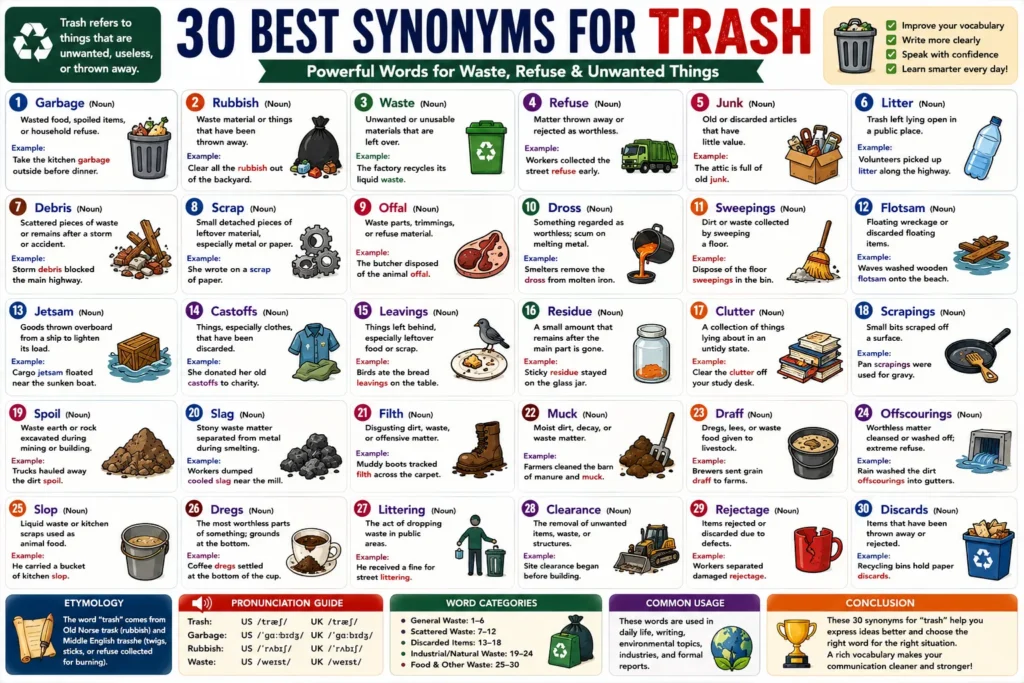
1. Garbage (Noun) — US: /ˈɡɑːrbɪdʒ/ | UK: /ˈɡɑːbɪdʒ/
Meaning: Wasted food, spoiled items, or household refuse.
Examples:
Take the kitchen garbage outside before dinner.
The city garbage truck comes every Tuesday.
2. Rubbish (Noun) — US: /ˈrʌbɪʃ/ | UK: /ˈrʌbɪʃ/
Meaning: Waste material or things that have been thrown away.
Examples:
Clear all the rubbish out of the backyard.
He threw the torn envelope into the rubbish bin.
3. Waste (Noun) — US: /weɪst/ | UK: /weɪst/
Meaning: Unwanted or unusable materials that are left over.
Examples:
The factory recycles its liquid waste.
Food waste should be composted in the garden.
4. Refuse (Noun) — US: /ˈrɛfjuːs/ | UK: /ˈrefjuːs/
Meaning: Matter thrown away or rejected as worthless.
Examples:
Workers collected the street refuse early in the morning.
The dump accepts residential refuse free of charge.
5. Junk (Noun) — US: /dʒʌŋk/ | UK: /dʒʌŋk/
Meaning: Old or discarded articles that have little value.
Examples:
The attic is full of old junk.
He sold his rusty junk at a yard sale.
6. Litter (Noun) — US: /ˈlɪtər/ | UK: /ˈlɪtə/
Meaning: Trash left lying open in a public place.
Examples:
Volunteers picked up litter along the highway.
Throwing litter on the beach harms sea life.
7. Debris (Noun) — US: /dəˈbriː/ | UK: /ˈdebriː/
Meaning: Scattered pieces of waste or remains after a storm or accident.
Examples:
Storm debris blocked the main highway.
Crews cleared broken glass debris from the road.
8. Scrap (Noun) — US: /skræp/ | UK: /skræp/
Meaning: Small detached pieces of leftover material, especially metal or paper.
Examples:
She wrote down the phone number on a scrap of paper.
The welder sold old scrap metal to the recycling yard.
9. Offal (Noun) — US: /ˈɔːfəl/ | UK: /ˈɒfl/
Meaning: Waste parts, trimmings, or refuse material.
Examples:
The butcher disposed of the animal offal properly.
Fishermen used fish offal as crab bait.
10. Dross (Noun) — US: /drɔːs/ | UK: /drɒs/
Meaning: Something regarded as worthless; scum on melting metal.
Examples:
Smelters remove the dross from molten iron.
The editor cut the dross out of the long story.
11. Sweepings (Noun) — US: /ˈswiːpɪŋz/ | UK: /ˈswiːpɪŋz/
Meaning: Dirt or waste collected by sweeping a floor.
Examples:
Dispose of the floor sweepings in the bin.
Dust and sweepings gathered in the dustpan.
12. Flotsam (Noun) — US: /ˈflɑːtsəm/ | UK: /ˈflɒtsəm/
Meaning: Floating wreckage or discarded floating items.
Examples:
Ocean waves washed wooden flotsam onto the beach.
Sea creatures swam past the floating flotsam.
13. Jetsam (Noun) — US: /ˈdʒɛtsəm/ | UK: /ˈdʒetsəm/
Meaning: Goods thrown overboard from a ship to lighten its load.
Examples:
Cargo jetsam floated near the sunken boat.
Sailors recovered damaged jetsam along the coast.
14. Castoffs (Noun) — US: /ˈkæstˌɔːfs/ | UK: /ˈkɑːstɒfs/
Meaning: Things, especially clothes, that have been discarded.
Examples:
She donated her old castoffs to charity.
He wore castoffs handed down from his older brother.
15. Leavings (Noun) — US: /ˈliːvɪŋz/ | UK: /ˈliːvɪŋz/
Meaning: Things left behind, especially leftover food or scrap.
Examples:
Birds ate the bread leavings on the picnic table.
The dog searched for food leavings under the table.
16. Residue (Noun) — US: /ˈrɛzəduː/ | UK: /ˈrezɪdjuː/
Meaning: A small amount of something that remains after the main part has gone.
Examples:
Sticky residue stayed on the glass jar.
Chemical residue was washed off the apples.
17. Clutter (Noun) — US: /ˈklʌtər/ | UK: /ˈklʌtə/
Meaning: A collection of things lying about in an untidy state.
Examples:
Clear the clutter off your study desk.
Too much clutter makes a small room feel crowded.
18. Scrapings (Noun) — US: /ˈskreɪpɪŋz/ | UK: /ˈskreɪpɪŋz/
Meaning: Small bits scraped off a surface.
Examples:
Pan scrapings were used to flavor the gravy.
He swept up the paint scrapings from the floor.
19. Spoil (Noun) — US: /spoɪl/ | UK: /spɔɪl/
Meaning: Waste earth or rock excavated during mining or building.
Examples:
Trucks hauled away the dirt spoil from the ditch.
The mine created giant piles of rocky spoil.
20. Slag (Noun) — US: /slæɡ/ | UK: /slæɡ/
Meaning: Stony waste matter separated from metal during smelting.
Examples:
Workers dumped cooled slag near the steel mill.
Black slag covered the ground around the furnace.
21. Filth (Noun) — US: /fɪlθ/ | UK: /fɪlθ/
Meaning: Disgusting dirt, waste, or offensive matter.
Examples:
The muddy boots tracked filth across the carpet.
Water filled with filth drained into the sewer.
22. Muck (Noun) — US: /mʌk/ | UK: /mʌk/
Meaning: Moist dirt, decay, or waste matter.
Examples:
Farmers cleaned the barn of manure and muck.
Heavy boots got stuck in the wet river muck.
23. Draff (Noun) — US: /dræf/ | UK: /dræf/
Meaning: Dregs, lees, or waste food given to livestock.
Examples:
Brewers sent grain draff to local dairy farms.
Pigs ate the bucket of farm draff.
24. Offscourings (Noun) — US: /ˈɔːfˌskaʊərɪŋz/ | UK: /ˈɒfˌskaʊərɪŋz/
Meaning: Worthless matter cleansed or washed off; extreme refuse.
Examples:
Rain washed the dirt offscourings into the gutter.
Old city drains held offscourings from industrial plants.
25. Slop (Noun) — US: /slɑːp/ | UK: /slɒp/
Meaning: Liquid waste or kitchen scraps used as animal food.
Examples:
He carried a bucket of kitchen slop to the pigpen.
Careful not to spill the dirty sink slop.
26. Dregs (Noun) — US: /drɛɡz/ | UK: /dregz/
Meaning: The most worthless parts of something; grounds at the bottom of a liquid.
Examples:
Coffee dregs settled at the bottom of the cup.
The storm left muddy dregs in the basin.
27. Littering (Noun) — US: /ˈlɪtərɪŋ/ | UK: /ˈlɪtərɪŋ/
Meaning: The act of dropping waste in public areas.
Examples:
Signs warn against littering in the national park.
He received a fine for street littering.
28. Clearance (Noun) — US: /ˈklɪrəns/ | UK: /ˈklɪərəns/
Meaning: The removal of unwanted items, waste, or structures.
Examples:
Site clearance began before building the house.
Spring clearance cleared out the old shed.
29. Rejectage (Noun) — US: /rɪˈdʒɛktɪdʒ/ | UK: /rɪˈdʒektɪdʒ/
Meaning: Items rejected or discarded due to defects.
Examples:
Factory workers separated damaged rejectage from good goods.
The store sent rejectage back to the maker.
30. Discards (Noun) — US: /ˈdɪskɑːrdz/ | UK: /ˈdɪskɑːdz/
Meaning: Items that have been thrown away or rejected.
Examples:
Recycling bins hold paper discards.
She found useful craft supplies among factory discards.
Prototype Meaning
When people hear the word trash, they usually think of things they do not need anymore. Such as old paper, plastic wrappers, empty bottles, or broken items. These things are often put in a trash can or bag before they are taken away.
Prototype Categorization
- Everyday Household Waste:
- Garbage, Rubbish, Waste, Refuse, Junk, Discards, Castoffs.
- Public & Outdoor Litter:
- Litter, Littering, Debris, Flotsam, Jetsam, Clearance.
- Leftover Bits & Pieces:
- Scrap, Residue, Clutter, Sweepings, Scrapings, Leavings, Rejectage.
- Dirt, Slime & Industrial Waste:
- Offal, Dross, Spoil, Slag, Filth, Muck, Draff, Offscourings, Slop, Dregs.
Antonyms of Trash
- Treasure
- Valuables
- Assets
- Possessions
- Keepsakes
- Belongings
Short Questions and Answers
- What does trash mean?
- It means unwanted waste material, discarded household items, or garbage.
- When should trash be used?
- Use it when referring to household waste, discarded paper, unwanted items. Also when describing the act of breaking something.
- Is trash positive or negative?
- It is almost always negative, as it describes unwanted filth, or low-quality items.
- How is trash different from garbage?
- In everyday American usage, trash often refers to dry waste like paper, cardboard, and boxes. While garbage usually refers to wet food waste from the kitchen.
Conclusion
Synonyms for trash to build your English vocabulary. Repeating the word “junk” or “trash” over and over makes your writing simple and repetitive. Using precise synonyms like debris for storm remains, flotsam for ocean waste, or garbage for kitchen scraps. Synonyms for trash makes your descriptions accurate and vivid. Mastering these terms strengthens your English writing. Expands your reading comprehension, and builds overall language confidence. Try using two or three of these new words in your writing. English learners and content writers can improve their vocabulary, writing, and speaking skills by learning synonyms for trash.

I’m Zahid Abbas, an educator, researcher, and digital publishing strategist with a passion for linguistics, grammar, and clear communication. As a content creator and SEO specialist, I craft research-driven, reader-focused content that empowers learners and makes knowledge accessible worldwide.