Hence means “for this reason” or “therefore.” Think about a rainy day. A boy says, “It is raining hard. Hence, we cannot play outside.” That word “hence” connects the reason to the result. People use synonyms for hence a lot in writing and speaking. It helps show why something happens. Learning new words like this helps English learners and writers. Synonyms for hence helps you say the same idea in fresh ways. Synonyms for hence also makes your writing sound more clear. This article will teach you the meaning of hence. You will learn its history, how to say it, and 30 words that mean the same thing.
Meaning of Hence
Definition
Hence (Adverb): A word that shows a reason or result. It means “for this reason” or “therefore.”
Examples
- The bridge is closed; hence, we must take a longer road.
- She studied hard, hence her good grades.
Connotative Meaning
- Positive tone: This word can sound smart, like a clear and logical way of explaining something.
- Negative tone: This word does not usually feel bad. It stays calm and simple in tone.
- Neutral tone: In most writing, this word is used in a plain, formal way to link a cause and a result.
Etymology
- This word comes from Old English “heonan,” meaning “from here.”
- In Middle English, it became “hennes,” which later changed to “hence.”
- Over time, its meaning grew from “from this place” to “for this reason.”
Short History
- Old English (450–1100): The word “heonan” meant “from this place.” It showed movement away from a spot.
- Middle English (1100–1500): The word became “hennes,” then “hence.” It began to be used for both place and time, like “from now.”
- Modern English (1500–Present): The word is now mostly used to show a reason or result, like “therefore.” The older meaning about place is rarely used today.
Pronunciation (US & UK – IPA)
- US: /hɛns/
- UK: /hɛns/
Syllables
hence (1 syllable)
Affixation Pattern of Hence
- Root: hence
- Prefix: none
- Suffix: none
Word Formation:
- Hence (adverb)
- Henceforth (adverb, meaning “from now on”)
- Whence (related word, meaning “from where”)
Discover related vocabulary https://synonymhubb.com/synonyms-for-circumstances/
Synonyms for Hence
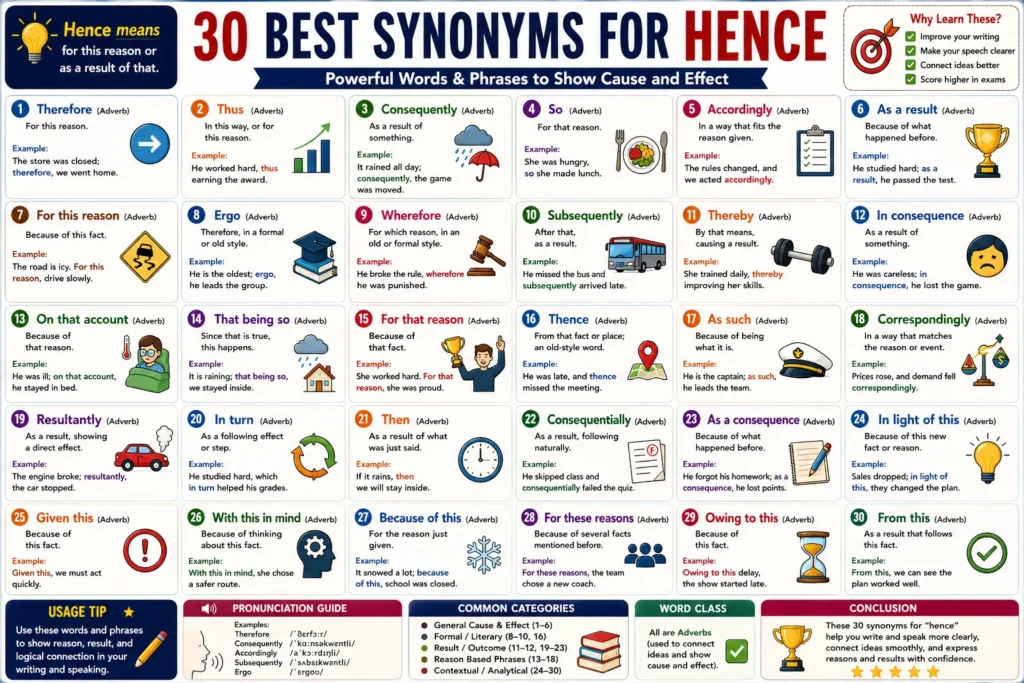
1. Therefore (Adverb) — US: /ˈðɛrfɔːr/ | UK: /ˈðeəfɔː/
Meaning: For this reason. Examples:
- The store was closed; therefore, we went home.
- She was tired; therefore, she went to bed early.
2. Thus (Adverb) — US: /ðʌs/ | UK: /ðʌs/
Meaning: In this way, or for this reason. Examples:
- He worked hard, thus earning the award.
- The plan failed, thus they tried again.
3. Consequently (Adverb) — US: /ˈkɑːnsəkwɛntli/ | UK: /ˈkɒnsɪkwəntli/
Meaning: As a result of something. Examples:
- It rained all day; consequently, the game was moved.
- He forgot his keys; consequently, he was locked out.
4. So (Adverb) — US: /soʊ/ | UK: /səʊ/
Meaning: For that reason. Examples:
- She was hungry, so she made lunch.
- It was late, so they went home.
5. Accordingly (Adverb) — US: /əˈkɔːrdɪŋli/ | UK: /əˈkɔːdɪŋli/
Meaning: In a way that fits the reason given. Examples:
- The rules changed, and we acted accordingly.
- The weather turned bad, so we planned accordingly.
6. As a result (Adverb) — US: /æz ə rɪˈzʌlt/ | UK: /æz ə rɪˈzʌlt/
Meaning: Because of what happened before. Examples:
- He studied hard; as a result, he passed the test.
- The car broke down; as a result, they were late.
7. For this reason (Adverb) — US: /fɔːr ðɪs ˈriːzən/ | UK: /fɔː ðɪs ˈriːzən/
Meaning: Because of this fact. Examples:
- The road is icy. For this reason, drive slowly.
- She was sick; for this reason, she stayed home.
8. Ergo (Adverb) — US: /ˈɛrɡoʊ/ | UK: /ˈɜːɡəʊ/
Meaning: Therefore, in a formal or old style. Examples:
- He is the oldest; ergo, he leads the group.
- She trained the most; ergo, she won the race.
9. Wherefore (Adverb) — US: /ˈwɛrfɔːr/ | UK: /ˈweəfɔː/
Meaning: For which reason, in an old or formal style. Examples:
- He broke the rule, wherefore he was punished.
- She lied, wherefore no one trusted her.
10. Subsequently (Adverb) — US: /ˈsʌbsɪkwəntli/ | UK: /ˈsʌbsɪkwəntli/
Meaning: After that, as a result. Examples:
- He missed the bus and subsequently arrived late.
- The team lost, and subsequently changed its plan.
11. Thereby (Adverb) — US: /ðɛrˈbaɪ/ | UK: /ðeəˈbaɪ/
Meaning: By that means, causing a result. Examples:
- She trained daily, thereby improving her skills.
- He saved money, thereby buying a new bike.
12. In consequence (Adverb) — US: /ɪn ˈkɑːnsɪkwəns/ | UK: /ɪn ˈkɒnsɪkwəns/
Meaning: As a result of something. Examples:
- He was careless; in consequence, he lost the game.
- The bridge broke; in consequence, traffic stopped.
13. On that account (Adverb) — US: /ɒn ðæt əˈkaʊnt/ | UK: /ɒn ðæt əˈkaʊnt/
Meaning: Because of that reason. Examples:
- He was ill; on that account, he stayed in bed.
- The roads were closed; on that account, we waited.
14. That being so (Adverb) — US: /ðæt ˈbiːɪŋ soʊ/ | UK: /ðæt ˈbiːɪŋ səʊ/
Meaning: Since that is true, this happens. Examples:
- It is raining; that being so, we stayed inside.
- He was tired; that being so, he rested.
15. For that reason (Adverb) — US: /fɔːr ðæt ˈriːzən/ | UK: /fɔː ðæt ˈriːzən/
Meaning: Because of that fact. Examples:
- She worked hard. For that reason, she was proud.
- The car was old; for that reason, they sold it.
16. Thence (Adverb) — US: /ðɛns/ | UK: /ðɛns/
Meaning: From that fact or place; an old-style word. Examples:
- He was late, and thence missed the meeting.
- The plan failed, thence they built a new one.
17. As such (Adverb) — US: /æz sʌtʃ/ | UK: /æz sʌtʃ/
Meaning: Because of being what it is. Examples:
- He is the captain; as such, he leads the team.
- The item is fragile; as such, handle it with care.
18. Correspondingly (Adverb) — US: /ˌkɔːrəˈspɑːndɪŋli/ | UK: /ˌkɒrɪˈspɒndɪŋli/
Meaning: In a way that matches the reason or event. Examples:
- Prices rose, and demand fell correspondingly.
- He worked harder, and his grades improved correspondingly.
19. Resultantly (Adverb) — US: /rɪˈzʌltəntli/ | UK: /rɪˈzʌltəntli/
Meaning: As a result, showing a direct effect. Examples:
- The engine broke; resultantly, the car stopped.
- She skipped practice; resultantly, she played poorly.
20. In turn (Adverb) — US: /ɪn tɜːrn/ | UK: /ɪn tɜːn/
Meaning: As a following effect or step. Examples:
- He studied hard, which in turn helped his grades.
- She saved money, which in turn helped her buy a car.
21. Then (Adverb) — US: /ðɛn/ | UK: /ðɛn/
Meaning: As a result of what was just said. Examples:
- If it rains, then we will stay inside.
- He was late, then he missed the bus.
22. Consequentially (Adverb) — US: /ˌkɑːnsɪˈkwɛnʃəli/ | UK: /ˌkɒnsɪˈkwɛnʃəli/
Meaning: As a result, following naturally. Examples:
- He skipped class and consequentially failed the quiz.
- The road flooded, and consequentially traffic stopped.
23. As a consequence (Adverb) — US: /æz ə ˈkɑːnsɪkwəns/ | UK: /æz ə ˈkɒnsɪkwəns/
Meaning: Because of what happened before. Examples:
- He forgot his homework; as a consequence, he lost points.
- The storm hit; as a consequence, the flight was canceled.
24. In light of this (Adverb) — US: /ɪn laɪt əv ðɪs/ | UK: /ɪn laɪt əv ðɪs/
Meaning: Because of this new fact or reason. Examples:
- Sales dropped; in light of this, they changed the plan.
- It is late; in light of this, let’s finish tomorrow.
25. Given this (Adverb) — US: /ˈɡɪvən ðɪs/ | UK: /ˈɡɪvən ðɪs/
Meaning: Because of this fact. Examples:
- Given this, we must act quickly.
- Given this news, the team changed its plan.
26. With this in mind (Adverb) — US: /wɪð ðɪs ɪn maɪnd/ | UK: /wɪð ðɪs ɪn maɪnd/
Meaning: Because of thinking about this fact. Examples:
- With this in mind, she chose a safer route.
- With this in mind, they saved more money.
27. Because of this (Adverb) — US: /bɪˈkɔːz əv ðɪs/ | UK: /bɪˈkɒz əv ðɪs/
Meaning: For the reason just given. Examples:
- It snowed a lot; because of this, school was closed.
- He was sick; because of this, he missed the trip.
28. For these reasons (Adverb) — US: /fɔːr ðiːz ˈriːzənz/ | UK: /fɔː ðiːz ˈriːzənz/
Meaning: Because of several facts mentioned before. Examples:
- For these reasons, the team chose a new coach.
- For these reasons, the trip was canceled.
29. Owing to this (Adverb) — US: /ˈoʊɪŋ tuː ðɪs/ | UK: /ˈəʊɪŋ tuː ðɪs/
Meaning: Because of this fact. Examples:
- Owing to this delay, the show started late.
- Owing to this rule, no pets are allowed.
30. From this (Adverb) — US: /frʌm ðɪs/ | UK: /frɒm ðɪs/
Meaning: As a result that follows this fact. Examples:
- From this, we can see the plan worked well.
- From this, they learned to plan ahead.
Prototype Meaning
When people hear the word hence, they think of a clear link between a reason and a result. It shows that one thing caused another to happen. This word often appears in careful, thoughtful writing, showing that an idea follows logically from what came before.
Prototype Categorization
- Simple reason words: so, then, thus, therefore
- Formal reason words: ergo, wherefore, thence, hence itself
- Result-based words: consequently, resultantly, consequentially, as a result
- Cause-and-effect phrases: as a consequence, in consequence, because of this, owing to this
- Reason-linking phrases: for this reason, for that reason, for these reasons, on that account
- Thoughtful transition phrases: given this, with this in mind, in light of this, that being so, as such, in turn, thereby, correspondingly, from this
Antonyms of Hence
- However
- Nevertheless
- Regardless
- Despite this
- Although
Short Questions and Answers
- What does hence mean? It means “for this reason” or “therefore.”
- When should hence be used? Use it to link a reason to a result, often in formal or thoughtful writing.
- Is hence positive or negative? It is neutral. It simply connects a cause to its result, with no strong feeling attached.
- How is it different from similar words? “So” is casual and used in everyday talk. “Hence” sounds more formal and is often used in essays, reports, or careful explanations.
Conclusion
Synonyms for hence helps you grow your word bank. It makes your writing and talking more clear and logical. Synonyms for hence helps you use different words instead of the same one again and again. Synonyms for hence also helps you feel more sure when you speak English. Try to learn one new word from this list each day. Small steps like this help you grow a lot over time. English learners and content writers can improve their vocabulary, writing, and speaking skills by learning synonyms for hence.

I’m Zahid Abbas, an educator, researcher, and digital publishing strategist with a passion for linguistics, grammar, and clear communication. As a content creator and SEO specialist, I craft research-driven, reader-focused content that empowers learners and makes knowledge accessible worldwide.