Tyrant means a ruler or person who uses power in a cruel and unfair way. Think about an old story where a kingdom suffers under a harsh king who taxes his people heavily and punishes anyone who disagrees with him. The villagers whisper in fear, calling him a tyrant behind closed doors. This word is often used in history books, fairy tales. Also in news stories to describe someone who rules with cruelty instead of kindness. People use synonyms for tyrant to describe leaders, bosses, or even characters in stories who treat others unfairly. Learning new synonyms for tyrant are helpful for English learners and writers. Who want to describe unfair power and cruelty in many different ways. Synonyms for tyrant also makes writing feel more vivid and precise. This article explains the meaning of tyrant, its history, how to say it, and 30 words that share a similar meaning.
Meaning of Tyrant
Definition
Tyrant (Noun): A ruler or person who uses power in a cruel, unfair, or harsh way.
Examples
- The story tells of a tyrant who ruled the kingdom with fear.
- His strict boss acted like a tyrant at the office.
Connotative Meaning
- Positive tone: This word almost never feels positive. It is used to criticize unfair or cruel power.
- Negative tone: This word has a bad meaning. It describes fear, cruelty, and unfair control over people.
- Neutral tone: In history books, the word can sometimes be used simply to describe rulers with complete power, without saying whether they were good or bad.
Etymology
- This word comes from the Latin word “tyrannus,” meaning “absolute ruler.”
- The word comes from the Greek word “tyrannos.” At first, it meant a ruler who did not get power by birth. It did not always mean a cruel ruler.
- Over time, the meaning changed. It began to describe rulers who used their power in a cruel and unfair way.
Short History
- Old English (450–1100): This word did not exist yet. People used other native words to describe harsh or unjust rulers.
- Middle English (1100–1500): The word “tyrant” came into English from Old French. Old French got it from Latin and Greek. It meant a ruler who had complete and often unfair power.
- Modern English (1500–Present): The word began to describe not only kings and rulers but also people who control others in a cruel way, such as a mean boss or a bullying leader.
Pronunciation (US & UK – IPA)
- US: /ˈtaɪrənt/
- UK: /ˈtaɪərənt/
Syllables
ty-rant (2 syllables)
Affixation Pattern of Tyrant
- Root: tyrann (from Greek “tyrannos,” meaning “absolute ruler”)
- Prefix: none
- Suffix: none in the modern English form
Word Formation:
- Tyrant (noun)
- Tyranny (noun)
- Tyrannical (adjective)
- Tyrannize (verb)
Read more about https://synonymhubb.com/synonyms-for-dominant/
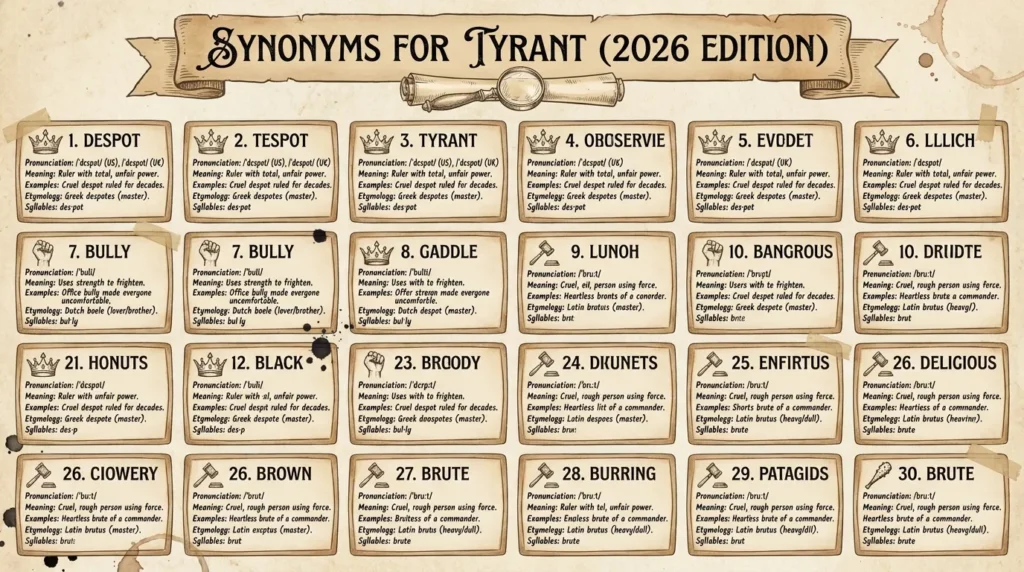
Synonyms for Tyrant
1. Despot (Noun) — US: /ˈdɛspət/ | UK: /ˈdɛspɒt/
Meaning: A ruler with total power who often treats people unfairly.
Examples:
- The despot ruled the small country for decades.
- History remembers him as a cruel despot.
2. Dictator (Noun) — US: /ˈdɪkˌteɪtər/ | UK: /dɪkˈteɪtə/
Meaning: A leader who holds total control and does not let anyone disagree.
Examples:
- The dictator controlled every part of the government.
- People lived in fear under the harsh dictator.
3. Autocrat (Noun) — US: /ˈɔːtəˌkræt/ | UK: /ˈɔːtəkræt/
Meaning: A ruler who has complete power and makes decisions alone.
Examples:
- The autocrat ignored the advice of his own council.
- The autocrat ruled without caring about the people’s wishes.
4. Oppressor (Noun) — US: /əˈprɛsər/ | UK: /əˈprɛsə/
Meaning: A person who treats others cruelly and unfairly using power.
Examples:
- The rebels fought against their cruel oppressor.
- The oppressor silenced anyone who spoke out.
5. Authoritarian (Noun) — US: /əˌθɔːrɪˈtɛriən/ | UK: /ɔːˌθɒrɪˈtɛəriən/
Meaning: A leader who demands strict obedience and allows little freedom.
Examples:
- The authoritarian punished any sign of disagreement.
- Life under the authoritarian was strict and fearful.
6. Tormentor (Noun) — US: /tɔːrˈmɛntər/ | UK: /tɔːˈmɛntə/
Meaning: Someone who causes great suffering to others.
Examples:
- The villagers lived in fear of their tormentor.
- The story’s tormentor showed no mercy.
7. Bully (Noun) — US: /ˈbʊli/ | UK: /ˈbʊli/
Meaning: A person who uses strength or power to frighten or hurt others.
Examples:
- The office bully made everyone uncomfortable.
- No one dared to stand up to the bully.
8. Overlord (Noun) — US: /ˈoʊvərˌlɔːrd/ | UK: /ˈəʊvəˌlɔːd/
Meaning: A powerful ruler who controls others with strict authority.
Examples:
- The overlord demanded loyalty from every village.
- The kingdom suffered under its harsh overlord.
9. Absolutist (Noun) — US: /ˈæbsəˌluːtɪst/ | UK: /ˈæbsəluːtɪst/
Meaning: A ruler who holds unlimited power with no checks or limits.
Examples:
- The absolutist crushed any attempt at reform.
- His rule as an absolutist lasted for thirty years.
10. Strongman (Noun) — US: /ˈstrɔːŋˌmæn/ | UK: /ˈstrɒŋmæn/
Meaning: A powerful leader who rules through force and control.
Examples:
- The strongman used the army to keep control.
- Citizens feared speaking against the strongman.
11. Persecutor (Noun) — US: /ˈpɜːrsɪˌkjuːtər/ | UK: /ˈpɜːsɪkjuːtə/
Meaning: Someone who treats others cruelly because of their beliefs or identity.
Examples:
- The persecutor targeted anyone who disagreed with him.
- Many fled the land to escape the persecutor.
12. Subjugator (Noun) — US: /ˈsʌbdʒʊˌɡeɪtər/ | UK: /ˈsʌbdʒʊɡeɪtə/
Meaning: A person who forces others under strict control.
Examples:
- The subjugator conquered several neighboring lands.
- The people resisted their harsh subjugator.
13. Martinet (Noun) — US: /ˌmɑːrtɪˈnɛt/ | UK: /ˌmɑːtɪˈnɛt/
Meaning: A strict leader who demands exact obedience to rules.
Examples:
- The martinet punished even small mistakes harshly.
- His coach was a real martinet during practice.
14. Taskmaster (Noun) — US: /ˈtæskˌmæstər/ | UK: /ˈtɑːskˌmɑːstə/
Meaning: A person who forces others to work hard, often unfairly.
Examples:
- The factory owner was a harsh taskmaster.
- Her boss acted like a strict taskmaster.
15. Slave driver (Noun) — US: /sleɪv ˈdraɪvər/ | UK: /sleɪv ˈdraɪvə/
Meaning: A person who forces others to work extremely hard without care.
Examples:
- The manager was called a slave driver by his tired staff.
- Working under a slave driver left the team exhausted.
16. Iron-fisted ruler (Noun) — US: /ˈaɪərn ˈfɪstɪd ˈruːlər/ | UK: /ˈaɪən ˈfɪstɪd ˈruːlə/
Meaning: A ruler who controls with strict and unbending force.
Examples:
- The iron-fisted ruler allowed no protests.
- The country was led by an iron-fisted ruler for years.
17. Totalitarian leader (Noun) — US: /toʊˌtælɪˈtɛriən ˈliːdər/ | UK: /təʊˌtælɪˈtɛəriən ˈliːdə/
Meaning: A leader who controls every part of people’s lives.
Examples:
- Under the totalitarian leader, even speech was controlled.
- The totalitarian leader banned free elections.
18. Tyrannizer (Noun) — US: /ˈtɪrəˌnaɪzər/ | UK: /ˈtɪrənaɪzə/
Meaning: A person who rules or treats others with great cruelty.
Examples:
- The tyrannizer punished the smallest mistakes.
- The kingdom suffered under its cruel tyrannizer.
19. Oppressive ruler (Noun) — US: /əˈprɛsɪv ˈruːlər/ | UK: /əˈprɛsɪv ˈruːlə/
Meaning: A ruler who limits freedom and treats people unfairly.
Examples:
- The oppressive ruler silenced the free press.
- People suffered under the oppressive ruler’s harsh laws.
20. Tyrannical leader (Noun) — US: /tɪˈrænɪkəl ˈliːdər/ | UK: /tɪˈrænɪkəl ˈliːdə/
Meaning: A leader who rules with cruelty and unfair power.
Examples:
- The tyrannical leader crushed anyone who disagreed with him.
- History remembers him as a tyrannical leader.
21. Warlord (Noun) — US: /ˈwɔːrˌlɔːrd/ | UK: /ˈwɔːlɔːd/
Meaning: A powerful military leader who rules an area through force.
Examples:
- The warlord controlled the region with his private army.
- Local warlords often fought each other for land.
22. Potentate (Noun) — US: /ˈpoʊtənˌteɪt/ | UK: /ˈpəʊtənteɪt/
Meaning: A powerful ruler, often used to describe someone with harsh control.
Examples:
- The potentate ruled with absolute authority.
- No one questioned the powerful potentate.
23. Autarch (Noun) — US: /ˈɔːtɑːrk/ | UK: /ˈɔːtɑːk/
Meaning: A ruler who holds all the power alone, with no one to share it.
Examples:
- The autarch made every decision alone.
- The nation lived under the rule of an autarch.
24. Draconian ruler (Noun) — US: /drəˈkoʊniən ˈruːlər/ | UK: /drəˈkəʊniən ˈruːlə/
Meaning: A ruler known for extremely harsh laws and punishments.
Examples:
- The draconian ruler punished small crimes severely.
- Citizens feared the draconian ruler’s strict laws.
25. Domineering leader (Noun) — US: /ˌdɑːmɪˈnɪrɪŋ ˈliːdər/ | UK: /ˌdɒmɪˈnɪərɪŋ ˈliːdə/
Meaning: A leader who controls others in a forceful, bossy way.
Examples:
- The domineering leader ignored everyone else’s opinions.
- Her domineering leader made decisions without any discussion.
26. Harsh ruler (Noun) — US: /hɑːrʃ ˈruːlər/ | UK: /hɑːʃ ˈruːlə/
Meaning: A ruler who treats people with strictness and little kindness.
Examples:
- The harsh ruler raised taxes without warning.
- People lived carefully under the harsh ruler.
27. Cruel ruler (Noun) — US: /ˈkruːəl ˈruːlər/ | UK: /ˈkruːəl ˈruːlə/
Meaning: A ruler who causes suffering through unkind and unfair actions.
Examples:
- The cruel ruler showed no mercy to his enemies.
- Stories tell of a cruel ruler who feared no one.
28. Repressor (Noun) — US: /rɪˈprɛsər/ | UK: /rɪˈprɛsə/
Meaning: A person who controls others by limiting their freedom.
Examples:
- The repressor silenced any form of protest.
- Citizens lived quietly under the strict repressor.
29. Enslaver (Noun) — US: /ɪnˈsleɪvər/ | UK: /ɪnˈsleɪvə/
Meaning: A person who forces others into being controlled or unfree.
Examples:
- The enslaver ruled through fear and control.
- History remembers the cruelty of the enslaver.
30. Brute (Noun) — US: /bruːt/ | UK: /bruːt/
Meaning: A cruel and rough person who uses force to control others.
Examples:
- The story’s villain was portrayed as a heartless brute.
- The soldiers feared their brute of a commander.
Prototype Meaning
When people hear the word “tyrant,” they think of a cruel ruler who scares and controls people. A tyrant may use unfair rules and punish people. This word can describe cruel kings, queens, leaders, or even bosses who treat people badly.. It carries a strong feeling of injustice and fear.
Prototype Categorization
- Political rulers: despot, dictator, autocrat, absolutist, autarch, potentate
- Military or forceful leaders: warlord, strongman, iron-fisted ruler, totalitarian leader
- Cruel or harsh authority: oppressor, oppressive ruler, cruel ruler, harsh ruler, draconian ruler
- Strict or controlling figures: authoritarian, martinet, taskmaster, domineering leader, repressor
- Everyday cruel figures: bully, tormentor, brute, slave driver
- Those who force control on others: subjugator, persecutor, tyrannizer, enslaver, tyrannical leader, overlord
Antonyms of Tyrant
- Liberator
- Protector
- Democrat
- Benefactor
- Guardian
Short Questions and Answers
- What does tyrant mean?
- It means a ruler or person who uses power in a cruel and unfair way.
- When should tyrant be used?
- Use it when describing a leader, boss, or person who treats others harshly and unfairly through power.
- Is tyrant positive or negative?
- It is almost always negative, showing cruelty, fear, and unjust control.
- How is it different from similar words?
- “Dictator” often describes a specific kind of political leader with total control. “Tyrant” is broader and can describe any person, ruler, or figure who acts cruelly using their power.
Conclusion
Synonyms for tyrant helps you build a stronger, more precise vocabulary. It strengthens your writing and speaking by giving you many ways to describe unfair power. Synonyms for tyrant also helps you avoid repeating the same word again and again. Which keeps your writing clearer and more expressive. Most importantly, learning new synonyms for tyrant builds your confidence as an English speaker and writer. Try learning one new word from this list each day, and watch your vocabulary grow steadily over time.

I’m Zahid Abbas, an educator, researcher, and digital publishing strategist with a passion for linguistics, grammar, and clear communication. As a content creator and SEO specialist, I craft research-driven, reader-focused content that empowers learners and makes knowledge accessible worldwide.