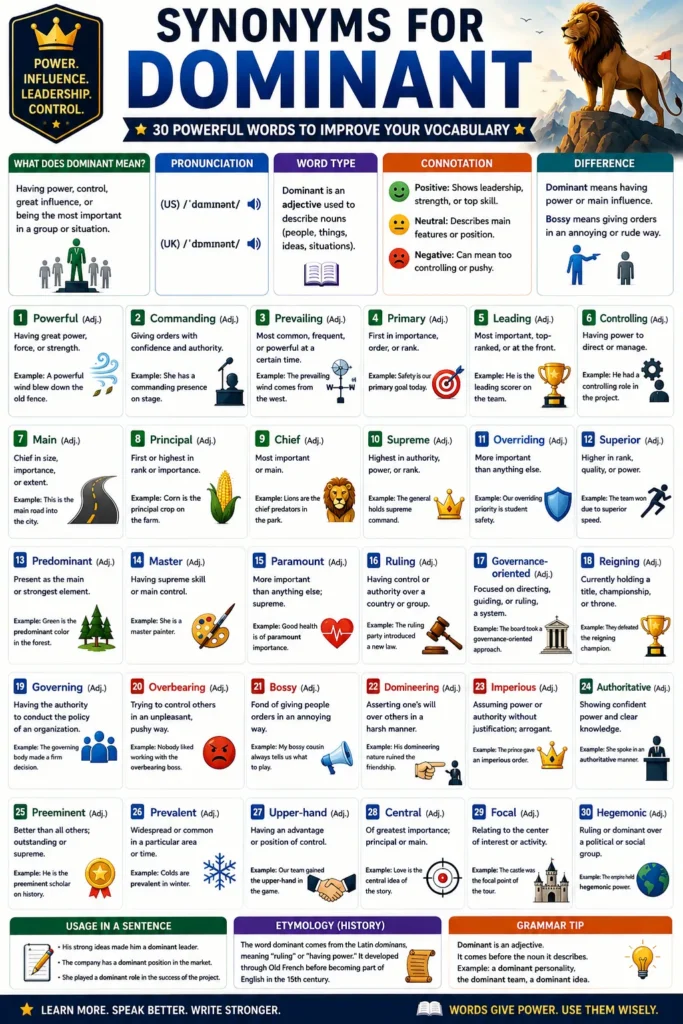
The word dominant describes something or someone that has power, control, or the strongest influence. Picture a tall lion leading a pride of animals, or the tallest tree in a forest blocking out the sun. That lion and that tree are dominant. People use synonyms for dominant often because power, control, and leadership are part of everyday life. Learning synonyms for dominant helps English learners and writers avoid repeating the same word. It also helps them express ideas clearly and make their writing stronger. This guide explains the meaning, history, pronunciation, grammar. And also 30 useful synonyms for dominant, with simple examples and helpful categories.
Meaning of Dominant
Definition
Dominant (Adjective): Having power, control, authority, or main influence over others.
Examples
- The lion is the dominant animal in the savanna.
- Her team played a dominant game and won easily.
Connotative Meaning
- Positive tone: Represents strong leadership, confidence, excellence, and success.
- Negative tone: Can imply bossiness, harsh control, or pushing others around.
- Neutral tone: Describes the most common, largest, or main feature in a group.
Etymology
- Source language: Comes from the Latin word dominari, which means “to rule” or “to govern.”
- Old English (450–1100): The word dominant was not used in Old English. People used other words, such as rice, to describe someone powerful or ruling.
- Middle English (1100–1500): The word came from Old French and Latin. It was first used to describe strong influence, including the influence of planets.
- Modern English (1500–Present): The meaning grew to describe powerful people, leading businesses, common genetic traits, and the most important features of something.
Pronunciation
- US: /ˈdɑːmɪnənt/
- UK: /ˈdɒmɪnənt/
Syllables
dom-i-nant (3 parts)
Affixation Pattern of Dominant
- Root: Domin- (from Latin dominus, meaning master or lord)
- Prefix: None
- Suffix: -ant (adjective maker meaning “performing an action”)
- Word Formation:
- Verb: Dominate
- Noun: Dominance / Domination
- Adjective: Dominant
- Adverb: Dominantly
Read our guide on https://synonymhubb.com/synonyms-for-systemic/
Synonyms for Dominant
1. Powerful (Adjective) — US: /ˈpaʊərfəl/ | UK: /ˈpaʊəfl/
Meaning: Having great power, force, or strength.
Examples:
The powerful king ruled the land wisely.
A powerful wind blew down the old fence.
2. Commanding (Adjective) — US: /kəˈmændɪŋ/ | UK: /kəˈmɑːndɪŋ/
Meaning: Giving orders with confidence and authority.
Examples:
The captain spoke in a commanding voice.
She has a commanding presence on stage.
3. Prevailing (Adjective) — US: /prɪˈveɪlɪŋ/ | UK: /prɪˈveɪlɪŋ/
Meaning: Most common, frequent, or powerful at a certain time.
Examples:
The prevailing wind comes from the west.
That was the prevailing opinion among the voters.
4. Primary (Adjective) — US: /ˈpraɪmɛri/ | UK: /ˈpraɪməri/
Meaning: First in importance, order, or rank.
Examples:
Safety is our primary goal today.
Her primary duty is helping customers.
5. Leading (Adjective) — US: /ˈliːdɪŋ/ | UK: /ˈliːdɪŋ/
Meaning: Most important, top-ranked, or at the front.
Examples:
He is the leading scorer on the soccer team.
She works for a leading tech company.
6. Controlling (Adjective) — US: /kənˈtroʊlɪŋ/ | UK: /kənˈtrəʊlɪŋ/
Meaning: Having power to direct or manage things.
Examples:
The company holds a controlling share in the business.
He had a controlling role in the project.
7. Main (Adjective) — US: /meɪn/ | UK: /meɪn/
Meaning: Chief in size, importance, or extent.
Examples:
This is the main road into the city.
Our main dish tonight is chicken soup.
8. Principal (Adjective) — US: /ˈprɪnsəpəl/ | UK: /ˈprɪnsəpl/
Meaning: First or highest in rank or importance.
Examples:
Corn is the principal crop grown on the farm.
His principal reason for leaving was work.
9. Chief (Adjective) — US: /tʃiːf/ | UK: /tʃiːf/
Meaning: Most important or main.
Examples:
Lions are the chief predators in the park.
Her chief concern was getting home safely.
10. Supreme (Adjective) — US: /suːˈpriːm/ | UK: /suːˈpriːm/
Meaning: Highest in authority, power, or rank.
Examples:
The general holds supreme command of the army.
They treated the ruler with supreme respect.
11. Overriding (Adjective) — US: /ˌoʊvərˈraɪdɪŋ/ | UK: /ˌəʊvəˈraɪdɪŋ/
Meaning: More important than anything else.
Examples:
Our overriding priority is student safety.
Winning the game was his overriding desire.
12. Superior (Adjective) — US: /suːˈpɪriər/ | UK: /suːˈpɪəriə/
Meaning: Higher in rank, quality, or power.
Examples:
The team won due to superior speed.
He reported the news to his superior officer.
13. Predominant (Adjective) — US: /prɪˈdɑːmɪnənt/ | UK: /prɪˈdɒmɪnənt/
Meaning: Present as the main or strongest element.
Examples:
Green is the predominant color in the forest.
English is the predominant language spoken there.
14. Master (Adjective) — US: /ˈmæstər/ | UK: /ˈmɑːstə/
Meaning: Having supreme skill or main control.
Examples:
He followed a master plan to build the house.
She is a master painter with years of practice.
15. Paramount (Adjective) — US: /ˈpærəmaʊnt/ | UK: /ˈpærəmaʊnt/
Meaning: More important than anything else; supreme.
Examples:
Good health is of paramount importance.
Truth is paramount in court cases.
16. Ruling (Adjective) — US: /ˈruːlɪŋ/ | UK: /ˈruːlɪŋ/
Meaning: Having control or authority over a country or group.
Examples:
The ruling party introduced a new law.
The ruling class lived in the castle.
17. Governance-oriented (Adjective) — US: /ˈɡʌvərnəns ˈɔːriɛntɪd/ | UK: /ˈɡʌvənəns ˈɔːriəntɪd/
Meaning: Focused on directing, guiding, or ruling a system.
Examples:
The board took a governance-oriented approach to the issue.
They made governance-oriented rules for the school.
18. Reigning (Adjective) — US: /ˈreɪnɪŋ/ | UK: /ˈreɪnɪŋ/
Meaning: Currently holding a title, championship, or throne.
Examples:
They defeated the reigning champion in the final match.
The reigning queen greeted the crowd.
19. Governing (Adjective) — US: /ˈɡʌvərnɪŋ/ | UK: /ˈɡʌvənɪŋ/
Meaning: Having the authority to conduct the policy of an organization.
Examples:
The governing body made a firm decision.
He joined the governing board of the hospital.
20. Overbearing (Adjective) — US: /ˌoʊvərˈbɛrɪŋ/ | UK: /ˌəʊvəˈbeərɪŋ/
Meaning: Trying to control others in an unpleasant, pushy way.
Examples:
Nobody liked working with the overbearing boss.
Her overbearing style pushed people away.
21. Bossy (Adjective) — US: /ˈbɔːsi/ | UK: /ˈbɒsi/
Meaning: Fond of giving people orders in an annoying way.
Examples:
My bossy cousin always tells us what to play.
Try to ask nicely instead of being bossy.
22. Domineering (Adjective) — US: /ˌdɑːmɪˈnɪrɪŋ/ | UK: /ˌdɒmɪˈnɪərɪŋ/
Meaning: Asserting one’s will over others in a harsh manner.
Examples:
His domineering nature ruined the friendship.
She left the room to avoid his domineering words.
23. Imperious (Adjective) — US: /ɪmˈpɪriəs/ | UK: /ɪmˈpɪəriəs/
Meaning: Assuming power or authority without justification; arrogant.
Examples:
He made an imperious gesture demanding quiet.
The prince gave an imperious order to his guards.
24. Authoritative (Adjective) — US: /əˈθɔːrətətɪv/ | UK: /ɔːˈθɒrətətɪv/
Meaning: Showing confident power and clear knowledge.
Examples:
She spoke in an authoritative manner during the talk.
This book is an authoritative source on birds.
25. Preeminent (Adjective) — US: /priːˈɛmɪnənt/ | UK: /priːˈemɪnənt/
Meaning: Better than all others; outstanding or supreme.
Examples:
He is the preeminent scholar on world history.
The city is the preeminent art center of the country.
26. Prevalent (Adjective) — US: /ˈprɛvələnt/ | UK: /ˈprevələnt/
Meaning: Widespread or common in a particular area or time.
Examples:
Colds are prevalent during the cold winter months.
That belief was prevalent many years ago.
27. Upper-hand (Adjective) — US: /ˈʌpər hænd/ | UK: /ˈʌpə hænd/
Meaning: Having an advantage or position of control.
Examples:
Our team gained an upper-hand position in the game.
She held an upper-hand advantage during negotiations.
28. Central (Adjective) — US: /ˈsɛntrəl/ | UK: /ˈsentrəl/
Meaning: Of greatest importance; principal or main.
Examples:
The central theme of the book is friendship.
Love is the central idea of the story.
29. Focal (Adjective) — US: /ˈfoʊkəl/ | UK: /ˈfəʊkl/
Meaning: Relating to the center of interest or activity.
Examples:
The castle was the focal point of the tour.
She was the focal figure in the news report.
30. Hegemonic (Adjective) — US: /ˌhɛdʒəˈmɑːnɪk/ | UK: /ˌhɪˈdʒemənɪk/
Meaning: Ruling or dominant over a political or social group.
Examples:
The empire held hegemonic power over neighboring lands.
They fought against the hegemonic influence of the state.
Prototype Meaning
When people hear dominant, they often think of something that is powerful than others. For example, it could be a strong leader, a team that keeps winning, or a tall building that stands above all the others.
Prototype Categorization
- Power & Leadership: Powerful, Commanding, Supreme, Ruling, Governance-oriented, Reigning, Governing, Preeminent, Hegemonic, Upper-hand.
- Main & Most Important: Primary, Leading, Controlling, Main, Principal, Chief, Overriding, Superior, Predominant, Master, Paramount, Central, Focal.
- Widespread & Common: Prevailing, Prevalent.
- Bossy & Pushy Control: Overbearing, Bossy, Domineering, Imperious, Authoritative.
Antonyms of Dominant
- Submissive
- Weak
- Minor
- Secondary
- Humble
- Yielding
Short Questions and Answers
- What does dominant mean?
- It means having power, control, authority, or main influence over others.
- When should dominant be used?
- Use it when describing top leaders, main ideas, winning teams, or things that stand out above the rest.
- Is dominant positive or negative?
- Dominant can be positive, neutral, or negative. It can mean strong and powerful, the main or most important, or too controlling.
- How is dominant different from bossy?
- Dominant means having more power, control, or influence. Bossy means often telling others what to do in an annoying or rude way.
Conclusion
Synonyms for dominant can help you describe power, control, influence, and importance clearly. The right word depends on the situation and the meaning you want to express. By learning these words and using them in sentences, you can improve your vocabulary. And also make your writing more natural and effective. Keep practicing synonyms for dominant in daily conversations, reading, and writing to use them with confidence.

I’m Zahid Abbas, an educator, researcher, and digital publishing strategist with a passion for linguistics, grammar, and clear communication. As a content creator and SEO specialist, I craft research-driven, reader-focused content that empowers learners and makes knowledge accessible worldwide.