The word aspect means a part, feature, side, or quality of something. Imagine a student talking about school life. One aspect may be studying, while another aspect may be sports or friendships. The word helps people explain different parts of a topic clearly.
People use aspect often in education, business, writing, science, and daily conversations. It is a useful English word because it helps describe details and viewpoints. However, repeating the same word too often can make speaking and writing less interesting.
Learning synonyms of aspect helps English learners improve vocabulary and communicate ideas more naturally. It also helps writers avoid repetition and choose more accurate words for different situations. In this article, you will learn the meaning of aspect, its pronunciation, history, grammar, and 30 useful synonyms with examples. You will also explore semantic categories, antonyms, and common questions to strengthen your English skills.
Meaning of Aspect
Definition
Aspect (noun): a particular part, feature, side, or quality of something.
Examples
- One important aspect of learning is practice.
- Safety is an important aspect of driving.
Connotative Meaning
- Positive tone: useful feature, strong quality, helpful side
- Negative tone: problematic side, difficult feature
- Neutral tone: a part or characteristic of something
Etymology
- From Latin aspectus meaning “appearance” or “view”
- Entered English through French and Latin influence
Short History:
- Old English (450–1100): similar words described appearance and view
- Middle English (1100–1500): “aspect” became linked with appearance and position
- Modern English (1500–Present): widely used for features, sides, and viewpoints
Pronunciation (US & UK – IPA)
- US: /ˈæspekt/
- UK: /ˈæspekt/
Syllables
- as-pect
Affixation Pattern of Aspect
- Root: aspect
- Prefix: none
- Suffix: none
Word Formation:
- aspect (noun)
- aspects (plural noun)
- aspectual (adjective)
- aspectually (adverb)
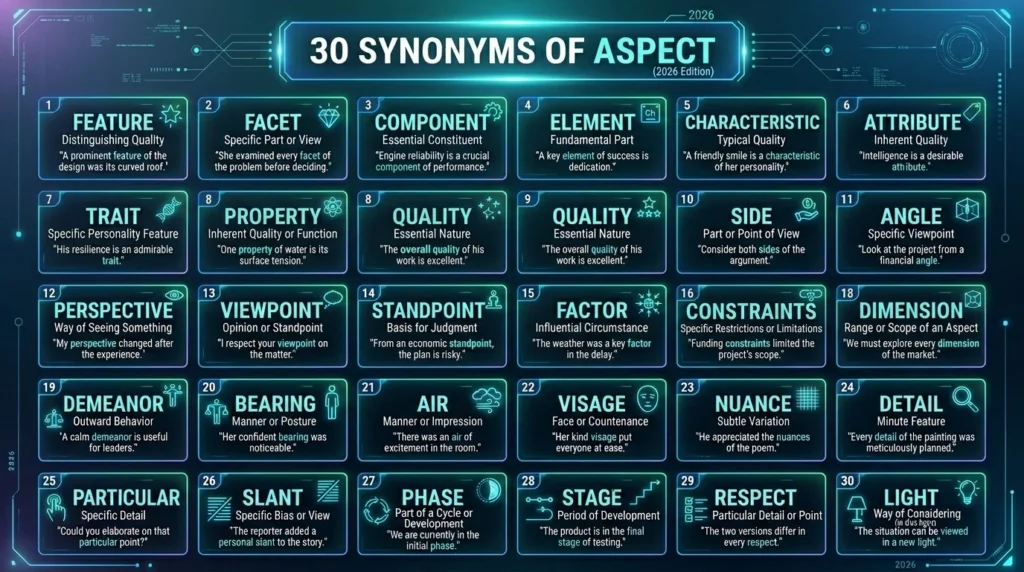
30 Synonyms of Aspect
1. Feature (noun)
US: /ˈfiːtʃər/ | UK: /ˈfiːtʃə/
Meaning: an important part or quality of something
Examples:
- This phone has a useful feature.
- Safety is a key feature of the system.
2. Part (noun)
US: /pɑːrt/ | UK: /pɑːt/
Meaning: a section of something larger
Examples:
- Exercise is part of a healthy life.
- This is the best part of the movie.
3. Side (noun)
US: /saɪd/ | UK: /saɪd/
Meaning: one viewpoint or section
Examples:
- We discussed the financial side of the project.
- There is another side to the story.
4. Element (noun)
US: /ˈelɪmənt/ | UK: /ˈelɪmənt/
Meaning: a basic part of something
Examples:
- Trust is an important element of friendship.
- Water is a natural element.
5. Factor (noun)
US: /ˈfæktər/ | UK: /ˈfæktə/
Meaning: something that influences a result
Examples:
- Cost is a major factor.
- Weather was an important factor.
6. Characteristic (noun)
US: /ˌkærɪktəˈrɪstɪk/ | UK: /ˌkærəktəˈrɪstɪk/
Meaning: a quality that makes something different
Examples:
- Patience is a good characteristic.
- Bright colors are a characteristic of the design.
7. Trait (noun)
US: /treɪt/ | UK: /treɪt/
Meaning: a particular quality in someone or something
Examples:
- Honesty is a strong trait.
- Kindness is an important trait.
8. Attribute (noun)
US: /ˈætrɪˌbjuːt/ | UK: /ˈætrɪbjuːt/
Meaning: a quality or feature
Examples:
- Confidence is a positive attribute.
- Speed is an important attribute.
9. Component (noun)
US: /kəmˈpoʊnənt/ | UK: /kəmˈpəʊnənt/
Meaning: one part of a larger system
Examples:
- The engine is a major component.
- Education is a key component of success.
10. Dimension (noun)
US: /daɪˈmenʃən/ | UK: /daɪˈmenʃən/
Meaning: a particular side or feature
Examples:
- The issue has many dimensions.
- We studied the social dimension.
11. Angle (noun)
US: /ˈæŋɡəl/ | UK: /ˈæŋɡəl/
Meaning: a viewpoint or way of thinking
Examples:
- Reporters discussed the political angle.
- Look at the problem from another angle.
12. Perspective (noun)
US: /pərˈspektɪv/ | UK: /pəˈspektɪv/
Meaning: a way of seeing something
Examples:
- Her perspective is interesting.
- Travel changes your perspective.
13. Point (noun)
US: /pɔɪnt/ | UK: /pɔɪnt/
Meaning: a specific detail or idea
Examples:
- That is an important point.
- He explained every point clearly.
14. Phase (noun)
US: /feɪz/ | UK: /feɪz/
Meaning: a stage or period
Examples:
- The project entered a new phase.
- Childhood is an important phase of life.
15. Facet (noun)
US: /ˈfæsɪt/ | UK: /ˈfæsɪt/
Meaning: one side or feature of something complex
Examples:
- Leadership has many facets.
- We studied every facet of the issue.
16. Detail (noun)
US: /ˈdiːteɪl/ | UK: /ˈdiːteɪl/
Meaning: a small part of something
Examples:
- He explained every detail.
- The painting has beautiful details.
17. Appearance (noun)
US: /əˈpɪrəns/ | UK: /əˈpɪərəns/
Meaning: the way something looks
Examples:
- Her appearance changed greatly.
- The building has a modern appearance.
18. Outlook (noun)
US: /ˈaʊtlʊk/ | UK: /ˈaʊtlʊk/
Meaning: attitude or viewpoint
Examples:
- She has a positive outlook.
- His economic outlook is hopeful.
19. Shape (noun)
US: /ʃeɪp/ | UK: /ʃeɪp/
Meaning: the form or condition of something
Examples:
- The table has a round shape.
- The plan is taking shape.
20. Nature (noun)
US: /ˈneɪtʃər/ | UK: /ˈneɪtʃə/
Meaning: the basic quality of something
Examples:
- We discussed the true nature of the problem.
- Kindness is part of her nature.
21. Form (noun)
US: /fɔːrm/ | UK: /fɔːm/
Meaning: the structure or arrangement of something
Examples:
- Water exists in liquid form.
- Art takes many forms.
22. Style (noun)
US: /staɪl/ | UK: /staɪl/
Meaning: a particular way of doing something
Examples:
- Her writing style is clear.
- The house has a modern style.
23. Condition (noun)
US: /kənˈdɪʃən/ | UK: /kənˈdɪʃən/
Meaning: the state of something
Examples:
- The car is in good condition.
- Health is an important condition for success.
24. Quality (noun)
US: /ˈkwɑːləti/ | UK: /ˈkwɒləti/
Meaning: a special feature or standard
Examples:
- Honesty is a valuable quality.
- This product has high quality.
25. Section (noun)
US: /ˈsekʃən/ | UK: /ˈsekʃən/
Meaning: one part of a larger whole
Examples:
- Read the last section carefully.
- This section explains grammar.
26. Category (noun)
US: /ˈkætəɡɔːri/ | UK: /ˈkætəɡəri/
Meaning: a group with similar features
Examples:
- Fruits belong to one category.
- The book fits this category.
27. Segment (noun)
US: /ˈseɡmənt/ | UK: /ˈseɡmənt/
Meaning: a separate part of something
Examples:
- The show has a music segment.
- We watched the final segment.
28. Interpretation (noun)
US: /ɪnˌtɜːrprəˈteɪʃən/ | UK: /ɪnˌtɜːprɪˈteɪʃən/
Meaning: a personal understanding or explanation
Examples:
- Everyone has a different interpretation.
- His interpretation was creative.
29. Viewpoint (noun)
US: /ˈvjuːpɔɪnt/ | UK: /ˈvjuːpɔɪnt/
Meaning: an opinion or perspective
Examples:
- I respect your viewpoint.
- The article presents another viewpoint.
30. Observation (noun)
US: /ˌɑːbzərˈveɪʃən/ | UK: /ˌɒbzəˈveɪʃən/
Meaning: something noticed or observed
Examples:
- Her observation was correct.
- Scientists recorded every observation.
Prototype Meaning
The most common meaning of aspect is a particular part or side of something. People usually imagine different features of a topic, such as the financial aspect, social aspect, or educational aspect of life.
Prototype Categorization
- Parts and sections: part, section, segment
- Qualities and features: characteristic, trait, quality
- Viewpoints and opinions: perspective, angle, viewpoint
- Structure and organization: component, category, dimension
Antonyms of Aspect
- Whole (noun): the complete thing
- Totality (noun): everything together
- Entirety (noun): full amount or complete state
- Unity (noun): complete combination into one
- Sameness (noun): lack of differences or parts
Short Questions and Answers
What does aspect mean?
- It means a part, feature, or side of something.
When should aspect be used?
- Use it when discussing different features, viewpoints, or parts of a topic.
Is aspect positive or negative?
- It is usually neutral, but context can make it positive or negative.
How is it different from similar words?
- “Aspect” focuses on one side or feature, while “part” is more general.
Conclusion
Learning Synonyms of Aspect and Synonyms of Aspect improves vocabulary and communication skills. These words help English learners describe ideas, viewpoints, qualities, and features more clearly in speaking and writing. Using different synonyms also avoids repetition and makes language more natural and engaging.
Understanding synonyms of aspect builds confidence in conversations, essays, presentations, and professional communication. These words allow writers to express ideas with greater accuracy and detail. Practice learning and using new vocabulary every day. Small daily efforts can greatly improve English fluency, writing quality, and speaking confidence over time.

I’m Zahid Abbas, an educator, researcher, and digital publishing strategist with a passion for linguistics, grammar, and clear communication. As a content creator and SEO specialist, I craft research-driven, reader-focused content that empowers learners and makes knowledge accessible worldwide.