The word elite means a group or person considered the best, most powerful, or highly skilled. Imagine a student winning top honors in school and joining a special academic team. That student may be called part of the elite group because of excellent performance and ability.
People use this word in education, sports, business, politics, fashion, and social life. It is a common English word because it describes excellence, status, and high quality. However, using the same word many times can make writing repetitive and less interesting.
Learning synonyms of elite helps English learners improve vocabulary and express ideas more clearly. It also helps writers choose the best word for different situations and tones. In this article, you will learn the meaning of elite, its pronunciation, history, grammar, and 30 useful synonyms with examples, categories, and antonyms to strengthen your English communication skills.
Meaning of Elite
Definition
Elite (noun/adjective): a person or group considered superior because of skill, quality, wealth, or power.
Examples
- She studied at an elite university.
- The athlete joined an elite training team.
Connotative Meaning
- Positive tone: excellent, successful, skilled
- Negative tone: proud, exclusive, privileged
- Neutral tone: high-ranking or superior group
Etymology
- From French élite meaning “chosen” or “selected”
- Derived from Old French and Latin roots connected to selection
Short History:
- Old English (450–1100): no direct use of elite
- Middle English (1100–1500): ideas of noble and superior groups existed
- Modern English (1500–Present): “elite” became common for powerful or outstanding groups
Pronunciation (US & UK – IPA)
- US: /eɪˈliːt/ or /ɪˈliːt/
- UK: /eɪˈliːt/
Syllables
- e-lite
Affixation Pattern of Elite
- Root: elite
- Prefix: none
- Suffix: none
Word Formation:
- elite (noun/adjective)
- elitism (noun)
- elitist (noun/adjective)
- elitistic (adjective)
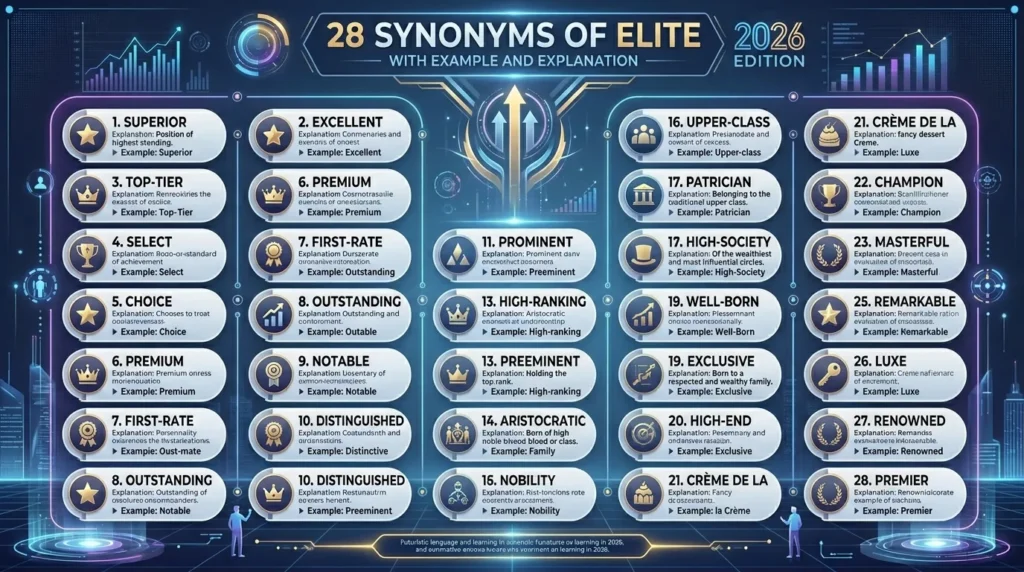
30 Synonyms of Elite
1. Superior (adjective)
US: /suːˈpɪriər/ | UK: /suːˈpɪəriə/
Meaning: better than others in quality or ability
Examples:
- This product is superior in quality.
- She showed superior skills.
2. Excellent (adjective)
US: /ˈeksələnt/ | UK: /ˈeksələnt/
Meaning: extremely good
Examples:
- He did an excellent job.
- The school has an excellent reputation.
3. Outstanding (adjective)
US: /aʊtˈstændɪŋ/ | UK: /aʊtˈstændɪŋ/
Meaning: clearly better than others
Examples:
- She gave an outstanding performance.
- The student received outstanding grades.
4. Premier (adjective)
US: /prɪˈmɪr/ | UK: /ˈpremiə/
Meaning: first in importance or quality
Examples:
- It is a premier institution.
- He joined a premier club.
5. Top-tier (adjective)
US: /ˌtɑːp ˈtɪr/ | UK: /ˌtɒp ˈtɪə/
Meaning: belonging to the highest level
Examples:
- She works for a top-tier company.
- The athlete received top-tier coaching.
6. First-class (adjective)
US: /ˌfɜːrst ˈklæs/ | UK: /ˌfɜːst ˈklɑːs/
Meaning: of the best quality
Examples:
- They offered first-class service.
- He stayed in a first-class hotel.
7. High-ranking (adjective)
US: /ˌhaɪ ˈræŋkɪŋ/ | UK: /ˌhaɪ ˈræŋkɪŋ/
Meaning: holding an important position
Examples:
- She met a high-ranking officer.
- The event included high-ranking guests.
8. Distinguished (adjective)
US: /dɪˈstɪŋɡwɪʃt/ | UK: /dɪˈstɪŋɡwɪʃt/
Meaning: respected and successful
Examples:
- He is a distinguished scientist.
- The school invited a distinguished speaker.
9. Prestigious (adjective)
US: /preˈstɪdʒəs/ | UK: /preˈstɪdʒəs/
Meaning: admired and respected
Examples:
- She attended a prestigious university.
- He won a prestigious award.
10. Exclusive (adjective)
US: /ɪkˈskluːsɪv/ | UK: /ɪkˈskluːsɪv/
Meaning: limited to a special group
Examples:
- They joined an exclusive club.
- The event was exclusive.
11. Select (adjective)
US: /sɪˈlekt/ | UK: /sɪˈlekt/
Meaning: carefully chosen
Examples:
- Only a select few attended.
- The school accepted select students.
12. Privileged (adjective)
US: /ˈprɪvəlɪdʒd/ | UK: /ˈprɪvəlɪdʒd/
Meaning: having special advantages
Examples:
- He came from a privileged family.
- Some students receive privileged access.
13. Noble (adjective)
US: /ˈnoʊbəl/ | UK: /ˈnəʊbəl/
Meaning: belonging to a high social class or showing honor
Examples:
- The noble family owned the castle.
- She made a noble decision.
14. Aristocratic (adjective)
US: /əˌrɪstəˈkrætɪk/ | UK: /əˌrɪstəˈkrætɪk/
Meaning: related to the highest social class
Examples:
- They lived an aristocratic lifestyle.
- He came from an aristocratic family.
15. Eminent (adjective)
US: /ˈemɪnənt/ | UK: /ˈemɪnənt/
Meaning: famous and respected
Examples:
- She is an eminent doctor.
- The university hired an eminent professor.
16. Exceptional (adjective)
US: /ɪkˈsepʃənəl/ | UK: /ɪkˈsepʃənəl/
Meaning: unusually excellent
Examples:
- He showed exceptional talent.
- The service was exceptional.
17. Prime (adjective)
US: /praɪm/ | UK: /praɪm/
Meaning: best or most important
Examples:
- This is a prime location.
- She is in her prime years.
18. Champion (noun/adjective)
US: /ˈtʃæmpiən/ | UK: /ˈtʃæmpiən/
Meaning: a winner or top performer
Examples:
- He became a world champion.
- The team trained with champion athletes.
19. Choice (adjective)
US: /tʃɔɪs/ | UK: /tʃɔɪs/
Meaning: of very high quality
Examples:
- They served choice foods.
- The store sells choice products.
20. Finest (adjective)
US: /ˈfaɪnɪst/ | UK: /ˈfaɪnɪst/
Meaning: best in quality
Examples:
- This restaurant serves the finest meals.
- She wore the finest dress.
21. Leading (adjective)
US: /ˈliːdɪŋ/ | UK: /ˈliːdɪŋ/
Meaning: most important or successful
Examples:
- He works at a leading company.
- She is a leading expert.
22. Skilled (adjective)
US: /skɪld/ | UK: /skɪld/
Meaning: highly trained or talented
Examples:
- The team hired skilled workers.
- She is a skilled musician.
23. Accomplished (adjective)
US: /əˈkɑːmplɪʃt/ | UK: /əˈkʌmplɪʃt/
Meaning: highly trained and successful
Examples:
- He is an accomplished writer.
- She became an accomplished artist.
24. Professional (adjective)
US: /prəˈfeʃənəl/ | UK: /prəˈfeʃənəl/
Meaning: showing high skill and quality
Examples:
- The team gave a professional performance.
- She handled the issue professionally.
25. Refined (adjective)
US: /rɪˈfaɪnd/ | UK: /rɪˈfaɪnd/
Meaning: elegant and cultured
Examples:
- He has refined manners.
- The hotel has a refined atmosphere.
26. Superior-class (adjective)
US: /suːˈpɪriər klæs/ | UK: /suːˈpɪəriə klɑːs/
Meaning: belonging to a higher quality level
Examples:
- They sell superior-class products.
- The company offers superior-class service.
27. Influential (adjective)
US: /ˌɪnfluˈenʃəl/ | UK: /ˌɪnfluˈenʃəl/
Meaning: having strong power or effect
Examples:
- She became an influential leader.
- He knows many influential people.
28. Blue-blooded (adjective)
US: /ˈbluː ˌblʌdɪd/ | UK: /ˈbluː ˌblʌdɪd/
Meaning: belonging to a noble family
Examples:
- The story follows a blue-blooded family.
- He had a blue-blooded background.
29. Superior-grade (adjective)
US: /suːˈpɪriər ɡreɪd/ | UK: /suːˈpɪəriə ɡreɪd/
Meaning: of the highest quality level
Examples:
- They use superior-grade materials.
- The company produces superior-grade goods.
30. Best (adjective)
US: /best/ | UK: /best/
Meaning: highest in quality or excellence
Examples:
- She is one of the best players.
- This is the best solution.
Prototype Meaning
The most typical meaning of elite is a person or group considered better, more powerful, or more skilled than others. People usually imagine top students, famous athletes, successful leaders, or exclusive social groups.
Prototype Categorization
- Quality and excellence: superior, excellent, exceptional
- Status and power: prestigious, influential, aristocratic
- Skill and achievement: skilled, accomplished, champion
- Exclusivity and selection: exclusive, select, privileged.
Antonyms of Elite
Antonyms
- Ordinary (adjective): normal and not special
- Average (adjective): typical or common
- Common (adjective): shared by many people
- Inferior (adjective): lower in quality or ability
- Mediocre (adjective): not very good
Short Questions and Answers
What does elite mean?
- It means a person or group considered the best or most powerful.
When should elite be used?
- Use it when describing excellence, high skill, status, or superiority.
Is elite positive or negative?
- It can be positive for excellence but negative when suggesting unfair privilege.
How is it different from similar words?
- “Elite” focuses on superiority and status, while “excellent” mainly focuses on quality.
Conclusion
Learning synonyms of elite and synonyms of elite improves vocabulary and communication skills. These words help English learners describe quality, success, skill, and social status more clearly. Using different synonyms also avoids repetition and makes writing stronger and more engaging. Understanding words related to excellence and superiority helps in academic writing, professional communication, and everyday conversations. These synonyms allow speakers and writers to express ideas with better accuracy and confidence. Practice using new vocabulary every day. Small daily learning habits can greatly improve English fluency, writing quality, and speaking confidence over time.

I’m Zahid Abbas, an educator, researcher, and digital publishing strategist with a passion for linguistics, grammar, and clear communication. As a content creator and SEO specialist, I craft research-driven, reader-focused content that empowers learners and makes knowledge accessible worldwide.