Expertise means having a high level of knowledge or skill in a particular subject or activity. Imagine you need someone to repair your computer. You would trust a person with years of experience and deep knowledge. That person has expertise. We use this word every day when talking about professionals, teachers, doctors, engineers, artists, and many other skilled people.
Learning synonyms of expertise helps English learners speak and write more naturally. It also helps students, bloggers, content writers, and professionals avoid repeating the same word. Different synonyms fit different situations, making communication clearer and stronger. In this article, you will learn the meaning of expertise, its pronunciation, history, grammar, connotation, word formation, and 30 useful synonyms with meanings and examples. You will also discover antonyms, semantic categories, and common questions that will improve your English vocabulary.
Meaning of Expertise
Definition
Expertise (Noun):
The special knowledge, skill, or experience that someone has in a particular subject or job.
Examples
Example 1: The company hired her because of her expertise in marketing.
Example 2: His expertise helped the team solve the problem quickly.
Connotative Meaning
- Positive tone: Shows great skill, talent, knowledge, professionalism, and competence.
- Negative tone: Can suggest someone is overconfident or claims to know more than others in certain contexts.
- Neutral tone: Simply refers to someone’s level of knowledge or skill.
Etymology
- Origin: French expertise
- Source language: Old French
- Original meaning: Examination, expert knowledge, or skill
- Derived from the Latin word expertus, meaning “experienced” or “tested.”
Short History of the Keyword
Old English (450–1100)
The word expertise did not exist during Old English. People used words meaning skill or wisdom instead.
Middle English (1100–1500)
After the Norman French influence, words related to expert entered English.
Modern English (1500–Present)
The noun expertise became common and now refers to professional knowledge or specialized skill.
Pronunciation (US & UK – IPA)
US: /ˌek.spɝˈtiːz/
UK: /ˌek.spɜːˈtiːz/
Syllables
ex-per-tise
Affixation Pattern of Expertise
Root: expert
Prefix: None
Suffix: -ise
Word Formation of Expertise
- Expert (noun)
- Expert (adjective)
- Expertly (adverb)
- Expertise (noun)
- Inexpert (adjective)
- Inexpertly (adverb)
- Inexpertness (noun)
Synonyms of expertise
1. Skill (Noun)
US: /skɪl/ | UK: /skɪl/
Meaning: The ability to do something well.
Examples
- She has excellent cooking skills.
- Reading improves language skills.
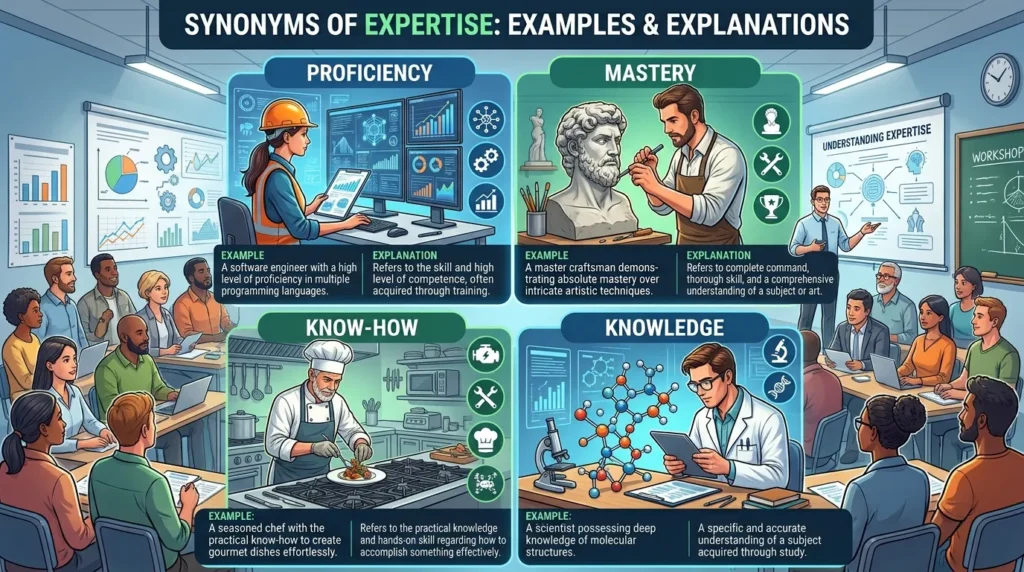
2. Knowledge (Noun)
US: /ˈnɑː.lɪdʒ/ | UK: /ˈnɒl.ɪdʒ/
Meaning: Information and understanding gained through learning.
Examples
- His knowledge of science is impressive.
- Good knowledge helps people make better decisions.
3. Competence (Noun)
US: /ˈkɑːm.pə.təns/ | UK: /ˈkɒm.pɪ.təns/
Meaning: The ability to perform a task successfully.
Examples
- Her competence earned everyone’s respect.
- Employers value competence.
4. Mastery (Noun)
US: /ˈmæs.tɚ.i/ | UK: /ˈmɑː.stər.i/
Meaning: Complete control or deep understanding of a subject.
Examples
- Mastery takes years of practice.
- He showed mastery of mathematics.
5. Proficiency (Noun)
US: /prəˈfɪʃ.ən.si/ | UK: /prəˈfɪʃ.ən.si/
Meaning: A high level of skill.
Examples
- She has English proficiency.
- Computer proficiency is important.
6. Ability (Noun)
US: /əˈbɪl.ə.ti/ | UK: /əˈbɪl.ə.ti/
Meaning: The power or talent to do something.
Examples
- His ability surprised everyone.
- Practice improves ability.
7. Talent (Noun)
US: /ˈtæl.ənt/ | UK: /ˈtæl.ənt/
Meaning: A natural ability to do something well.
Examples
- She has musical talent.
- Talent grows with practice.
8. Experience (Noun)
US: /ɪkˈspɪr.i.əns/ | UK: /ɪkˈspɪə.ri.əns/
Meaning: Knowledge gained through doing something.
Examples
- Experience makes workers better.
- Years of experience helped him succeed.
9. Capability (Noun)
US: /ˌkeɪ.pəˈbɪl.ə.ti/ | UK: /ˌkeɪ.pəˈbɪl.ə.ti/
Meaning: The ability to achieve something.
Examples
- She has great leadership capability.
- The machine has advanced capabilities.
10. Know-how (Noun)
US: /ˈnoʊˌhaʊ/ | UK: /ˈnəʊˌhaʊ/
Meaning: Practical knowledge gained through experience.
Examples
- He has the technical know-how.
- Know-how helps solve problems quickly.
11. Wisdom (Noun)
US: /ˈwɪz.dəm/ | UK: /ˈwɪz.dəm/
Meaning: The ability to make good decisions based on knowledge and experience.
Examples
- Her wisdom guided the whole team.
- Wisdom comes from learning and experience.
12. Insight (Noun)
US: /ˈɪn.saɪt/ | UK: /ˈɪn.saɪt/
Meaning: A deep understanding of a person, problem, or situation.
Examples
- His insight improved the project.
- Good leaders have valuable insight.
13. Understanding (Noun)
US: /ˌʌn.dɚˈstæn.dɪŋ/ | UK: /ˌʌn.dəˈstæn.dɪŋ/
Meaning: Knowledge about how something works.
Examples
- She has a good understanding of history.
- Understanding grows through study.
14. Authority (Noun)
US: /əˈθɔːr.ə.t̬i/ | UK: /ɔːˈθɒr.ə.ti/
Meaning: Expert knowledge that makes people trust someone.
Examples
- He is an authority on climate science.
- Her authority comes from years of research.
15. Professionalism (Noun)
US: /prəˈfeʃ.ə.nə.lɪ.zəm/ | UK: /prəˈfeʃ.ən.əl.ɪ.zəm/
Meaning: The high standards and skills expected in a profession.
Examples
- Her professionalism impressed the client.
- Professionalism builds trust.
16. Craftsmanship (Noun)
US: /ˈkræfts.mən.ʃɪp/ | UK: /ˈkrɑːfts.mən.ʃɪp/
Meaning: Great skill in making something.
Examples
- The furniture shows fine craftsmanship.
- Good craftsmanship lasts for years.
17. Dexterity (Noun)
US: /dekˈster.ə.t̬i/ | UK: /dekˈster.ə.ti/
Meaning: Skill in using the hands or body.
Examples
- The surgeon has excellent dexterity.
- Dexterity is important for artists.
18. Acumen (Noun)
US: /əˈkjuː.mən/ | UK: /əˈkjuː.mən/
Meaning: The ability to make quick and good decisions.
Examples
- Her business acumen made the company successful.
- Financial acumen is valuable.
19. Savvy (Noun)
US: /ˈsæv.i/ | UK: /ˈsæv.i/
Meaning: Practical understanding and smart judgment.
Examples
- He has great marketing savvy.
- Technology savvy helps at work.
20. Aptitude (Noun)
US: /ˈæp.tə.tuːd/ | UK: /ˈæp.tɪ.tjuːd/
Meaning: A natural ability to learn or do something.
Examples
- She has an aptitude for languages.
- His aptitude impressed the teachers.
21. Capability (Noun)
US: /ˌkeɪ.pəˈbɪl.ə.ti/ | UK: /ˌkeɪ.pəˈbɪl.ə.ti/
Meaning: The power or ability to perform successfully.
Examples
- She proved her capability.
- The company expanded its capabilities.
22. Qualification (Noun)
US: /ˌkwɑː.lə.fəˈkeɪ.ʃən/ | UK: /ˌkwɒl.ɪ.fɪˈkeɪ.ʃən/
Meaning: A skill, education, or certificate that prepares someone for work.
Examples
- His qualifications matched the job.
- Experience is as valuable as qualifications.
23. Specialization (Noun)
US: /ˌspeʃ.ə.ləˈzeɪ.ʃən/ | UK: /ˌspeʃ.əl.aɪˈzeɪ.ʃən/
Meaning: Deep knowledge in one specific area.
Examples
- Her specialization is robotics.
- Doctors often choose a specialization.
24. Command (Noun)
US: /kəˈmænd/ | UK: /kəˈmɑːnd/
Meaning: Excellent control or knowledge of something.
Examples
- She has a strong command of English.
- His command of coding is impressive.
25. Finesse (Noun)
US: /fɪˈnes/ | UK: /fɪˈnes/
Meaning: Great skill shown in handling difficult situations.
Examples
- She handled the meeting with finesse.
- The artist painted with great finesse.
26. Genius (Noun)
US: /ˈdʒiː.ni.əs/ | UK: /ˈdʒiː.ni.əs/
Meaning: Extraordinary natural ability.
Examples
- Einstein was a genius.
- Her musical genius amazed everyone.
27. Prowess (Noun)
US: /ˈpraʊ.es/ | UK: /ˈpraʊ.es/
Meaning: Great skill or bravery.
Examples
- His athletic prowess is well known.
- She showed writing prowess.
28. Excellence (Noun)
US: /ˈek.sə.ləns/ | UK: /ˈek.səl.əns/
Meaning: The quality of being extremely good.
Examples
- The school is known for excellence.
- Excellence requires effort.
29. Ingenuity (Noun)
US: /ˌɪn.dʒəˈnuː.ə.t̬i/ | UK: /ˌɪn.dʒəˈnjuː.ə.ti/
Meaning: The ability to create clever solutions.
Examples
- His ingenuity solved the problem.
- Human ingenuity changes the world.
30. Scholarship (Noun)
US: /ˈskɑː.lɚ.ʃɪp/ | UK: /ˈskɒl.ə.ʃɪp/
Meaning: Deep academic knowledge and study.
Examples
- Her scholarship earned international respect.
- Years of scholarship produced the book.
Prototype Meaning
When people hear the word expertise, they usually think of a person who has spent many years learning and practicing a specific skill. An expert is trusted because of deep knowledge, experience, and the ability to solve difficult problems. Expertise is commonly linked with professionals such as doctors, engineers, teachers, lawyers, scientists, and skilled workers.
Prototype Categorization
- Knowledge: Knowledge, Understanding, Insight, Wisdom, Scholarship
- Professional Skill: Expertise, Competence, Proficiency, Professionalism, Qualification
- Natural Ability: Talent, Aptitude, Genius
- Practical Experience: Experience, Know-how, Savvy
- Leadership and Decision-Making: Authority, Acumen
- Technical Ability: Skill, Capability, Command, Dexterity
- Creative Excellence: Ingenuity, Craftsmanship, Finesse, Prowess, Excellence, Mastery, Specialization
Antonyms of Expertise
- Ignorance (Noun): Lack of knowledge.
- Inexperience (Noun): Lack of practical experience.
- Incompetence (Noun): Lack of ability to perform well.
- Ineptness (Noun): Lack of skill.
- Unfamiliarity (Noun): Not knowing something well.
- Unskillfulness (Noun): Poor ability.
- Amateurism (Noun): Lack of professional skill.
- Clumsiness (Noun): Lack of coordination or skill.
- Weakness (Noun): Lack of strength or ability.
- Inability (Noun): Not being able to do something.
Short Questions and Answers
- What does expertise mean? Expertise means having special knowledge, experience, or skill in a particular subject or profession.
- When should expertise be used? Use expertise when describing someone’s advanced knowledge or professional ability in a specific field.
- Is expertise positive or negative? It is usually positive because it describes valuable knowledge and skill. In some contexts, it can be neutral.
- How is expertise different from similar words? Expertise refers to specialized knowledge gained through learning and experience, while words like skill, talent, and ability describe different types or levels of competence.
Conclusion
Learning the Synonyms of Expertise and Synonyms of Expertise helps you build a richer English vocabulary. Instead of repeating the same word, you can choose the best synonym for different situations, making your writing and speaking more interesting and accurate. Understanding meanings, pronunciation, history, grammar, and connotations also improves your confidence when communicating in English. Whether you are a student, teacher, content writer, blogger, or professional, these vocabulary words will help you express ideas clearly. Practice using one or two new synonyms every day in conversations and writing. Over time, your vocabulary will become stronger, your communication will become more natural, and your confidence in English will continue to grow.

I’m Zahid Abbas, an educator, researcher, and digital publishing strategist with a passion for linguistics, grammar, and clear communication. As a content creator and SEO specialist, I craft research-driven, reader-focused content that empowers learners and makes knowledge accessible worldwide.