The word extraordinary means something very unusual, special, or impressive. Imagine a student who wins a science competition with a creative invention. Teachers and friends may call the achievement extraordinary because it is far above normal expectations.
People use this word in daily conversations, books, movies, schools, and workplaces to describe amazing people, events, or talents. It is a powerful word that adds excitement and strong meaning to communication. However, using the same word too often can make writing repetitive.
Learning synonyms of extraordinary helps English learners and content writers improve vocabulary and express ideas more clearly. It also helps speakers choose the right word for formal, academic, or creative situations. In this article, you will learn the meaning of extraordinary, its pronunciation, history, grammar, and 30 useful synonyms with examples and categories.
Meaning of Extraordinary
Definition
Extraordinary (adjective): very unusual, remarkable, or better than ordinary.
Examples
- She showed extraordinary courage during the storm.
- The artist created an extraordinary painting.
Connotative Meaning
(Connotation means the feeling or emotion a word suggests beyond its basic meaning.)
- Positive tone: amazing, impressive, exceptional
- Negative tone: strange or unusually shocking in some contexts
- Neutral tone: beyond the ordinary or normal
Etymology
- From Latin extraordinarius meaning “outside the usual order”
- Derived from extra meaning “outside” and ordinarius meaning “ordinary”
Short History:
- Old English (450–1100): similar ideas existed through words meaning wonderful or rare
- Middle English (1100–1500): influenced by French and Latin vocabulary
- Modern English (1500–Present): “extraordinary” became common in literature and formal writing
Pronunciation (US & UK – IPA)
- US: /ɪkˈstrɔːrdəˌnɛri/
- UK: /ɪkˈstrɔːdnri/
Syllables
- ex-tra-or-di-na-ry
Affixation Pattern of Extraordinary
- Root: ordinary
- Prefix: extra-
- Suffix: none
Word Formation:
- ordinary (adjective)
- extraordinary (adjective)
- extraordinarily (adverb)
- extraordinariness (noun)
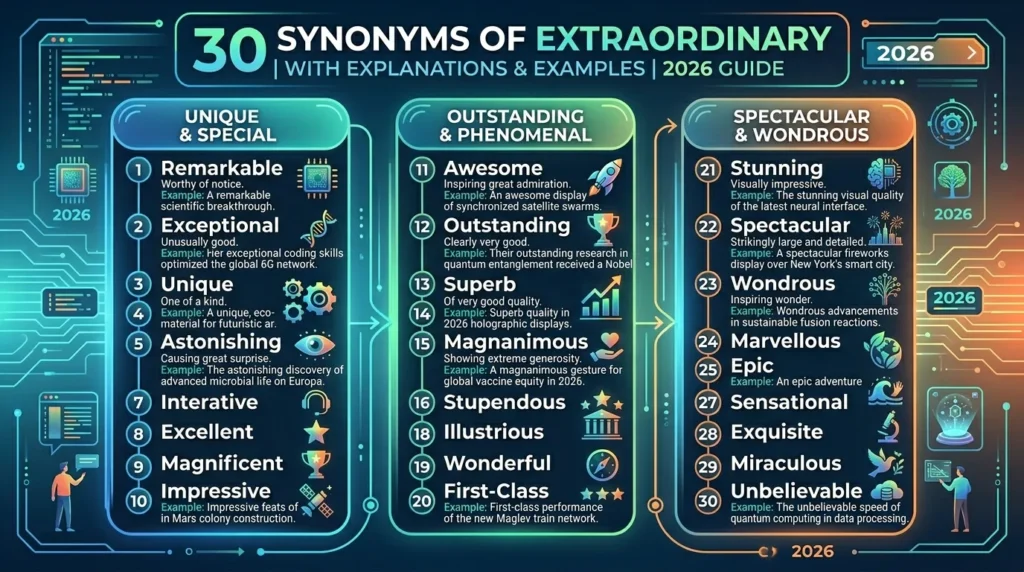
30 Synonyms of Extraordinary
1. Amazing (adjective)
US: /əˈmeɪzɪŋ/ | UK: /əˈmeɪzɪŋ/
Meaning: causing great surprise or admiration
Examples:
- She gave an amazing performance.
- The view was absolutely amazing.
2. Exceptional (adjective)
US: /ɪkˈsɛpʃənəl/ | UK: /ɪkˈsepʃənəl/
Meaning: much better than normal
Examples:
- He has exceptional talent.
- The school offers exceptional education.
3. Remarkable (adjective)
US: /rɪˈmɑːrkəbəl/ | UK: /rɪˈmɑːkəbəl/
Meaning: worthy of attention or praise
Examples:
- She made a remarkable recovery.
- His success is truly remarkable.
4. Outstanding (adjective)
US: /aʊtˈstændɪŋ/ | UK: /aʊtˈstændɪŋ/
Meaning: extremely good or impressive
Examples:
- The teacher did an outstanding job.
- Her work was outstanding.
5. Incredible (adjective)
US: /ɪnˈkrɛdəbəl/ | UK: /ɪnˈkredəbəl/
Meaning: hard to believe because it is so impressive
Examples:
- The athlete showed incredible strength.
- We had an incredible experience.
6. Wonderful (adjective)
US: /ˈwʌndərfəl/ | UK: /ˈwʌndəfəl/
Meaning: extremely good and pleasing
Examples:
- They had a wonderful vacation.
- She is a wonderful singer.
7. Spectacular (adjective)
US: /spɛkˈtækjələr/ | UK: /spekˈtækjʊlə/
Meaning: very exciting and impressive
Examples:
- The fireworks were spectacular.
- He made a spectacular entrance.
8. Marvelous (adjective)
US: /ˈmɑːrvələs/ | UK: /ˈmɑːvələs/
Meaning: extremely good or enjoyable
Examples:
- She cooked a marvelous meal.
- The concert was marvelous.
9. Fantastic (adjective)
US: /fænˈtæstɪk/ | UK: /fænˈtæstɪk/
Meaning: extremely good or exciting
Examples:
- We had a fantastic time.
- The movie was fantastic.
10. Phenomenal (adjective)
US: /fəˈnɑːmənəl/ | UK: /fəˈnɒmɪnəl/
Meaning: exceptionally impressive
Examples:
- She achieved phenomenal success.
- His memory is phenomenal.
11. Unique (adjective)
US: /juˈniːk/ | UK: /juˈniːk/
Meaning: unlike anything else
Examples:
- She has a unique style.
- The design looks unique.
12. Rare (adjective)
US: /rɛr/ | UK: /reə/
Meaning: uncommon or unusual
Examples:
- That bird is very rare.
- We witnessed a rare event.
13. Magnificent (adjective)
US: /mæɡˈnɪfəsənt/ | UK: /mæɡˈnɪfɪsənt/
Meaning: extremely beautiful or impressive
Examples:
- The palace looked magnificent.
- She wore a magnificent dress.
14. Brilliant (adjective)
US: /ˈbrɪljənt/ | UK: /ˈbrɪljənt/
Meaning: extremely intelligent or impressive
Examples:
- He had a brilliant idea.
- The scientist gave a brilliant speech.
15. Superb (adjective)
US: /suːˈpɜːrb/ | UK: /suːˈpɜːb/
Meaning: excellent in quality
Examples:
- The restaurant serves superb food.
- Her performance was superb.
16. Wonderful-looking (adjective)
US: /ˈwʌndərfəl ˈlʊkɪŋ/ | UK: /ˈwʌndəfəl ˈlʊkɪŋ/
Meaning: very attractive or impressive in appearance
Examples:
- The garden looked wonderful-looking.
- She wore a wonderful-looking outfit.
17. Unusual (adjective)
US: /ʌnˈjuːʒuəl/ | UK: /ʌnˈjuːʒuəl/
Meaning: different from normal
Examples:
- That was an unusual idea.
- He noticed an unusual sound.
18. Astonishing (adjective)
US: /əˈstɑːnɪʃɪŋ/ | UK: /əˈstɒnɪʃɪŋ/
Meaning: very surprising
Examples:
- The magician performed an astonishing trick.
- Her speed was astonishing.
19. Stunning (adjective)
US: /ˈstʌnɪŋ/ | UK: /ˈstʌnɪŋ/
Meaning: extremely beautiful or impressive
Examples:
- The beach was stunning.
- She looked stunning tonight.
20. Extraordinary-minded (adjective)
US: /ɪkˈstrɔːrdəˌnɛri maɪndɪd/ | UK: /ɪkˈstrɔːdnri maɪndɪd/
Meaning: thinking in highly creative ways
Examples:
- He is an extraordinary-minded inventor.
- Extraordinary-minded leaders inspire people.
21. Impressive (adjective)
US: /ɪmˈprɛsɪv/ | UK: /ɪmˈpresɪv/
Meaning: causing admiration
Examples:
- She gave an impressive presentation.
- His results are impressive.
22. Uncommon (adjective)
US: /ʌnˈkɑːmən/ | UK: /ʌnˈkɒmən/
Meaning: not seen often
Examples:
- He showed uncommon courage.
- This flower is uncommon.
23. Glorious (adjective)
US: /ˈɡlɔːriəs/ | UK: /ˈɡlɔːriəs/
Meaning: deserving praise and admiration
Examples:
- They celebrated a glorious victory.
- It was a glorious day.
24. Fabulous (adjective)
US: /ˈfæbjələs/ | UK: /ˈfæbjələs/
Meaning: extremely good or wonderful
Examples:
- She looks fabulous.
- The show was fabulous.
25. Memorable (adjective)
US: /ˈmɛmərəbəl/ | UK: /ˈmemərəbəl/
Meaning: worth remembering
Examples:
- We had a memorable trip.
- His speech was memorable.
26. Special (adjective)
US: /ˈspɛʃəl/ | UK: /ˈspeʃəl/
Meaning: different and important
Examples:
- She is a special friend.
- Today feels special.
27. Grand (adjective)
US: /ɡrænd/ | UK: /ɡrænd/
Meaning: large, important, or impressive
Examples:
- They planned a grand celebration.
- The hotel looked grand.
28. Splendid (adjective)
US: /ˈsplɛndɪd/ | UK: /ˈsplendɪd/
Meaning: very impressive or beautiful
Examples:
- We had a splendid evening.
- The castle appeared splendid.
29. Majestic (adjective)
US: /məˈdʒɛstɪk/ | UK: /məˈdʒestɪk/
Meaning: grand and beautiful
Examples:
- The mountains looked majestic.
- A majestic eagle flew overhead.
30. Unforgettable (adjective)
US: /ˌʌnfərˈɡɛtəbəl/ | UK: /ˌʌnfəˈɡetəbəl/
Meaning: impossible to forget because it is so special
Examples:
- We had an unforgettable experience.
- Her smile was unforgettable.
Prototype Meaning
The most common meaning of extraordinary is something unusually impressive, special, or beyond normal expectations. People usually imagine amazing talent, great success, beautiful experiences, or rare achievements when hearing this word.
Prototype Categorization
- Achievement and excellence: exceptional, outstanding, phenomenal
- Beauty and appearance: stunning, magnificent, majestic
- Uniqueness and rarity: unique, rare, uncommon
- Emotional admiration: amazing, wonderful, fabulous
Categorization helps writers choose the best synonym based on tone, context, and meaning.
Antonyms of Extraordinary
- Ordinary (adjective): normal and not special
- Common (adjective): seen often
- Average (adjective): typical or normal
- Regular (adjective): usual or standard
- Mediocre (adjective): not very good
Short Questions and Answers
What does extraordinary mean?
- It means very unusual, impressive, or better than normal.
When should extraordinary be used?
- Use it when describing amazing people, events, talents, or experiences.
Is extraordinary positive or negative?
- It is mostly positive because it describes something special or impressive.
How is it different from similar words?
- “Extraordinary” means beyond normal, while “amazing” mainly focuses on surprise and admiration.
Conclusion
Learning Synonyms of Extraordinary and Synonyms of Extraordinary improves vocabulary and communication skills. These words help English learners describe special people, rare events, and impressive experiences more clearly. Using different synonyms also avoids repetition and makes writing stronger and more engaging.
These vocabulary words are useful in school, work, storytelling, and daily conversations. They help writers and speakers express admiration, excitement, and uniqueness with accuracy. Daily vocabulary practice builds confidence and improves English fluency over time. By learning and using powerful synonyms regularly, you can make your communication more natural, expressive, and professional.

I’m Zahid Abbas, an educator, researcher, and digital publishing strategist with a passion for linguistics, grammar, and clear communication. As a content creator and SEO specialist, I craft research-driven, reader-focused content that empowers learners and makes knowledge accessible worldwide.