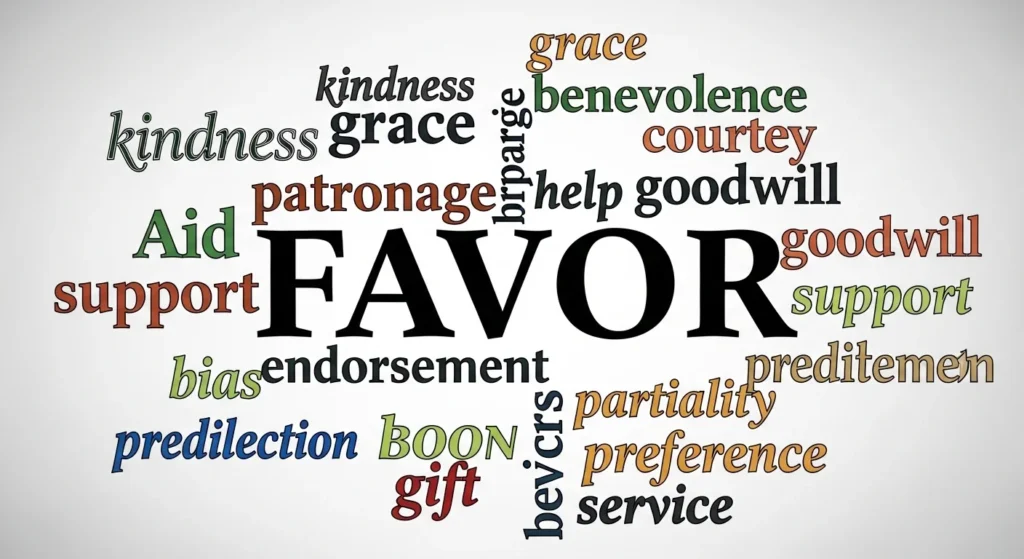
The word favor means a kind act, support, or approval given to someone. Imagine you help a friend with homework, and later you ask, “Can you do me a favor?” Or think about a teacher who favors one student because of good behavior. In both cases, favor shows kindness or preference.
This word is common in daily English. It appears in conversations, formal writing, business emails, and even legal language. Because it has more than one meaning—kind act, support, approval, or preference—it is important to understand its synonyms.
Learning synonyms helps English learners avoid repetition and sound more natural. Writers also use synonyms to make content clearer and more engaging.
In this article, we will explore the meaning of favor, its pronunciation, history, tone, grammar, and 30 powerful synonyms with examples.
Meaning of Favor
Definition
Favor (Noun / Verb):
A kind act done to help someone; or support, approval, or preference for someone or something.
Examples
- She did me a favor by lending her notes.
- The judge seemed to favor the defendant.
Connotative Meaning
(Connotation means the emotional feeling or tone connected to a word.)
- Positive tone: Kindness, support, goodwill.
- Negative tone: Can suggest unfair preference (favoritism).
- Neutral tone: Simple approval or choice.
Etymology
- From Old French “faveur”, meaning goodwill or approval.
- From Latin “favor”, meaning kindness or support.
Short History
- Old English (450–1100): Word was not common; used through French influence later.
- Middle English (1100–1500): Adopted from French as favour.
- Modern English (1500–Present): Expanded to mean kindness, support, or preference.
Pronunciation (US & UK – IPA)
US: /ˈfeɪvər/
UK: /ˈfeɪvə/
Syllables
fa-vor
Affixation Pattern of Favor
- Root: favor
- Prefix: None
- Suffix: None
Word Formation
- Favorable (Adjective)
- Favorably (Adverb)
- Favorite (Noun / Adjective)
- Favoritism (Noun)
- Favored (Adjective / Verb past)
A List Of 30 Synonyms for Favor
1. Support (Verb/Noun) — US /səˈpɔːrt/ | UK /səˈpɔːt/
Meaning: To back up or approve.
Examples:
- She supports the new rule.
- He gave his full support.
2. Help (Verb/Noun) — US /hɛlp/ | UK /help/
Meaning: To assist someone.
Examples:
- Can you help me?
- She offered help.
3. Aid (Verb/Noun) — US /eɪd/ | UK /eɪd/
Meaning: To give assistance.
Examples:
- The charity aided families.
- He came to my aid.
4. Assistance (Noun) — US /əˈsɪstəns/ | UK /əˈsɪstəns/
Meaning: Help or support.
Examples:
- She asked for assistance.
- Thank you for your assistance.
5. Approval (Noun) — US /əˈpruːvəl/ | UK /əˈpruːvəl/
Meaning: Agreement or positive opinion.
Examples:
- The plan got approval.
- She smiled in approval.
6. Preference (Noun) — US /ˈprɛfərəns/ | UK /ˈprɛfərəns/
Meaning: Liking one thing more than another.
Examples:
- She has a preference for tea.
- The teacher showed preference.
7. Endorse (Verb) — US /ɪnˈdɔːrs/ | UK /ɪnˈdɔːs/
Meaning: To publicly support.
Examples:
- The leader endorsed the policy.
- She endorsed the product.
8. Blessing (Noun) — US /ˈblɛsɪŋ/ | UK /ˈblɛsɪŋ/
Meaning: Approval or good wish.
Examples:
- They married with her blessing.
- It was a blessing in disguise.
9. Kindness (Noun) — US /ˈkaɪndnəs/ | UK /ˈkaɪndnəs/
Meaning: A gentle and helpful act.
Examples:
- Thank you for your kindness.
- Her kindness touched me.
10. Goodwill (Noun) — US /ˌɡʊdˈwɪl/ | UK /ˌɡʊdˈwɪl/
Meaning: Friendly or helpful feeling.
Examples:
- The gift showed goodwill.
- They acted in goodwill.
11. Courtesy (Noun) — US /ˈkɝːtəsi/ | UK /ˈkɜːtəsi/
Meaning: Polite behavior.
Examples:
- He did it as a courtesy.
- Show courtesy to others.
12. Grace (Noun) — US /ɡreɪs/ | UK /ɡreɪs/
Meaning: Kindness or mercy.
Examples:
- She accepted with grace.
- He gave them grace.
13. Advantage (Noun) — US /ədˈvæntɪdʒ/ | UK /ədˈvɑːntɪdʒ/
Meaning: A helpful benefit.
Examples:
- She has the advantage.
- It worked in his favor.
14. Privilege (Noun) — US /ˈprɪvəlɪdʒ/ | UK /ˈprɪvəlɪdʒ/
Meaning: A special right.
Examples:
- It was a privilege.
- She had special privileges.
15. Benefit (Noun/Verb) — US /ˈbɛnɪfɪt/ | UK /ˈbɛnɪfɪt/
Meaning: Something helpful.
Examples:
- The plan gives benefit.
- It will benefit you.
16. Back (Verb) — US /bæk/ | UK /bæk/
Meaning: To support.
Examples:
- I back your idea.
- She backed the campaign.
17. Approve (Verb) — US /əˈpruːv/ | UK /əˈpruːv/
Meaning: To agree with.
Examples:
- The manager approved it.
- She approved the design.
18. Patronage (Noun) — US /ˈpætrənɪdʒ/ | UK /ˈpætrənɪdʒ/
Meaning: Support given by a patron.
Examples:
- The artist received patronage.
- Patronage helped the project.
19. Service (Noun) — US /ˈsɜːrvɪs/ | UK /ˈsɜːvɪs/
Meaning: Help provided.
Examples:
- She did him a service.
- Thank you for your service.
20. Mercy (Noun) — US /ˈmɜːrsi/ | UK /ˈmɜːsi/
Meaning: Kind forgiveness.
Examples:
- The judge showed mercy.
- Have mercy on him.
21. Advocacy (Noun) — US /ˈædvəkəsi/ | UK /ˈædvəkəsi/
Meaning: Public support.
Examples:
- She works in advocacy.
- His advocacy changed minds.
22. Sympathy (Noun) — US /ˈsɪmpəθi/ | UK /ˈsɪmpəθi/
Meaning: Feeling of understanding.
Examples:
- She showed sympathy.
- I have sympathy for him.
23. Consideration (Noun) — US /kənˌsɪdəˈreɪʃən/ | UK /kənˌsɪdəˈreɪʃən/
Meaning: Careful thought or kindness.
Examples:
- Show consideration.
- Thank you for your consideration.
24. Preference (Repeat avoided, use Alternative)
24. Liking (Noun) — US /ˈlaɪkɪŋ/ | UK /ˈlaɪkɪŋ/
Meaning: A feeling of enjoyment.
Examples:
- She has a liking for art.
- He showed liking toward her.
25. Approval rating (Noun) — US /əˈpruːvəl ˈreɪtɪŋ/ | UK /əˈpruːvəl ˈreɪtɪŋ/
Meaning: Level of public support.
Examples:
- His approval rating increased.
- The rating shows favor.
26. Promotion (Noun) — US /prəˈmoʊʃən/ | UK /prəˈməʊʃən/
Meaning: Support to advance.
Examples:
- She got a promotion.
- The company promoted him.
27. Encourage (Verb) — US /ɪnˈkɜːrɪdʒ/ | UK /ɪnˈkʌrɪdʒ/
Meaning: To give support or confidence.
Examples:
- She encouraged me.
- Parents encourage learning.
28. Approval vote (Noun) — US /əˈpruːvəl voʊt/ | UK /əˈpruːvəl vəʊt/
Meaning: Official support.
Examples:
- The law passed with approval vote.
- Members gave approval.
29. Consent (Noun/Verb) — US /kənˈsɛnt/ | UK /kənˈsɛnt/
Meaning: Permission or agreement.
Examples:
- She gave consent.
- He consented to help.
30. Favoritism (Noun) — US /ˈfeɪvərɪtɪzəm/ | UK /ˈfeɪvərɪtɪzəm/
Meaning: Unfair preference.
Examples:
- The teacher showed favoritism.
- Favoritism caused problems.
Prototype Meaning
The most typical meaning of favor is a kind act done to help someone. Most people imagine asking someone, “Can you do me a favor?” It usually suggests goodwill and support.
Prototype Categorization
Synonyms can be grouped into:
- Kind acts: help, aid, kindness, courtesy
- Support/approval: support, endorse, approve, advocacy
- Preference: liking, preference, favoritism
- Benefit: advantage, benefit, privilege
Categorization helps writers choose the best word depending on context. For example, “endorse” is formal, while “help” is casual.
Antonyms of Favor
- Oppose
- Reject
- Disapprove
- Harm
- Criticize
Short Questions and Answers
- What does favor mean?
It means a kind act, support, or preference. - When should favor be used?
Use it when talking about helping, supporting, or choosing someone. - Is favor positive or negative?
Usually positive, but can be negative if it means unfair preference. - How is it different from similar words?
“Help” is general assistance, while “favor” can also mean preference or approval.
CONCLUSION
Learning the word favor and its synonyms improves your English vocabulary. It helps you express kindness, support, and preference in different ways. Instead of repeating “help,” you can use aid, support, endorse, or encourage. This makes your writing more natural and powerful.
Understanding tone is also important. Some synonyms are formal, like “endorse,” while others are friendly, like “help.” Daily vocabulary practice builds confidence. Learn one word each day and use it in sentences. Over time, your speaking and writing will become clearer, richer, and more professional.

I’m Zahid Abbas, an educator, researcher, and digital publishing strategist with a passion for linguistics, grammar, and clear communication. As a content creator and SEO specialist, I craft research-driven, reader-focused content that empowers learners and makes knowledge accessible worldwide.