The word individuality means the qualities that make a person different from others. Imagine two students in a class. One loves art, the other loves science. Their unique interests show their individuality. This word is often used in education, psychology, and daily life when talking about personal identity and uniqueness.
Learning synonyms of individuality is important for English learners and content writers. It helps avoid repetition and makes your writing more expressive. It also helps you describe people and ideas in a more precise way.
In this article, you will learn the meaning of individuality and its synonyms with examples, pronunciation, grammar, history, and categories. Everything is explained in simple English to help you use the word confidently.
Meaning of Individuality
Definition
Individuality (noun): the qualities or characteristics that make a person or thing unique and different.
Examples
- Her individuality makes her special.
- The artist shows individuality in his work.
Connotative Meaning
(Connotation: the emotional feeling connected to a word beyond its basic meaning)
- Positive tone: uniqueness, creativity, identity
- Negative tone: selfishness (rarely, in some contexts)
- Neutral tone: being different
Etymology
- From Latin individuus meaning “indivisible”
- Formed from in- (not) + dividere (to divide)
Short History
- Old English (450–1100): no exact form
- Middle English (1100–1500): “individual” appeared
- Modern English (1500–Present): “individuality” used for uniqueness
Pronunciation (US & UK – IPA)
- US: /ˌɪn.dəˌvɪdʒ.uˈæl.ə.t̬i/
- UK: /ˌɪn.dɪˌvɪdʒ.uˈæl.ə.ti/
Syllables
in-di-vid-u-al-i-ty
Affixation Pattern of Individuality
- Root: divide
- Prefix: in- (not)
- Suffix: -ality
Word Formation
- individual (noun/adjective)
- individuality (noun)
- individually (adverb)
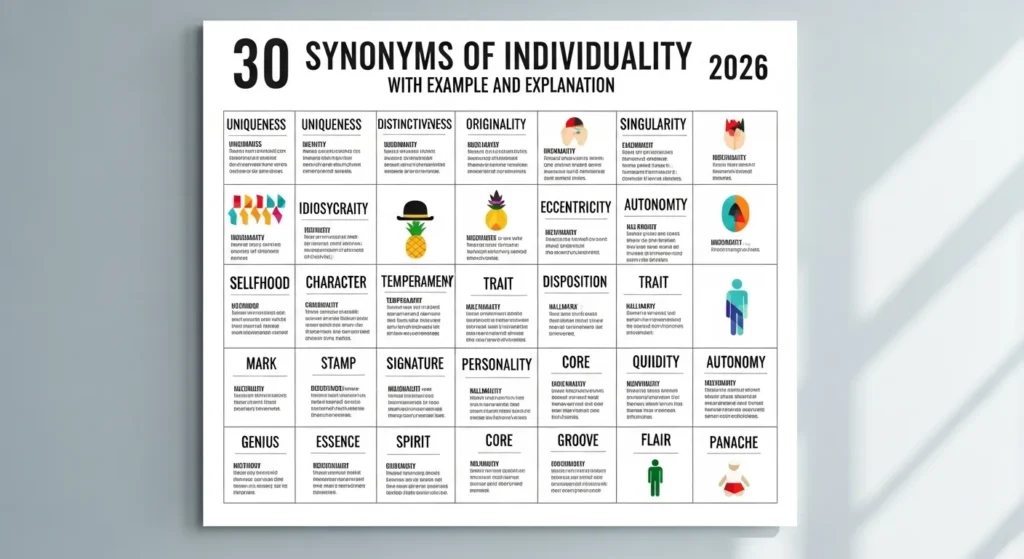
Synonyms of Individuality
1. Uniqueness (noun) — /juːˈniː.nəs/ | /juːˈniːk.nəs/
Meaning: being one of a kind Examples:
- Her uniqueness stands out.
- Each person has uniqueness.
2. Identity (noun) — /aɪˈdn.t̬ə.t̬i/ | /aɪˈden.tɪ.ti/
Meaning: who a person is Examples:
- Culture shapes identity.
- He found his identity.
3. Character (noun) — /ˈkr.ək.tɚ/ | /ˈkær.ək.tə/
Meaning: special qualities Examples:
- She has strong character.
- His character is unique.
4. Personality (noun) — /ˌpː.səˈnæl.ə.t̬i/ | /ˌpɜː.səˈnæl.ə.ti/
Meaning: way a person behaves Examples:
- She has a bright personality.
- His personality is calm.
5. Originality (noun) — /əˌɪdʒ.əˈnæl.ə.t̬i/ | /əˌrɪdʒ.ɪˈnæl.ə.ti/
Meaning: new and different ideas Examples:
- The artist shows originality.
- Originality is valued.
6. Distinctiveness (noun) — /ɪˈstɪŋk.tɪv.nəs/ | /dɪˈstɪŋk.tɪv.nəs/
Meaning: quality of being different Examples:
- The design has distinctiveness.
- His voice has distinctiveness.
7. Selfhood (noun) — /ˈself.ʊd/ | /ˈself.hʊd/
Meaning: sense of self Examples:
- She developed selfhood.
- Selfhood is important.
8. Individualism (noun) — ˌɪn.dɪˈvɪdʒ.u.ə.lɪ.zəm/ | /ˌɪn.dɪˈvɪdʒ.u.ə.lɪ.zəm/
Meaning: belief in personal freedom Examples:
- The culture values individualism.
- He believes in individualism.
9. Singularity (noun) — /ˌsŋ.ɡjəˈler.ə.t̬i/ | /ˌsɪŋ.ɡjʊˈlær.ə.ti/
Meaning: being unique Examples:
- Her style has singularity.
- It shows singularity.
10. Self-expression (noun) —/ˌself.ɪkˈspreʃ.ən/ | /ˌself.ɪkˈspreʃ.ən/
Meaning: showing one’s feelings Examples:
- Art is self-expression.
- Writing shows self-expression.
11. Flair (noun) — /fle/ | /fleə/
Meaning: natural talent Examples:
- She has flair.
- He writes with flair.
12. Style (noun) — /saɪl/ | /staɪl/
Meaning: personal way of doing things Examples:
- She has her own style.
- His style is unique.
13. Voic (noun) — /vɔɪs/ | /vɔɪs/
Meaning: personal expression Examples:
- Writers have a voice.
- Her voice is strong.
14. Eccentricity (noun) — /ˌek.enˈtrɪs.ə.t̬i/ | /ˌek.senˈtrɪs.ə.ti/
Meaning: unusual behavior Examples:
- His eccentricity is clear.
- It shows uniqueness.
15. Persona (noun) — /pɚˈsoʊnə/ | /pəˈsəʊ.nə/
Meaning: public image Examples:
- His persona is strong.
- She created a persona.
16. Essence (noun) — /ˈes.əs/ | /ˈes.əns/
Meaning: core nature Examples:
- This is her essence.
- The essence is clear.
17. Spirit (noun) — /ˈspɪrɪt/ | /ˈspɪr.ɪt/
Meaning: inner nature Examples:
- She has a strong spirit.
- His spirit is unique.
18. Temperament (noun)— /ˈtem.pɚ.ə.mənt/ | /ˈtem.pər.ə.mənt/
Meaning: natural behavior Examples:
- He has a calm temperament.
- Her temperament is bright.
19. Nature (noun) — /ˈnɪ.tʃɚ/ | /ˈneɪ.tʃə/
Meaning: basic character Examples:
- It is his nature.
- Her nature is kind.
20. Traits (noun) — /trɪts/ | /treɪts/
Meaning: personal qualities Examples:
- She has good traits.
- Traits define people.
21. Attributes (noun) /ˈæt.rɪ.bjuːts/ | /ˈæt.rɪ.bjuːts/
Meaning: qualities or features Examples:
- He has strong attributes.
- Attributes define identity.
22. Mark (noun) — /mːrk/ | /mɑːk/
Meaning: sign of uniqueness Examples:
- It left a mark.
- His work has a mark.
23. Signature (noun) — /ˈsɡ.nə.tʃɚ/ | /ˈsɪɡ.nə.tʃə/
Meaning: unique style Examples:
- It is her signature style.
- His signature is clear.
24. Stamp (noun) — /stæp/ | /stæmp/
Meaning: personal mark Examples:
- He left his stamp.
- The work has a stamp.
25. Identity traits (noun)
Meaning: features of identity Examples:
- Identity traits matter.
- They define a person.
26. Personal style (noun)
Meaning: individual way Examples:
- She has a personal style.
- Style shows individuality.
27. Self-identity (noun)
Meaning: sense of self Examples:
- Self-identity is important.
- It shapes behavior.
28. Distinction (noun) — /dɪˈstɪŋk.ʃən/ | dɪˈstɪŋk.ʃən/
Meaning: clear difference Examples:
- There is distinction.
- It shows uniqueness.
29. Individual character (noun)
Meaning: unique nature Examples:
- Each person has character.
- Individual character matters.
30. Personal identity (noun)
Meaning: who a person is Examples:
- Personal identity is strong.
- It defines a person.
Prototype Meaning
The typical meaning of individuality is the unique qualities that make a person different from others. People often imagine personal style, behavior, and identity.
Prototype Categorization
- Uniqueness: uniqueness, singularity, originality
- Identity: identity, selfhood, persona
- Personality: character, temperament, nature
- Expression: style, voice, self-expression
This helps writers choose the right synonym based on context.
Antonyms
- conformity
- sameness
- uniformity
- similarity
Short Questions and Answers
- What does individuality mean? It means being unique.
- When should individuality be used? When talking about personal traits or identity.
- Is individuality positive or negative? Mostly positive.
- How is it different from similar words? It focuses on uniqueness and personal identity.
Conclusion
Learning individuality and its synonyms improves your vocabulary and communication. It helps you describe people clearly and avoid repetition. This builds confidence in English. Practice daily to master these words.

I’m Zahid Abbas, an educator, researcher, and digital publishing strategist with a passion for linguistics, grammar, and clear communication. As a content creator and SEO specialist, I craft research-driven, reader-focused content that empowers learners and makes knowledge accessible worldwide.