The word just is one of the most common words in English. It can mean fair, honest, exact, recent, or simply. Imagine a teacher giving equal marks to students based on their work. The students may say the teacher was just and fair. In another situation, a friend may say, “I just arrived,” meaning only a short time ago.
Because this word has many meanings, people use it in daily conversations, books, news, and professional writing. However, repeating the same word often can make speech and writing sound weak. Learning synonyms of just helps English learners improve vocabulary and express ideas more clearly. This article explains the meaning of just, its pronunciation, grammar, history, semantic categories, and 30 useful synonyms with simple examples to strengthen your English skills.
Meaning of Just
Definition
Just (adjective/adverb): fair, honest, exact, recent, or only.
Examples
- The judge made a just decision.
- I just finished my homework.
Connotative Meaning
- Positive tone: fair, honest, reasonable
- Negative tone: strict or limiting in some contexts
- Neutral tone: exact or recent
Etymology
- From Latin justus meaning “upright” or “fair”
- Entered English through Old French
Short History:
- Old English (450–1100): words related to fairness existed
- Middle English (1100–1500): “just” became common from French influence
- Modern English (1500–Present): widely used for fairness, time, and accuracy
Pronunciation (US & UK – IPA)
- US: /dʒʌst/
- UK: /dʒʌst/
Syllables
- just
Affixation Pattern of Just
- Root: just
- Prefix: none
- Suffix: none
Word Formation:
- justice (noun)
- justify (verb)
- justified (adjective)
- justification (noun)
- justly (adverb)
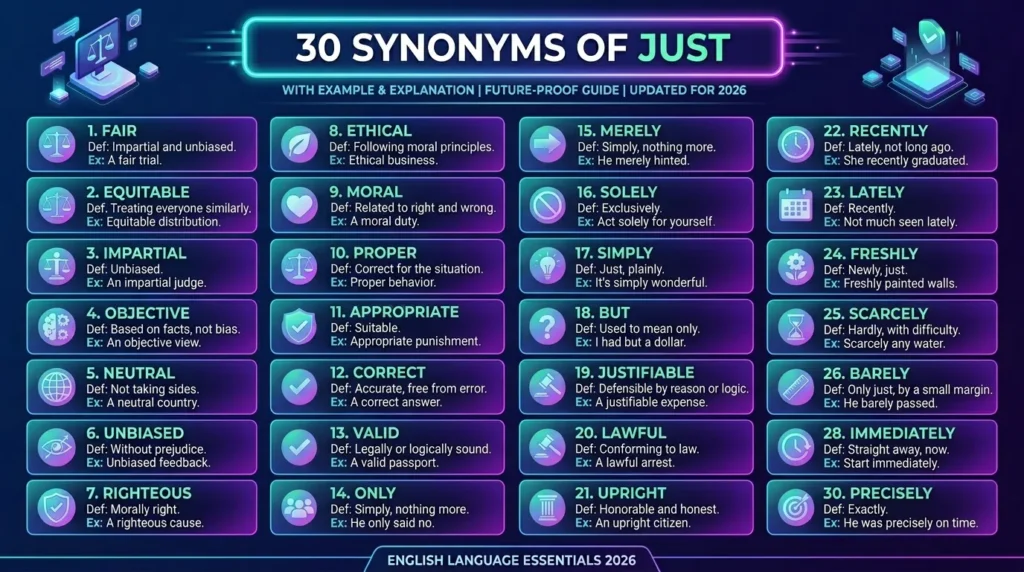
30 Synonyms of Just
1. Fair (adjective)
US: /fɛr/ | UK: /feə/
Meaning: treating people equally and honestly
Examples:
- The teacher was fair to everyone.
- It was a fair decision.
2. Honest (adjective)
US: /ˈɑːnɪst/ | UK: /ˈɒnɪst/
Meaning: truthful and sincere
Examples:
- She gave an honest answer.
- He is an honest man.
3. Ethical (adjective)
US: /ˈɛθɪkəl/ | UK: /ˈeθɪkəl/
Meaning: morally right
Examples:
- The company followed ethical rules.
- She made an ethical choice.
4. Moral (adjective)
US: /ˈmɔːrəl/ | UK: /ˈmɒrəl/
Meaning: connected to right behavior
Examples:
- He showed moral courage.
- It was the moral thing to do.
5. Upright (adjective)
US: /ˈʌpraɪt/ | UK: /ˈʌpraɪt/
Meaning: honest and respectable
Examples:
- She is an upright citizen.
- The leader remained upright.
6. Impartial (adjective)
US: /ɪmˈpɑːrʃəl/ | UK: /ɪmˈpɑːʃəl/
Meaning: fair to all sides
Examples:
- Judges should be impartial.
- He gave an impartial opinion.
7. Equitable (adjective)
US: /ˈɛkwɪtəbəl/ | UK: /ˈekwɪtəbəl/
Meaning: fair and balanced
Examples:
- They wanted an equitable solution.
- The law should be equitable.
8. Reasonable (adjective)
US: /ˈriːzənəbəl/ | UK: /ˈriːzənəbəl/
Meaning: sensible and fair
Examples:
- That sounds reasonable.
- She made a reasonable request.
9. Proper (adjective)
US: /ˈprɑːpər/ | UK: /ˈprɒpə/
Meaning: correct or suitable
Examples:
- Use the proper method.
- He showed proper behavior.
10. Right (adjective)
US: /raɪt/ | UK: /raɪt/
Meaning: morally correct
Examples:
- You made the right choice.
- It is right to help others.
11. Exact (adjective)
US: /ɪɡˈzækt/ | UK: /ɪɡˈzækt/
Meaning: completely correct
Examples:
- Give the exact number.
- Her answer was exact.
12. Precise (adjective)
US: /prɪˈsaɪs/ | UK: /prɪˈsaɪs/
Meaning: very accurate
Examples:
- The measurements were precise.
- Please be precise.
13. Accurate (adjective)
US: /ˈækjərət/ | UK: /ˈækjərət/
Meaning: free from mistakes
Examples:
- The report is accurate.
- He gave accurate information.
14. Correct (adjective)
US: /kəˈrɛkt/ | UK: /kəˈrekt/
Meaning: true or proper
Examples:
- Your answer is correct.
- She used the correct form.
15. Recent (adjective)
US: /ˈriːsənt/ | UK: /ˈriːsənt/
Meaning: happening a short time ago
Examples:
- This is a recent photo.
- He discussed recent events.
16. Newly (adverb)
US: /ˈnuːli/ | UK: /ˈnjuːli/
Meaning: only a short time ago
Examples:
- They are newly married.
- The shop was newly opened.
17. Merely (adverb)
US: /ˈmɪrli/ | UK: /ˈmɪəli/
Meaning: only and nothing more
Examples:
- I was merely asking.
- She is merely a student.
18. Simply (adverb)
US: /ˈsɪmpli/ | UK: /ˈsɪmpli/
Meaning: in a plain or easy way
Examples:
- He simply smiled.
- The answer is simply wrong.
19. Only (adverb)
US: /ˈoʊnli/ | UK: /ˈəʊnli/
Meaning: no more than
Examples:
- I only need water.
- She was only joking.
20. Barely (adverb)
US: /ˈbɛrli/ | UK: /ˈbeəli/
Meaning: almost not
Examples:
- He could barely walk.
- We barely arrived on time.
21. Exactly (adverb)
US: /ɪɡˈzæktli/ | UK: /ɪɡˈzæktli/
Meaning: perfectly correctly
Examples:
- That is exactly right.
- She arrived exactly at noon.
22. Directly (adverb)
US: /dəˈrɛktli/ | UK: /dəˈrektli/
Meaning: in a straight or immediate way
Examples:
- He spoke directly.
- Go directly home.
23. Virtuous (adjective)
US: /ˈvɜːrtʃuəs/ | UK: /ˈvɜːtʃuəs/
Meaning: morally good
Examples:
- She lived a virtuous life.
- He is a virtuous person.
24. Lawful (adjective)
US: /ˈlɔːfəl/ | UK: /ˈlɔːfəl/
Meaning: allowed by law
Examples:
- The action was lawful.
- They followed lawful rules.
25. Legitimate (adjective)
US: /lɪˈdʒɪtəmət/ | UK: /lɪˈdʒɪtɪmət/
Meaning: legal or acceptable
Examples:
- It is a legitimate business.
- She had a legitimate reason.
26. Balanced (adjective)
US: /ˈbælənst/ | UK: /ˈbælənst/
Meaning: fair and equal
Examples:
- The discussion stayed balanced.
- He made a balanced judgment.
27. Neutral (adjective)
US: /ˈnuːtrəl/ | UK: /ˈnjuːtrəl/
Meaning: not supporting either side
Examples:
- She stayed neutral.
- The report sounded neutral.
28. Valid (adjective)
US: /ˈvælɪd/ | UK: /ˈvælɪd/
Meaning: acceptable or true
Examples:
- That is a valid point.
- Your ticket is valid.
29. Sound (adjective)
US: /saʊnd/ | UK: /saʊnd/
Meaning: sensible and reliable
Examples:
- He gave sound advice.
- The plan looks sound.
30. Genuine (adjective)
US: /ˈdʒɛnjuɪn/ | UK: /ˈdʒenjuɪn/
Meaning: real and sincere
Examples:
- She showed genuine kindness.
- His apology was genuine.
Prototype Meaning
The most typical meaning of just is fairness and correctness. People usually imagine a fair judge, an honest person, or an exact answer when they hear this word.
Prototype Categorization
- Fairness and morality: fair, ethical, impartial, upright
- Accuracy and correctness: exact, accurate, precise, correct
- Limitation and simplicity: merely, simply, only, barely
- Legality and truth: lawful, legitimate, valid, genuine
Antonyms of Just
- Unfair (adjective): not fair or equal
- Dishonest (adjective): not truthful
- Wrong (adjective): incorrect or improper
- Biased (adjective): unfairly favoring one side
- Illegal (adjective): against the law
Short Questions and Answers
What does just mean?
- It means fair, correct, recent, or only.
When should just be used?
- Use it when talking about fairness, accuracy, or recent actions.
Is just positive or negative?
- It is usually positive because it often relates to fairness and honesty.
How is it different from similar words?
- “Just” can mean fair, exact, or only, while similar words usually have one specific meaning.
Conclusion
Learning synonyms of just and synonyms of just improves vocabulary and communication skills. It helps English learners express fairness, honesty, accuracy, and simplicity more clearly in speaking and writing. Using different synonyms also avoids repetition and makes language more natural and professional. These words are useful in daily conversations, essays, academic work, and business communication. Understanding different meanings of just helps writers choose the best word for each situation. Practice using new vocabulary every day. Small daily efforts can build stronger English confidence, better fluency, and clearer communication over time.

I’m Zahid Abbas, an educator, researcher, and digital publishing strategist with a passion for linguistics, grammar, and clear communication. As a content creator and SEO specialist, I craft research-driven, reader-focused content that empowers learners and makes knowledge accessible worldwide.