The word reason means a cause, explanation, or purpose for something. Imagine a student arriving late to school. The teacher asks for the reason, and the student explains that heavy rain caused traffic. In daily life, people often ask for reasons to understand actions, decisions, and feelings.
This word is very common in English conversations, academic writing, business communication, and storytelling. However, using the same word repeatedly can make writing sound repetitive. Learning synonyms of reason helps English learners express ideas more clearly and naturally.
In this article, you will learn the meaning of reason, its pronunciation, history, grammar, and 30 useful synonyms with meanings and examples. You will also explore semantic categories, antonyms, and simple questions that improve vocabulary, writing, and speaking confidence.
Meaning of Reason
Definition
Reason (noun/verb): a cause, explanation, or logical basis for something.
Examples
- She explained the reason for her absence.
- There is a good reason to study English daily.
Connotative Meaning
(Connotation means the feeling or emotion a word suggests beyond its basic meaning.)
- Positive tone: logical, thoughtful, sensible
- Negative tone: excuse, blame, justification
- Neutral tone: explanation or cause
Etymology
- From Latin ratio meaning “calculation, understanding, judgment”
- Entered English through Old French raison
Short History:
- Old English (450–1100): similar ideas existed for wisdom and judgment
- Middle English (1100–1500): “reason” became common through French influence
- Modern English (1500–Present): widely used for logic, explanation, and purpose
Pronunciation (US & UK – IPA)
- US: /ˈriːzən/
- UK: /ˈriːzən/
Syllables
- rea-son
Affixation Pattern of Reason
- Root: reason
- Prefix: none
- Suffix: none
Word Formation:
- reason (noun/verb)
- reasonable (adjective)
- reasonably (adverb)
- reasoning (noun)
- reasoned (adjective/verb)
- unreasonable (adjective)
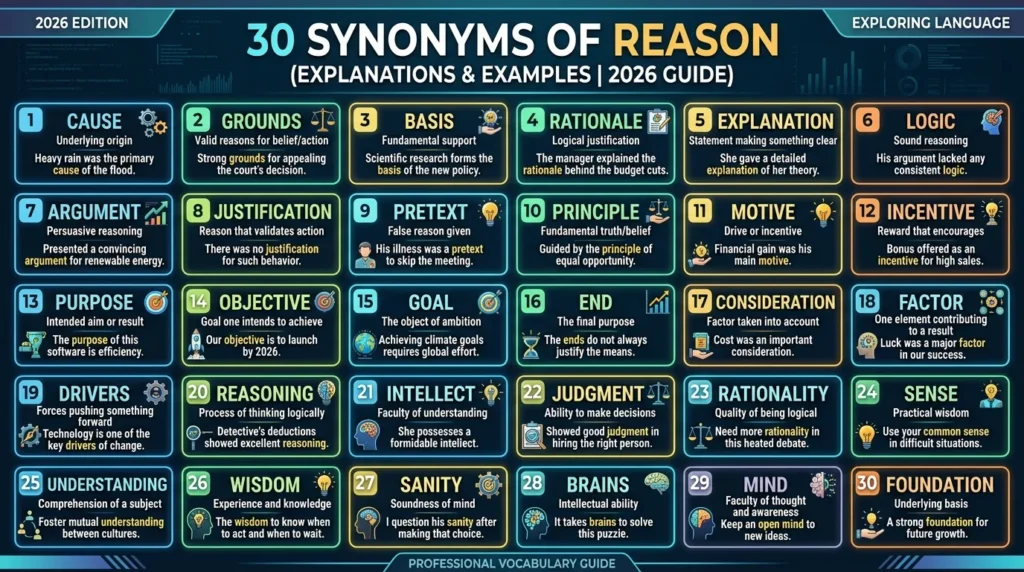
30 Synonyms of Reason
1. Cause (noun)
US: /kɔːz/ | UK: /kɔːz/
Meaning: something that makes an event happen
Examples:
- Rain was the cause of the flood.
- Stress can be a cause of illness.
2. Explanation (noun)
US: /ˌɛkspləˈneɪʃən/ | UK: /ˌekspləˈneɪʃən/
Meaning: a statement that makes something clear
Examples:
- He gave an explanation for his mistake.
- The teacher provided a simple explanation.
3. Motive (noun)
US: /ˈmoʊtɪv/ | UK: /ˈməʊtɪv/
Meaning: a reason for doing something
Examples:
- Police searched for the criminal’s motive.
- Money was not his only motive.
4. Purpose (noun)
US: /ˈpɜːrpəs/ | UK: /ˈpɜːpəs/
Meaning: the aim of something
Examples:
- The purpose of exercise is better health.
- She explained the purpose of the meeting.
5. Basis (noun)
US: /ˈbeɪsɪs/ | UK: /ˈbeɪsɪs/
Meaning: the foundation for an idea or action
Examples:
- Facts form the basis of science.
- Trust is the basis of friendship.
6. Ground (noun)
US: /ɡraʊnd/ | UK: /ɡraʊnd/
Meaning: a justified reason for something
Examples:
- She had no ground for complaint.
- There is strong ground for concern.
7. Justification (noun)
US: /ˌdʒʌstəfɪˈkeɪʃən/ | UK: /ˌdʒʌstɪfɪˈkeɪʃən/
Meaning: a good reason for an action
Examples:
- He offered no justification for his behavior.
- Safety was the justification for the rule.
8. Excuse (noun)
US: /ɪkˈskjuːs/ | UK: /ɪkˈskjuːs/
Meaning: a reason used to defend a mistake
Examples:
- She made an excuse for being late.
- That is not a good excuse.
9. Logic (noun)
US: /ˈlɑːdʒɪk/ | UK: /ˈlɒdʒɪk/
Meaning: clear and sensible thinking
Examples:
- His argument lacked logic.
- Good decisions require logic.
10. Argument (noun)
US: /ˈɑːrɡjəmənt/ | UK: /ˈɑːɡjʊmənt/
Meaning: a set of reasons supporting an idea
Examples:
- She presented a strong argument.
- His argument convinced the class.
11. Rationalization (noun)
US: /ˌræʃənələˈzeɪʃən/ | UK: /ˌræʃənəlaɪˈzeɪʃən/
Meaning: an attempt to explain behavior logically
Examples:
- His story sounded like a rationalization.
- She offered a weak rationalization.
12. Principle (noun)
US: /ˈprɪnsəpəl/ | UK: /ˈprɪnsəpəl/
Meaning: a basic truth or belief
Examples:
- Honesty is an important principle.
- The rule follows scientific principles.
13. Intention (noun)
US: /ɪnˈtɛnʃən/ | UK: /ɪnˈtenʃən/
Meaning: a planned purpose
Examples:
- Her intention was to help.
- He explained his true intention.
14. Aim (noun)
US: /eɪm/ | UK: /eɪm/
Meaning: a desired result
Examples:
- The aim is better education.
- Their aim was success.
15. Objective (noun)
US: /əbˈdʒɛktɪv/ | UK: /əbˈdʒektɪv/
Meaning: a goal or target
Examples:
- The project met its objective.
- Safety is our main objective.
16. End (noun)
US: /ɛnd/ | UK: /end/
Meaning: a final purpose or goal
Examples:
- Peace was the desired end.
- The plan served a useful end.
17. Incentive (noun)
US: /ɪnˈsɛntɪv/ | UK: /ɪnˈsentɪv/
Meaning: something that encourages action
Examples:
- Money is a strong incentive.
- Awards give students incentive.
18. Stimulus (noun)
US: /ˈstɪmjələs/ | UK: /ˈstɪmjʊləs/
Meaning: something that causes activity or reaction
Examples:
- Praise can be a learning stimulus.
- The news acted as a stimulus.
19. Catalyst (noun)
US: /ˈkætəlɪst/ | UK: /ˈkætəlɪst/
Meaning: something that causes change
Examples:
- The event became a catalyst for reform.
- Education is a catalyst for growth.
20. Factor (noun)
US: /ˈfæktər/ | UK: /ˈfæktə/
Meaning: one part that influences a result
Examples:
- Weather was an important factor.
- Cost is a major factor.
21. Consideration (noun)
US: /kənˌsɪdəˈreɪʃən/ | UK: /kənˌsɪdəˈreɪʃən/
Meaning: careful thought about something
Examples:
- Safety was a key consideration.
- Thank you for your consideration.
22. Sense (noun)
US: /sɛns/ | UK: /sens/
Meaning: practical understanding
Examples:
- Her decision showed good sense.
- It makes no sense to argue.
23. Wisdom (noun)
US: /ˈwɪzdəm/ | UK: /ˈwɪzdəm/
Meaning: good judgment from knowledge
Examples:
- Age often brings wisdom.
- His advice showed great wisdom.
24. Understanding (noun)
US: /ˌʌndərˈstændɪŋ/ | UK: /ˌʌndəˈstændɪŋ/
Meaning: knowledge or comprehension
Examples:
- She has deep understanding of history.
- Mutual understanding improves teamwork.
25. Judgment (noun)
US: /ˈdʒʌdʒmənt/ | UK: /ˈdʒʌdʒmənt/
Meaning: the ability to make good decisions
Examples:
- Good judgment is important in business.
- His judgment was correct.
26. Evidence (noun)
US: /ˈɛvɪdəns/ | UK: /ˈevɪdəns/
Meaning: facts that support an idea
Examples:
- Scientists rely on evidence.
- There is little evidence of damage.
27. Proof (noun)
US: /pruːf/ | UK: /pruːf/
Meaning: clear evidence that something is true
Examples:
- She showed proof of payment.
- We need more proof.
28. Premise (noun)
US: /ˈprɛmɪs/ | UK: /ˈpremɪs/
Meaning: an idea used as the basis of reasoning
Examples:
- The story follows a simple premise.
- His argument started with a false premise.
29. Rationale (noun)
US: /ˌræʃəˈnæl/ | UK: /ˌræʃəˈnɑːl/
Meaning: the logical explanation for something
Examples:
- She explained the rationale behind the decision.
- The policy lacks clear rationale.
30. Causeway (noun)
US: /ˈkɔːzweɪ/ | UK: /ˈkɔːzweɪ/
Meaning: a raised road or path
Examples:
- The cars crossed the causeway.
- Floods damaged the causeway.
Prototype Meaning
The most typical meaning of reason is an explanation for why something happens or why someone acts in a certain way. People usually imagine logical thinking, answers, or causes when they hear this word.
Prototype Categorization
- Causes and explanations: cause, explanation, factor
- Goals and purposes: aim, objective, intention
- Logic and thinking: logic, rationale, judgment
- Support and proof: evidence, proof, justification
Categorization helps writers choose the best synonym depending on context, tone, and meaning.
Antonyms of Reason
- Nonsense (noun): words or ideas without meaning
- Illogic (noun): lack of logical thinking
- Confusion (noun): lack of understanding
- Irrationality (noun): unreasonable thinking
- Foolishness (noun): lack of wisdom or judgment
Short Questions and Answers
What does reason mean?
- It means a cause, explanation, or logical basis for something.
When should reason be used?
- Use it when explaining actions, decisions, or events.
Is reason positive or negative?
- It is usually neutral or positive because it relates to logic and understanding.
How is it different from similar words?
- “Reason” is broad and general, while words like “motive” or “purpose” focus on specific intentions.
Conclusion
Learning synonyms of reason and synonyms of reason improves vocabulary and communication skills. It helps English learners explain ideas, decisions, and emotions more clearly in speaking and writing. Using different synonyms also avoids repetition and makes language more natural and professional.Understanding these words strengthens logical thinking and improves academic, business, and everyday communication. It also builds confidence when expressing opinions, explaining actions, or writing essays. Practice learning and using new vocabulary daily. Small improvements each day can make your English stronger, clearer, and more fluent over time.

I’m Zahid Abbas, an educator, researcher, and digital publishing strategist with a passion for linguistics, grammar, and clear communication. As a content creator and SEO specialist, I craft research-driven, reader-focused content that empowers learners and makes knowledge accessible worldwide.