The word the is one of the most common words in English. It is used before nouns to talk about a specific person, thing, or place. Imagine saying, “Please close the door.” Both people already know which door is being discussed. That is why the word the and synonyms of the is important in communication.
People use this word every day in speaking, writing, reading, and learning English grammar. It is known as the definite article because it points to something specific. Unlike many vocabulary words, the does not have exact synonyms in every situation. However, English offers alternative determiners and similar reference words that can replace it depending on context.
Learning related words and substitutes for the helps English learners improve grammar, sentence variety, and writing skills. This article explains the meaning, pronunciation, history, grammar, and 30 related alternatives of the with examples and semantic categories.
Meaning of The
Definition
The (article/determiner): used before a noun to show that the person or thing is already known or specific.
Examples
- Please open the window.
- I enjoyed the movie last night.
Connotative Meaning
(Connotation means the feeling or emotion a word suggests beyond its basic meaning.)
- Positive tone: clarity, specificity
- Negative tone: none in most contexts
- Neutral tone: grammatical function word
Etymology
- From Old English þe and þæt
- Related to Germanic words meaning “that” or “this”
Short History:
- Old English (450–1100): forms like se, seo, and þæt were used
- Middle English (1100–1500): simplified into “the”
- Modern English (1500–Present): became the standard definite article
Pronunciation (US & UK – IPA)
- US: /ðə/, /ðiː/
- UK: /ðə/, /ðiː/
Syllables
- the
Affixation Pattern of The
- Root: the
- Prefix: none
- Suffix: none
Word Formation:
- the (article)
- there (adverb)
- they (pronoun)
- them (pronoun)
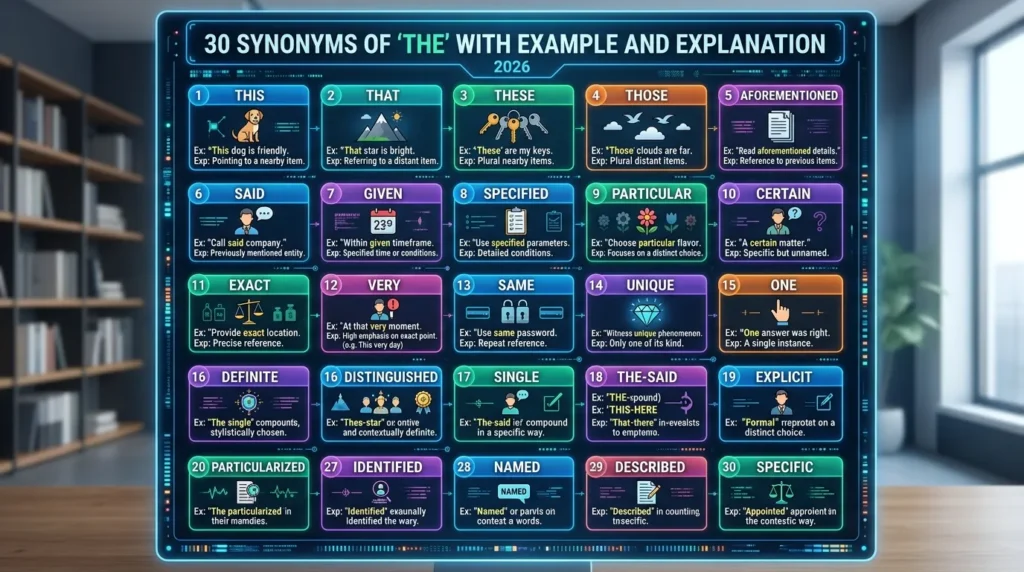
30 Synonyms of The
Note: The word the does not have exact synonyms. The following words are context-based substitutes or related determiners.
1. This (determiner/pronoun)
US: /ðɪs/ | UK: /ðɪs/
Meaning: refers to a specific nearby thing
Examples:
- This book is interesting.
- I like this idea.
2. That (determiner/pronoun)
US: /ðæt/ | UK: /ðæt/
Meaning: refers to a specific thing farther away
Examples:
- That house is old.
- I remember that moment.
3. These (determiner/pronoun)
US: /ðiːz/ | UK: /ðiːz/
Meaning: refers to specific nearby plural things
Examples:
- These apples are fresh.
- I bought these shoes yesterday.
4. Those (determiner/pronoun)
US: /ðoʊz/ | UK: /ðəʊz/
Meaning: refers to specific distant plural things
Examples:
- Those cars are expensive.
- I remember those days.
5. Such (determiner)
US: /sʌtʃ/ | UK: /sʌtʃ/
Meaning: of a particular kind
Examples:
- I have never seen such beauty.
- Such problems are common.
6. This Particular (phrase)
US: /ðɪs pərˈtɪkjələr/ | UK: /ðɪs pəˈtɪkjʊlə/
Meaning: one exact thing
Examples:
- I want this particular chair.
- This particular lesson is important.
7. That Specific (phrase)
US: /ðæt spəˈsɪfɪk/ | UK: /ðæt spəˈsɪfɪk/
Meaning: one clearly identified thing
Examples:
- I remember that specific song.
- She discussed that specific topic.
8. Said (adjective/determiner)
US: /sed/ | UK: /sed/
Meaning: previously mentioned
Examples:
- The lawyer discussed the said document.
- The said event happened yesterday.
9. Mentioned (adjective)
US: /ˈmenʃənd/ | UK: /ˈmenʃənd/
Meaning: already spoken about
Examples:
- The mentioned article was useful.
- He reviewed the mentioned plan.
10. Identified (adjective)
US: /aɪˈdentɪfaɪd/ | UK: /aɪˈdentɪfaɪd/
Meaning: clearly recognized
Examples:
- The identified suspect escaped.
- We studied the identified problem.
11. Particular (adjective)
US: /pərˈtɪkjələr/ | UK: /pəˈtɪkjʊlə/
Meaning: specific and exact
Examples:
- She likes one particular song.
- This particular rule matters.
12. Certain (determiner/adjective)
US: /ˈsɜːrtn/ | UK: /ˈsɜːtn/
Meaning: specific but not fully named
Examples:
- A certain teacher helped me.
- I need certain tools.
13. Specified (adjective)
US: /ˈspesəfaɪd/ | UK: /ˈspesɪfaɪd/
Meaning: clearly stated
Examples:
- Use the specified method.
- The specified room is upstairs.
14. Named (adjective)
US: /neɪmd/ | UK: /neɪmd/
Meaning: clearly identified by name
Examples:
- The named student won.
- A named location was chosen.
15. Referenced (adjective)
US: /ˈrefərənsd/ | UK: /ˈrefrənst/
Meaning: already referred to
Examples:
- The referenced chapter is helpful.
- He reviewed the referenced text.
16. Defined (adjective)
US: /dɪˈfaɪnd/ | UK: /dɪˈfaɪnd/
Meaning: clearly described
Examples:
- The defined area is restricted.
- A defined goal improves focus.
17. Pointed-Out (adjective)
US: /ˈpɔɪntɪd aʊt/ | UK: /ˈpɔɪntɪd aʊt/
Meaning: clearly indicated
Examples:
- The pointed-out mistake was corrected.
- She discussed the pointed-out issue.
18. Indicated (adjective)
US: /ˈɪndɪkeɪtɪd/ | UK: /ˈɪndɪkeɪtɪd/
Meaning: shown or identified
Examples:
- Use the indicated route.
- The indicated answer is correct.
19. Chosen (adjective)
US: /ˈtʃoʊzn/ | UK: /ˈtʃəʊzn/
Meaning: selected from others
Examples:
- The chosen player scored.
- We followed the chosen plan.
20. Selected (adjective)
US: /sɪˈlektɪd/ | UK: /sɪˈlektɪd/
Meaning: carefully picked
Examples:
- The selected books are useful.
- He reviewed the selected files.
21. Exact (adjective)
US: /ɪɡˈzækt/ | UK: /ɪɡˈzækt/
Meaning: precise and specific
Examples:
- Tell me the exact time.
- She found the exact location.
22. Same (adjective)
US: /seɪm/ | UK: /seɪm/
Meaning: identical or already known
Examples:
- We visited the same park.
- He wore the same jacket.
23. One Certain (phrase)
US: /wʌn ˈsɜːrtn/ | UK: /wʌn ˈsɜːtn/
Meaning: one specific thing or person
Examples:
- One certain teacher inspired me.
- She visited one certain shop.
24. Existing (adjective)
US: /ɪɡˈzɪstɪŋ/ | UK: /ɪɡˈzɪstɪŋ/
Meaning: already present or known
Examples:
- The existing rules remain active.
- We improved the existing system.
25. Recognized (adjective)
US: /ˈrekəɡnaɪzd/ | UK: /ˈrekəɡnaɪzd/
Meaning: known or identified
Examples:
- The recognized expert spoke today.
- A recognized pattern appeared.
26. Official (adjective)
US: /əˈfɪʃəl/ | UK: /əˈfɪʃəl/
Meaning: formally accepted
Examples:
- The official statement was released.
- He read the official report.
27. Designated (adjective)
US: /ˈdezɪɡneɪtɪd/ | UK: /ˈdezɪɡneɪtɪd/
Meaning: officially selected
Examples:
- Use the designated entrance.
- The designated seat was empty.
28. Prescribed (adjective)
US: /prɪˈskraɪbd/ | UK: /prɪˈskraɪbd/
Meaning: officially required
Examples:
- Follow the prescribed steps.
- The prescribed method works best.
29. Determined (adjective)
US: /dɪˈtɜːrmɪnd/ | UK: /dɪˈtɜːmɪnd/
Meaning: clearly decided or fixed
Examples:
- The determined route was safe.
- We used the determined amount.
30. Definite (adjective)
US: /ˈdefɪnət/ | UK: /ˈdefɪnət/
Meaning: clear and specific
Examples:
- There is a definite answer.
- She gave a definite reply.
Prototype Meaning
The most typical meaning of the is showing that a noun is specific and already known. People usually imagine a familiar object, person, or place when hearing the word.
Prototype Categorization
- Specific reference words: this, that, these, those
- Formal identification words: said, specified, designated
- Precision words: exact, definite, particular
- Recognition words: identified, recognized, named
Categorization helps writers choose the best substitute depending on grammar, tone, and context.
Antonyms of The
Antonyms
- A (article): refers to any one thing, not specific
- An (article): refers to any one vowel-starting noun
- Any (determiner): no specific thing chosen
- Some (determiner): an unspecified amount or group
- Several (determiner): more than one but not exact
Short Questions and Answers
What does the mean?
- It is a definite article used before specific nouns.
When should the be used?
- Use it when talking about something already known or clearly identified.
Is the positive or negative?
- It is neutral because it mainly serves a grammatical purpose.
How is it different from similar words?
- “The” points to a specific noun, while “a” or “an” refers to general nouns.
Conclusion
Learning synonyms of the and synonyms of the related substitutes improves grammar, vocabulary, and sentence variety. It helps English learners understand specificity and reference more clearly in writing and speaking. Using different determiners and descriptive alternatives also helps avoid repetition and creates more natural communication.Although the is a small word, it plays a major role in English grammar. Understanding how it works builds stronger reading, writing, and speaking skills. Practice using articles and reference words daily to improve fluency and confidence in English communication.

I’m Zahid Abbas, an educator, researcher, and digital publishing strategist with a passion for linguistics, grammar, and clear communication. As a content creator and SEO specialist, I craft research-driven, reader-focused content that empowers learners and makes knowledge accessible worldwide.