The word acquire means to get, gain, or obtain something through effort, learning, or experience. Imagine a student studying every day to acquire new skills for a future job. Over time, the student gains knowledge and confidence.
People often use the word acquire in education, business, communication, and daily conversation. It is common when talking about gaining knowledge, buying something, or developing abilities. However, repeating the same word many times can make writing dull.
Learning synonyms of acquire helps English learners improve vocabulary and communication skills. It also helps writers express ideas more naturally and clearly. In this article, you will learn the meaning of acquire, its pronunciation, grammar, history, examples, and 30 useful synonyms.
You will also explore semantic categories, antonyms, and simple questions to strengthen your English.
Meaning of Acquire
Definition
Acquire (verb): to get or gain something through effort, learning, or action.
Examples
- She worked hard to acquire new skills.
- He hopes to acquire more knowledge.
Connotative Meaning
(Connotation means the feeling or emotion a word suggests beyond its basic meaning.)
- Positive tone: growth, learning, success
- Negative tone: greed or taking too much in some contexts
- Neutral tone: obtaining or gaining something
Etymology
- From Latin acquirere meaning “to gain” or “to add to”
- Entered English through Old French
Short History:
- Old English (450–1100): similar words meant “gain” or “receive”
- Middle English (1100–1500): acquire entered through French influence
- Modern English (1500–Present): used widely for learning and obtaining
Pronunciation (US & UK – IPA)
- US: /əˈkwaɪər/
- UK: /əˈkwaɪə/
Syllables
- ac-quire
Affixation Pattern of Acquire
- Root: quire
- Prefix: ac-
- Suffix: none
Word Formation:
- acquisition (noun)
- acquired (adjective/verb)
- acquiring (verb)
- acquirable (adjective)
Synonyms of Acquire
1. Obtain (verb)
US: /əbˈteɪn/ | UK: /əbˈteɪn/
Meaning: to get something successfully
Examples:
- She obtained a scholarship.
- He worked hard to obtain permission.
2. Gain (verb)
US: /ɡeɪn/ | UK: /ɡeɪn/
Meaning: to get something useful
Examples:
- She gained experience quickly.
- He gained confidence over time.
3. Get (verb)
US: /ɡɛt/ | UK: /ɡet/
Meaning: to receive or obtain something
Examples:
- I want to get a new phone.
- She got good grades.
4. Earn (verb)
US: /ɜːrn/ | UK: /ɜːn/
Meaning: to receive through effort
Examples:
- He earned respect.
- She earned a promotion.
5. Attain (verb)
US: /əˈteɪn/ | UK: /əˈteɪn/
Meaning: to achieve something after effort
Examples:
- She attained success.
- He hopes to attain his goals.
6. Secure (verb)
US: /sɪˈkjʊr/ | UK: /sɪˈkjʊə/
Meaning: to obtain safely or firmly
Examples:
- He secured a job.
- She secured funding.
7. Receive (verb)
US: /rɪˈsiːv/ | UK: /rɪˈsiːv/
Meaning: to be given something
Examples:
- She received an award.
- He received the package.
8. Collect (verb)
US: /kəˈlɛkt/ | UK: /kəˈlekt/
Meaning: to gather things together
Examples:
- He collects stamps.
- She collected useful data.
9. Gather (verb)
US: /ˈɡæðər/ | UK: /ˈɡæðə/
Meaning: to bring together
Examples:
- They gathered information.
- She gathered resources.
10. Learn (verb)
US: /lɜːrn/ | UK: /lɜːn/
Meaning: to gain knowledge
Examples:
- He wants to learn English.
- She learned new skills.
11. Develop (verb)
US: /dɪˈvɛləp/ | UK: /dɪˈveləp/
Meaning: to grow or improve abilities
Examples:
- She developed leadership skills.
- He developed confidence.
12. Pick Up (verb)
US: /pɪk ʌp/ | UK: /pɪk ʌp/
Meaning: to learn casually
Examples:
- He picked up Spanish quickly.
- She picked up useful habits.
13. Win (verb)
US: /wɪn/ | UK: /wɪn/
Meaning: to gain through competition
Examples:
- She won a prize.
- He won public support.
14. Procure (verb)
US: /prəˈkjʊr/ | UK: /prəˈkjʊə/
Meaning: to obtain something with effort
Examples:
- The company procured supplies.
- He procured important documents.
15. Capture (verb)
US: /ˈkæptʃər/ | UK: /ˈkæptʃə/
Meaning: to take control of something
Examples:
- The army captured the city.
- She captured attention quickly.
16. Attain Possession Of (verb phrase)
US: /əˈteɪn pəˈzɛʃən/ | UK: /əˈteɪn pəˈzeʃən/
Meaning: to come to own something
Examples:
- He attained possession of the land.
- She attained possession of the files.
17. Purchase (verb)
US: /ˈpɜːrtʃəs/ | UK: /ˈpɜːtʃəs/
Meaning: to buy something
Examples:
- She purchased a car.
- He purchased new books.
18. Buy (verb)
US: /baɪ/ | UK: /baɪ/
Meaning: to pay money for something
Examples:
- I want to buy a laptop.
- She bought fresh fruit.
19. Master (verb)
US: /ˈmæstər/ | UK: /ˈmɑːstə/
Meaning: to learn completely
Examples:
- He mastered French grammar.
- She mastered cooking skills.
20. Achieve (verb)
US: /əˈtʃiːv/ | UK: /əˈtʃiːv/
Meaning: to reach success
Examples:
- She achieved her dream.
- He achieved high grades.
21. Reach (verb)
US: /riːtʃ/ | UK: /riːtʃ/
Meaning: to arrive at a goal
Examples:
- He reached success.
- She reached her target.
22. Amass (verb)
US: /əˈmæs/ | UK: /əˈmæs/
Meaning: to gather a large amount
Examples:
- He amassed wealth slowly.
- She amassed useful knowledge.
23. Garner (verb)
US: /ˈɡɑːrnər/ | UK: /ˈɡɑːnə/
Meaning: to collect or earn gradually
Examples:
- She garnered support online.
- He garnered praise.
24. Inherit (verb)
US: /ɪnˈhɛrɪt/ | UK: /ɪnˈherɪt/
Meaning: to receive from family
Examples:
- She inherited property.
- He inherited money.
25. Absorb (verb)
US: /əbˈzɔːrb/ | UK: /əbˈzɔːb/
Meaning: to take in information
Examples:
- Students absorb knowledge quickly.
- She absorbed new ideas.
26. Acquire Knowledge (verb phrase)
US: /əˈkwaɪər ˈnɑːlɪdʒ/ | UK: /əˈkwaɪə ˈnɒlɪdʒ/
Meaning: to learn information
Examples:
- He wants to acquire knowledge daily.
- She reads books to acquire knowledge.
27. Net (verb)
US: /nɛt/ | UK: /net/
Meaning: to gain as a result
Examples:
- The company netted profits.
- He netted a reward.
28. Come By (verb phrase)
US: /kʌm baɪ/ | UK: /kʌm baɪ/
Meaning: to obtain something
Examples:
- Good jobs are hard to come by.
- Fresh water is difficult to come by.
29. Acquire Ownership Of (verb phrase)
US: /əˈkwaɪər ˈoʊnərʃɪp/ | UK: /əˈkwaɪə ˈəʊnəʃɪp/
Meaning: to become the owner of something
Examples:
- She acquired ownership of the company.
- He acquired ownership of the house.
30. Take In (verb phrase)
US: /teɪk ɪn/ | UK: /teɪk ɪn/
Meaning: to understand or absorb information
Examples:
- It takes time to take in new ideas.
- She quickly took in the lesson.
Prototype Meaning
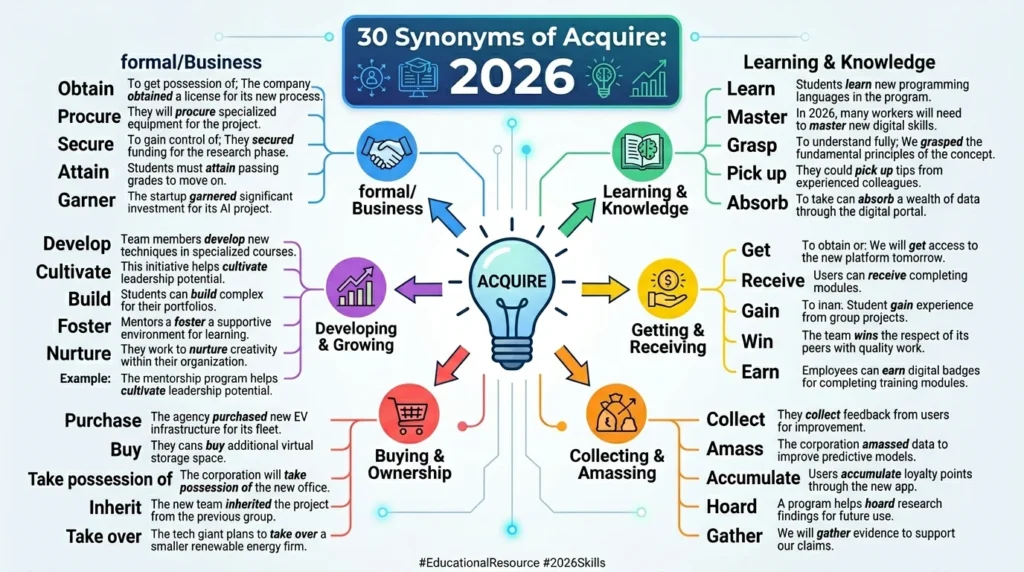
The most common meaning of acquire is getting something valuable through learning, effort, or experience. People often imagine gaining skills, knowledge, money, or possessions over time.
Prototype Categorization
- Getting possessions: buy, purchase, inherit
- Learning and knowledge: learn, absorb, master
- Achieving success: attain, achieve, secure
- Gathering gradually: collect, amass, garner
Categorization helps writers choose the best synonym based on education, business, personal growth, or ownership situations.
Antonyms of Acquire
Antonyms
- Lose (verb): to no longer have something
- Surrender (verb): to give up something
- Forfeit (verb): to lose as punishment
- Relinquish (verb): to give away voluntarily
- Discard (verb): to throw away
Short Questions and Answers
What does acquire mean?
- It means to get or gain something through effort or action.
When should acquire be used?
- Use it when talking about gaining skills, knowledge, or possessions.
Is acquire positive or negative?
- It is usually positive because it suggests growth or success.
How is it different from similar words?
- “Acquire” often suggests effort and gradual gain, while “get” is more general.
Conclusion
Learning synonyms of acquire and synonyms of acquire improves vocabulary and communication skills. It helps English learners express ideas clearly in speaking and writing. Using different synonyms also avoids repetition and makes language more natural.Understanding these words is useful in education, business, and daily conversation. They help describe learning, success, ownership, and personal growth more accurately. Practice using a few new synonyms every day in simple sentences. Small daily habits can build stronger English confidence and fluency over time.

I’m Zahid Abbas, an educator, researcher, and digital publishing strategist with a passion for linguistics, grammar, and clear communication. As a content creator and SEO specialist, I craft research-driven, reader-focused content that empowers learners and makes knowledge accessible worldwide.