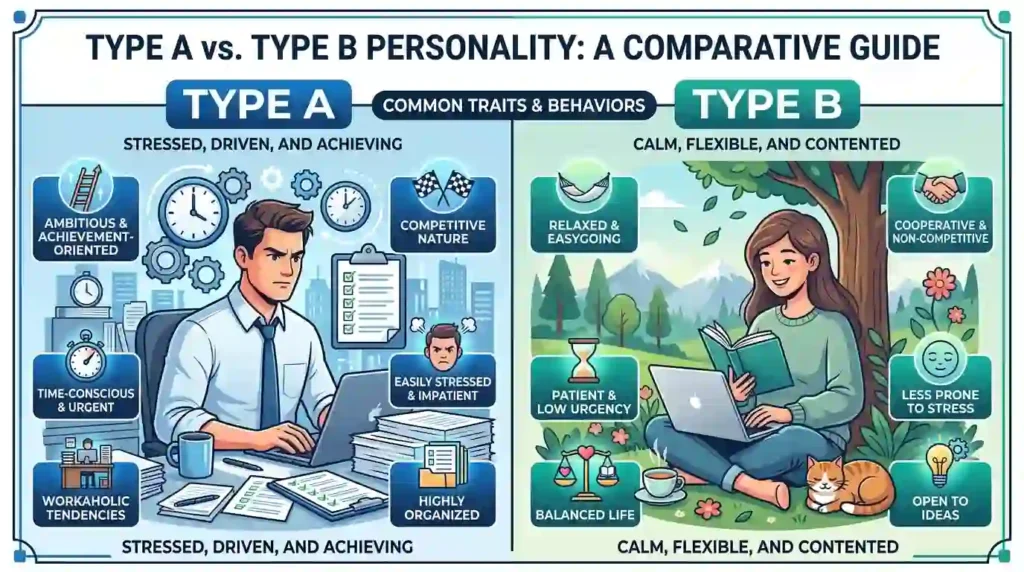

Type A vs Type B usually refers to two contrasting patterns of behavior. Type A is commonly associated with time urgency, competitiveness, achievement, impatience, and a strong drive to get things done. Type B is generally associated with a more relaxed, patient, flexible approach. Most people do not fit perfectly into either category and may show traits from both.
Key Takeaways
- Type A behavior is commonly linked with urgency, competition, achievement, and impatience.
- Type B behavior is generally more relaxed, patient, and flexible.
- The A/B framework describes behavior patterns rather than fixed medical diagnoses.
- Most people show a mixture of Type A and Type B tendencies.
- The original Type A concept came from research by cardiologists Meyer Friedman and Ray Rosenman in the 1950s.
What Does Type A vs Type B Mean?
The terms Type A and Type B are commonly used to describe different ways people respond to time, pressure, competition, and everyday demands.
A person with strong Type A tendencies may feel a constant need to move quickly, meet goals, compete, or stay productive. A person with stronger Type B tendencies may be more comfortable working at a steady pace and may be less affected by time pressure.
However, these labels are easy to oversimplify. Type A does not simply mean “successful,” and Type B does not mean “lazy.” A Type B person can be ambitious and productive, while a Type A person can struggle with stress despite being highly motivated.
Modern sources also emphasize that people often fall somewhere between the two patterns rather than belonging completely to one category.
Type A Personality Traits
Type A behavior is traditionally associated with a strong sense of urgency and achievement.
Common characteristics include:
- Strong competitiveness
- High motivation
- Goal orientation
- Impatience with delays
- A strong focus on deadlines
- Desire to accomplish several tasks
- Frustration when things move slowly
- Difficulty relaxing at times
- A tendency to measure progress through results
For example, imagine two people waiting in a long checkout line. A person with stronger Type A tendencies may become frustrated because the delay is interfering with their schedule. They may check the time repeatedly or look for a faster option.
That does not automatically make them aggressive or unhealthy. It simply illustrates a stronger response to time pressure.
Medical News Today describes Type A characteristics as including competitiveness, determination, hard work, impatience, and a sense of urgency.
Common Type A Behaviors
At work, someone with Type A tendencies might create detailed deadlines, take on several projects, or become highly focused on completing a task.
These behaviors can be useful in situations that require strong organization and urgency. However, constant pressure can also become frustrating when a person has difficulty slowing down.
It is important not to assume that every organized, ambitious, or hardworking person is Type A. The traditional pattern includes more than productivity alone.
Type B Personality Traits
Type B behavior generally represents a less time-pressured and more relaxed approach.
Common characteristics include:
- Patience
- Flexibility
- Calmness
- Lower competitiveness
- A steady work pace
- Comfort with unstructured time
- Less frustration with delays
- Greater willingness to adapt
- An even-tempered approach
For example, if a meeting starts 10 minutes late, a person with stronger Type B tendencies may simply wait without becoming highly frustrated. They may use the extra time to talk with someone, check their notes, or relax.
Type B does not mean a person lacks goals. Someone can be ambitious while still being comfortable with a slower and more flexible process.
Common Type B Behaviors
At work, a Type B-leaning person may prefer to focus on one task at a time rather than constantly switching between projects.
They may also be comfortable changing plans when circumstances change. The possible downside is that lower urgency can sometimes lead to procrastination or less attention to tight deadlines.
Again, these are tendencies rather than rules. Individual behavior depends on personality, environment, experience, and the situation.
Type A vs Type B: Key Differences
| Behavior | Type A tendencies | Type B tendencies |
|---|---|---|
| Pace | Fast and urgent | Steady and relaxed |
| Deadlines | Strong focus on deadlines | Generally less time-pressured |
| Competition | Often highly competitive | Usually less competition-focused |
| Stress | May react strongly to pressure | Often more comfortable with pressure |
| Frustration | Can become impatient | Usually more patient |
| Work style | May multitask | May prefer focused tasks |
| Goals | Strong achievement drive | Can be ambitious without constant urgency |
| Change | May want quick action | Often more flexible |
| Relaxation | May find it difficult to slow down | Usually more comfortable relaxing |
These differences describe general patterns, not rules that apply to everyone.
Stress and Pressure
One of the clearest differences involves the way people respond to pressure.
Type A tendencies may involve urgency, impatience, and frustration when progress is slow. Type B tendencies are generally associated with a calmer response and less concern about competing against the clock.
But stress does not depend on personality labels alone. Workload, financial pressure, relationships, sleep, environment, and many other factors can affect how someone responds to stress.
Work and Deadlines
A Type A-leaning person may enjoy tight goals and measurable results. They may naturally create deadlines even when none exist.
A Type B-leaning person may prefer enough time to explore a task and adjust their approach.
Neither description tells you whether someone will perform well at work. Job demands and individual skills matter too.
Competition and Achievement
Type A behavior is strongly associated with competitive achievement. Winning, reaching targets, and comparing performance may provide extra motivation.
Type B behavior generally involves less competitive pressure. A Type B person may still have ambitious goals but may focus more on the process than on outperforming other people.
Social Behavior
Type A tendencies can sometimes appear as impatience, especially when conversations or activities move slowly. Type B tendencies are often described as more easygoing and even-tempered.
These labels should not be used to predict whether someone will be friendly, introverted, extroverted, or socially successful. Personality is much more complicated than two categories.
Can You Be Both Type A and Type B?
Yes. Many people show characteristics associated with both.
The Type A and Type B framework is often presented as an either-or choice, but real human behavior is more flexible. A person might be highly Type A about work but strongly Type B during free time.
For example, someone could be extremely organized about an important project while remaining relaxed about weekend plans. Another person could be highly competitive in sports but patient and calm in everyday situations.
This is one reason the A/B framework is better understood as a description of tendencies rather than a strict classification.
Where Did the Type A and Type B Idea Come From?
The concept dates back to the work of cardiologists Meyer Friedman and Ray Rosenman in the 1950s.
They used the term Type A behavior pattern to describe a cluster of behaviors involving characteristics such as competitiveness, time urgency, and hostility. Type B was used as a contrasting pattern.
The original research was connected to questions about cardiovascular disease rather than today’s popular personality quizzes. Over time, the labels became widely used in everyday discussions about personality and behavior.
Does Type A Personality Cause Heart Disease?
The simple claim that being a Type A personality directly causes heart disease is not supported by the modern understanding of the evidence.
Early research proposed a connection between Type A behavior and coronary heart disease. Later research challenged the idea that the entire Type A pattern was a reliable independent predictor.
Some research has focused more specifically on components such as hostility and chronic anger rather than ambition or busyness alone. Therefore, it is misleading to say that simply being ambitious or hardworking causes heart disease.
If you have concerns about cardiovascular risk, factors such as blood pressure, cholesterol, smoking, diabetes, family history, diet, physical activity, and other established health factors should be discussed with a healthcare professional rather than relying on a personality label.
Type A vs Type B vs Modern Personality Science
The A/B framework remains popular because it is simple and easy to understand. However, modern personality research often uses more detailed approaches.
For example, the Big Five framework measures personality across several broad dimensions rather than placing someone into only Type A or Type B.
This matters because a person can be highly conscientious, moderately competitive, socially outgoing, emotionally sensitive, and very relaxed about deadlines at the same time.
The Type A/B model can therefore be useful as everyday shorthand, but it should not be treated as a complete description of someone’s personality.
How to Recognize Your Own Tendencies
Instead of asking only, “Am I Type A or Type B?” consider these questions:
- How do I react when someone makes me wait?
- Do deadlines motivate me or make me anxious?
- How important is competition to me?
- Do I feel uncomfortable when I am not being productive?
- Can I relax without feeling that I should be doing something?
- How do I react when plans suddenly change?
- Do I usually rush through tasks or work at a steady pace?
Your answers may show that you lean toward one pattern in certain situations and the other pattern elsewhere.
A self-assessment can encourage reflection, but it should not be treated as a clinical diagnosis.
Frequently Asked Questions
Is Type A or Type B better?
Neither label is inherently better. Type A tendencies may involve strong achievement motivation and urgency, while Type B tendencies may involve patience and flexibility. The usefulness of either pattern depends on the person and situation.
Can someone be both Type A and Type B?
Yes. People can show characteristics associated with both patterns. Someone may be highly driven and organized at work but relaxed during personal time. Most people cannot be accurately described by a strict two-category label.
What is the main difference between Type A and Type B?
The main distinction is how a person tends to respond to time, pressure, competition, and achievement. Type A is generally associated with greater urgency and competitiveness, while Type B is associated with a more relaxed and flexible approach.
Is Type A personality a medical diagnosis?
No. Type A and Type B are behavioral descriptions, not medical diagnoses. They should not be used to diagnose a mental or physical health condition.
Are Type A and Type B blood types the same thing?
No. Type A and Type B personality and Type A and Type B blood are completely different concepts.
In the ABO blood group system, Type A blood has A antigens on red blood cells, while Type B blood has B antigens. Type A blood has anti-B antibodies in its plasma, while Type B blood has anti-A antibodies. Blood type is important for safe transfusions.
Conclusion
Type A vs Type B is mainly a comparison of two traditional behavioral patterns. Type A is commonly associated with urgency, competition, achievement, and impatience, while Type B is generally associated with patience, flexibility, and a more relaxed approach.
The important point is that people rarely fit perfectly into one box. Your behavior can change depending on the situation, responsibilities, environment, and stage of life. The A/B framework can help describe certain tendencies, but it is only one simple way of thinking about personality.