The word learn refers to getting new knowledge, understanding something new, or gaining a skill by studying, practicing. Imagine opening an exciting storybook or discovering how to ride a bicycle for the first time. That process of gaining new understanding is to learn.
We use synonyms for learn to describe a student studying math formulas, an artist practicing how to draw. Also someone finding out new facts about nature. Learning new ways to say learn and synonyms for learn helps learners make their story writing clear, and varied. English learners and content writers need synonyms for learn too.
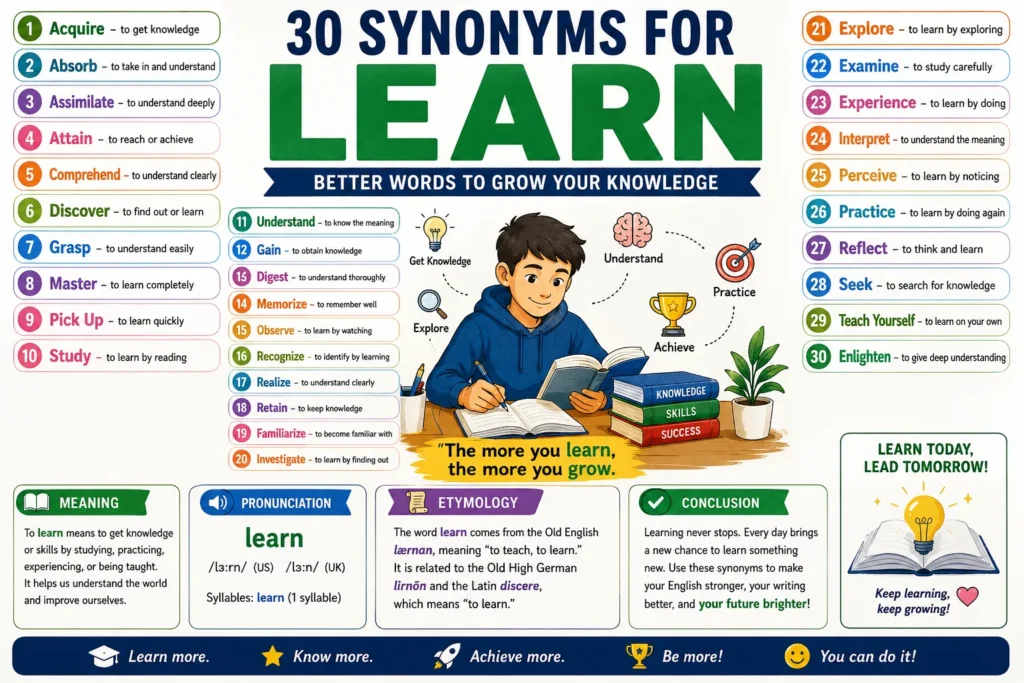
This guide gives you 30 simple synonyms for learn. Along with easy sentences, word origins, pronunciation guides, and clear categories,
Meaning of Learn
Definition
Learn (Verb): To gain knowledge, skill, or understanding by study, experience, or being taught.
Examples
- Children learn how to read simple sentences in primary school.
- She wants to learn how to play the piano during summer vacation.
Connotative Meaning
- Positive tone: Represents growth, curiosity, self-improvement, and intelligence.
- Negative tone: Rarely negative, though sometimes associated with hard work or making mistakes before succeeding.
- Neutral tone: Simply describes receiving or acquiring new facts and skills.
Etymology
- Source language: Came from Old English (leornian).
- Old Germanic: Related to words meaning “to follow a track” or “to find a path”.
- Modern English: Literally means following a path of knowledge to discover new things!
Pronunciation
- US: /lɜːrn/
- UK: /lɜːn/
Syllables
learn (1 part)
Affixation Pattern of Learn
- Root: Learn (verb)
- Suffix: -er (one who learns), -ed / -t (past tense), -ing (action)
- Word Formation:
- Noun: Learner / Learning
- Verb: Learn
- Adjective: Learned / Learning
- Adverb: Learnedly
For further information, you can also visit our website https://synonymhubb.com/synonyms-for-children/
Synonyms for Learn
1. Study (Verb) — US: /ˈstʌdi/ | UK: /ˈstʌdi/
Meaning: To spend time reading or practicing to gain knowledge.
Examples:
She likes to study science books after school.
We must study hard to perform well on the test.
2. Discover (Verb) — US: /dɪˈskʌvər/ | UK: /dɪˈskʌvə/
Meaning: To find or learn something for the first time.
Examples:
Scientists discover new plant species in deep forests.
He was excited to discover a hidden passage in the storybook.
3. Understand (Verb) — US: /ˌʌndərˈstænd/ | UK: /ˌʌndəˈstænd/
Meaning: To get the clear meaning or reason behind something.
Examples:
The teacher helped us understand the tricky math problem.
Once you understand the rules, the game becomes easy.
4. Master (Verb) — US: /ˈmæstər/ | UK: /ˈmɑːstə/
Meaning: To learn a skill completely so that you become very good at it.
Examples:
It takes lots of practice to master playing the violin.
She managed to master her multiplication tables in a week.
5. Absorb (Verb) — US: /əbˈzɔːrb/ | UK: /əbˈzɔːb/
Meaning: To take in and hold information in your mind.
Examples:
Young children absorb new vocabulary very quickly.
He sat quietly to absorb all the facts from the history lesson.
6. Grasp (Verb) — US: /ɡræsp/ | UK: /ɡrɑːsp/
Meaning: To understand a difficult idea or concept clearly.
Examples:
She quickly managed to grasp how the mechanism works.
He found it easy to grasp the main point of the lesson.
7. Memorize (Verb) — US: /ˈmɛməraɪz/ | UK: /ˈmeməraɪz/
Meaning: To learn something so well that you remember every word or detail.
Examples:
We need to memorize the lines for our school play.
He tried to memorize his phone number in case of emergencies.
8. Gather (Verb) — US: /ˈɡæðər/ | UK: /ˈɡæðə/
Meaning: To collect information, facts, or ideas together.
Examples:
Students go to the library to gather facts for their reports.
The detective worked hard to gather clues about the mystery.
9. Acquire (Verb) — US: /əˈkwaɪər/ | UK: /əˈkwaɪə/
Meaning: To gain a new skill, habit, or piece of knowledge.
Examples:
Reading daily helps you acquire a strong vocabulary.
He hopes to acquire good swimming skills this summer.
10. Comprehend (Verb) — US: /ˌkɑːmprɪˈhɛnd/ | UK: /ˌkɒmprɪˈhend/
Meaning: To fully understand or grasp the meaning of something complex.
Examples:
It was hard to comprehend the long scientific explanation.
Illustrations help young readers comprehend difficult stories.
11. Find out (Verb) — US: /faɪnd aʊt/ | UK: /faɪnd aʊt/
Meaning: An informal way to say discover or get news about something.
Examples:
Call your friend to find out what time the party starts.
I want to find out how birds build their sturdy nests.
12. Uncover (Verb) — US: /ʌnˈkʌvər/ | UK: /ʌnˈkʌvə/
Meaning: To reveal or bring to light information that was hidden.
Examples:
The historian worked to uncover ancient stories of the city.
Reading news helps us uncover interesting facts about the world.
13. Pick up (Verb) — US: /pɪk ʌp/ | UK: /pɪk ʌp/
Meaning: To learn a new skill or language naturally without formal lessons.
Examples:
Children can pick up a second language very easily.
He managed to pick up chess just by watching his brother play.
14. Observe (Verb) — US: /əbˈzɜːrv/ | UK: /əbˈzɜːv/
Meaning: To learn by watching carefully what people or things do.
Examples:
Students observe how seeds grow into plants in science class.
If you observe closely, you can see how ants work together.
15. Determine (Verb) — US: /dɪˈtɜːrmɪn/ | UK: /dɪˈtɜːmɪn/
Meaning: To discover or establish exact facts through calculation or study.
Examples:
The test results will determine who wins the prize.
We measured the box to determine its exact length.
16. Adopt (Verb) — US: /əˈdɑːpt/ | UK: /əˈdɒpt/
Meaning: To take up and start using a new method, habit, or idea.
Examples:
It is good to adopt healthy study habits early in life.
The team chose to adopt a new strategy for the game.
17. Practice (Verb) — US: /ˈpræktɪs/ | UK: /ˈpræktɪs/
Meaning: To do something repeatedly to learn and improve a skill.
Examples:
You must practice every day to become a good writer.
She likes to practice her spelling words before dinner.
18. Assimilate (Verb) — US: /əˈsɪməleɪt/ | UK: /əˈsɪməleɪt/
Meaning: To absorb and fully digest ideas or information into your mind.
Examples:
It takes time to assimilate complex rules in a new game.
The human mind can assimilate vast amounts of knowledge.
19. Identify (Verb) — US: /aɪˈdɛntɪfaɪ/ | UK: /aɪˈdentɪfaɪ/
Meaning: To recognize and name a specific thing or fact correctly.
Examples:
Can you identify the different types of leaves on the table?
The chart helps students identify safe street signs.
20. Trace (Verb) — US: /treɪs/ | UK: /treɪs/
Meaning: To follow or discover the background or origin of something.
Examples:
We can trace the history of airplanes back over a century.
The teacher showed us how to trace the river on the map.
21. Realize (Verb) — US: /ˈriːəlaɪz/ | UK: /ˈrɪəlaɪz/
Meaning: To suddenly become aware of or understand a fact clearly.
Examples:
I began to realize that I had solved the riddle correctly.
She did not realize how late it had gotten while reading.
22. Deduce (Verb) — US: /dɪˈduːs/ | UK: /dɪˈdjuːs/
Meaning: To reach an answer by thinking carefully about known facts.
Examples:
From the footprints, the detective could deduce where he went.
You can deduce the meaning of a word from context clues.
23. Perceive (Verb) — US: /pərˈsiːv/ | UK: /pəˈsiːv/
Meaning: To become aware of something using your senses or mind.
Examples:
Artists perceive subtle details in light and shadow.
He began to perceive a change in his friend’s mood.
24. Glean (Verb) — US: /ɡliːn/ | UK: /ɡliːn/
Meaning: To gather small bits of information gradually and slowly.
Examples:
They managed to glean useful tips from the expert’s speech.
She liked to glean fun facts from old magazines.
25. Internalize (Verb) — US: /ɪnˈtɜːrnəlaɪz/ | UK: /ɪnˈtɜːnəlaɪz/
Meaning: To make an idea or belief a permanent part of your mind.
Examples:
Good leaders internalize lessons about kindness and fair play.
Practice helps you internalize basic addition rules.
26. Track down (Verb) — US: /træk daʊn/ | UK: /træk daʊn/
Meaning: To search for and find information or a missing item.
Examples:
He went to the library to track down an ancient recipe book.
She helped her friend track down the missing study notes.
27. Ascertain (Verb) — US: /ˌæsərˈteɪn/ | UK: /ˌæsəˈteɪn/
Meaning: To find out something with complete certainty.
Examples:
The doctor ran tests to ascertain the cause of the fever.
We checked the schedule to ascertain the exact train time.
28. Familiarize (Verb) — US: /fəˈmɪliəraɪz/ | UK: /fəˈmɪliəraɪz/
Meaning: To make yourself or someone else well acquainted with something.
Examples:
Take time to familiarize yourself with the new computer.
The guide helped us familiarize ourselves with the museum.
29. Explore (Verb) — US: /ɪkˈsplɔːr/ | UK: /ɪkˈsplɔː/
Meaning: To inquire into or examine a topic to learn more about it.
Examples:
We love to explore new science experiments in class.
The book allows readers to explore outer space mysteries.
30. Review (Verb) — US: /rɪˈvjuː/ | UK: /rɪˈvjuː/
Meaning: To go over material again to strengthen your learning.
Examples:
Always review your answers before submitting your test paper.
We will review yesterday’s vocabulary words this morning.
Prototype Meaning
When children hear learn, they picture sitting at a school desk listening to a teacher, opening an exciting book. Practicing swimming with floaties, or figuring out how to build a complex toy block tower step by step.
Prototype Categorization
- Studying & Formal Practice: Study, Practice, Memorize, Review, Familiarize, Master.
- Understanding & Mental Grasp: Understand, Grasp, Comprehend, Realize, Absorb, Assimilate, Internalize.
- Finding Out & Discovering: Discover, Find out, Uncover, Explore, Gather, Glean, Track down.
- Watching & Thinking Carefully: Observe, Deduce, Perceive, Identify, Ascertain, Determine, Trace, Adopt, Acquire, Pick up.
Antonyms of Learn
- Forget
- Ignore
- Overlook
- Teach (opposite role)
- Misunderstand
- Neglect
Short Questions and Answers
- What does learn mean?
- It means gaining new knowledge, skills, or understanding through study, practice, or being taught.
- When should I use learn?
- Use it when writing about school, studying, discovering new facts, picking up hobbies, or practicing skills.
- Is learn a verb or a noun?
- It is a verb! The noun form is learning or learner.
- What is the difference between learn and teach?
- Learn means taking in knowledge yourself, while teach means giving knowledge to someone else.
Conclusion
Synonyms for learn can make your English more varied and expressive. Words such as study, understand, discover, grasp, master, acquire, and absorb can be used in different situations and tones. Knowing synonyms for learn alternatives helps you avoid repetition. Choose the right word for your writing or conversation. Keep practicing synonyms for learn with simple examples to build a stronger vocabulary. Also communicate your ideas with confidence.

I’m Zahid Abbas, an educator, researcher, and digital publishing strategist with a passion for linguistics, grammar, and clear communication. As a content creator and SEO specialist, I craft research-driven, reader-focused content that empowers learners and makes knowledge accessible worldwide.