Use means to take something and put it to work for a purpose. Think about a boy who finds an old rope in the garage. He does not throw it away. He decides to use it to tie up his tent. That is what “use” means putting something to work. People use this word all day long. We use synonyms for use for tools, time, skills, and even people’s help. For English learners and content writers, learning synonyms for use like this one is very useful.Synonyms for use helps you avoid repeating the same word too many times, makes your writing sound more natural, and keeps readers interested. This article explores the meaning of the word, its synonyms with examples, grammar, history, pronunciation, and semantic categories all explained in simple sentences to help you learn faster and write with more skill.
Meaning of Use
Definition
Use (verb): to take something and put it to work for a job or purpose.
Examples
- She used a pencil to draw the picture.
- He uses his phone every morning.
Connotative Meaning
- Positive tone: smart, helpful, and full of purpose
- Negative tone: taking advantage of someone unfairly
- Neutral tone: just doing a simple action with a tool or thing
Etymology
- This word comes from the Latin word usus. It means “a using” or “a habit.”
- Usus comes from the Latin verb uti. It means “to use” or “to enjoy.”
- The word moved into English through Old French in the 1200s.
- Old English (450–1100): This word did not exist yet. People used the word brūcan instead. It meant “to make use of” or “to enjoy.”
- Middle English (1100–1500): The word use entered English through French. It meant “to put something to work” or “a habit.”
- Modern English (1500–Present): The word grew to cover many meanings. It now covers tools, time, skills, and even unfair treatment of people.
Pronunciation (US & UK — IPA)
- US: /juːz/ (verb) or /juːs/ (noun)
- UK: /juːz/ (verb) or /juːs/ (noun)
Syllables
use (1 part)
Affixation Pattern of Use
- Root: us- (from Latin uti, meaning “to use”)
- Prefix: none in the base word (though forms like re-use and mis-use use prefixes)
- Suffix: none in the base word (though forms like use-ful and use-less use suffixes)
- Word formation: This root makes many words. We get use (noun/verb), useful (adjective), useless (adjective), user (noun), usable (adjective), usage (noun), reuse (verb), and misuse (verb/noun). That is eight related words.
You May Also Like https://synonymhubb.com/synonyms-for-science/
Synonyms for Use
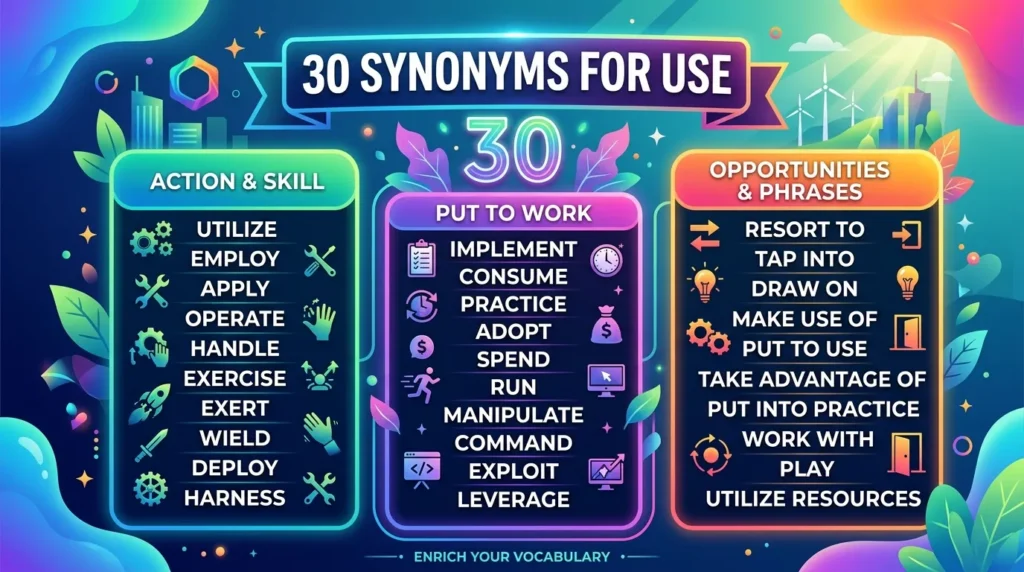
1. Utilize (verb) — US /ˈjuː.tə.laɪz/ | UK /ˈjuː.tɪ.laɪz/
Meaning: to use something for a clear purpose.
Examples:
- We can utilize this room as a library.
- The team utilized new tools for the project.
2. Employ (verb) — US /ɪmˈplɔɪ/ | UK /ɪmˈplɔɪ/
Meaning: to use something or someone to do a job.
Examples:
- She employed a new method to solve the problem.
- The company employed extra workers this month.
3. Apply (verb) — US /əˈplaɪ/ | UK /əˈplaɪ/
Meaning: to put something to work on a task.
Examples:
- Please apply the cream to the cut.
- He applied his skills to fix the car.
4. Operate (verb) — US /ˈɑː.pɚ.eɪt/ | UK /ˈɒp.ə.reɪt/
Meaning: to use or run a machine or system.
Examples:
- She knows how to operate this machine.
- He operates the crane at the site.
5. Handle (verb) — US /ˈhæn.dəl/ | UK /ˈhæn.dəl/
Meaning: to use or manage something with care.
Examples:
- He handles the tools carefully.
- She handled the problem well.
6. Exercise (verb) — US /ˈek.sɚ.saɪz/ | UK /ˈek.sə.saɪz/
Meaning: to use a power, right, or skill.
Examples:
- She exercised her right to vote.
- He exercised good judgment during the test.
7. Exert (verb) — US /ɪɡˈzɝːt/ | UK /ɪɡˈzɜːt/
Meaning: to use effort or force to get a result.
Examples:
- He exerted pressure on the lever.
- She exerted her influence to help the team.
8. Wield (verb) — US /wiːld/ | UK /wiːld/
Meaning: to use a tool or power with skill.
Examples:
- He wields the hammer with ease.
- The leader wields great power in the group.
9. Deploy (verb) — US /dɪˈplɔɪ/ | UK /dɪˈplɔɪ/
Meaning: to put something into use for a task or plan.
Examples:
- The team deployed new tools for the project.
- They deployed extra staff during the rush.
10. Harness (verb) — US /ˈhɑːr.nəs/ | UK /ˈhɑː.nəs/
Meaning: to use natural power for a goal.
Examples:
- Farmers harness the wind for energy.
- She harnessed her anger into hard work.
11. Implement (verb) — US /ˈɪm.plə.ment/ | UK /ˈɪm.plɪ.ment/
Meaning: to put a plan or tool into use.
Examples:
- The school implemented a new rule.
- We implemented the software last week.
12. Consume (verb) — US /kənˈsuːm/ | UK /kənˈsjuːm/
Meaning: to use up something, like fuel or time.
Examples:
- The car consumes a lot of gas.
- This task consumes too much time.
13. Practice (verb) — US /ˈpræk.tɪs/ | UK /ˈpræk.tɪs/
Meaning: to use a skill or method often.
Examples:
- She practices good habits daily.
- He practices safe driving rules.
14. Adopt (verb) — US /əˈdɑːpt/ | UK /əˈdɒpt/
Meaning: to start using a new method or idea.
Examples:
- The company adopted a new plan.
- She adopted a healthy morning routine.
15. Spend (verb) — US /spend/ | UK /spend/
Meaning: to use time, money, or energy on something.
Examples:
- He spends hours reading books.
- She spends her energy on her hobby.
16. Run (verb) — US /rʌn/ | UK /rʌn/
Meaning: to use or operate something, like a machine or program.
Examples:
- She runs the app every morning.
- He runs the old engine each week.
17. Manipulate (verb) — US /məˈnɪp.jə.leɪt/ | UK /məˈnɪp.jʊ.leɪt/
Meaning: to use or control something with skill.
Examples:
- She manipulates the tools with ease.
- He manipulates data for his job.
18. Command (verb) — US /kəˈmænd/ | UK /kəˈmɑːnd/
Meaning: to use skill or control over something well.
Examples:
- He commands three languages with ease.
- She commands respect in the office.
19. Exploit (verb) — US /ɪkˈsplɔɪt/ | UK /ɪkˈsplɔɪt/
Meaning: to use something fully, often for gain.
Examples:
- The company exploited the new market.
- She exploited her natural talent.
20. Leverage (verb) — US /ˈlev.ɚ.ɪdʒ/ | UK /ˈliː.vər.ɪdʒ/
Meaning: to use something to get the best result.
Examples:
- They leveraged their skills to win the deal.
- She leveraged her network to find a job.
21. Resort to (phrasal verb) — US /rɪˈzɔːrt tuː/ | UK /rɪˈzɔːt tuː/
Meaning: to use something, often as a last choice.
Examples:
- He resorted to old methods when new ones failed.
- She resorted to asking for help.
22. Tap into (phrasal verb) — US /tæp ˈɪn.tuː/ | UK /tæp ˈɪn.tuː/
Meaning: to use a hidden source of strength or supply.
Examples:
- She tapped into her creative side.
- The team tapped into new funding.
23. Draw on (phrasal verb) — US /drɔː ɑːn/ | UK /drɔː ɒn/
Meaning: to use something you already have, like knowledge or skill.
Examples:
- She drew on her past experience.
- He drew on his training to solve the case.
24. Make use of (phrase) — US /meɪk juːs ʌv/ | UK /meɪk juːs ɒv/
Meaning: to use something that is ready and free.
Examples:
- We should make use of this free time.
- They made use of the old barn.
25. Put to use (phrase) — US /pʊt tuː juːz/ | UK /pʊt tuː juːz/
Meaning: to use something that was sitting idle.
Examples:
- He put the old tools to use.
- She put her free time to use.
26. Take advantage of (phrase) — US /teɪk ədˈvæn.tɪdʒ ʌv/ | UK /teɪk ədˈvɑːn.tɪdʒ ɒv/
Meaning: to use a chance or resource well.
Examples:
- We took advantage of the sale.
- She took advantage of the free class.
27. Put into practice (phrase) — US /pʊt ˈɪn.tuː ˈpræk.tɪs/ | UK /pʊt ˈɪn.tuː ˈpræk.tɪs/
Meaning: to use an idea or plan in real life.
Examples:
- She put the theory into practice.
- He put his training into practice at work.
28. Work with (phrase) — US /wɝːk wɪð/ | UK /wɜːk wɪð/
Meaning: to use something as part of a task.
Examples:
- I like to work with clay.
- She works with new software every day.
29. Play (verb) — US /pleɪ/ | UK /pleɪ/
Meaning: to use a role or part in something.
Examples:
- Trust plays a big role in teamwork.
- Practice plays a part in success.
30. Utilize resources (phrase) — US /ˈjuː.tə.laɪz ˈriː.sɔːr.sɪz/ | UK /ˈjuː.tɪ.laɪz rɪˈzɔː.sɪz/
Meaning: to use the things available to reach a goal.
Examples:
- The team utilized resources wisely.
- They utilized every resource they had.
Prototype Meaning
When people hear “use,” they picture someone picking up a tool or a skill and putting it to work. They think of purpose and action, not just holding something, but doing something with it. This is the main picture the word gives us.
Prototype Categorization
- Simple action words: apply, handle, run, work with, play
- Skill and power words: exercise, wield, command, manipulate
- Formal or business words: utilize, employ, deploy, implement, leverage
- Effort words: exert, harness
- Using-up words: consume, spend
- Repeated-use words: practice, adopt
- Unfair-use words: exploit
- Phrase-based words: make use of, put to use, take advantage of, draw on, tap into, resort to, put into practice
Antonyms of Use:
- Waste
- Ignore
- Neglect
- Discard
- Abandon
Short Questions and Answers
- What does use mean? It means to take something and put it to work for a purpose.
- When should use be used? Use it when you talk about a tool, a skill, time, or a resource being put to work.
- Is use positive or negative? It is mostly neutral or positive, showing purpose and action. It can feel negative when it means treating a person unfairly.
- How is it different from similar words? “Use” is simple and general. “Utilize” sounds more formal. “Exploit” often means using something unfairly. “Consume” means using something up fully.
Conclusion
Synonyms for use helps you build a stronger vocabulary. It improves both your writing and speaking, helps you avoid repeating the same word again and again, and builds real confidence in English. Synonyms for use like “utilize,” “apply,” “leverage,” and “harness” each carry a slightly different shade of meaning, and knowing when to use each one makes your language clearer and more skilled. Keep practicing a little every day read new synonyms for use, try them in sentences, and notice how strong writers vary their word choice. Small daily habits lead to big improvement over time.

I’m Zahid Abbas, an educator, researcher, and digital publishing strategist with a passion for linguistics, grammar, and clear communication. As a content creator and SEO specialist, I craft research-driven, reader-focused content that empowers learners and makes knowledge accessible worldwide.