The word children refers to young human beings who are not yet adults. Imagine a lively playground filled with young kids playing tag, swinging on swings, laughing, and learning together. All those young people are what we call children.
We use children to describe students in school, sons and daughters in a family, or young people playing in the park. Learning new ways to say children helps learners make their story writing creative. English learners and content writer need synonyms for children too.
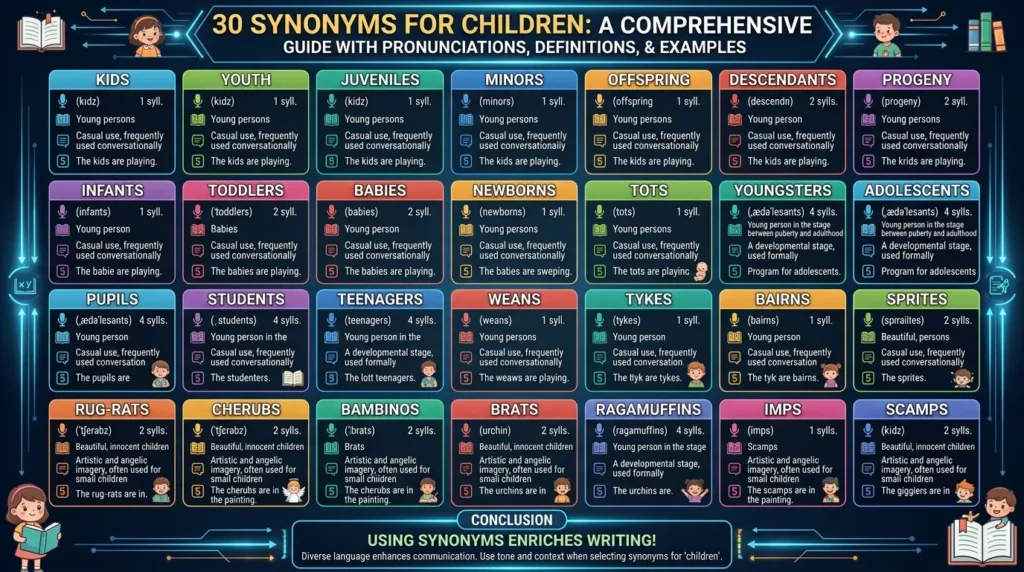
This guide gives you 30 simple synonyms for children . Along with easy sentences, word origins, pronunciation guides, and clear categories.
Meaning of Children
Definition
Children (Noun): Young human beings between infancy and adulthood; plural form of child.
Examples
- The children laughed loudly as they played games at the birthday party.
- Our school library has many exciting storybooks for children.
Connotative Meaning
- Positive tone: Represents innocence, playful energy, learning, and wonder.
- Negative tone: Can sometimes suggest being noisy, rowdy, or misbehaving.
- Neutral tone: Simply refers to young people or family offspring.
You can also get more information https://synonymhubb.com/synonyms-for-domestic/
Etymology
- Source language: Came from Old English.
- Old English: Cild (singular meaning “child” or “infant”), which expanded to cildru and later became children in Middle English.
- Modern English: Plural form used to group young kids together.
Pronunciation
- US: /ˈtʃɪldrən/
- UK: /ˈtʃɪldrən/
Syllables
chil-dren (2 parts)
Affixation Pattern of Children
- Root: Child (means a young human)
- Plural Suffix: -ren (an old English plural ending)
- Word Formation:
- Noun: Child / Children / Childhood
- Adjective: Childish / Childlike
- Adverb: Childishly
Synonyms for Children
1. Kids (Noun) — US: /kɪdz/ | UK: /kɪdz/
Meaning: An easy, informal, and friendly word for young people.
Examples:
The kids built a big sandcastle on the beach.
All the kids cheered when the bell rang for recess.
2. Little ones (Noun) — US: /ˈlɪtl wʌnz/ | UK: /ˈlɪtl wʌnz/
Meaning: A gentle, affectionate name for very young kids.
Examples:
The teacher read a fairytale story to the little ones.
Please make sure the little ones hold hands while crossing the street.
3. Youth (Noun) — US: /juːθ/ | UK: /juːθ/
Meaning: Young people grouped together during their early years.
Examples:
The community park built a new soccer field for the local youth.
He spent his youth exploring the woods near his farm.
4. Youngsters (Noun) — US: /ˈjʌŋstərz/ | UK: /ˈjʌŋstəz/
Meaning: Lively young people or older children.
Examples:
A group of youngsters rode their bicycles around the block.
The youngsters performed a wonderful dance on stage.
5. Offspring (Noun) — US: /ˈɔːfsprɪŋ/ | UK: /ˈɒfsprɪŋ/
Meaning: The young produced by parents or family members.
Examples:
The mother bird flew back to feed her hungry offspring.
Parents always take great care of their offspring.
6. Toddlers (Noun) — US: /ˈtɑːdlərz/ | UK: /ˈtɒdləz/
Meaning: Very young children who are just learning to walk.
Examples:
The toddlers played safely with soft building blocks.
Two toddlers were giggling on the play mat.
7. Juveniles (Noun) — US: /ˈdʒuːvənlz/ | UK: /ˈdʒuːvənaɪlz/
Meaning: Young people who are not yet fully grown adults.
Examples:
The library opened a special reading room for juveniles.
This author writes adventure novels for juveniles.
8. Tot (Noun) — US: /tɑːt/ | UK: /tɒt/
Meaning: A very small child or toddler.
Examples:
The tiny tot held tightly onto her mother’s hand.
Every tot at the party received a colorful balloon.
9. Tykes (Noun) — US: /taɪks/ | UK: /taɪks/
Meaning: A friendly, informal name for small, mischievous children.
Examples:
Those little tykes had fun splashing in the rain puddles.
The neighborhood tykes set up a lemonade stand.
10. Minors (Noun) — US: /ˈmaɪnərz/ | UK: /ˈmaɪnəz/
Meaning: Persons under the legal age of full adulthood.
Examples:
Amusement park rides require an adult to accompany young minors.
Rules are created to protect all minors in public places.
11. Schoolchildren (Noun) — US: /ˈskuːltʃɪldrən/ | UK: /ˈskuːltʃɪldrən/
Meaning: kids attending primary or middle school.
Examples:
The schoolchildren wore smart blue uniforms to class.
A bus full of schoolchildren arrived at the zoo.
12. Pupils (Noun) — US: /ˈpjuːplz/ | UK: /ˈpjuːplz/
Meaning: Young students being taught by a teacher in school.
Examples:
The teacher asked her pupils to open their science books.
All the pupils listened quietly to the instructions.
13. Juniors (Noun) — US: /ˈdʒuːniərz/ | UK: /ˈdʒuːniəz/
Meaning: Younger members of a school, club, or group.
Examples:
The juniors played their soccer match on the front field.
Special craft activities were planned for the juniors.
14. Babes (Noun) — US: /beɪbz/ | UK: /beɪbz/
Meaning: Very young children or infants.
Examples:
The story told of innocent babes in an enchanted forest.
Mother birds protect their newborn babes in cozy nests.
15. Cubs (Noun) — US: /kʌbz/ | UK: /kʌbz/
Meaning: Young animals, or a nickname for young group members.
Examples:
The lioness watched her lively cubs play in the grass.
The scout cubs learned how to tie camping knots.
16. Descendants (Noun) — US: /dɪˈsɛndənts/ | UK: /dɪˈsendənts/
Meaning: People descended from a particular family line or ancestor.
Examples:
The family reunion brought together many grand descendants.
They are the descendants of famous pioneers.
17. Issue (Noun) — US: /ˈɪʃuː/ | UK: /ˈɪʃuː/
Meaning: A person’s children or direct family line.
Examples:
The historical records listed the king and his royal issue.
The family estate was passed down to their legal issue.
18. Cherubs (Noun) — US: /ˈtʃɛrəbz/ | UK: /ˈtʃerəbz/
Meaning: Sweet, innocent-looking young children with round faces.
Examples:
The sweet little cherubs sang beautifully in the holiday choir.
She painted a picture of sleeping cherubs.
19. Chicks (Noun) — US: /tʃɪks/ | UK: /tʃɪks/
Meaning: Baby birds, or a gentle nickname for young family members.
Examples:
The hen kept her fluffy chicks warm under her wings.
All her little chicks gathered around the kitchen table for lunch.
20. Progeny (Noun) — US: /ˈprɑːdʒəni/ | UK: /ˈprɒdʒəni/
Meaning: A formal word for the children or offspring of a family.
Examples:
Proud parents showed photos of their brilliant progeny.
The garden was planted to be enjoyed by future progeny.
21. Little ones (Noun) — US: /ˈlɪtl wʌnz/ | UK: /ˈlɪtl wʌnz/
Meaning: Small, young members of a home or school.
Examples:
The little ones fell asleep during the long car ride home.
We bought small safety scissors for the little ones.
22. Infancy-age (Noun) — US: /ˈɪnfənsi eɪdʒ/ | UK: /ˈɪnfənsi eɪdʒ/
Meaning: Very young children in their first year of life.
Examples:
The clinic provides checkups for newborn infants.
Soft lullabies help soothe tired infants to sleep.
23. Nestlings (Noun) — US: /ˈnɛstlɪŋz/ | UK: /ˈnestlɪŋz/
Meaning: Very young birds or small children staying close to home.
Examples:
The small nestlings chirped loudly for food.
The mother tucked her little nestlings into bed.
24. Pre-teens (Noun) — US: /priː ˈtiːnz/ | UK: /priː ˈtiːnz/
Meaning: Children between the ages of 9 and 12 years old.
Examples:
The library started a new book club specifically for pre-teens.
Many pre-teens enjoy learning science experiments.
25. Tots (Noun) — US: /tɑːts/ | UK: /tɒts/
Meaning: Plural form for very small kids.
Examples:
The tots enjoyed building towers with wooden blocks.
A play area was set up for tots in the park.
26. Under-fives (Noun) — US: /ˈʌndər faɪvz/ | UK: /ˈʌndə faɪvz/
Meaning: Children who are under five years of age.
Examples:
The community center offers free swimming lessons for under-fives.
Storytime for under-fives happens every Tuesday morning.
27. Striplings (Noun) — US: /ˈstrɪplɪŋz/ | UK: /ˈstrɪplɪŋz/
Meaning: Young boys or youths growing into young adults.
Examples:
The two striplings helped carry wood for the campfire.
Ancient tales describe young striplings setting off on quests.
28. Whippersnappers (Noun) — US: /ˈwɪpərsnæpərz/ | UK: /ˈwɪpəsnæpəz/
Meaning: A funny, old-fashioned name for young, lively children.
Examples:
Grandpa smiled as the young whippersnappers ran across the lawn.
Those energetic whippersnappers kept everyone entertained.
29. Tiny tots (Noun) — US: /ˈtaɪni tɑːts/ | UK: /ˈtaɪni tɒts/
Meaning: Small toddlers and young preschoolers.
Examples:
The tiny tots wore colorful paper crowns for the play.
A soft gym class was designed just for tiny tots.
30. Youngsters (Noun) — US: /ˈjʌŋstərz/ | UK: /ˈjʌŋstəz/
Meaning: Energetic young kids.
Examples:
The youngsters cheered happily when the party game began.
Our school organized a sports day for all the local youngsters.
Prototype Meaning
When children hear children, they picture classmates in a classroom. Also friends playing tag at recess, or brothers and sisters gathered together at home.
Prototype Categorization
- Everyday & Friendly: Kids, Youngsters, Little ones, Tykes, Whippersnappers.
- School & Learning: Schoolchildren, Pupils, Juniors, Pre-teens.
- Very Young & Toddlers: Toddlers, Tot, Tots, Tiny tots, Babes, Infants, Under-fives.
- Family & Formal Terms: Offspring, Progeny, Descendants, Issue, Minors, Juveniles, Youth.
Antonyms of Children
- Adults
- Grown-ups
- Elders
- Parents
- Ancestors
- older people
Short Questions and Answers
- What does children mean?
- It means young human beings who are not yet adults; it is the plural form of child.
- When should I use children?
- Use it when writing about students, young family members,or friends at play.
- Is children a singular or plural noun?
- It is a plural noun! (The singular form is child).
- What is the difference between children and kids?
- Children is the regular and formal word, while kids is an easy, friendly, and casual synonym!
Conclusion
Synonyms for children can make your English more varied, natural, and engaging. Words such as kids, youngsters, youths, minors, little ones, and offspring can be used in different contexts and tones. Understanding these alternatives helps you avoid repetition. Choose the right synonyms for children for conversations, school writing, stories, and other types of content. Keep practicing synonyms for children in your own sentences to build a stronger vocabulary.

I’m Zahid Abbas, an educator, researcher, and digital publishing strategist with a passion for linguistics, grammar, and clear communication. As a content creator and SEO specialist, I craft research-driven, reader-focused content that empowers learners and makes knowledge accessible worldwide.