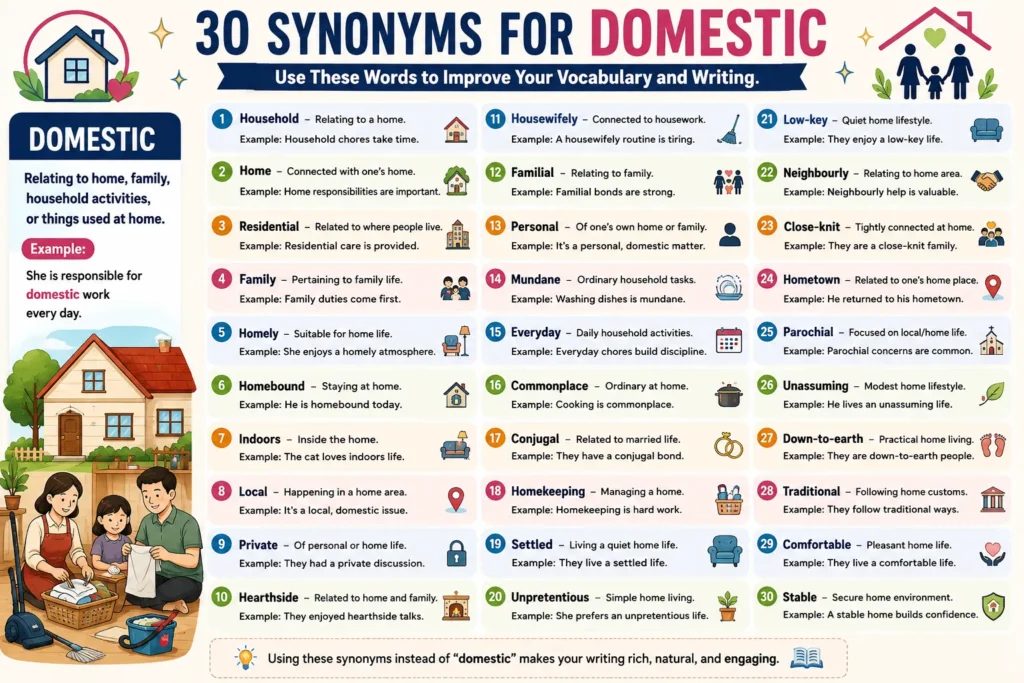
The word domestic means connected to the home, family life, or your own country. Imagine a cozy pet cat sleeping peacefully on a warm carpet inside your house. Because it lives indoors with a family instead of in the wild forest, we call it a domestic animal!
We use synonyms for domestic to describe household chores, tame pets, family activities, or flights within your home country. Learning new ways to say domestic helps learners make their story writing informative. English learners and content writers need synonyms for domestic too.
This guide gives you 30 simple synonyms for domestic. Along with easy sentences, word origins, pronunciation guides, and clear categories.
Meaning of Domestic
Definition
Domestic (Adjective): Relating to the home, household, family affairs, tame animals, or one’s own country.
Examples
- Cleaning your bedroom is an example of a domestic chore.
- Cows and sheep are domestic animals that live on farms.
Connotative Meaning
- Positive tone: Represents warmth, comfort, peaceful home life, and gentle, tame nature.
- Negative tone: Can sometimes feel dull, plain, or limited to routine housework.
- Neutral tone: Simply describes anything belonging inside a house or within a nation.
Etymology
- Source language: Came from Latin through Old French.
- Latin: Domesticus (from domus, meaning “house” or “home”).
- Old French: Domestique (meaning “belonging to the household”).
- Modern English: Literally means belonging directly to the house, family, or homeland.
For more information https://synonymhubb.com/synonyms-for-consequences/
Pronunciation
- US: /dəˈmɛstɪk/
- UK: /dəˈmestɪk/
Syllables
do-mes-tic (3 parts)
Affixation Pattern of Domestic
- Root: Dom (from domus, means home)
- Suffix: -ic (makes an adjective meaning “relating to”)
- Word Formation:
- Noun: Domestic / Domesticity
- Adjective: Domestic / Nondomestic
- Adverb: Domestically
Synonyms for Domestic
1. Household (Adjective) — US: /ˈhaʊshoʊld/ | UK: /ˈhaʊshəʊld/
Meaning: Relating to a house and the people living together inside it.
Examples:
She helped her dad with daily household chores.
Brooms and soaps are common household items.
2. Tame (Adjective) — US: /teɪm/ | UK: /teɪm/
Meaning: Not wild; trained to live peacefully around human beings.
Examples:
The tame rabbit ate carrots straight from my hand.
Farm animals are tame and gentle with visitors.
3. Home (Adjective) — US: /hoʊm/ | UK: /həʊm/
Meaning: Connected to your own house, family, or personal living space.
Examples:
They enjoyed a delicious home cooked meal together.
She loves her quiet home life on the weekends.
4. Family (Adjective) — US: /ˈfæməli/ | UK: /ˈfæməli/
Meaning: Suitable for, belonging to, or shared by parents and children.
Examples:
We took a fun family trip to the beach last summer.
Board games are great for a cozy family evening.
5. National (Adjective) — US: /ˈnæʃnəl/ | UK: /ˈnæʃnəl/
Meaning: Relating to or happening within your own country.
Examples:
The news reported on national events across the country.
Today is a national holiday so school is closed.
6. Internal (Adjective) — US: /ɪnˈtɜːrnl/ | UK: /ɪnˈtɜːnl/
Meaning: Located inside a building, group, or country rather than outside.
Examples:
The government focused on internal affairs this week.
The house has an internal staircase leading upstairs.
7. Native (Adjective) — US: /ˈneɪtɪv/ | UK: /ˈneɪtɪv/
Meaning: Belonging naturally to a particular place or country by birth.
Examples:
Peacocks are native birds in many parts of Asia.
She returned to her native city after traveling.
8. Indoor (Adjective) — US: /ˈɪndɔːr/ | UK: /ˈɪndɔː/
Meaning: Happening, used, or located inside a house or building.
Examples:
Swimming in an indoor pool is fun when it rains.
Plants need sunlight even if they are indoor plants.
9. Local (Adjective) — US: /ˈloʊkl/ | UK: /ˈləʊkl/
Meaning: Belonging to the nearby area, neighborhood, or town.
Examples:
We buy fresh apples from the local market.
The local park has new swings for children.
10. Homebred (Adjective) — US: /ˈhoʊmbrɛd/ | UK: /ˈhəʊmbred/
Meaning: Raised, born, or trained in one’s own home or local region.
Examples:
The farm showed off its homebred ponies.
He is a homebred athlete who loves his hometown.
11. Trained (Adjective) — US: /treɪnd/ | UK: /treɪnd/
Meaning: Taught to behave well, follow commands, or do specific tasks.
Examples:
The trained guide dog helped its owner walk safely.
A trained parrot can say simple words.
12. Familial (Adjective) — US: /fəˈmɪliəl/ | UK: /fəˈmɪliəl/
Meaning: Relating to a family or passed down through relatives.
Examples:
They felt strong familial love during the holiday dinner.
Passing down old stories is a special familial custom.
13. Pet (Adjective) — US: /pɛt/ | UK: /pet/
Meaning: Kept for companionship, fun, and affection in the house.
Examples:
My pet hamster loves running on his small wheel.
Goldfish are popular pet animals for small rooms.
14. Inward (Adjective) — US: /ˈɪnwərd/ | UK: /ˈɪnwəd/
Meaning: Directed toward the inside or center of a home or region.
Examples:
The door opens in an inward direction into the hall.
They turned their inward focus toward family needs.
15. Homegrown (Adjective) — US: /ˌhoʊmˈɡroʊn/ | UK: /ˌhəʊmˈɡrəʊn/
Meaning: Grown or produced in your own garden, home, or country.
Examples:
We ate homegrown tomatoes from Grandma’s garden.
The team celebrated their homegrown star player.
16. Residential (Adjective) — US: /ˌrɛzɪˈdɛnʃl/ | UK: /ˌrezɪˈdenʃl/
Meaning: Designed or used for people to live in houses or apartments.
Examples:
Cars must drive slowly in a residential neighborhood.
Our school is located near a quiet residential area.
17. House-trained (Adjective) — US: /ˈhaʊs treɪnd/ | UK: /ˈhaʊs treɪnd/
Meaning: Taught to keep the inside of a home clean and neat.
Examples:
Our new puppy is fully house-trained now.
A house-trained pet can roam freely in the living room.
18. Homebound (Adjective) — US: /ˈhoʊmbaʊnd/ | UK: /ˈhəʊmbaʊnd/
Meaning: Staying inside the home or heading back toward home.
Examples:
The snowstorm kept everyone homebound for two days.
We saw many homebound travelers at the station.
19. Inland (Adjective) — US: /ˈɪnlænd/ | UK: /ˈɪnlənd/
Meaning: Located away from the sea coast, inside the mainland.
Examples:
They drove to an inland lake for fishing.
The storm lost power as it moved to inland towns.
20. Domesticated (Adjective) — US: /dəˈmɛstɪkeɪtɪd/ | UK: /dəˈmestɪkeɪtɪd/
Meaning: Adapted over time to live alongside humans peacefully.
Examples:
Dogs were among the first domesticated animals.
Horses became domesticated to help people travel.
21. Non-foreign (Adjective) — US: /nɑːn ˈfɔːrən/ | UK: /nɒn ˈfɒrən/
Meaning: Originating from your own country rather than abroad.
Examples:
The store sells non-foreign goods made nearby.
They traveled on non-foreign airlines within the state.
22. Civil (Adjective) — US: /ˈsɪvl/ | UK: /ˈsɪvl/
Meaning: Relating to the ordinary citizens and internal life of a nation.
Examples:
Voting is an important civil duty for citizens.
The nation worked to protect civil peace.
23. Intramural (Adjective) — US: /ˌɪntrəˈmjʊrəl/ | UK: /ˌɪntrəˈmjʊərəl/
Meaning: Happening within the walls or limits of one school or group.
Examples:
Our class joined the intramural soccer matches.
She won first place in the intramural art contest.
24. Home-made (Adjective) — US: /ˌhoʊm ˈmeɪd/ | UK: /ˌhəʊm ˈmeɪd/
Meaning: Crafted or cooked at home rather than bought from a store.
Examples:
Nothing tastes better than home-made chocolate cookies.
She wore a pretty home-made costume for Halloween.
25. Coastwise (Adjective) — US: /ˈkoʊstwaɪz/ | UK: /ˈkəʊstwaɪz/
Meaning: Moving along or staying near a country’s own coastline.
Examples:
Small boats carried cargo on a coastwise route.
The ship made a coastwise trip between local ports.
26. Interior (Adjective) — US: /ɪnˈtɪriər/ | UK: /ɪnˈtɪəriə/
Meaning: Located inside a house, room, or country border.
Examples:
They painted the interior walls of the house light blue.
The interior region of the island has big mountains.
27. Unwild (Adjective) — US: /ʌnˈwaɪld/ | UK: /ʌnˈwaɪld/
Meaning: Not fierce or living in nature; quiet and gentle.
Examples:
The sheep gave an unwild look as we walked past.
These birds are unwild because people feed them daily.
28. Subdued (Adjective) — US: /səbˈdjuːd/ | UK: /səbˈdjuːd/
Meaning: Calm, quiet, and kept under gentle control indoors.
Examples:
The room had soft, subdued lighting in the evening.
He kept a subdued tone while reading in the library.
29. Homely (Adjective) — US: /ˈhoʊmli/ | UK: /ˈhəʊmli/
Meaning: Simple, cozy, and comfortable like a pleasant home.
Examples:
The cabin had a homely feeling with its fireplace.
She served a warm, homely soup on a cold afternoon.
30. Hearth-side (Adjective) — US: /ˈhɑːrθsaɪd/ | UK: /ˈhɑːθsaɪd/
Meaning: Sitting or happening right by the warm fireplace at home.
Examples:
Grandmother told us a sweet hearth-side story.
They enjoyed a warm hearth-side chat on a chilly night.
Prototype Meaning
When children hear domestic, they picture a cozy house with family members. cooking in the kitchen, a tame dog curled up near the rug. Also a simple flight flying from one city to another inside the same country.
Prototype Categorization
- Home & Family Life: Household, Home, Family, Familial, Indoor, Residential, Homebound, Home-made, Homely, Hearth-side.
- Tame & Farm Animals: Tame, Trained, Pet, Homebred, House-trained, Domesticated, Unwild, Subdued.
- Country & Internal Affairs: National, Internal, Native, Local, Inward, Homegrown, Inland, Non-foreign, Civil, Intramural, Coastwise, Interior.
Antonyms of Domestic
- Wild
- Foreign
- International
- Outdoor
- Alien
- Fascinating
Short Questions and Answers
- What does domestic mean?
- It means connected to the home, family life, tame animals, or your own country.
- When should I use domestic?
- Use it when writing about chores, house pets, home-cooked food, or events inside your country.
- Is domestic an adjective or a noun?
- It is mostly an adjective! (It can also be a noun when referring to a helper at home).
- What is a domestic animal?
- An animal like a dog, cat, cow, or horse that has been trained over time to live alongside humans.
Conclusion
Synonyms of domestic can help you describe things related to the home, family, or a particular country in a clearer way. Words such as household, home, family, local, national, and internal can make your English natural. The best synonym depends on the meaning of domestic in the sentence. For English learners, synonyms for domestic can improve speaking, writing, reading, and everyday communication. They can also help you avoid repeating the same word too often. Practice synonyms for domestic in simple sentences about home life, family, travel, and countries. With regular practice, you can build a stronger vocabulary. Also express your ideas more clearly, and speak English with greater confidence.

I’m Zahid Abbas, an educator, researcher, and digital publishing strategist with a passion for linguistics, grammar, and clear communication. As a content creator and SEO specialist, I craft research-driven, reader-focused content that empowers learners and makes knowledge accessible worldwide.