Tools are objects that help us do a job. A hammer helps us hit nails, and a screwdriver helps us turn screws. Imagine a child helping a parent fix a small table. The child brings the right tools from a box. The job becomes easier because each tool has a special use. The word tools is common in daily English because we use tools at home, at school, in gardens, and at work. Learning synonyms for tools helps English learners use more words and avoid repeating. Synonyms for tools also helps content writers make their writing clear and interesting. In this article, we will learn 30 synonyms of tools, with simple meanings, examples, pronunciation, grammar, word history.
Meaning of Tools
Definition
Tools (Noun)
Tools are objects used to help someone do a job or complete a task.
Examples
- Dad keeps his tools in a box.
- We used simple tools to fix the chair.
Connotative Meaning
- Positive tone: Tools can suggest skill, help, work, and progress.
- Negative tone: In some situations, tools may suggest hard work or difficult tasks.
- Neutral tone: Tools can simply mean objects used to complete a job.
Etymology
- Source: The word tool comes from Old English tōl.
- Original meaning: It meant an instrument or object used to do work.
- The word has been used for many hundreds of years.
Short History
- Old English (450–1100): Tōl meant an object or instrument used for work.
- Middle English (1100–1500): The word developed into forms such as tool and continued to mean an object used for a task.
- Modern English (1500–Present): Tool became a common word for objects used in building, fixing, gardening, cooking, and many other jobs. Today, tool can also mean something used to complete a task, such as a computer tool.
Pronunciation of Tools
- US: /tuːlz/
- UK: /tuːlz/
Syllables
tools — one syllable
Affixation Pattern of Tools
- Root: tool
- Prefix: None
- Suffix: -s in tools, showing plural form.
- Word formation: The main word is tool (noun). Common related forms include tools (plural noun), toolbox (noun), toolkit (noun), toolmaker (noun), toolset (noun), and tooling (noun).
Also read more about https://synonymhubb.com/synonyms-of-expertise/
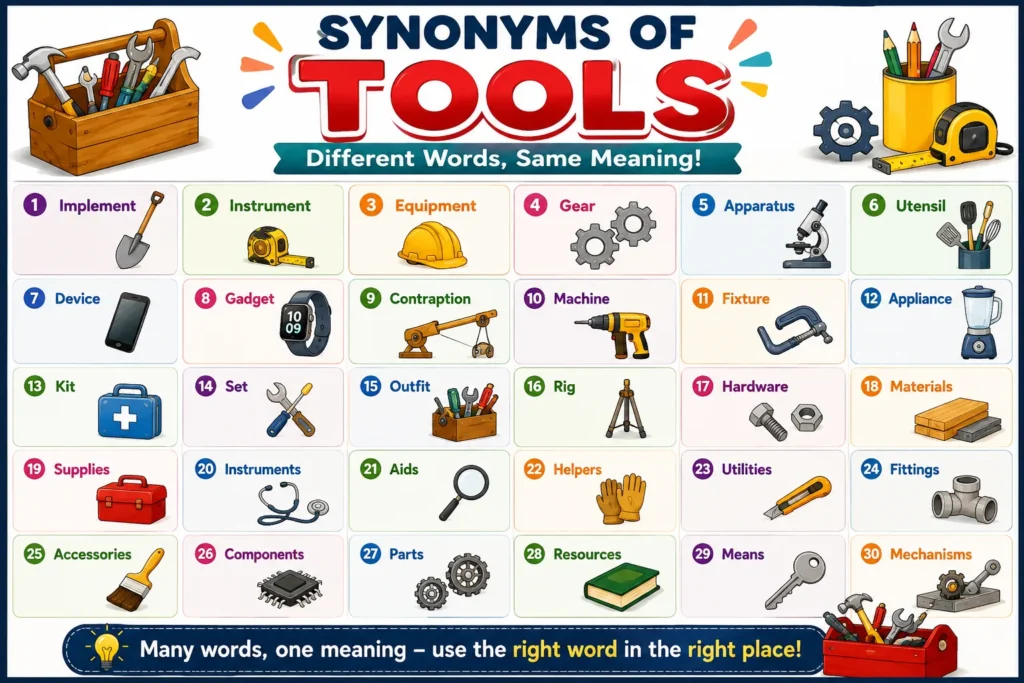
Synonyms for Tools
1. Equipment (Noun) — US /ɪˈkwɪpmənt/ | UK /ɪˈkwɪpmənt/
Meaning: The tools and things needed for a job or activity.
Examples:
- The farmer keeps his equipment in the shed.
- We need sports equipment for the game.
2. Implements (Noun) — US /ˈɪmpləmənts/ | UK /ˈɪmplɪmənts/
Meaning: Simple objects used to do a particular job.
Examples:
- The gardener cleaned his implements.
- These garden implements are easy to use.
3. Instruments (Noun) — US /ˈɪnstrəmənts/ | UK /ˈɪnstrəmənts/
Meaning: Objects used to do a special job or measure something.
Examples:
- The doctor used special instruments.
- The scientist cleaned his instruments.
4. Devices (Noun) — US /dɪˈvaɪsɪz/ | UK /dɪˈvaɪsɪz/
Meaning: Objects made for a special purpose.
Examples:
- The shop sells useful devices.
- This small device helps us measure time.
5. Utensils (Noun) — US /juːˈtensəlz/ | UK /juːˈtensəlz/
Meaning: Tools used for cooking or eating.
Examples:
- Put the kitchen utensils in the drawer.
- We washed the cooking utensils after dinner.
6. Gear (Noun) — US /ɡɪr/ | UK /ɡɪr/
Meaning: Equipment or things used for a special activity.
Examples:
- We packed our camping gear.
- He bought new sports gear.
7. Apparatus (Noun) — US /ˌæpəˈrætəs/ | UK /ˌæpəˈrætəs/
Meaning: A set of equipment used for a special purpose.
Examples:
- The science lab has new apparatus.
- The teacher showed us the lab apparatus.
8. Machinery (Noun) — US /məˈʃiːnəri/ | UK /məˈʃiːnəri/
Meaning: Machines used to do work.
Examples:
- The factory has large machinery.
- The farmer uses machinery to plant crops.
9. Appliances (Noun) — US /əˈplaɪənsɪz/ | UK /əˈplaɪənsɪz/
Meaning: Machines used to do jobs at home.
Examples:
- Our kitchen has new appliances.
- We use home appliances every day.
10. Gadgets (Noun) — US /ˈɡædʒəts/ | UK /ˈɡædʒəts/
Meaning: Small machines or devices that do useful jobs.
Examples:
- My brother likes useful gadgets.
- This kitchen gadget cuts vegetables quickly.
11. Supplies (Noun) — US /səˈplaɪz/ | UK /səˈplaɪz/
Meaning: Things needed for a task or activity.
Examples:
- We bought art supplies for school.
- The teacher put the supplies on the table.
12. Materials (Noun) — US /məˈtɪriəlz/ | UK /məˈtɪriəlz/
Meaning: Things used to make or build something.
Examples:
- We need some materials to make a box.
- Wood and glue are useful materials for this project.
13. Machines (Noun) — US /məˈʃiːnz/ | UK /məˈʃiːnz/
Meaning: Devices that use power to do work.
Examples:
- The workers use machines to move heavy boxes.
- The factory has many large machines.
14. Appliances (Noun) — US /əˈplaɪənsɪz/ | UK /əˈplaɪənsɪz/
Meaning: Electrical machines that help with jobs at home.
Examples:
- The kitchen appliances are easy to use.
- We cleaned the appliances this morning.
15. Kit (Noun) — US /kɪt/ | UK /kɪt/
Meaning: A group of tools or things needed for a job.
Examples:
- Dad has a repair kit.
- The first-aid kit is in the car.
16. Toolkit (Noun) — US /ˈtuːlˌkɪt/ | UK /ˈtuːlˌkɪt/
Meaning: A box or set that holds tools.
Examples:
- Dad opened his toolkit.
- The hammer was inside the toolkit.
17. Hardware (Noun) — US /ˈhɑːrdwer/ | UK /ˈhɑːdweə/
Meaning: Metal tools and other useful building items.
Examples:
- The shop sells hardware for home repairs.
- We bought some hardware for the new shelf.
18. Accessories (Noun) — US /əkˈsesəriz/ | UK /əkˈsesəriz/
Meaning: Extra things used with a main item.
Examples:
- The camera came with useful accessories.
- We bought some computer accessories.
19. Aids (Noun) — US /eɪdz/ | UK /eɪdz/
Meaning: Things that help you do something.
Examples:
- Pictures are useful learning aids.
- The teacher used simple aids to explain the lesson.
20. Resources (Noun) — US /rɪˈsɔːrsɪz/ | UK /rɪˈsɔːsɪz/
Meaning: Things that help you complete a task.
Examples:
- Books are useful learning resources.
- The school has many online resources.
21. Mechanisms (Noun) — US /ˈmekənɪzəmz/ | UK /ˈmekənɪzəmz/
Meaning: Parts that make a machine work.
Examples:
- The clock has small mechanisms inside.
- The toy has a simple mechanism.
22. Contrivances (Noun) — US /kənˈtraɪvənsɪz/ | UK /kənˈtraɪvənsɪz/
Meaning: Objects made to solve a problem or do a job.
Examples:
- He made clever contrivances from old boxes.
- The children built a simple contrivance for the game.
23. Utensil (Noun) — US /juːˈtensəl/ | UK /juːˈtensəl/
Meaning: A tool used for cooking or eating.
Examples:
- A spoon is a kitchen utensil.
- She washed each utensil after cooking.
24. Instrument (Noun) — US /ˈɪnstrəmənt/ | UK /ˈɪnstrəmənt/
Meaning: A tool used for a special job.
Examples:
- A ruler is a useful instrument for measuring.
- The doctor used an instrument to check the child.
25. Device (Noun) — US /dɪˈvaɪs/ | UK /dɪˈvaɪs/
Meaning: A thing made to perform a particular job.
Examples:
- This device tells us the temperature.
- The small device is easy to carry.
26. Gadgetry (Noun) — US /ˈɡædʒətri/ | UK /ˈɡædʒətri/
Meaning: A collection of small useful devices.
Examples:
- The store sells new gadgetry.
- His room is full of useful gadgetry.
27. Workwear (Noun) — US /ˈwɜːrkwer/ | UK /ˈwɜːkwɛə/
Meaning: Clothes and items worn while doing a job.
Examples:
- The builder wore strong workwear.
- Safety workwear can protect workers.
28. Accessories (Noun) — US /əkˈsesəriz/ | UK /əkˈsesəriz/
Meaning: Extra items that help or improve the use of something.
Examples:
- The phone has many useful accessories.
- We bought computer accessories for the new desk.
29. Means (Noun) — US /miːnz/ | UK /miːnz/
Meaning: A way or method used to achieve something.
Examples:
- A bicycle is a useful means of transport.
- Practice is a means of improving your skills.
30. Work Equipment (Noun Phrase) — US /wɜːrk ɪˈkwɪpmənt/ | UK /wɜːrk ɪˈkwɪpmənt/
Meaning: Tools and other things used to do a job.
Examples:
- The workers checked their work equipment.
- All the work equipment was ready.
Prototype Meaning
The most typical meaning of tools is objects used to do a job. When people hear the word tools, they often imagine things such as a hammer, screwdriver, saw, or wrench. Tools help people build, fix, cut, measure, or make things. The exact meaning can change with the situation.
Prototype Categorization
Synonyms of tools can be grouped by their use:
- General work: equipment, implements, gear, work equipment.
- Small devices: devices, gadgets, appliances.
- Kitchen use: utensils, utensil.
- Science and medical use: instruments, apparatus.
- Machines: machinery, machines, mechanisms.
- Building and making: hardware, materials, supplies.
- Help and support: aids, resources, means.
- Groups of tools: kit, toolkit.
- Extra items: accessories, gadgetry.
Antonyms of Tools
- Obstacles — things that make a task harder.
- Barriers — things that stop progress.
- Hindrances — things that cause problems or delays.
- Burdens — things that make work harder.
- Blockers — things that prevent something from happening.
- Waste — something that has no useful purpose.
Short Questions and Answers
- What does tools mean?
- Tools are objects used to help complete a job or task.
- When should tools be used?
- Use tools when talking about objects that help people build, fix, make, measure, or do other jobs.
- Is tools positive or negative?
- Tools is usually neutral. It can have a positive feeling when tools help someone complete a job.
- How is tools different from similar words?
- Tools is a broad word. Utensils usually means kitchen tools, machinery means machines used for work, and equipment means the group of things needed for an activity.
Conclusion
Synonyms for tools can make your English stronger. Words such as equipment, gear, devices, utensils, instruments, machinery, gadgets, kit, and implements help you describe different types of tools. These words are useful in school, at home, at work, and in everyday conversations. Knowing different words also helps writers avoid using tools again and again. English learners can improve their speaking and writing by learning one new synonym. Try to use each new word in a simple sentence. With regular practice, you will build a stronger vocabulary. Write better sentences, and feel more confident when using English.

I’m Zahid Abbas, an educator, researcher, and digital publishing strategist with a passion for linguistics, grammar, and clear communication. As a content creator and SEO specialist, I craft research-driven, reader-focused content that empowers learners and makes knowledge accessible worldwide.