Have you ever met someone who truly believes they can win a marathon without doing any training? They are not just hoping for the best. They fully believe it will happen, even when everyone tells them it is impossible. The right word for this mindset is delusional. People use synonyms for delusional often because it perfectly describes holding onto false ideas despite clear facts.
For English learners and writers, using the same word over and over makes writing feel dull. Expanding your vocabulary with rich synonyms allows you to express exact shades of meaning. This guide explores the core meaning of delusional alongside 30 powerful synonyms for delusional. You will discover their definitions, real-world example sentences, grammar breakdown, history, pronunciation, and exact semantic categories.
Meaning of Delusional
Definition
Delusional (Adjective):
Having false beliefs or ideas that are not based on reality, even when proven wrong.
Examples
- Sarah was delusional to think she could learn fluent Japanese overnight without studying.
- The team had a delusional belief that they could win the match after losing every practice game.
Connotative Meaning
- Positive tone:
- Rarely used positively, though it can sometimes describe playful, harmless dreamers.
- Negative tone:
- Strongly negative, implying a severe lack of judgment, mental illness, or dangerous self-deception.
- Neutral tone:
- Used clinically in psychology to describe an objective mental state without judgment.
Etymology
- Source: Derived from the Latin verb deludere, which means “to play falsely,” “to mock,” or “to deceive.”
- Old English (450–1100):
- The word did not exist in Old English; native terms like dwas (foolish) were used instead.
- Middle English (1100–1500):
- Middle English adopted delude from Old French, meaning to trick or deceive.
- Modern English (1500–Present):
- The noun delusion formed first, leading to the modern adjective delusional in the 19th century to describe fixed false beliefs.
Related Articles https://synonymhubb.com/synonyms-for-sorrow/
Pronunciation
- US: /dɪˈluː.ʒən.əl/
- UK: /dɪˈluː.ʒən.əl/
Syllables
de-lu-sion-al
Affixation Pattern
- Root: Delude (verb)
- Prefix: None
- Suffix: -al (creates an adjective)
Word Formation:
- Delusion (Noun)
- Delude (Verb)
- Delusional (Adjective)
- Delusionally (Adverb)
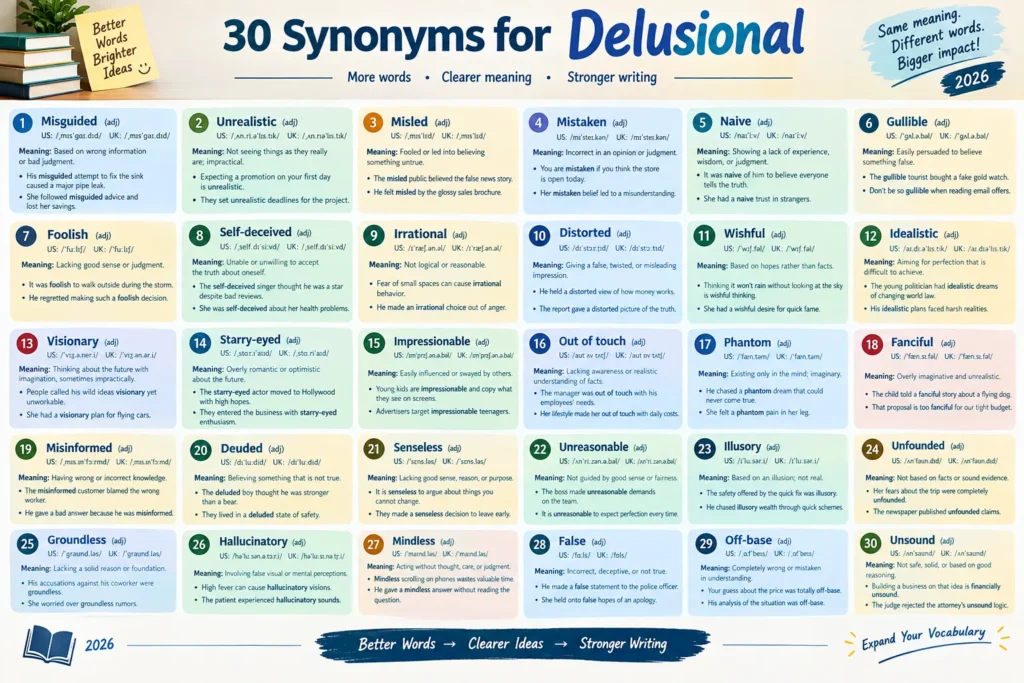
30 Synonyms for Delusional
1. Misguided (Adjective) — US: /ˌmɪsˈɡaɪ.dɪd/ | UK: /ˌmɪsˈɡaɪ.dɪd/
Meaning: Based on wrong information or bad judgment.
- Example 1: His misguided attempt to fix the sink caused a major pipe leak.
- Example 2: She followed misguided advice and lost her savings.
2. Unrealistic (Adjective) — US: /ˌʌn.riː.əˈlɪs.tɪk/ | UK: /ˌʌn.rɪəˈlɪs.tɪk/
Meaning: Not seeing things as they really are; impractical.
- Example 1: Expecting a promotion on your first day is unrealistic.
- Example 2: They set unrealistic deadlines for the project.
3. Misled (Adjective) — US: /ˌmɪsˈlɛd/ | UK: /ˌmɪsˈlɛd/
Meaning: Fooled or led into believing something untrue.
- Example 1: The misled public believed the false news story.
- Example 2: He felt misled by the glossy sales brochure.
4. Mistaken (Adjective) — US: /mɪˈsteɪ.kən/ | UK: /mɪˈsteɪ.kən/
Meaning: Incorrect in an opinion or judgment.
- Example 1: You are mistaken if you think the store is open today.
- Example 2: Her mistaken belief led to a misunderstanding.
5. Naive (Adjective) — US: /naɪˈiːv/ | UK: /naɪˈiːv/
Meaning: Showing a lack of experience, wisdom, or judgment.
- Example 1: It was naive of him to believe everyone tells the truth.
- Example 2: She had a naive trust in strangers.
6. Gullible (Adjective) — US: /ˈɡʌl.ə.bəl/ | UK: /ˈɡʌl.ə.bəl/
Meaning: Easily persuaded to believe something false.
- Example 1: The gullible tourist bought a fake gold watch.
- Example 2: Don’t be so gullible when reading email offers.
7. Foolish (Adjective) — US: /ˈfuː.lɪʃ/ | UK: /ˈfuː.lɪʃ/
Meaning: Lacking good sense or judgment.
- Example 1: It was foolish to walk outside during the storm.
- Example 2: He regretted making such a foolish decision.
8. Self-deceived (Adjective) — US: /ˌsɛlf.dɪˈsiːvd/ | UK: /ˌsɛlf.dɪˈsiːvd/
Meaning: Unable or unwilling to accept the truth about oneself.
- Example 1: The self-deceived singer thought he was a star despite bad reviews.
- Example 2: She was self-deceived about her health problems.
9. Irrational (Adjective) — US: /ɪˈræʃ.ən.əl/ | UK: /ɪˈræʃ.ən.əl/
Meaning: Not logical or reasonable.
- Example 1: Fear of small spaces can cause irrational behavior.
- Example 2: He made an irrational choice out of anger.
10. Distorted (Adjective) — US: /dɪˈstɔːr.t̬ɪd/ | UK: /dɪˈstɔː.tɪd/
Meaning: Giving a false, twisted, or misleading impression.
- Example 1: He held a distorted view of how money works.
- Example 2: The report gave a distorted picture of the truth.
11. Wishful (Adjective) — US: /ˈwɪʃ.fəl/ | UK: /ˈwɪʃ.fəl/
Meaning: Based on hopes rather than facts.
- Example 1: Thinking it won’t rain without looking at the sky is wishful thinking.
- Example 2: She had a wishful desire for quick fame.
12. Idealistic (Adjective) — US: /aɪˌdiː.əˈlɪs.tɪk/ | UK: /aɪˌdɪəˈlɪs.tɪk/
Meaning: Aiming for perfection that is difficult to achieve.
- Example 1: The young politician had idealistic dreams of changing world law.
- Example 2: His idealistic plans faced harsh realities.
13. Visionary (Adjective) — US: /ˈvɪʒ.ə.ner.i/ | UK: /ˈvɪʒ.ən.ər.i/
Meaning: Thinking about the future with imagination, sometimes impractically.
- Example 1: People called his wild ideas visionary yet unworkable.
- Example 2: She had a visionary plan for flying cars.
14. Starry-eyed (Adjective) — US: /ˌstɑːr.iˈaɪd/ | UK: /ˌstɑː.riˈaɪd/
Meaning: Overly romantic or optimistic about the future.
- Example 1: The starry-eyed actor moved to Hollywood with high hopes.
- Example 2: They entered the business with starry-eyed enthusiasm.
15. Impressionable (Adjective) — US: /ɪmˈprɛʃ.ən.ə.bəl/ | UK: /ɪmˈprɛʃ.ən.ə.bəl/
Meaning: Easily influenced or swayed by others.
- Example 1: Young kids are impressionable and copy what they see on screens.
- Example 2: Advertisers target impressionable teenagers.
16. Out of touch (Adjective) — US: /aʊt ʌv tʌtʃ/ | UK: /aʊt ɒv tʌtʃ/
Meaning: Lacking awareness or realistic understanding of facts.
- Example 1: The manager was out of touch with his employees’ needs.
- Example 2: Her lifestyle made her out of touch with daily costs.
17. Phantom (Adjective) — US: /ˈfæn.təm/ | UK: /ˈfæn.təm/
Meaning: Existing only in the mind; imaginary.
- Example 1: He chased a phantom dream that could never come true.
- Example 2: She felt a phantom pain in her leg.
18. Fanciful (Adjective) — US: /ˈfæn.sɪ.fəl/ | UK: /ˈfæn.sɪ.fəl/
Meaning: Overly imaginative and unrealistic.
- Example 1: The child told a fanciful story about a flying dog.
- Example 2: That proposal is too fanciful for our tight budget.
19. Misinformed (Adjective) — US: /ˌmɪs.ɪnˈfɔːrmd/ | UK: /ˌmɪs.ɪnˈfɔːmd/
Meaning: Having wrong or incorrect knowledge.
- Example 1: The misinformed customer blamed the wrong worker.
- Example 2: He gave a bad answer because he was misinformed.
20. Deuded (Adjective) — US: /dɪˈluː.dɪd/ | UK: /dɪˈluː.dɪd/
Meaning: Believing something that is not true.
- Example 1: The deluded boy thought he was stronger than a bear.
- Example 2: They lived in a deluded state of safety.
21. Senseless (Adjective) — US: /ˈsɛns.ləs/ | UK: /ˈsɛns.ləs/
Meaning: Lacking good sense, reason, or purpose.
- Example 1: It is senseless to argue about things you cannot change.
- Example 2: They made a senseless decision to leave early.
22. Unreasonable (Adjective) — US: /ʌnˈriː.zən.ə.bəl/ | UK: /ʌnˈriː.zən.ə.bəl/
Meaning: Not guided by good sense or fairness.
- Example 1: The boss made unreasonable demands on the team.
- Example 2: It is unreasonable to expect perfection every time.
23. Illusory (Adjective) — US: /ɪˈluː.sɚ.i/ | UK: /ɪˈluː.sər.i/
Meaning: Based on an illusion; not real.
- Example 1: The safety offered by the quick fix was illusory.
- Example 2: He chased illusory wealth through quick schemes.
24. Unfounded (Adjective) — US: /ʌnˈfaʊn.dɪd/ | UK: /ʌnˈfaʊn.dɪd/
Meaning: Not based on facts or sound evidence.
- Example 1: Her fears about the trip were completely unfounded.
- Example 2: The newspaper published unfounded claims.
25. Groundless (Adjective) — US: /ˈɡraʊnd.ləs/ | UK: /ˈɡraʊnd.ləs/
Meaning: Lacking a solid reason or foundation.
- Example 1: His accusations against his coworker were groundless.
- Example 2: She worried over groundless rumors.
26. Hallucinatory (Adjective) — US: /həˈluː.sən.ə.tɔːr.i/ | UK: /həˈluː.sɪ.nə.tr̩.i/
Meaning: Involving false visual or mental perceptions.
- Example 1: High fever can cause hallucinatory visions.
- Example 2: The patient experienced hallucinatory sounds.
27. Mindless (Adjective) — US: /ˈmaɪnd.ləs/ | UK: /ˈmaɪnd.ləs/
Meaning: Acting without thought, care, or judgment.
- Example 1: Mindless scrolling on phones wastes valuable time.
- Example 2: He gave a mindless answer without reading the question.
28. False (Adjective) — US: /fɑːls/ | UK: /fɒls/
Meaning: Incorrect, deceptive, or not true.
- Example 1: He made a false statement to the police officer.
- Example 2: She held onto false hopes of an apology.
29. Off-base (Adjective) — US: /ˌɑːfˈbeɪs/ | UK: /ˌɒfˈbeɪs/
Meaning: Completely wrong or mistaken in understanding.
- Example 1: Your guess about the price was totally off-base.
- Example 2: His analysis of the situation was off-base.
30. Unsound (Adjective) — US: /ʌnˈsaʊnd/ | UK: /ʌnˈsaʊnd/
Meaning: Not safe, solid, or based on good reasoning.
- Example 1: Building a business on that idea is financially unsound.
- Example 2: The judge rejected the attorney’s unsound logic.
Prototype Meaning
The prototype meaning of delusional centers on holding tightly to a fixed idea. It contradicts reality, evidence, or common sense. When people hear this word, they picture a person who refuses to acknowledge obvious facts, living in an imagined world of their own making.
Prototype Categorization
- Clinical / Mental Perception:
- Deluded, hallucinatory, illusory, distorted. These words describe severe breaks from factual reality or perception.
- Lack of Reason / Logic:
- Irrational, foolish, senseless, unreasonable, unsound. Use these when focusing on poor judgment or broken logic.
- Misinformed / Error:
- Misguided, mistaken, misled, misinformed, off-base. Best for situations where wrong information led to an incorrect belief.
- Unfounded Assumptions:
- Unfounded, groundless, false, phantom. Ideal for describing ideas or fears that lack supporting facts.
- Innocent / Naive Over-Optimism:
- Naive, gullible, wishful, idealistic, starry-eyed, fanciful, impressionable, out of touch, unrealistic, visionary, mindless. These apply to harmless, overly hopeful, or inexperienced perspectives.
Antonyms of Delusional
- Realistic
- Rational
- Sane
- Sensible
- Clear-headed
- Pragmatic
Short Questions and Answers
- What does delusional mean?
- It describes believing things that are not true, even when clear evidence proves them wrong.
- When should delusional be used?
- Use it when someone firmly holds onto false ideas, unrealistic goals, or deceptive beliefs despite obvious facts.
- Is delusional positive or negative?
- It is negative because it implies self-deception, foolishness, or a lack of mental clarity.
- How is it different from similar words?
- Delusional implies strong, fixed self-deception, while mistaken means making a simple error based on wrong information.
Conclusion
Synonyms for delusional dramatically expands your expressive range. Learning synonyms for delusional improves your overall vocabulary, strengthens your writing, and helps you avoid repetitive word choices. Using the exact right synonyms for delusional allows you to communicate complex ideas clearly. And also builds your confidence in English speaking and writing. Make it a habit to practice new synonyms for delusional daily in your conversations and notes. English learners and content writers can improve their vocabulary, writing, and speaking skills by learning synonyms for delusional.

I’m Zahid Abbas, an educator, researcher, and digital publishing strategist with a passion for linguistics, grammar, and clear communication. As a content creator and SEO specialist, I craft research-driven, reader-focused content that empowers learners and makes knowledge accessible worldwide.