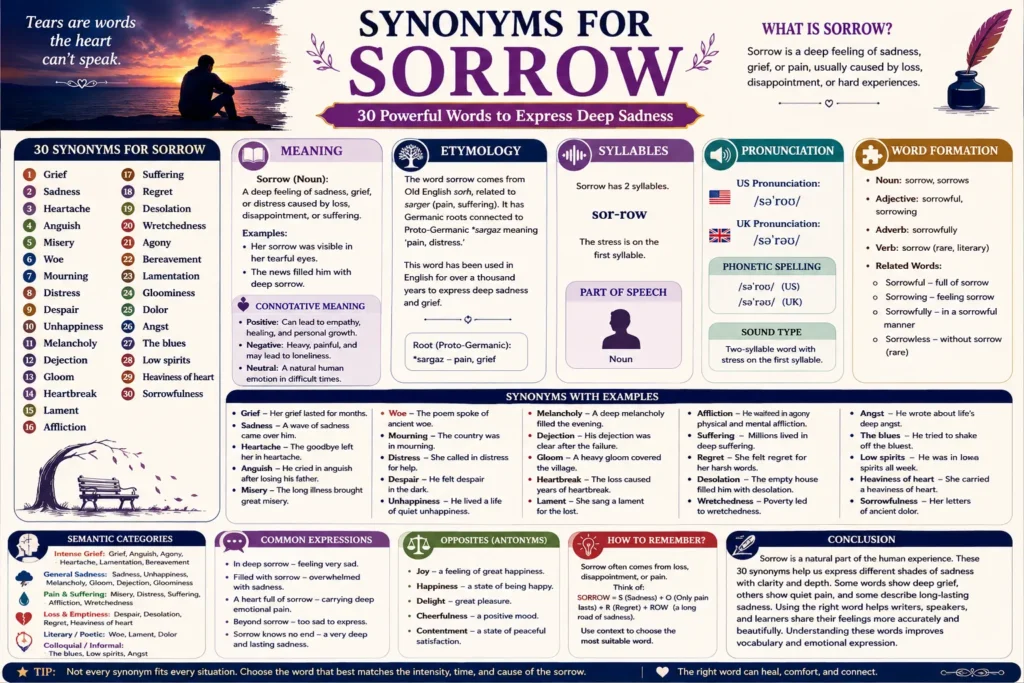
Sorrow means a deep feeling of sadness, often caused by loss or disappointment. Think about a young girl who loses her favorite pet after many happy years together. She sits quietly by the window, tears rolling down her cheeks, feeling a heavy sorrow inside her heart. Synonyms for sorrow are often used in stories, songs, and poems to describe strong sadness that lingers for a while. People also use synonyms for sorrow in everyday conversations when talking about loss, grief, or hard times. Learning new synonyms for sorrow is helpful for English learners and writers who want to describe deep feelings. It also makes writing feel more thoughtful and expressive. This article explains the meaning of sorrow, its history, how to say it, and 30 words that share a similar meaning.
Meaning of Sorrow
Definition
Sorrow (Noun): A deep feeling of sadness, often caused by loss, disappointment, or hardship.
Examples
- She felt deep sorrow after her grandmother passed away.
- The whole town shared in the family’s sorrow.
Connotative Meaning
- Positive tone:
- This word rarely feels positive, though it can show deep love, since strong sorrow often comes from caring deeply about someone or something.
- Negative tone:
- This word almost always carries a heavy, sad feeling, connected to loss, pain, or grief.
- Neutral tone:
- In formal or literary writing, this word can describe sadness in a calm, thoughtful way, without extra drama.
Etymology
- This word comes from the Old English word “sorg.”
- “Sorg” meant deep sadness, grief, or worry.
- It is closely related to the German word “Sorge,” which also means care or worry.
Short History
- Old English (450–1100):
- The word “sorg” was commonly used in poetry to describe deep grief, loss, and sadness, especially in stories about battles and death.
- Middle English (1100–1500):
- The spelling changed to “sorwe,” but the meaning stayed close to the original idea of grief and sadness.
- Modern English (1500–Present):
- The spelling settled as “sorrow.” The word became common in literature, religious writing, and everyday speech to describe deep and lasting sadness.
Pronunciation (US & UK – IPA)
- US: /ˈsɔːroʊ/
- UK: /ˈsɒrəʊ/
Syllables
sor-row (2 syllables)
Affixation Pattern of Sorrow
- Root: sorrow
- Prefix: none
- Suffix: -ful (forms “sorrowful”) + -ly (forms “sorrowfully”)
Word Formation:
- Sorrow (noun/verb)
- Sorrowful (adjective)
- Sorrowfully (adverb)
- Sorrowing (adjective/verb form)
Discover more about https://synonymhubb.com/synonyms-for-unexpected/
Synonyms for Sorrow
1. Grief (Noun) — US: /ɡriːf/ | UK: /ɡriːf/
Meaning: Deep sadness, often caused by the loss of someone loved. Examples:
- Her grief was clear to everyone at the funeral.
- He struggled with grief after losing his best friend.
2. Sadness (Noun) — US: /ˈsædnəs/ | UK: /ˈsædnəs/
Meaning: A general feeling of unhappiness or sorrow. Examples:
- A wave of sadness came over her at the news.
- His sadness showed clearly on his tired face.
3. Heartache (Noun) — US: /ˈhɑːrtˌeɪk/ | UK: /ˈhɑːtˌeɪk/
Meaning: Deep emotional pain, often caused by loss or disappointment. Examples:
- The breakup caused her great heartache.
- Years of heartache had left him quiet and tired.
4. Anguish (Noun) — US: /ˈæŋɡwɪʃ/ | UK: /ˈæŋɡwɪʃ/
Meaning: Severe pain or distress, often felt deeply inside. Examples:
- He cried out in anguish after hearing the news.
- Her anguish was visible in every word she spoke.
5. Misery (Noun) — US: /ˈmɪzəri/ | UK: /ˈmɪzəri/
Meaning: A state of great unhappiness or suffering. Examples:
- The long illness brought him great misery.
- She lived in misery after losing her job.
6. Woe (Noun) — US: /woʊ/ | UK: /wəʊ/
Meaning: Deep sadness or trouble, often used in stories and poems. Examples:
- The old tale spoke of great woe and hardship.
- Their woe lasted long after the storm passed.
7. Mourning (Noun) — US: /ˈmɔːrnɪŋ/ | UK: /ˈmɔːnɪŋ/
Meaning: The act of feeling and showing deep sadness over a loss. Examples:
- The family spent weeks in mourning.
- She wore black during the period of mourning.
8. Distress (Noun) — US: /dɪˈstrɛs/ | UK: /dɪˈstrɛs/
Meaning: Great worry, pain, or sadness caused by a hard situation. Examples:
- Her voice was full of distress on the phone.
- The news caused deep distress in the small town.
9. Despair (Noun) — US: /dɪˈspɛr/ | UK: /dɪˈspeə/
Meaning: A complete loss of hope, often paired with deep sadness. Examples:
- He fell into despair after losing everything.
- Her despair slowly turned to quiet acceptance.
10. Unhappiness (Noun) — US: /ʌnˈhæpinəs/ | UK: /ʌnˈhæpinəs/
Meaning: A general lack of joy or happiness. Examples:
- Her unhappiness grew as the weeks passed.
- The long journey left him with quiet unhappiness.
11. Melancholy (Noun) — US: /ˈmɛlənˌkɑːli/ | UK: /ˈmɛlənkəli/
Meaning: A deep, thoughtful sadness that lasts for a while. Examples:
- A gentle melancholy filled the empty house.
- The old song carried a sense of melancholy.
12. Dejection (Noun) — US: /dɪˈdʒɛkʃən/ | UK: /dɪˈdʒɛkʃən/
Meaning: A feeling of sadness and low spirits. Examples:
- His dejection was clear after losing the match.
- She felt a wave of dejection after the rejection letter.
13. Gloom (Noun) — US: /ɡluːm/ | UK: /ɡluːm/
Meaning: A heavy, sad feeling, often affecting a whole mood or place. Examples:
- A thick gloom settled over the quiet house.
- The bad news brought gloom to the whole team.
14. Heartbreak (Noun) — US: /ˈhɑːrtˌbreɪk/ | UK: /ˈhɑːtˌbreɪk/
Meaning: Intense sadness, often caused by loss of love or hope. Examples:
- The loss brought years of heartbreak to the family.
- Her heartbreak slowly began to heal with time.
15. Lament (Noun) — US: /ləˈmɛnt/ | UK: /ləˈmɛnt/
Meaning: An expression of deep sorrow, often spoken or sung. Examples:
- The old song was a lament for lost soldiers.
- Her lament could be heard throughout the village.
16. Affliction (Noun) — US: /əˈflɪkʃən/ | UK: /əˈflɪkʃən/
Meaning: Great suffering or sadness, often caused by hardship or illness. Examples:
- The disease brought years of affliction to the family.
- His quiet affliction went unnoticed for a long time.
17. Suffering (Noun) — US: /ˈsʌfərɪŋ/ | UK: /ˈsʌfərɪŋ/
Meaning: Great pain or sadness endured over time. Examples:
- The war caused terrible suffering for the people.
- Her suffering finally eased after the treatment.
18. Regret (Noun) — US: /rɪˈɡrɛt/ | UK: /rɪˈɡrɛt/
Meaning: A feeling of sadness over something that happened or was lost. Examples:
- He felt deep regret for the harsh words he said.
- Her only regret was not visiting her family more.
19. Desolation (Noun) — US: /ˌdɛsəˈleɪʃən/ | UK: /ˌdɛsəˈleɪʃən/
Meaning: A deep and empty sadness, often linked to loneliness. Examples:
- The empty house filled her with desolation.
- His desolation grew after his friends moved away.
20. Wretchedness (Noun) — US: /ˈrɛtʃɪdnəs/ | UK: /ˈrɛtʃɪdnəs/
Meaning: A state of deep unhappiness and misery. Examples:
- The long winter added to their wretchedness.
- Her wretchedness slowly lifted as spring arrived.
21. Agony (Noun) — US: /ˈæɡəni/ | UK: /ˈæɡəni/
Meaning: Intense pain or sadness, often sudden and strong. Examples:
- She waited in agony for the test results.
- His face showed the agony of the loss.
22. Bereavement (Noun) — US: /bɪˈriːvmənt/ | UK: /bɪˈriːvmənt/
Meaning: The sadness felt after losing a loved one. Examples:
- The company gave him time off for bereavement.
- Her bereavement was still fresh months later.
23. Lamentation (Noun) — US: /ˌlæmənˈteɪʃən/ | UK: /ˌlæmənˈteɪʃən/
Meaning: A strong, often loud, expression of grief. Examples:
- Loud lamentation filled the room after the announcement.
- The poem was full of quiet lamentation.
24. Gloominess (Noun) — US: /ˈɡluːminəs/ | UK: /ˈɡluːminəs/
Meaning: A heavy feeling of sadness or a lack of hope. Examples:
- The gray sky matched the gloominess of the day.
- Her gloominess lifted once the good news arrived.
25. Dolor (Noun) — US: /ˈdoʊlər/ | UK: /ˈdəʊlə/
Meaning: A literary word for deep sorrow or sadness. Examples:
- The poem spoke of ancient dolor and loss.
- His voice carried a quiet, lasting dolor.
26. Angst (Noun) — US: /ɑːŋkst/ | UK: /æŋkst/
Meaning: A deep feeling of worry or sadness, often about life in general. Examples:
- Teenage angst filled her diary entries.
- His quiet angst grew as the deadline approached.
27. The blues (Noun) — US: /ðə bluːz/ | UK: /ðə bluːz/
Meaning: A casual term for a mild feeling of sadness. Examples:
- She had the blues after the long, gray winter.
- He tried to shake off the blues with a walk outside.
28. Low spirits (Noun) — US: /loʊ ˈspɪrɪts/ | UK: /ləʊ ˈspɪrɪts/
Meaning: A tired, sad state of mind. Examples:
- He was in low spirits after the disappointing news.
- Her low spirits lifted once her friends arrived.
29. Heaviness of heart (Noun) — US: /ˈhɛvinəs əv hɑːrt/ | UK: /ˈhɛvinəs əv hɑːt/
Meaning: A deep and lasting feeling of sadness. Examples:
- She carried a heaviness of heart for weeks.
- His heaviness of heart slowly began to fade.
30. Sorrowfulness (Noun) — US: /ˈsɔːroʊfəlnəs/ | UK: /ˈsɒrəʊfəlnəs/
Meaning: The state or quality of being deeply sad. Examples:
- Her sorrowfulness was clear in every letter she wrote.
- The song captured the sorrowfulness of the story.
Prototype Meaning
When people hear the word sorrow, they often picture someone experiencing deep, quiet sadness, usually after a loss or a hard event in life. It brings to mind slow tears, heavy hearts, and long periods of grieving. This word carries a strong emotional weight, often tied to love, loss, and the passing of time.
Prototype Categorization
- Loss-related sadness: grief, mourning, bereavement, heartbreak
- Deep or intense sadness: anguish, agony, misery, wretchedness
- Everyday feelings of sadness: sadness, unhappiness, the blues, low spirits
- Thoughtful or lasting sadness: melancholy, dejection, gloom, gloominess
- Expressed grief: lament, lamentation, woe
- Formal or literary sadness: dolor, affliction, desolation, angst, heaviness of heart, regret, distress, despair, suffering, sorrowfulness
Antonyms of Sorrow
- Joy
- Happiness
- Delight
- Cheerfulness
- Contentment
Short Questions and Answers
- What does sorrow mean?
- It means a deep feeling of sadness, often caused by loss or disappointment.
- When should sorrow be used?
- Use it when describing deep or lasting sadness, especially connected to loss or hardship.
- Is sorrow positive or negative?
- It is almost always negative, though it can reflect deep love or care for someone who was lost.
- How is it different from similar words?
- “Sadness” describes a general unhappy feeling. “Sorrow” usually describes a deeper, longer-lasting sadness, often tied to grief or loss.
Conclusion
Synonyms for sorrow helps you build a richer, more thoughtful vocabulary. It strengthens your writing and speaking. By giving you many ways to describe deep feelings and hard moments in life. Synonyms for sorrow also helps you avoid repeating the same word again and again. Which keeps your writing more expressive and meaningful. Most importantly, learning new synonyms for sorrow builds your confidence as an English speaker and writer. Try learning one new word from this list each day, and watch your vocabulary grow steadily over time.

I’m Zahid Abbas, an educator, researcher, and digital publishing strategist with a passion for linguistics, grammar, and clear communication. As a content creator and SEO specialist, I craft research-driven, reader-focused content that empowers learners and makes knowledge accessible worldwide.