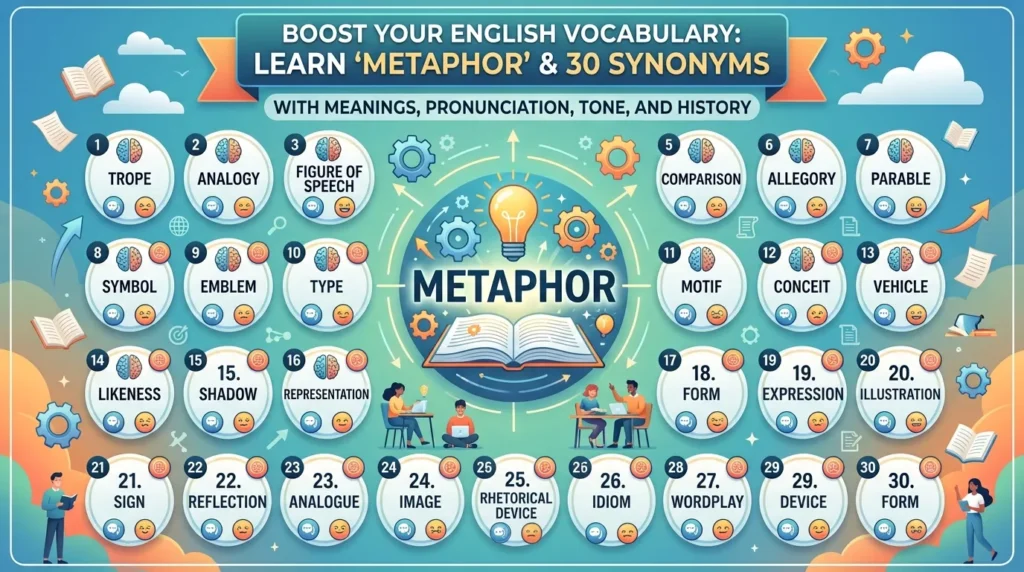
Metaphor means a way of describing something by calling it another thing, to show a hidden likeness. Think about a teacher who tells her class, “Time is money.” She does not mean time is really cash. She means time is valuable, just like money. That is a metaphor. People use synonyms for metaphor a lot. We use synonyms for metaphor in poems, songs, speeches, and even daily talk to make ideas feel stronger. Synonyms for metaphor help you talk better. They help you write better too. You will not repeat the same word. Your writing will be more fun to read. This article will teach you the word “metaphor.” You will learn 30 other words like it. You will see easy examples. We will learn how to say each word. You will learn some history too.
Meaning of Metaphor
Definition
Metaphor (noun): a way of describing one thing as if it were another, to show a hidden likeness.
Examples
- “Her smile is sunshine” is a metaphor.
- The poem used a metaphor to describe sadness.
Connotative Meaning
- Positive tone: creative, clever, and full of imagination
- Negative tone: can feel confusing if the metaphor is unclear
- Neutral tone: just describes a figure of speech used in language
Etymology
- This word comes from the Greek word metaphora. It means “a transfer” or “a carrying over.”
- Metaphora comes from meta- (over) and pherein (to carry).
- The word moved into English through Latin and French in the 1500s.
- Old English (450–1100): This word did not exist yet. People used simple comparisons in speech and poems, but had no special word for it.
- Middle English (1100–1500): The word was not common yet. Writers still used comparisons, but without the word “metaphor.”
- Modern English (1500–Present): “Metaphor” entered English in the 1500s through Latin and Greek roots. It became a key word in poetry, writing, and public speaking.
Pronunciation (US & UK — IPA)
- US: /ˈmet.ə.fɔːr/
- UK: /ˈmet.ə.fə/
Syllables
met-a-phor (3 parts)
Affixation Pattern of Metaphor
- Root: -phor- (from Greek pherein, meaning “to carry”)
- Prefix: meta- (means “over” or “beyond”)
- Suffix: none in the base word (though forms like metaphor-ic use one)
- Word formation: This root makes many words. We get metaphor (noun), metaphorical (adjective), metaphorically (adverb), and metaphorize (verb, rare). That is four related words.
Explore related topics https://synonymhubb.com/synonyms-for-conservative/
Synonyms for Metaphor
1. Symbol (noun) — US /ˈsɪm.bəl/ | UK /ˈsɪm.bəl/
Meaning: a thing that stands for a deeper idea or meaning.
Examples:
- A dove is a symbol of peace.
- The ring was a symbol of their love.
2. Analogy (noun) — US /əˈnæl.ə.dʒi/ | UK /əˈnæl.ə.dʒi/
Meaning: a comparison that shows how two things are alike.
Examples:
- She used an analogy to explain the plan.
- The teacher gave a simple analogy for the lesson.
3. Simile (noun) — US /ˈsɪm.ə.li/| UK /ˈsɪm.ɪ.li/
Meaning: a comparison using “like” or “as.”
Examples:
- “Brave as a lion” is a simile.
- He wrote a simile to describe the storm.
4. Figure of speech (phrase) — US /ˈfɪɡ.jɚ əv spiːtʃ/ | UK /ˈfɪɡ.ə əv spiːtʃ/
Meaning: a creative way of using words beyond their plain meaning.
Examples:
- “Break the ice” is a figure of speech.
- The poem was full of figures of speech.
5. Allegory (noun) — US /ˈæl.ə.ɡɔːr.i/ | UK /ˈæl.ə.ɡər.i/
Meaning: a story that uses symbols to show a deeper message.
Examples:
- The novel is an allegory about power.
- Animal Farm is a famous allegory.
6. Image (noun) — US /ˈɪm.ɪdʒ/ | UK /ˈɪm.ɪdʒ/
Meaning: a word picture used to show a deeper feeling or idea.
Examples:
- The poet painted a vivid image of the sea.
- Her words created a strong image in my mind.
7. Comparison (noun) — US /kəmˈper.ə.sən/ | UK /kəmˈpær.ɪ.sən/
Meaning: a way of showing how two things are alike or different.
Examples:
- The writer made a clever comparison.
- He used a comparison to explain the idea.
8. Trope (noun) — US /troʊp/ | UK /trəʊp/
Meaning: a common or creative use of words with a hidden meaning.
Examples:
- The movie used a classic trope.
- This phrase is a well-known literary trope.
9. Parable (noun) — US /ˈper.ə.bəl/ | UK /ˈpær.ə.bəl/
Meaning: a short story that teaches a lesson through hidden meaning.
Examples:
- The teacher told a parable about kindness.
- Many parables appear in old religious texts.
10. Emblem (noun) — US /ˈem.bləm/ | UK /ˈem.bləm/
Meaning: an object or image that represents a bigger idea.
Examples:
- The eagle is an emblem of freedom.
- The flag is an emblem of the nation.
11. Representation (noun) — US /ˌrep.rɪ.zenˈteɪ.ʃən/ | UK /ˌrep.rɪ.zenˈteɪ.ʃən/
Meaning: something that stands for or shows a deeper idea.
Examples:
- The painting is a representation of hope.
- Her story is a representation of courage.
12. Parallel (noun) — US /ˈper.ə.lel/ | UK /ˈpær.ə.lel/
Meaning: a likeness drawn between two different things.
Examples:
- The writer drew a parallel between love and war.
- There is a clear parallel in both stories.
13. Equivalent (noun) — US /ɪˈkwɪv.ə.lənt/ | UK /ɪˈkwɪv.ə.lənt/
Meaning: something treated as equal or matching in meaning.
Examples:
- The idea is the equivalent of a warning.
- Her smile was the equivalent of a yes.
14. Correlation (noun) — US /ˌkɔːr.əˈleɪ.ʃən/ | UK /ˌkɒr.əˈleɪ.ʃən/
Meaning: a link or connection shown between two different things.
Examples:
- The poem shows a correlation between love and fire.
- He noted a correlation between the two ideas.
15. Likeness (noun) — US /ˈlaɪk.nəs/ | UK /ˈlaɪk.nəs/
Meaning: a way one thing resembles another.
Examples:
- The story shows a likeness between life and a journey.
- There is a strong likeness in the two tales.
16. Illustration (noun) — US /ˌɪl.əˈstreɪ.ʃən/ | UK /ˌɪl.əˈstreɪ.ʃən/
Meaning: an example used to explain an idea clearly.
Examples:
- She gave an illustration to explain her point.
- The speech used a strong illustration.
17. Picture (noun, figurative) — US /ˈpɪk.tʃɚ/ | UK /ˈpɪk.tʃə/
Meaning: a vivid way of describing something through words.
Examples:
- His words painted a picture of fear.
- The author gave a clear picture of hope.
18. Token (noun) — US /ˈtoʊ.kən/ | UK /ˈtəʊ.kən/
Meaning: something that stands for or shows a bigger meaning.
Examples:
- The gift was a token of thanks.
- A smile can be a token of kindness.
19. Type (noun, figurative) — US /taɪp/ | UK /taɪp/
Meaning: a figure or symbol that represents a larger idea.
Examples:
- The lion is a type of bravery in stories.
- She became a type of hope for the town.
20. Resemblance (noun) — US /rɪˈzem.bləns/ | UK /rɪˈzem.bləns/
Meaning: a close likeness between two different things.
Examples:
- There is a resemblance between the two poems.
- The story shows a resemblance to real life.
21. Motif (noun) — US /moʊˈtiːf/ | UK /məʊˈtiːf/
Meaning: a repeated idea or image used to show meaning.
Examples:
- Light is a common motif in her poems.
- The motif of water repeats through the novel.
22. Device (noun, literary) — US /dɪˈvaɪs/ | UK /dɪˈvaɪs/
Meaning: a tool or technique writers use to create meaning.
Examples:
- Metaphor is a common literary device.
- The author used a clever device in the story.
23. Expression (noun) — US /ɪkˈspreʃ.ən/ | UK /ɪkˈspreʃ.ən/
Meaning: a way of putting ideas into words, often creatively.
Examples:
- “Heart of gold” is a common expression.
- The poem used a bold expression of love.
24. Sign (noun) — US /saɪn/ | UK /saɪn/
Meaning: something that points to or represents a deeper meaning.
Examples:
- A rainbow is often a sign of hope.
- Her tears were a sign of joy.
25. Suggestion (noun) — US /səˈdʒes.tʃən/ | UK /səˈdʒes.tʃən/
Meaning: an idea hinted at rather than stated directly.
Examples:
- The poem carries a suggestion of loss.
- Her words held a quiet suggestion of fear.
26. Contrast (noun) — US /ˈkɑːn.træst/ | UK /ˈkɒn.trɑːst/
Meaning: a comparison that shows difference, often used to highlight meaning.
Examples:
- The writer used contrast to show change.
- Light and dark create a strong contrast in the poem.
27. Reference (noun) — US /ˈref.ɚ.əns/ | UK /ˈref.ər.əns/
Meaning: a mention of one thing to explain or connect to another.
Examples:
- The speech made a reference to an old story.
- Her poem holds a hidden reference to nature.
28. Word picture (phrase) — US /wɝːd ˈpɪk.tʃɚ/ | UK /wɜːd ˈpɪk.tʃə/
Meaning: a description that creates a strong image in the mind.
Examples:
- The author painted a word picture of the storm.
- Her speech was full of word pictures.
29. Figurative language (phrase) — US /ˈfɪɡ.jɚ.ə.tɪv ˈlæŋ.ɡwɪdʒ/ | UK /ˈfɪɡ.ər.ə.tɪv ˈlæŋ.ɡwɪdʒ/
Meaning: words used in a creative, non-literal way.
Examples:
- Poets often use figurative language.
- The essay explained figurative language with examples.
30. Conceit (noun, literary) — US /kənˈsiːt/ | UK /kənˈsiːt/
Meaning: an extended or clever metaphor used in writing.
Examples:
- The poet built the whole poem around one conceit.
- Her essay used a clever conceit about rivers and time.
Prototype Meaning
People hear “metaphor.” They think of comparing two different things to explain a feeling or idea in a deeper way. They picture poems, speeches, and creative writing full of hidden meaning. This is the main picture the word gives us.
Prototype Categorization
- Comparison words: analogy, simile, comparison, parallel, resemblance, likeness
- Symbolic words: symbol, emblem, token, sign, type
- Story-based words: allegory, parable, motif, conceit
- Language and writing words: figure of speech, trope, device, expression, figurative language
- Descriptive words: image, picture, word picture, illustration
- Connection words: representation, correlation, reference, suggestion, contrast, equivalent
Antonyms of Metaphor
- Literal meaning
- Plain statement
- Fact
- Directness
Short Questions and Answers
- What does metaphor mean?
- means describing one thing as if it were another, to show a hidden likeness.
- When should metaphor be used?
- Use it when writing poems, speeches, or creative text to make an idea feel stronger or clearer.
- Is metaphor positive or negative?
- It is mostly positive, showing creativity and imagination. It can feel negative if the comparison confuses the reader.
- How is it different from similar words?
- “Metaphor” directly calls one thing another. “Simile” uses “like” or “as” to compare. “Symbol” stands for an idea without comparing two things directly. “Allegory” uses a whole story to show a deeper meaning.
Conclusion
Synonyms for metaphor helps you build a stronger vocabulary. It improves both your writing and speaking, helps you avoid repeating the same word again and again, and builds real confidence in English. Synonyms for metaphor like “symbol,” “analogy,” “simile,” and “allegory” each carry a slightly different shade of meaning, and knowing when to use each one makes your language clearer and more creative. Keep practicing a little every day read new synonyms for metaphor, try them in sentences, and notice how skilled writers vary their word choice. Small daily habits lead to big improvement over time.

I’m Zahid Abbas, an educator, researcher, and digital publishing strategist with a passion for linguistics, grammar, and clear communication. As a content creator and SEO specialist, I craft research-driven, reader-focused content that empowers learners and makes knowledge accessible worldwide.