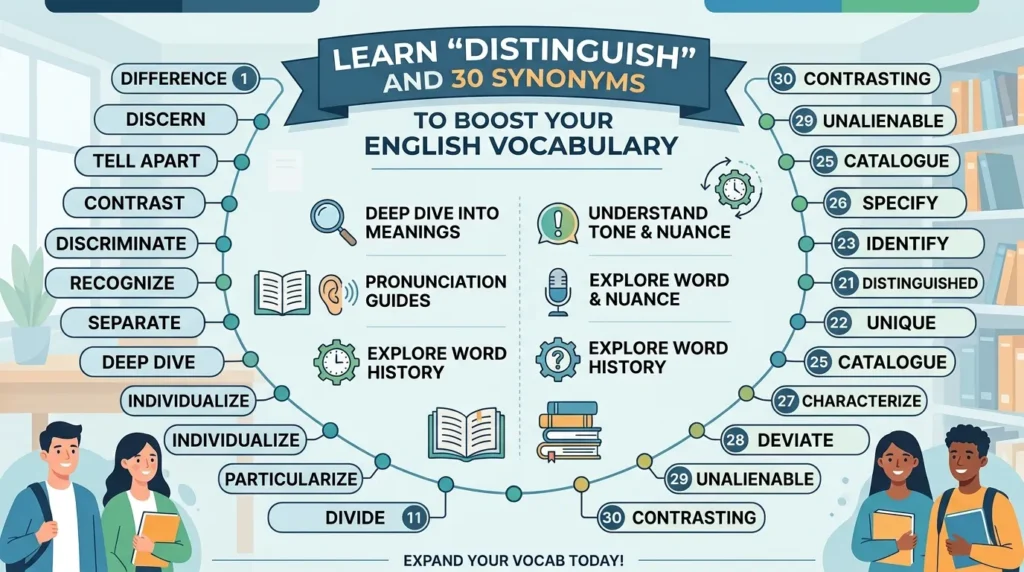
Distinguish means to see or show a clear difference between two or more things. Think about a boy sorting red and green apples into two baskets. He looks closely and says, “I can distinguish the sweet ones by their color.” He tells them apart with care. People use synonyms for distinguish a lot. We use synonyms for distinguish in science, school, art, and daily talk to show how things differ. New synonyms for distinguish help you talk better. They help you write better too. You will not repeat the same word. Your writing will be more fun to read. This article will teach you the word “distinguish.” You will learn 30 other words like it. You will see easy examples. We will learn how to say each word. You will learn some history too.
Meaning of Distinguish
Definition
Distinguish (verb): to see, show, or explain a clear difference between things.
Examples
- She can distinguish between the twins easily.
- It is hard to distinguish real gold from fake gold.
Connotative Meaning
- Positive tone: sharp, smart, and careful in noticing details
- Negative tone: can feel cold if used to separate people unfairly
- Neutral tone: just describes telling two things apart
Etymology
- This word comes from the Latin word distinguere. It means “to separate by marking.”
- Distinguere comes from dis- (apart) and stinguere (to prick or mark).
- The word moved into English through French in the 1400s.
- Old English (450–1100): This word did not exist yet. People used simple words like tōdǣlan, meaning “to divide” or “to separate.”
- Middle English (1100–1500): The word “distinguish” entered English through French and Latin. It meant “to mark apart” or “to tell things apart.”
- Modern English (1500–Present): The word kept its core meaning. It also grew to mean “to make something stand out,” as in “to distinguish oneself.”
Pronunciation (US & UK — IPA)
- US: /dɪˈstɪŋ.ɡwɪʃ/
- UK: /dɪˈstɪŋ.ɡwɪʃ/
Syllables
dis-tin-guish (3 parts)
Affixation Pattern of Distinguish
- Root: stingu- (from Latin stinguere, meaning “to mark” or “to prick”)
- Prefix: dis- (means “apart” or “away”)
- Suffix: none in the base word (though forms like distinguish-able use one)
- Word formation: This root makes many words. We get distinguish (verb), distinguished (adjective), distinguishable (adjective), distinguishing (adjective), and distinction (noun). That is five related words.
Explore related topics https://synonymhubb.com/synonyms-for-insignificant/
Synonyms for Distinguish
1. Differentiate (verb) — US /ˌdɪf.əˈren.ʃi.eɪt/ | UK /ˌdɪf.əˈren.ʃi.eɪt/
Meaning: to show how two things are not the same.
Examples:
- She can differentiate between the two flavors.
- It helps to differentiate your products from others.
2. Discern (verb) — US /dɪˈsɝːn/ | UK /dɪˈsɜːn/
Meaning: to notice or understand something, often with care.
Examples:
- He could discern a change in her mood.
- It is hard to discern the truth in the story.
3. Tell apart (phrasal verb) — US /tel əˈpɑːrt/ | UK /tel əˈpɑːt/
Meaning: to know the difference between two similar things.
Examples:
- I can barely tell the twins apart.
- Can you tell these two colors apart?
4. Recognize (verb) — US /ˈrek.ɪɡ.naɪz/ | UK /ˈrek.ɪɡ.naɪz/
Meaning: to notice and know what something is.
Examples:
- She recognized the song right away.
- He could recognize the fake watch at once.
5. Separate (verb) — US /ˈsep.ə.reɪt/ | UK /ˈsep.ə.reɪt/
Meaning: to keep or set things apart from each other.
Examples:
- She separated the good fruit from the bad.
- He separated the two kinds of beads.
6. Classify (verb) — US /ˈklæs.ə.faɪ/ | UK /ˈklæs.ɪ.faɪ/
Meaning: to sort things by their differences or type.
Examples:
- Scientists classify animals by their features.
- She classified the books by subject.
7. Identify (verb) — US /aɪˈden.tə.faɪ/ | UK /aɪˈden.tɪ.faɪ/
Meaning: to know or name exactly what something is.
Examples:
- He identified the bird by its call.
- She identified the mistake quickly.
8. Mark off (phrasal verb) — US /mɑːrk ɔːf/ | UK /mɑːk ɒf/
Meaning: to show the difference by a clear line or sign.
Examples:
- A fence marks off the two yards.
- The color marks off the two sections.
9. Set apart (phrasal verb) — US /set əˈpɑːrt/ | UK /set əˈpɑːt/
Meaning: to make something different or special from others.
Examples:
- Her talent sets her apart from the rest.
- This feature sets the phone apart from others.
10. Contrast (verb) — US /kənˈtræst/ | UK /kənˈtrɑːst/
Meaning: to show how two things are different when placed together.
Examples:
- The bright colors contrast with the dark walls.
- Her calm voice contrasted with his loud one.
11. Perceive (verb) — US /pɚˈsiːv/ | UK /pəˈsiːv/
Meaning: to notice or become aware of something.
Examples:
- She perceived a small change in his tone.
- He could perceive the danger right away.
12. Discriminate (verb) — US /dɪˈskrɪm.ə.neɪt/ | UK /dɪˈskrɪm.ɪ.neɪt/
Meaning: to notice a clear difference between things.
Examples:
- A trained ear can discriminate between the notes.
- She can discriminate between real and fake jewelry.
13. Single out (phrasal verb) — US /ˈsɪŋ.ɡəl aʊt/ | UK /ˈsɪŋ.ɡəl aʊt/
Meaning: to choose or notice one thing from a group.
Examples:
- The teacher singled out his best answer.
- She was singled out for her hard work.
14. Categorize (verb) — US /ˈkæt.ə.ɡə.raɪz/ | UK /ˈkæt.ə.ɡə.raɪz/
Meaning: to sort things into groups based on their differences.
Examples:
- He categorized the files by date.
- The store categorizes shoes by size.
15. Note the difference (phrase) — US /noʊt ðə ˈdɪf.ɚ.əns/ | UK /nəʊt ðə ˈdɪf.ər.əns/
Meaning: to clearly see how two things are not alike.
Examples:
- Please note the difference in these two models.
- She noted the difference right away.
16. Tell from (phrase) — US /tel frʌm/ | UK /tel frɒm/
Meaning: to know one thing is not another.
Examples:
- I can tell silk from cotton easily.
- Can you tell real diamonds from fake ones?
17. Pinpoint (verb) — US /ˈpɪn.pɔɪnt/ | UK /ˈpɪn.pɔɪnt/
Meaning: to find or show the exact difference or detail.
Examples:
- She pinpointed the error in the plan.
- He pinpointed the small change in the design.
18. Mark out (phrasal verb) — US /mɑːrk aʊt/ | UK /mɑːk aʊt/
Meaning: to clearly show something as different or special.
Examples:
- Her skill marks her out as a leader.
- This feature marks the model out from others.
19. Characterize (verb) — US /ˈker.ək.tə.raɪz/ | UK /ˈkær.ək.tə.raɪz/
Meaning: to describe the special features that make something different.
Examples:
- Bright colors characterize her paintings.
- Loud music characterized the whole party.
20. Delineate (verb) — US /dɪˈlɪn.i.eɪt/ | UK /dɪˈlɪn.i.eɪt/
Meaning: to describe or mark the clear edges or differences of something.
Examples:
- The report delineates the two plans clearly.
- He delineated the border between the lands.
21. Sort out (phrasal verb) — US /sɔːrt aʊt/ | UK /sɔːt aʊt/
Meaning: to separate things by their type or difference.
Examples:
- She sorted out the good eggs from the bad.
- He sorted out the real letters from the ads.
22. Specify (verb) — US /ˈspes.ə.faɪ/ | UK /ˈspes.ɪ.faɪ/
Meaning: to clearly state what makes something different or exact.
Examples:
- Please specify which color you want.
- She specified the exact size needed.
23. Make a distinction (phrase) — US /meɪk ə dɪˈstɪŋk.ʃən/ | UK /meɪk ə dɪˈstɪŋk.ʃən/
Meaning: to clearly point out how two things differ.
Examples:
- The teacher made a distinction between facts and opinions.
- She made a distinction between the two plans.
24. Notice (verb) — US /ˈnoʊ.tɪs/ | UK /ˈnəʊ.tɪs/
Meaning: to become aware of something, often a small detail.
Examples:
- He noticed a difference in her voice.
- She noticed the two paintings were not the same.
25. Define (verb) — US /dɪˈfaɪn/ | UK /dɪˈfaɪn/
Meaning: to clearly explain what makes something different or exact.
Examples:
- The lines define the edge of the shape.
- Her work defines what good design means.
26. Draw a line between (phrase) — US /drɔː ə laɪn bɪˈtwiːn/ | UK /drɔː ə laɪn bɪˈtwiːn/
Meaning: to clearly separate two things or ideas.
Examples:
- She drew a line between work and home life.
- We must draw a line between fact and rumor.
27. Spot the difference (phrase) — US /spɑːt ðə ˈdɪf.ɚ.əns/ | UK /spɒt ðə ˈdɪf.ər.əns/
Meaning: to notice how two things are not the same.
Examples:
- Can you spot the difference in these photos?
- She quickly spotted the difference in the reports.
28. Divide (verb) — US /dɪˈvaɪd/ | UK /dɪˈvaɪd/
Meaning: to separate things into clear, different parts.
Examples:
- The river divides the two towns.
- She divided the tasks by type.
29. Single apart (rare phrase) — US /ˈsɪŋ.ɡəl əˈpɑːrt/ | UK /ˈsɪŋ.ɡəl əˈpɑːt/
Meaning: to clearly separate one thing from a group.
Examples:
- The judge singled apart the winning design.
- Her voice singled apart from the choir.
30. Tell the difference (phrase) — US /tel ðə ˈdɪf.ɚ.əns/ | UK /tel ðə ˈdɪf.ər.əns/
Meaning: to know clearly how two things are not the same.
Examples:
- I can tell the difference between the two brands.
- Can you tell the difference in these two fabrics?
Prototype Meaning
People hear “distinguish.” They think of looking closely at two things and finding what makes them different. They picture sharp eyes, careful thought, and a clear line between similar things. This is the main picture the word gives us.
Prototype Categorization
- Noticing words: notice, perceive, discern, spot the difference
- Sorting and grouping words: classify, categorize, sort out, divide, separate
- Naming and marking words: identify, define, specify, characterize, delineate
- Comparing words: contrast, differentiate, discriminate, tell from, tell the difference, tell apart
- Highlighting words: set apart, single out, mark out, mark off, pinpoint
- Phrase-based words: make a distinction, draw a line between, single apart
Antonyms of Distinguish
- Confuse
- Mix up
- Blur
- Mistake
- Merge
Short Questions and Answers
- What does distinguish mean? It means to see, show, or explain a clear difference between things.
- When should distinguish be used? Use it when comparing two or more things and showing how they are not the same.
- Is distinguish positive or negative? It is mostly neutral or positive, showing careful thought. It can feel negative if used to unfairly separate people.
- How is it different from similar words? “Distinguish” is a general word for telling things apart. “Discriminate” can mean the same, but is often linked to unfair treatment in other contexts. “Classify” focuses on sorting into groups. “Contrast” focuses on showing differences side by side.
Conclusion
Synonyms for distinguish helps you build a stronger vocabulary. It improves both your writing and speaking, helps you avoid repeating the same word again and again, and builds real confidence in English. Synonyms for distinguish like “differentiate,” “discern,” “classify,” and “contrast” each carry a slightly different shade of meaning, and knowing when to use each one makes your language clearer and more precise. Keep practicing a little every day read new synonyms for distinguish, try them in sentences, and notice how skilled writers vary their word choice. Small daily habits lead to big improvement over time.

I’m Zahid Abbas, an educator, researcher, and digital publishing strategist with a passion for linguistics, grammar, and clear communication. As a content creator and SEO specialist, I craft research-driven, reader-focused content that empowers learners and makes knowledge accessible worldwide.