Circumstances are the facts or things around a situation. They help explain why something happens. Think about a girl who is late for school. Her bus did not come. She tells her teacher about the circumstances. Now the teacher understands why she was late. People use this word a lot. It helps explain the “why” behind things. Learning synonyms for circumstances like this is helpful for English learners and writers. It helps you use fewer repeat words. Synonyms for circumstances also makes your writing sound better. This article will teach you the meaning of circumstances. You will learn its history, how to say it, and 30 words that mean the same thing.
Meaning of Circumstances
Definition
Circumstances (Noun, plural): The facts or things around a situation. They help explain what happened or why.
Examples
- The game was canceled because of bad weather circumstances.
- She told us the circumstances of the accident.
Connotative Meaning
- Positive tone: This word can sound kind, like when we understand someone’s hard day.
- Negative tone: This word can sound sad, like when we talk about hard times.
- Neutral tone: This word is often used in plain talk, like in school or work reports.
Etymology
- This word comes from Latin.
- It comes from two parts: “circum” means “around,” and “stare” means “to stand.”
- So the word once meant “things standing around” a situation.
Short History
- Old English (450–1100): This word did not exist yet. People used simpler words back then.
- Middle English (1100–1500): The word came into English from French. People used it to talk about facts in serious writing, like law.
- Modern English (1500–Present): Now we use this word every day. We use it at work, at home, and in stories.
Pronunciation (US & UK – IPA)
- US: /ˈsɜːrkəmˌstænsɪz/
- UK: /ˈsɜːkəmstənsɪz/
Syllables
cir-cum-stanc-es (4 syllables)
Affixation Pattern of Circumstances
- Root: stance (means “to stand”)
- Prefix: circum- (means “around”)
- Suffix: -es (makes the word plural)
Word Formation:
- Circumstance (one thing)
- Circumstances (many things)
- Circumstantial (describing word)
- Circumstantially (tells how)
Continue learning about https://synonymhubb.com/synonyms-for-accomplishment/
Synonyms for Circumstances
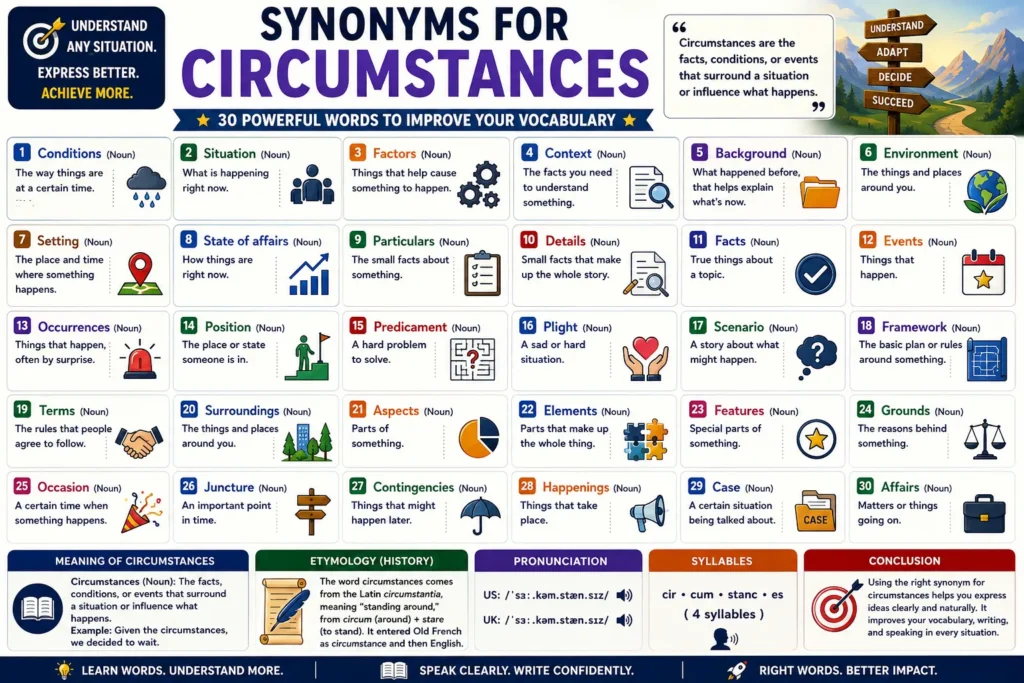
1. Conditions (Noun) — US: /kənˈdɪʃənz/ | UK: /kənˈdɪʃənz/
Meaning: The way things are at a certain time. Examples:
- The rainy conditions made the road wet.
- We waited for better conditions to start the trip.
2. Situation (Noun) — US: /ˌsɪtʃuˈeɪʃən/ | UK: /ˌsɪtʃuˈeɪʃən/
Meaning: What is happening right now. Examples:
- The teacher helped fix the bad situation.
- She stayed calm during the tricky situation.
3. Factors (Noun) — US: /ˈfæktərz/ | UK: /ˈfæktəz/
Meaning: Things that help cause something to happen. Examples:
- Many factors caused the team to win.
- Sleep is one factor in feeling good.
4. Context (Noun) — US: /ˈkɑːntɛkst/ | UK: /ˈkɒntɛkst/
Meaning: The facts you need to understand something. Examples:
- The story made no sense without context.
- She gave us context before the meeting.
5. Background (Noun) — US: /ˈbækˌɡraʊnd/ | UK: /ˈbækˌɡraʊnd/
Meaning: What happened before, that helps explain now. Examples:
- He shared the background of the problem.
- The report gave good background first.
6. Environment (Noun) — US: /ɪnˈvaɪrənmənt/ | UK: /ɪnˈvaɪərənmənt/
Meaning: The things and places around you. Examples:
- A calm environment helps kids learn.
- The office has a busy environment.
7. Setting (Noun) — US: /ˈsɛtɪŋ/ | UK: /ˈsɛtɪŋ/
Meaning: The place and time where something happens. Examples:
- The story has a spooky setting.
- The party had a fun outdoor setting.
8. State of affairs (Noun) — US: /steɪt əv əˈfɛrz/ | UK: /steɪt əv əˈfeəz/
Meaning: How things are right now. Examples:
- He explained the state of affairs at work.
- The state of affairs got better with time.
9. Particulars (Noun) — US: /pərˈtɪkjələrz/ | UK: /pəˈtɪkjʊləz/
Meaning: The small facts about something. Examples:
- She shared the particulars of the plan.
- We still need the particulars of the trip.
10. Details (Noun) — US: /ˈdiːteɪlz/ | UK: /ˈdiːteɪlz/
Meaning: Small facts that make up the whole story. Examples:
- He gave all the details of the trip.
- I need more details before I decide.
11. Facts (Noun) — US: /fækts/ | UK: /fækts/
Meaning: True things about a topic. Examples:
- The teacher gave us the facts first.
- She checked the facts before writing.
12. Events (Noun) — US: /ɪˈvɛnts/ | UK: /ɪˈvɛnts/
Meaning: Things that happen. Examples:
- The events of that day were sad.
- Many events led to the big win.
13. Occurrences (Noun) — US: /əˈkɜːrənsɪz/ | UK: /əˈkʌrənsɪz/
Meaning: Things that happen, often by surprise. Examples:
- Strange occurrences happened at night.
- We wrote down all the odd occurrences.
14. Position (Noun) — US: /pəˈzɪʃən/ | UK: /pəˈzɪʃən/
Meaning: The place or state someone is in. Examples:
- Her position at work got better.
- He explained his position clearly.
15. Predicament (Noun) — US: /prɪˈdɪkəmənt/ | UK: /prɪˈdɪkəmənt/
Meaning: A hard problem to solve. Examples:
- He was in a tough predicament.
- Their predicament needed quick help.
16. Plight (Noun) — US: /plaɪt/ | UK: /plaɪt/
Meaning: A sad or hard situation. Examples:
- People helped the family in their plight.
- Her plight made everyone sad.
17. Scenario (Noun) — US: /səˈnɛərioʊ/ | UK: /sɪˈnɑːriəʊ/
Meaning: A story about what might happen. Examples:
- We planned for the worst scenario.
- This scenario helped us get ready.
18. Framework (Noun) — US: /ˈfreɪmwɜːrk/ | UK: /ˈfreɪmwɜːk/
Meaning: The basic plan or rules around something. Examples:
- The rules gave us a clear framework.
- She built a framework for the project.
19. Terms (Noun) — US: /tɜːrmz/ | UK: /tɜːmz/
Meaning: The rules that people agree to follow. Examples:
- They agreed to the terms of the deal.
- The terms were fair to both sides.
20. Surroundings (Noun) — US: /səˈraʊndɪŋz/ | UK: /səˈraʊndɪŋz/
Meaning: The things and places around you. Examples:
- The calm surroundings helped her rest.
- New surroundings can feel strange.
21. Aspects (Noun) — US: /ˈæspɛkts/ | UK: /ˈæspɛkts/
Meaning: Parts of something. Examples:
- Every aspect of the plan was checked.
- She thought about all the aspects.
22. Elements (Noun) — US: /ˈɛləmənts/ | UK: /ˈɛlɪmənts/
Meaning: Parts that make up the whole thing. Examples:
- Many elements caused the delay.
- The story has fun elements in it.
23. Features (Noun) — US: /ˈfiːtʃərz/ | UK: /ˈfiːtʃəz/
Meaning: Special parts of something. Examples:
- The main features were unusual.
- Good features made the deal easy to like.
24. Grounds (Noun) — US: /ɡraʊndz/ | UK: /ɡraʊndz/
Meaning: The reasons behind something. Examples:
- There were no grounds for the complaint.
- She had good grounds to be upset.
25. Occasion (Noun) — US: /əˈkeɪʒən/ | UK: /əˈkeɪʒən/
Meaning: A certain time when something happens. Examples:
- On this occasion, she stayed quiet.
- It was a special occasion for the family.
26. Juncture (Noun) — US: /ˈdʒʌŋktʃər/ | UK: /ˈdʒʌŋktʃə/
Meaning: An important point in time. Examples:
- At this juncture, we must decide.
- The team reached a hard juncture.
27. Contingencies (Noun) — US: /kənˈtɪndʒənsiz/ | UK: /kənˈtɪndʒənsiz/
Meaning: Things that might happen later. Examples:
- The plan had a few contingencies.
- We prepared for surprise contingencies.
28. Happenings (Noun) — US: /ˈhæpənɪŋz/ | UK: /ˈhæpənɪŋz/
Meaning: Things that take place. Examples:
- Strange happenings scared the town.
- The report told us about new happenings.
29. Case (Noun) — US: /keɪs/ | UK: /keɪs/
Meaning: A certain situation being talked about. Examples:
- In this case, the rules changed.
- The case had many odd facts.
30. Affairs (Noun) — US: /əˈfɛrz/ | UK: /əˈfeəz/
Meaning: Matters or things going on. Examples:
- The boss checked the company’s affairs.
- Family affairs kept her busy.
Prototype Meaning
When people hear the word circumstances, they think about the facts around something that help explain why it happened. It is the “why” behind an event. This word often helps people understand things that are not fully in someone’s control.
Prototype Categorization
- How things are: conditions, environment, surroundings, setting
- What happened before: context, background, particulars, details
- True facts and reasons: facts, grounds, elements, aspects, features
- Hard situations: predicament, plight, situation, state of affairs
- Formal words: terms, framework, case, affairs
- Time-related words: occasion, juncture, events, occurrences, happenings, contingencies
Antonyms of Circumstances
- Certainty
- Irrelevance
- Constant
- Fixed state
- Isolation
Short Questions and Answers
- What does circumstances mean? It means the facts or things around a situation.
- When should circumstances be used? Use it when you want to explain why something happened.
- Is circumstances positive or negative? It can be both. It depends on the story you are telling.
- How is it different from similar words? “Situation” tells about the whole thing happening. “Circumstances” tells about the small facts that explain why.
Conclusion
Synonyms for circumstances helps you grow your word bank. It makes your writing and talking better. Synonyms for circumstances helps you use different words instead of the same one again and again. It also helps you feel more sure when you speak English. Try to learn one new word from this list each day. Small steps like this help you grow a lot over time. English learners and content writers can improve their vocabulary, writing, and speaking skills by learning synonyms for circumstances.

I’m Zahid Abbas, an educator, researcher, and digital publishing strategist with a passion for linguistics, grammar, and clear communication. As a content creator and SEO specialist, I craft research-driven, reader-focused content that empowers learners and makes knowledge accessible worldwide.