Informative means full of useful facts that help someone learn. Think about a boy who watches a video about volcanoes. He learns how they form, why they erupt, and where they are found. He tells his friend, “That video was so informative!” He learned a lot in a short time. People use synonyms for informative a lot. We use it for books, videos, articles, and talks that teach us something new. New words help you talk better. Synonyms for informative help you write better too. You will not repeat the same word. Your writing will be more fun to read. This article will teach you the word “informative.” You will learn 30 other words like it. We will see easy examples. You will learn how to say each word. You will learn some history too.
Meaning of Informative
Definition
Informative (adjective): giving useful facts or knowledge that helps someone learn.
Examples
- The teacher gave an informative talk on space.
- I found the article very informative.
Connotative Meaning
- Positive tone: helpful, smart, and worth your time
- Negative tone: can feel dry or boring if too full of facts
- Neutral tone: just describes something that gives facts
Etymology
- This word comes from the Latin word informare. It means “to give form to” or “to teach.”
- Informare comes from in- (into) and forma (shape or form).
- The word moved into English through French in the 1300s and 1400s.
- Old English (450–1100): This word did not exist yet. People used words like lǣran, which meant “to teach.”
- Middle English (1100–1500): The word “inform” came into English through French. It meant “to shape the mind” or “to teach.”
- Modern English (1500–Present): The word “informative” grew from “inform” in the 1600s. It came to describe things that give useful facts, like books, talks, and articles.
Pronunciation (US & UK — IPA)
- US: /ɪnˈfɔːr.mə.tɪv/
- UK: /ɪnˈfɔː.mə.tɪv/
Syllables
in-for-ma-tive (4 parts)
Affixation Pattern of Informative
- Root: form- (from Latin forma, meaning “shape”)
- Prefix: in- (means “into”)
- Suffix: -ative (turns the word into an adjective)
- Word formation:
- This root makes many words. We get inform (verb), information (noun), informative (adjective), informatively (adverb), informant (noun), and misinform (verb). That is six related words.
Explore related topics https://synonymhubb.com/synonyms-for-insignificant/
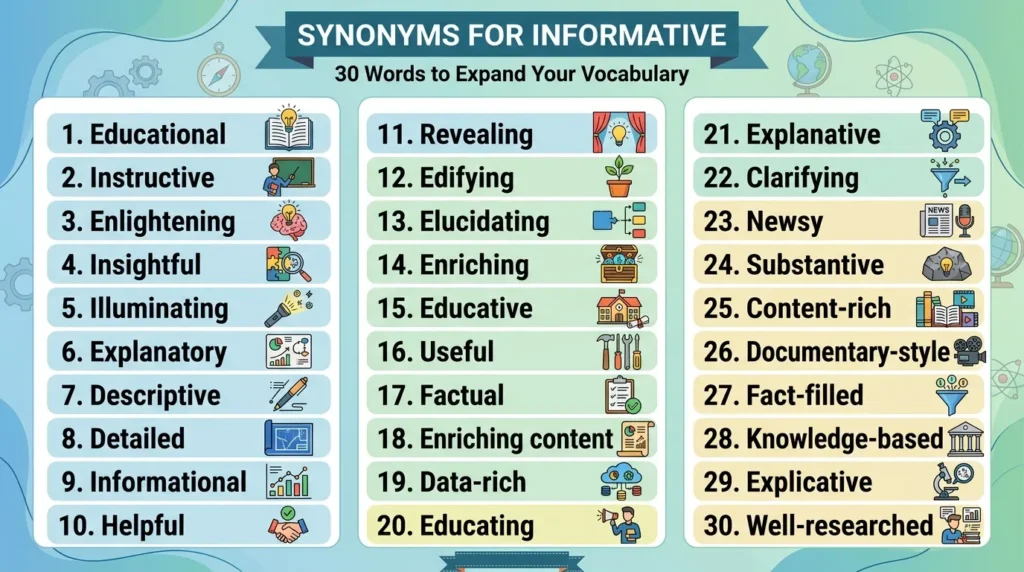
Synonyms for Informative
1. Educational (adjective) — US /ˌedʒ.əˈkeɪ.ʃən.əl/ | UK /ˌedʒ.ʊˈkeɪ.ʃən.əl/
Meaning: helping someone learn something new.
Examples:
- The museum trip was educational.
- She watches educational shows every day.
2. Instructive (adjective) — US /ɪnˈstrʌk.tɪv/ | UK /ɪnˈstrʌk.tɪv/
Meaning: teaching something useful.
Examples:
- His speech was instructive and clear.
- The book gave instructive tips on cooking.
3. Enlightening (adjective) — US /ɪnˈlaɪ.tən.ɪŋ/ | UK /ɪnˈlaɪ.tən.ɪŋ/
Meaning: helping someone understand something better.
Examples:
- The talk was enlightening for the students.
- I found the film very enlightening.
4. Insightful (adjective) — US /ˈɪn.saɪt.fəl/ | UK /ˈɪn.saɪt.fəl/
Meaning: showing a deep and clear understanding of something.
Examples:
- Her essay was insightful and smart.
- He gave an insightful answer to the question.
5. Illuminating (adjective) — US /ɪˈluː.mɪ.neɪ.tɪŋ/ | UK /ɪˈluː.mɪ.neɪ.tɪŋ/
Meaning: making something much clearer to understand.
Examples:
- The report was illuminating for the team.
- His story was illuminating and helpful.
6. Explanatory (adjective) — US /ɪkˈsplæn.ə.tɔːr.i/ | UK /ɪkˈsplæn.ə.tər.i/
Meaning: giving clear reasons or details about something.
Examples:
- The manual is very explanatory.
- She gave an explanatory note with the gift.
7. Descriptive (adjective) — US /dɪˈskrɪp.tɪv/ | UK /dɪˈskrɪp.tɪv/
Meaning: giving clear details about how something looks or works.
Examples:
- The guide gave a descriptive tour.
- Her writing is very descriptive.
8. Detailed (adjective) — US /dɪˈteɪld/ | UK /ˈdiː.teɪld/
Meaning: having many small facts and parts explained.
Examples:
- He gave a detailed report on the trip.
- The map is very detailed.
9. Informational (adjective) — US /ˌɪn.fɚˈmeɪ.ʃən.əl/ | UK /ˌɪn.fəˈmeɪ.ʃən.əl/
Meaning: made to give facts to the reader or listener.
Examples:
- The poster was informational only.
- She read an informational pamphlet.
10. Helpful (adjective) — US /ˈhelp.fəl/ | UK /ˈhelp.fəl/
Meaning: giving useful help or support.
Examples:
- The tips were very helpful.
- His advice was helpful during the test.
11. Revealing (adjective) — US /rɪˈviː.lɪŋ/ | UK /rɪˈviː.lɪŋ/
Meaning: showing facts that were not known before.
Examples:
- The interview was very revealing.
- Her diary was revealing about her past.
12. Edifying (adjective) — US /ˈed.ə.faɪ.ɪŋ/ | UK /ˈed.ɪ.faɪ.ɪŋ/
Meaning: helping someone grow in knowledge or wisdom.
Examples:
- The lecture was edifying and calm.
- She found the sermon edifying.
13. Elucidating (adjective) — US /ɪˈluː.sə.deɪ.tɪŋ/ | UK /ɪˈluː.sɪ.deɪ.tɪŋ/
Meaning: making a hard idea easy to understand.
Examples:
- His elucidating notes helped the class.
- The chart was elucidating for new staff.
14. Enriching (adjective) — US /ɪnˈrɪ.tʃɪŋ/ | UK /ɪnˈrɪ.tʃɪŋ/
Meaning: adding value and deeper meaning to someone’s knowledge.
Examples:
- The trip was enriching for the kids.
- Reading is an enriching habit.
15. Educative (adjective) — US /ˈedʒ.ə.keɪ.tɪv/ | UK /ˈedʒ.ʊ.keɪ.tɪv/
Meaning: made to teach or build knowledge.
Examples:
- The show has an educative purpose.
- The game is fun and educative.
16. Useful (adjective) — US /ˈjuːs.fəl/ | UK /ˈjuːs.fəl/
Meaning: helping in a practical way.
Examples:
- The tips were useful for the trip.
- Her notes were useful during the exam.
17. Factual (adjective) — US /ˈfæk.tʃu.əl/ | UK /ˈfæk.tʃu.əl/
Meaning: based only on true facts.
Examples:
- The report was factual and clear.
- His speech stayed factual throughout.
18. Enriching content (phrase) — US /ɪnˈrɪ.tʃɪŋ ˈkɑːn.tent/ | UK /ɪnˈrɪ.tʃɪŋ ˈkɒn.tent/
Meaning: material that adds value to what you know.
Examples:
- The podcast has enriching content.
- She shares enriching content online.
19. Data-rich (adjective) — US /ˈdeɪ.tə rɪtʃ/ | UK /ˈdeɪ.tə rɪtʃ/
Meaning: full of facts, numbers, and details.
Examples:
- The report is data-rich and clear.
- His talk was data-rich and useful.
20. Educating (adjective) — US /ˈedʒ.ə.keɪ.tɪŋ/ | UK /ˈedʒ.ʊ.keɪ.tɪŋ/
Meaning: teaching in a clear and simple way.
Examples:
- The video is educating for kids.
- Her class is fun and educating.
21. Explanative (adjective) — US /ɪkˈsplæn.ə.tɪv/ | UK /ɪkˈsplæn.ə.tɪv/
Meaning: giving clear reasons for something.
Examples:
- His explanative note helped a lot.
- The chart was explanative and simple.
22. Clarifying (adjective) — US /ˈkler.ə.faɪ.ɪŋ/ | UK /ˈklær.ɪ.faɪ.ɪŋ/
Meaning: making something clear and easy to grasp.
Examples:
- The chart was clarifying for new staff.
- Her answer was clarifying and short.
23. Newsy (adjective) — US /ˈnuː.zi/ | UK /ˈnjuː.zi/
Meaning: full of fresh news and facts.
Examples:
- The letter was newsy and long.
- Her blog is short but newsy.
24. Substantive (adjective) — US /ˈsʌb.stən.tɪv/ | UK /ˈsʌb.stən.tɪv/
Meaning: full of real, important content.
Examples:
- The report was substantive and clear.
- His answer was short but substantive.
25. Content-rich (adjective) — US /ˈkɑːn.tent rɪtʃ/ | UK /ˈkɒn.tent rɪtʃ/
Meaning: full of useful and helpful material.
Examples:
- The website is content-rich and clear.
- Her class notes are content-rich.
26. Documentary-style (adjective) — US /ˌdɑːk.jəˈmen.tər.i staɪl/ | UK /ˌdɒk.jʊˈmen.tər.i staɪl/
Meaning: made in a style that shows real facts and events.
Examples:
- The film has a documentary-style feel.
- Her project used a documentary-style report.
27. Fact-filled (adjective) — US /fækt fɪld/ | UK /fækt fɪld/
Meaning: full of true and useful facts.
Examples:
- The book is fact-filled and short.
- His speech was fact-filled and clear.
28. Knowledge-based (adjective) — US /ˈnɑː.lɪdʒ beɪst/ | UK /ˈnɒl.ɪdʒ beɪst/
Meaning: built on real facts and learning.
Examples:
- The course is knowledge-based and deep.
- Her report was knowledge-based and clear.
29. Explicative (adjective) — US /ɪkˈsplɪk.ə.tɪv/ | UK /ɪkˈsplɪk.ə.tɪv/
Meaning: made to explain something in detail.
Examples:
- The essay was explicative and long.
- His notes were explicative and neat.
30. Well-researched (adjective) — US /wel rɪˈsɝːtʃt/ | UK /wel rɪˈsɜːtʃt/
Meaning: based on careful study and true facts.
Examples:
- The article was well-researched.
- Her paper felt well-researched and clear.
Prototype Meaning
When people hear “informative,” they think of something that teaches them facts in a clear way. They picture a book, a video, or a talk that leaves them knowing more than before. This is the main picture the word gives us.
Prototype Categorization
- Teaching words: educational, instructive, educative, educating
- Clarity words: enlightening, illuminating, elucidating, clarifying, explanatory, explanative, explicative
- Fact-based words: factual, data-rich, fact-filled, well-researched, substantive
- Insight words: insightful, revealing, edifying
- Content words: informational, content-rich, knowledge-based, enriching content
- Simple everyday words: helpful, useful, detailed, descriptive, newsy
Antonyms of Informative
- Confusing
- Unhelpful
- Vague
- Empty
- Misleading
Short Questions and Answers
- What does informative mean? It means full of useful facts that help someone learn.
- When should informative be used? Use it when you talk about a book, talk, video, or article that teaches something.
- Is informative positive or negative? It is mostly positive. It shows something is helpful and smart. It can feel a bit dull if it has too many facts.
- How is it different from similar words? “Informative” is a general word for teaching facts. “Insightful” shows deep thinking. “Descriptive” focuses on details. “Enlightening” means it opens your mind to something new.
Conclusion
Synonyms for informative helps you build a stronger vocabulary. It improves both your writing and speaking, helps you avoid repeating the same word again and again, and builds real confidence in English. Synonyms for informative like “insightful,” “enlightening,” “instructive,” and “fact-filled” each carry a slightly different shade of meaning, and knowing when to use each one makes your language clearer and more skilled. Keep practicing a little every day read new synonyms for informative, try them in sentences, and notice how strong writers vary their word choice. Small daily habits lead to big improvement over time.

I’m Zahid Abbas, an educator, researcher, and digital publishing strategist with a passion for linguistics, grammar, and clear communication. As a content creator and SEO specialist, I craft research-driven, reader-focused content that empowers learners and makes knowledge accessible worldwide.