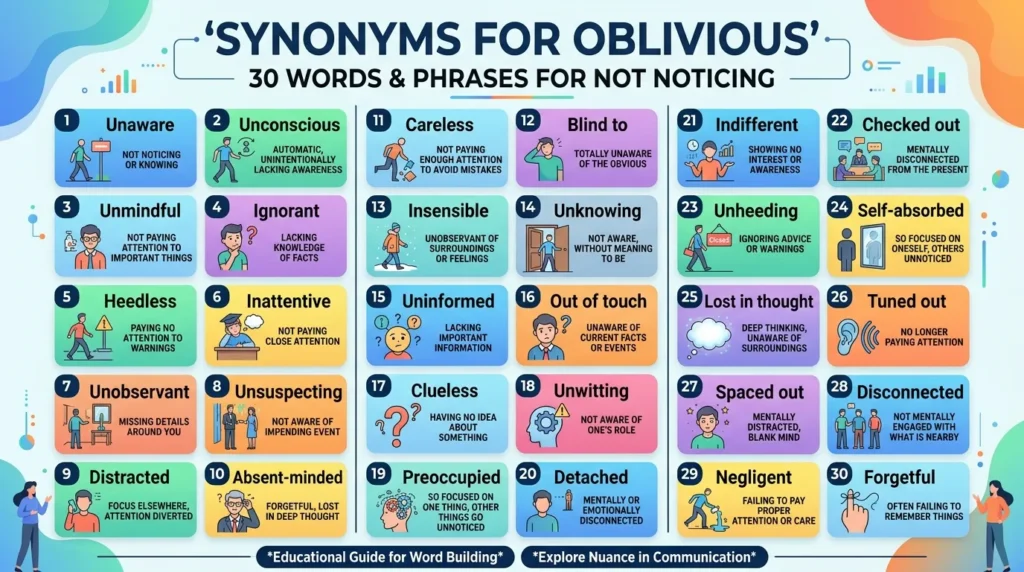
Oblivious means not aware of or paying attention to something happening around you. Think about a boy so lost in his video game that he doesn’t hear his mom calling him for dinner three times in a row. He is completely oblivious to everything happening in the room. People use synonyms for oblivious often to describe moments when someone misses something obvious because their mind is elsewhere. For English learners and content writers, learning synonyms for oblivious is important. Synonyms for oblivious helps you avoid repeating the same word again and again. Synonyms for oblivious makes writing sound more natural and engaging. This article explains the meaning of oblivious. Its synonyms, examples, grammar, history, pronunciation, and word categories.
Meaning of Oblivious
Definition
Oblivious (Adjective): Not aware of or paying attention to something happening around you.
Examples
- She was oblivious to the noise outside her window.
- He remained oblivious to the surprise party being planned.
Connotative Meaning
- Positive tone:
- Can feel calm or peaceful, showing someone lost happily in their own thoughts.
- Negative tone:
- Can feel frustrating when someone misses something important they should have noticed.
- Neutral tone:
- In science or reports, it can describe a simple lack of awareness without any strong feeling.
Etymology
- Comes from the Latin word “obliviosus,” meaning “forgetful.”
- That word came from “oblivio,” meaning “forgetfulness,” based on the verb “oblivisci,” meaning “to forget.”
- The word entered English in the 1400s, at first meaning “forgetful” rather than “unaware.”
Short History
- Old English (450–1100):
- This word did not exist yet. People used other native words to describe forgetting or not noticing something.
- Middle English (1100–1500):
- The word oblivious came into the English language from Latin near the end of this time. Back then, it meant making someone forget things or being forgetful.
- Modern English (1500–Present):
- Over time, the meaning changed. Today, it means not noticing or being unaware of what is happening around you.
Pronunciation (US & UK – IPA)
- US: /əˈblɪviəs/
- UK: /əˈblɪviəs/
Syllables
o-bliv-i-ous (4 syllables)
Affixation Pattern of Oblivious
- Root: liv (from Latin “oblivisci,” meaning “to forget”)
- Prefix: ob- (meaning “away” or “against”)
- Suffix: -ous (turns the word into an adjective)
Explore related topics https://synonymhubb.com/synonyms-for-underscore/
Word Formation:
Oblivion (noun), oblivious (adjective), obliviously (adverb), and obliviousness (noun) all come from this root.
Synonyms for Oblivious
1. Unaware (Adjective) — US: /ˌʌnəˈwɛr/ | UK: /ˌʌnəˈweə/
Meaning: Not knowing or noticing something.
Examples:
- He was unaware of the change in schedule.
- She remained unaware of his presence in the room.
2. Unconscious (Adjective) — US: /ʌnˈkɑːnʃəs/ | UK: /ʌnˈkɒnʃəs/
Meaning: Not aware, often used for automatic behavior.
Examples:
- She was unconscious of how loud her voice had become.
- He seemed unconscious of the tension in the room.
3. Unmindful (Adjective) — US: /ʌnˈmaɪndfəl/ | UK: /ʌnˈmaɪndfʊl/
Meaning: Not paying attention to something important.
Examples:
- He was unmindful of the time passing quickly.
- She stayed unmindful of the growing danger.
4. Ignorant (Adjective) — US: /ˈɪɡnərənt/ | UK: /ˈɪɡnərənt/
Meaning: Lacking knowledge or awareness of a fact.
Examples:
- He was ignorant of the new company policy.
- She remained ignorant of the changes happening nearby.
5. Heedless (Adjective) — US: /ˈhiːdləs/ | UK: /ˈhiːdləs/
Meaning: Paying no attention to warnings or surroundings.
Examples:
- He walked on, heedless of the storm approaching.
- She was heedless of her friend’s advice.
6. Inattentive (Adjective) — US: /ˌɪnəˈtɛntɪv/ | UK: /ˌɪnəˈtɛntɪv/
Meaning: Not paying close attention.
Examples:
- The inattentive driver missed the turn.
- He seemed inattentive during the entire meeting.
7. Unobservant (Adjective) — US: /ˌʌnəbˈzɜːrvənt/ | UK: /ˌʌnəbˈzɜːvənt/
Meaning: Not noticing details around oneself.
Examples:
- She is often unobservant about small changes at home.
- He was unobservant of the new sign by the door.
8. Unsuspecting (Adjective) — US: /ˌʌnsəˈspɛktɪŋ/ | UK: /ˌʌnsəˈspɛktɪŋ/
Meaning: Not aware that something is about to happen. Examples:
- The unsuspecting guest walked right into the surprise party.
- She remained unsuspecting until the very last moment.
9. Distracted (Adjective) — US: /dɪˈstræktɪd/ | UK: /dɪˈstræktɪd/
Meaning: Not focused because attention is elsewhere.
Examples:
- He was too distracted to notice her arrival.
- She stayed distracted by her phone during dinner.
10. Absent-minded (Adjective) — US: /ˈæbsənt ˈmaɪndɪd/ | UK: /ˈæbsənt ˈmaɪndɪd/
Meaning: Forgetful or unaware due to deep thought.
Examples:
- The absent-minded professor forgot his own keys.
- She gave an absent-minded nod without really listening.
11. Careless (Adjective) — US: /ˈkɛrləs/ | UK: /ˈkeələs/
Meaning: Not paying enough attention to avoid mistakes.
Examples:
- His careless mistake caused a small delay.
- She was careless about locking the door.
12. Blind to (Adjective phrase) — US: /blaɪnd tuː/ | UK: /blaɪnd tuː/
Meaning: Completely unaware of something obvious.
Examples:
- He was blind to his own growing anger.
- She remained blind to the warning signs.
13. Insensible (Adjective) — US: /ɪnˈsɛnsəbəl/ | UK: /ɪnˈsɛnsəbəl/
Meaning: Not aware of feelings or surroundings, an older style word.
Examples:
- He seemed insensible to the cold weather.
- She was insensible to the growing worry around her.
14. Unknowing (Adjective) — US: /ʌnˈnoʊɪŋ/ | UK: /ʌnˈnəʊɪŋ/
Meaning: Not aware, without meaning to be.
Examples:
- The unknowing tourist wandered into the wrong building.
- She remained unknowing of the mix-up for hours.
15. Uninformed (Adjective) — US: /ˌʌnɪnˈfɔːrmd/ | UK: /ˌʌnɪnˈfɔːmd/
Meaning: Lacking important information.
Examples:
- He made an uninformed guess about the price.
- She stayed uninformed about the schedule change.
16. Out of touch (Adjective phrase) — US: /aʊt əv tʌtʃ/ | UK: /aʊt əv tʌtʃ/
Meaning: Not aware of current facts or events.
Examples:
- He felt out of touch after his long trip.
- She seemed out of touch with the team’s progress.
17. Clueless (Adjective) — US: /ˈkluːləs/ | UK: /ˈkluːləs/
Meaning: Having no idea about something, used casually.
Examples:
- He was completely clueless about the surprise plan.
- She felt clueless during the technical discussion.
18. Unwitting (Adjective) — US: /ʌnˈwɪtɪŋ/ | UK: /ʌnˈwɪtɪŋ/
Meaning: Not aware, especially of one’s own role in something.
Examples:
- He was an unwitting participant in the prank.
- She remained unwitting of her mistake for days.
19. Preoccupied (Adjective) — US: /priˈɑːkjəˌpaɪd/ | UK: /priˈɒkjʊpaɪd/
Meaning: So focused on one thing that other things go unnoticed.
Examples:
- He was too preoccupied with work to notice the mess.
- She seemed preoccupied during the entire conversation.
20. Detached (Adjective) — US: /dɪˈtætʃt/ | UK: /dɪˈtætʃt/
Meaning: Not emotionally or mentally engaged with what is happening.
Examples:
- He stayed detached from the heated argument.
- She felt detached during the long meeting.
21. Indifferent (Adjective) — US: /ɪnˈdɪfərənt/ | UK: /ɪnˈdɪfrənt/
Meaning: Showing no interest or awareness of something.
Examples:
- He remained indifferent to the loud noise outside.
- She stayed indifferent to the growing gossip.
22. Checked out (Adjective phrase) — US: /tʃɛkt aʊt/ | UK: /tʃɛkt aʊt/
Meaning: Mentally disconnected from the present moment.
Examples:
- He looked checked out during the whole lecture.
- She felt checked out by the end of the long day.
23. Unheeding (Adjective) — US: /ʌnˈhiːdɪŋ/ | UK: /ʌnˈhiːdɪŋ/
Meaning: Not paying attention to advice or warnings.
Examples:
- He walked on, unheeding of the closed sign.
- She remained unheeding of her friend’s concern.
24. Self-absorbed (Adjective) — US: /sɛlf əbˈzɔːrbd/ | UK: /sɛlf əbˈzɔːbd/
Meaning: So focused on oneself that others go unnoticed.
Examples:
- His self-absorbed attitude annoyed his coworkers.
- She was too self-absorbed to notice his sadness.
25. Lost in thought (Adjective phrase) — US: /lɔːst ɪn θɔːt/ | UK: /lɒst ɪn θɔːt/
Meaning: So deep in thinking that surroundings go unnoticed.
Examples:
- He was lost in thought and missed his stop.
- She sat lost in thought, unaware of the time.
26. Tuned out (Adjective phrase) — US: /tuːnd aʊt/ | UK: /tjuːnd aʊt/
Meaning: No longer paying attention to what is happening.
Examples:
- He tuned out halfway through the long speech.
- She tuned out completely during the boring meeting.
27. Spaced out (Adjective phrase) — US: /speɪst aʊt/ | UK: /speɪst aʊt/
Meaning: Mentally distracted and unaware of surroundings, used casually.
Examples:
- He spaced out during the entire class.
- She looked spaced out after the long flight.
28. Disconnected (Adjective) — US: /ˌdɪskəˈnɛktɪd/ | UK: /ˌdɪskəˈnɛktɪd/
Meaning: Not mentally engaged with what is happening nearby.
Examples:
- He felt disconnected from the conversation.
- She seemed disconnected during the family dinner.
29. Negligent (Adjective) — US: /ˈnɛɡlɪdʒənt/ | UK: /ˈnɛɡlɪdʒənt/
Meaning: Failing to pay proper attention or care.
Examples:
- The negligent worker missed an important safety step.
- She was negligent about checking the details.
30. Forgetful (Adjective) — US: /fərˈɡɛtfəl/ | UK: /fəˈɡɛtfʊl/
Meaning: Often failing to remember or notice things.
Examples:
- He is forgetful about small daily tasks.
- She grew more forgetful during the stressful week.
Prototype Meaning
When people picture someone who is oblivious, they usually think of:
- A person lost in their own thoughts.
- Someone missing a loud sound, a sight, or an event right in front of them.
- Someone who is simply not paying attention to their surroundings.
Prototype Categorization
- Simple lack of awareness: unaware, unconscious, unknowing, uninformed, ignorant
- Distracted by other thoughts: distracted, preoccupied, lost in thought, spaced out, absent-minded
- Ignoring warnings or details: heedless, unheeding, careless, negligent, blind to
- Mentally disconnected: detached, checked out, tuned out, disconnected, indifferent
- Missing something obvious: unsuspecting, clueless, unwitting, unobservant, out of touch
- Focused only on oneself: self-absorbed, insensible, unmindful, forgetful
Antonyms of Oblivious:
- Aware
- Alert
- Attentive
- Observant
- Mindful
Short Questions and Answers
- What does oblivious mean? It means not aware of or paying attention to something happening around you.
- When should oblivious be used? Use it when describing someone who completely misses something obvious happening nearby.
- Is oblivious positive or negative? It depends on context. It can feel peaceful when describing calm daydreaming, or careless when someone misses something important.
- How is it different from similar words? “Ignorant” often focuses on a lack of knowledge about a fact. “Oblivious” usually describes a lack of attention to something happening right in front of a person.
Conclusion
Synonyms for oblivious helps you build a stronger, more expressive vocabulary. It strengthens your writing and speaking by giving you many ways to describe distraction, unawareness, and missed details. synonyms for oblivious helps you avoid repeating the same word again and again. It keep your writing clearer and more engaging. Most importantly, it builds your confidence as an English speaker and writer. Try learning one new synonyms for oblivious from this list each day, and watch your vocabulary grow steadily over time.

I’m Zahid Abbas, an educator, researcher, and digital publishing strategist with a passion for linguistics, grammar, and clear communication. As a content creator and SEO specialist, I craft research-driven, reader-focused content that empowers learners and makes knowledge accessible worldwide.