The word stand refers to remaining upright on your feet, placing something upright, or enduring or supporting a position. Imagine rising up tall on two legs or placing a lamp straight up on a table. That action or upright position is to stand.
We use synonyms for stand to describe students rising for the national anthem, a tall statue placed in a park, or someone holding a strong opinion. Learning new ways to say stand helps learners make their story writing precise.
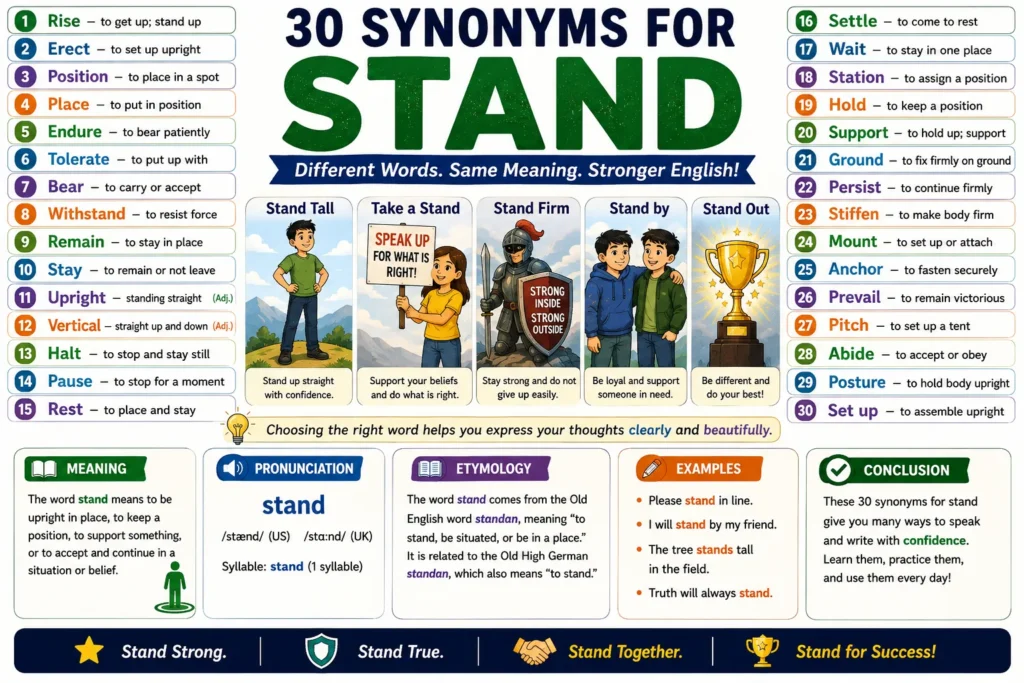
This guide gives you 30 simple synonyms for stand. Along with easy sentences, word origins, pronunciation guides, and clear categories.
Meaning of Stand
Definition
Stand (Verb): To be in or move into an upright position on your feet, or to support or tolerate something.
Examples
- Please stand in a straight line when waiting for the school bus.
- The old oak tree continues to stand tall in the middle of the field.
Connotative Meaning
- Positive tone: Represents strength, stability, honor, readiness, and bravery.
- Negative tone: Can mean being fixed, stubborn, or having to endure something uncomfortable.
- Neutral tone: Simply describes an upright physical position or location.
Etymology
- Source language: Came from Old English (standan).
- Old Germanic: Related to words meaning “to stay fixed” or “to be firm”.
- Modern English: Used to describe maintaining an upright or firm position!
Pronunciation
- US: /stænd/
- UK: /stænd/
Syllables
stand (1 part)
Affixation Pattern of Stand
- Root: Stand (verb/noun)
- Suffix: -er (one who stands), -ing (action), -point (perspective)
- Word Formation:
- Noun: Stand / Standing / Standpoint
- Verb: Stand
- Adjective: Standing / Outstanding
For further information, you can also visit our website https://synonymhubb.com/synonyms-of-expertise/
Synonyms for Stand
1. Rise (Verb) — US: /raɪz/ | UK: /raɪz/
Meaning: To move upward or stand up from a sitting position.
Examples:
Students rise when the teacher enters the classroom.
He had to rise early to catch the morning train.
2. Erect (Verb) — US: /ɪˈrɛkt/ | UK: /ɪˈrekt/
Meaning: To build or place something in a vertical upright position.
Examples:
Workers will erect a new wooden fence around the garden.
The team helped erect the tent for camping.
3. Position (Verb) — US: /pəˈzɪʃn/ | UK: /pəˈzɪʃn/
Meaning: To place someone or something in a specific spot or posture.
Examples:
Please position the flower pot near the sunny window.
The guard chose to position himself near the main door.
4. Place (Verb) — US: /pleɪs/ | UK: /pleɪs/
Meaning: To put something carefully in an upright or set location.
Examples:
Carefully place the glass cup on the flat table.
She decided to place her trophy on the top shelf.
5. Endure (Verb) — US: /ɪnˈdʊr/ | UK: /ɪnˈdjʊə/
Meaning: To bear or withstand a difficult or painful situation.
Examples:
The brave soldier had to endure long cold nights.
Camels can endure extreme heat in the desert.
6. Tolerate (Verb) — US: /ˈtɑːləreɪt/ | UK: /ˈtɒləreɪt/
Meaning: To put up with something unpleasant without complaining.
Examples:
I cannot tolerate loud noises while studying.
The teacher will not tolerate dishonest behavior in class.
7. Bear (Verb) — US: /bɛr/ | UK: /beə/
Meaning: To accept, carry, or deal with a heavy burden or hardship.
Examples:
She had to bear the weight of the heavy backpack.
He could hardly bear the chilly morning wind.
8. Withstand (Verb) — US: /wɪðˈstænd/ | UK: /wɪðˈstænd/
Meaning: To remain strong and undamaged against force or pressure.
Examples:
The sturdy brick house can withstand strong storm winds.
Good boots help your feet withstand snowy weather.
9. Remain (Verb) — US: /rɪˈmeɪn/ | UK: /rɪˈmeɪn/
Meaning: To continue staying in the same place or position.
Examples:
Please remain in your seats until the bell rings.
The old tower will remain standing for many years.
10. Stay (Verb) — US: /steɪ/ | UK: /steɪ/
Meaning: To stop moving and stay fixed in a particular posture or place.
Examples:
Tell the dog to stay right next to the porch.
We should stay together during the zoo trip.
11. Upright (Adjective) — US: /ˈʌpraɪt/ | UK: /ˈʌpraɪt/
Meaning: Sitting or standing straight up rather than bending over.
Examples:
Keep an upright posture while sitting at your study desk.
The pole remained upright despite the rainstorm.
12. Vertical (Adjective) — US: /ˈvɜːrtɪkl/ | UK: /ˈvɜːtɪkl/
Meaning: Pointing straight up and down at a right angle to the ground.
Examples:
Draw a vertical line down the middle of your paper.
The ladder was placed in a vertical position against the wall.
13. Halt (Verb) — US: /hɔːlt/ | UK: /hɔːlt/
Meaning: To come to a sudden stop and stay still.
Examples:
The parade will halt right in front of the town square.
The traffic officer made the cars halt at the crossing.
14. Pause (Verb) — US: /pɔːz/ | UK: /pɔːz/
Meaning: To stop temporarily before continuing an action.
Examples:
Let us pause for a moment to drink some water.
He chose to pause at the top of the hill to look at the view.
15. Rest (Verb) — US: /rɛst/ | UK: /rest/
Meaning: To settle or place something firmly on a surface.
Examples:
Allow your hands to rest gently on your knees.
The bird came to rest on the high wooden branch.
16. Settle (Verb) — US: /ˈsɛtl/ | UK: /ˈsetl/
Meaning: To come to rest or stay firmly in a fixed spot.
Examples:
Dust will settle on furniture if it is not cleaned.
The bird will settle on the branch for the night.
17. Wait (Verb) — US: /weɪt/ | UK: /weɪt/
Meaning: To stay in one place expecting something to happen.
Examples:
We must wait patiently for our turn on the slide.
She chose to wait near the main gate.
18. Station (Verb) — US: /ˈsteɪʃn/ | UK: /ˈsteɪʃn/
Meaning: To assign someone to stand or stay in a fixed position.
Examples:
The principal will station teachers near the bus entry.
The police officer was chosen to station himself at the crossing.
19. Hold (Verb) — US: /hoʊld/ | UK: /həʊld/
Meaning: To keep a specific position, posture, or status steady.
Examples:
Please hold the door open for the people behind you.
Gymnasts learn to hold their balance on the balance beam.
20. Support (Verb) — US: /səˈpɔːrt/ | UK: /səˈpɔːt/
Meaning: To bear the weight of something and keep it upright.
Examples:
Strong wooden pillars support the heavy roof.
Pillows can support your back when you sit straight.
21. Ground (Verb) — US: /ɡraʊnd/ | UK: /ɡraʊnd/
Meaning: To fix or place something firmly onto the floor or earth.
Examples:
Keep your feet grounded firmly while doing balance exercises.
The heavy statue was grounded on a stone base.
22. Persist (Verb) — US: /pərˈsɪst/ | UK: /pəˈsɪst/
Meaning: To continue firmly in an opinion or action despite obstacles.
Examples:
If you persist with practice, you will master writing.
The strong smell continued to persist in the kitchen.
23. Stiffen (Verb) — US: /ˈstɪfn/ | UK: /ˈstɪfn/
Meaning: To make your body or posture straight, firm, and rigid.
Examples:
The cat will stiffen its back when it sees a stranger.
His posture began to stiffen as the alarm rang.
24. Mount (Verb) — US: /maʊnt/ | UK: /maʊnt/
Meaning: To attach or set something up on a stand or display.
Examples:
They will mount the new painting on the living room wall.
He helped mount the flag onto the tall pole.
25. Anchor (Verb) — US: /ˈæŋkər/ | UK: /ˈæŋkə/
Meaning: To fasten or fix something securely in a upright position.
Examples:
Use strong ropes to anchor the camping tent to the ground.
The roots anchor the big tree firmly during storms.
26. Prevail (Verb) — US: /prɪˈveɪl/ | UK: /prɪˈveɪl/
Meaning: To remain standing, successful, or dominant after a struggle.
Examples:
Truth and honesty will always prevail in the end.
Our school team managed to prevail in the final match.
27. Pitch (Verb) — US: /pɪtʃ/ | UK: /pɪtʃ/
Meaning: To set up or place a tent upright in a fixed spot.
Examples:
We need to pitch the tent before sunset.
The campers chose to pitch their camp near the river.
28. Abide (Verb) — US: /əˈbaɪd/ | UK: /əˈbaɪd/
Meaning: To accept, tolerate, or stay faithful to a rule or condition.
Examples:
All students must abide by the library silence rules.
He could not abide unfair treatment in games.
29. Posture (Verb/Noun) — US: /ˈpɑːstʃər/ | UK: /ˈpɒstʃə/
Meaning: To hold your body upright in a particular standing way.
Examples:
Good posture helps you stand tall without hurting your back.
The soldier held a firm posture during the parade.
30. Set up (Verb) — US: /sɛt ʌp/ | UK: /set ʌp/
Meaning: To assemble and place something upright in a usable position.
Examples:
Let us set up the chess board on the patio table.
The teacher helped set up the science display stands.
Prototype Meaning
When children hear stand, they picture standing straight up on two feet. Placing a tall bookshelf against a bedroom wall, or remaining calm and still while waiting for a turn on the school playground.
Prototype Categorization
- Upright Posture & Rising: Rise, Upright, Vertical, Stiffen, Posture.
- Placing & Setting Upright: Erect, Position, Place, Mount, Pitch, Set up, Anchor, Ground, Station.
- Staying Still & Remaining: Remain, Stay, Halt, Pause, Rest, Settle, Wait, Hold.
- Enduring, Supporting & Tolerating: Endure, Tolerate, Bear, Withstand, Support, Persist, Prevail, Abide.
Antonyms of Stand
- Sit
- Lie
- Fall
- Collapse
- Yield
- Give up
Short Questions and Answers
- What does stand mean?
- It means staying upright on your feet, placing an item upright, or enduring a situation.
- When should I use stand?
- Use it when writing about posture, setting up objects, waiting in lines, or supporting an idea firmly.
- Is stand a verb or a noun?
- It can be both! It is a verb (to stand up) and a noun (a display stand).
- What is the difference between stand and sit?
- Stand means keeping your legs straight and body upright, while sit means resting your body on a chair or the floor.
Conclusion
Synonyms for stand can make your English more varied and precise. Words such as remain, rise, endure, tolerate, support, and withstand have different meanings and uses depending on the context. Understanding synonyms for stand helps you avoid repetition. Choose the right word for your writing or conversation. Practice synonyms for stand with simple examples to strengthen your vocabulary. Synonyms for stand also help you to communicate more clearly.

I’m Zahid Abbas, an educator, researcher, and digital publishing strategist with a passion for linguistics, grammar, and clear communication. As a content creator and SEO specialist, I craft research-driven, reader-focused content that empowers learners and makes knowledge accessible worldwide.