Imagine packing three heavy winter coats for a summer trip to the beach. You will not need those coats at all! Carrying them is unnecessary. A thing is unnecessary when it is extra, not needed, or serves no real purpose. We use synonyms for unnecessary often because people frequently talk about extra work, useless items, and wasted time.
Synonyms for unnecessary is a great way for young learners and writers to grow their vocabulary. Using different words keeps your writing lively and stops you from repeating the same basic terms. This guide will teach you the meaning of unnecessary. Along with 30 synonyms for unnecessary using definitions, sentences, history, pronunciation, and helpful word groups.
Meaning of Unnecessary
Definition
Unnecessary (Adjective): Not needed, extra, or more than what is useful or required.
Examples
- Carrying an umbrella on a clear, sunny day is unnecessary.
- He made an unnecessary stop at the store because we already had milk.
Connotative Meaning
- Positive tone: Can mean having extra or abundant things, like extra help or bonus supplies.
- Negative tone: Suggests wasted time, extra trouble, useless effort, or silly mess.
- Neutral tone: Simply describes something that is extra or not required for a task.
Etymology
- Source:
- Comes from the Latin word necessarius, which means unavoidable, combined with the prefix un-.
- Old English (450–1100):
- Early English used words like unnēdlic to describe things that were not needed.
- Middle English (1100–1500):
- The word developed into unnecesarie, meaning not essential or forced.
- Modern English (1500–Present):
- Established as unnecessary for anything extra or not needed.
Pronunciation
- US: /ʌnˈnɛs.ə.sɛr.i/
- UK: /ʌnˈnɛs.ə.sər.i/
Syllables
un-nec-es-sar-y
Affixation Pattern
- Root: Necessary
- Prefix: Un- (means not)
- Suffix: -ary
Word Formation:
- Necessary (Adjective)
- Unnecessary (Adjective)
- Unnecessarily (Adverb)
- Necessity (Noun)
- Necessitate (Verb)
Explore related words https://synonymhubb.com/synonyms-for-necessity/
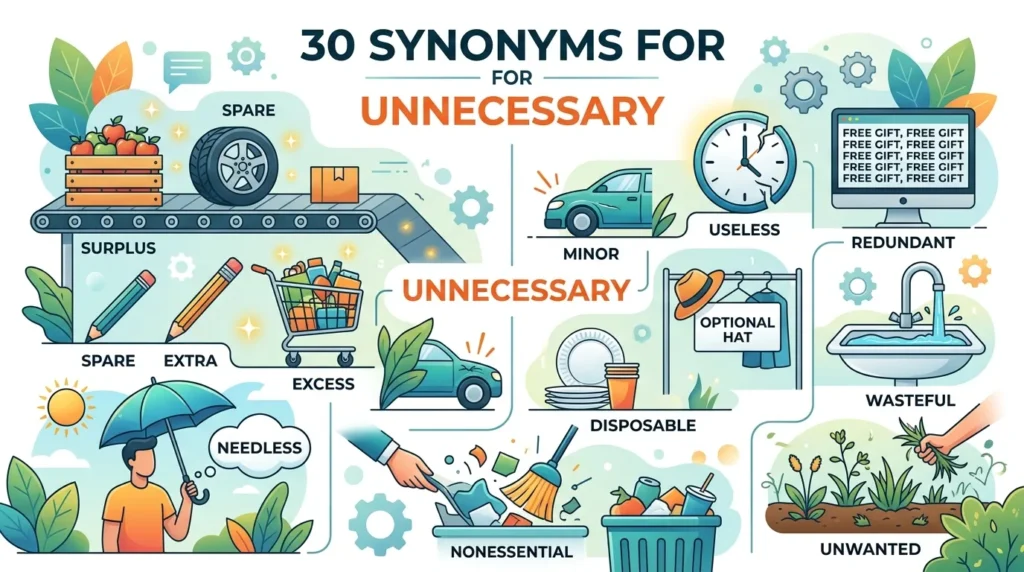
30 Synonyms for Unnecessary
1. Extra (Adjective) — US: /ˈɛk.strə/ | UK: /ˈek.strə/
Meaning: More than what is normal or needed.
- Example 1: She brought an extra pencil to school today.
- Example 2: We have extra seats at our lunch table.
2. Spare (Adjective) — US: /spɛr/ | UK: /speə/
Meaning: Kept in reserve to use if needed.
- Example 1: Dad keeps a spare tire in the trunk of the car.
- Example 2: Do you have a spare piece of paper?
3. Needless (Adjective) — US: /ˈniːd.ləs/ | UK: /ˈniːd.ləs/
Meaning: Done or existing without any good reason or need.
- Example 1: We avoided needless worry by preparing early.
- Example 2: Adding more salt to the soup was needless.
4. Unneeded (Adjective) — US: /ʌnˈniː.dɪd/ | UK: /ʌnˈniː.dɪd/
Meaning: Not required or wanted for a specific job.
- Example 1: Please put the unneeded boxes in the closet.
- Example 2: The extra help was unneeded because the job was easy.
5. Useless (Adjective) — US: /ˈjuːs.ləs/ | UK: /ˈjuːs.ləs/
Meaning: Having no use or giving no help.
- Example 1: An broken watch is useless for telling time.
- Example 2: Crying over spilled milk is useless.
6. Excess (Adjective) — US: /ˈɛk.sɛs/ | UK: /ɪkˈses/
Meaning: More than the right or allowed amount.
- Example 1: Wipe away any excess paint with a cloth.
- Example 2: The store sold its excess toys at a low price.
7. Surplus (Adjective) — US: /ˈsɝː.pləs/ | UK: /ˈsɜː.pləs/
Meaning: Left over after all needs are met.
- Example 1: The farm donated its surplus apples to the town.
- Example 2: We put the surplus wood in the shed.
8. Redundant (Adjective) — US: /rɪˈdʌn.dənt/ | UK: /rɪˈdʌn.dənt/
Meaning: More than needed and repeating the same thing.
- Example 1: Saying “free gift” is redundant because gifts are always free.
- Example 2: The writer cut out redundant words from the story.
9. Uncalled-for (Adjective) — US: /ʌnˈkɑːld.fɔːr/ | UK: /ʌnˈkɔːld.fɔː/
Meaning: Not needed, fair, or wanted in a situation.
- Example 1: His mean comment was completely uncalled-for.
- Example 2: An uncalled-for delay made us late for the bus.
10. Optional (Adjective) — US: /ˈɑːp.ʃən.əl/ | UK: /ˈɒp.ʃən.əl/
Meaning: Left to your choice and not forced.
- Example 1: Wearing a hat today is optional.
- Example 2: The homework had an optional drawing part.
11. Wasteful (Adjective) — US: /ˈweɪst.fəl/ | UK: /ˈweɪst.fəl/
Meaning: Using more of something than is needed.
- Example 1: Leaving the water running is a wasteful habit.
- Example 2: Throwing away good food is wasteful.
12. Pointless (Adjective) — US: /ˈpɔɪnt.ləs/ | UK: /ˈpɔɪnt.ləs/
Meaning: Having no clear purpose or meaning.
- Example 1: It is pointless to argue about a game that is over.
- Example 2: The long speech felt pointless to the children.
13. Superfluous (Adjective) — US: /suːˈpɝː.flu.əs/ | UK: /suːˈpɜː.flu.əs/
Meaning: More than what is sufficient or necessary.
- Example 1: Clear writing avoids superfluous details.
- Example 2: He trimmed the superfluous leaves off the plant.
14. Excessive (Adjective) — US: /ɪkˈsɛs.ɪv/ | UK: /ɪkˈses.ɪv/
Meaning: Much more than is reasonable or safe.
- Example 1: Too much sugar can cause excessive energy.
- Example 2: The noise from the party was excessive.
15. Unrequired (Adjective) — US: /ˌʌn.rɪˈkwaɪɚd/ | UK: /ˌʌn.rɪˈkwaɪəd/
Meaning: Not demanded or asked for by rules.
- Example 1: Bringing snacks to class was unrequired but nice.
- Example 2: He completed an unrequired practice page.
16. Unwanted (Adjective) — US: /ʌnˈwɑːn.t̬ɪd/ | UK: /ʌnˈwɒn.tɪd/
Meaning: Not desired or welcomed.
- Example 1: She pulled the unwanted weeds out of the garden.
- Example 2: He turned off the radio to stop the unwanted noise.
17. Secondary (Adjective) — US: /ˈsɛk.ən.dɛr.i/ | UK: /ˈsek.ən.dri/
Meaning: Less important than the main thing.
- Example 1: Speed is secondary to doing your work correctly.
- Example 2: Cleaning the room was a secondary task today.
18. Minor (Adjective) — US: /ˈmaɪ.nɚ/ | UK: /ˈmaɪ.nər/
Meaning: Small, unimportant, or not serious.
- Example 1: The car only had a minor scratch on the door.
- Example 2: We made a minor change to our game rules.
19. Nonessential (Adjective) — US: /ˌnɑːn.ɪˈsɛn.ʃəl/ | UK: /ˌnɒn.ɪˈsen.ʃəl/
Meaning: Not needed for life or basic success.
- Example 1: Toys and video games are nonessential items.
- Example 2: Pack only main supplies and leave nonessential gear at home.
20. Unessential (Adjective) — US: /ˌʌn.ɪˈsɛn.ʃəl/ | UK: /ˌʌn.ɪˈsen.ʃəl/
Meaning: Not necessary or essential.
- Example 1: Turn off unessential lights to save power.
- Example 2: They cut unessential spending this month.
21. Free (Adjective) — US: /friː/ | UK: /friː/
Meaning: Available and not tied up by duties or needs.
- Example 1: You can use your free time to read a book.
- Example 2: Is this chair free for me to sit on?
22. Unemployed (Adjective) — US: /ˌʌn.ɪmˈplɔɪd/ | UK: /ˌʌn.ɪmˈplɔɪd/
Meaning: Not currently being used for a job or task.
- Example 1: Put the unemployed tools back on the shelf.
- Example 2: The unemployed trucks rested in the parking lot.
23. Leftover (Adjective) — US: /ˈlɛft.oʊ.vɚ/ | UK: /ˈleft.əʊ.vər/
Meaning: Remaining after the rest has been used or eaten.
- Example 1: We ate leftover pizza for lunch today.
- Example 2: Use the leftover paper for your art project.
24. Extraneous (Adjective) — US: /ɪkˈstreɪ.ni.əs/ | UK: /ɪkˈstreɪ.ni.əs/
Meaning: Coming from outside and not belonging to the main part.
- Example 1: Erase all extraneous lines from your drawing.
- Example 2: The teacher ignored extraneous noise from the hallway.
25. Disposable (Adjective) — US: /dɪˈspoʊ.zə.bəl/ | UK: /dɪˈspəʊ.zə.bəl/
Meaning: Made to be thrown away after use because it is not kept.
- Example 1: We used disposable cups at the picnic.
- Example 2: These disposable napkins make cleanup easy.
26. Avoidable (Adjective) — US: /əˈvɔɪ.də.bəl/ | UK: /əˈvɔɪ.də.bəl/
Meaning: Possible to stop or prevent from happening.
- Example 1: Walking slowly helps you stop avoidable falls.
- Example 2: That spelling mistake was completely avoidable.
27. Random (Adjective) — US: /ˈræn.dəm/ | UK: /ˈræn.dəm/
Meaning: Done without a clear plan or reason.
- Example 1: He added a random sticker to his notebook.
- Example 2: She shared a random fact about whales.
28. Unimportant (Adjective) — US: /ˌʌn.ɪmˈpɔːr.tənt/ | UK: /ˌʌn.ɪmˈpɔː.tənt/
Meaning: Not carrying value or meaning.
- Example 1: Do not worry about unimportant mistakes.
- Example 2: It is an unimportant detail in the story.
29. Casual (Adjective) — US: /ˈkæʒ.u.əl/ | UK: /ˈkæʒ.ju.əl/
Meaning: Done without much thought or special care.
- Example 1: We made a casual stop at the park on our walk home.
- Example 2: He gave a casual wave as he walked past.
30. Excessive-free (Adjective) — US: /ɪkˈsɛs.ɪv.friː/ | UK: /ɪkˈses.ɪv.friː/
Meaning: Simple, clean, and trimmed of all extra parts.
- Example 1: The runner used an excessive-free style to move faster.
- Example 2: They built an excessive-free desk that takes up very little room.
Prototype Meaning
The main meaning of unnecessary is something extra that is not needed. You can live or work without it. For example, having five erasers when you need only one is unnecessary. Wearing heavy boots in a warm room can also be unnecessary.
Prototype Categorization
- Extra & Leftover Words: Extra, spare, surplus, excess, leftover, disposable. Use these words for physical items that are extra or kept in reserve.
- No Reason or Purpose Words: Needless, unneeded, useless, uncalled-for, pointless, avoidable. Use these when an action or event has no good reason to happen.
- Choice & Importance Words: Optional, unrequired, secondary, minor, nonessential, unessential, unimportant. Use these for rules or tasks that are not required or not very main.
- Repeating & Extra Detail Words: Redundant, superfluous, excessive, extraneous. Use these when writing or talking has too many repeated words or extra parts.
Antonyms of Unnecessary
- Necessary
- Needed
- Essential
- Important
- Required
- Useful
Short Questions and Answers
- What does unnecessary mean?
- It means not needed, extra, or more than what is useful.
- When should unnecessary be used?
- Use it when talking about extra things, wasted effort, or items you can skip.
- Is unnecessary positive or negative?
- It is mostly neutral or slightly negative because it points to wasted time or extra mess, but extra supplies can be helpful.
- How is it different from similar words?
- Unnecessary means not needed, while useless means it cannot work, and optional means you have a choice.
Conclusion
Synonyms for unnecessary helps you describe extra items, choices, and actions with great clarity. Using new words makes your writing shine and helps you express yourself clearly. Try using one or two of these new synonyms for unnecessary in your daily reading and writing activities. English learners and content writers can improve their vocabulary, writing, and speaking skills by learning synonyms for unnecessary.

I’m Zahid Abbas, an educator, researcher, and digital publishing strategist with a passion for linguistics, grammar, and clear communication. As a content creator and SEO specialist, I craft research-driven, reader-focused content that empowers learners and makes knowledge accessible worldwide.