The word inconvenience means a small problem, difficulty, or trouble that causes discomfort or delay. Imagine reaching the bus stop late because of heavy traffic. That situation creates inconvenience in your daily routine.
People use this word often in formal conversations, customer service, offices, travel, and daily communication. It is common because life regularly includes small problems and disruptions. However, using the same word many times can make writing repetitive and dull.
Learning synonyms of inconvenience helps English learners improve vocabulary and communicate problems more clearly. It also helps writers express different levels of difficulty in a natural way. In this article, you will learn the meaning of inconvenience, its pronunciation, history, grammar, and 30 useful synonyms with meanings and examples. You will also explore semantic categories, antonyms, and practical usage tips.
Meaning of Inconvenience
Definition
Inconvenience (noun): a situation that causes trouble, difficulty, discomfort, or extra effort.
Examples
- The road closure caused great inconvenience.
- We apologize for the inconvenience.
Connotative Meaning
(Connotation means the feeling or emotion a word suggests beyond its basic meaning.)
- Positive tone: sometimes suggests a temporary or manageable problem
- Negative tone: trouble, frustration, discomfort
- Neutral tone: a simple disruption or difficulty
Etymology
- From Latin roots meaning “not suitable” or “not fitting”
- Entered English through French influence
Short History:
- Old English (450–1100): similar words described discomfort and difficulty
- Middle English (1100–1500): forms related to “convenient” appeared
- Modern English (1500–Present): “inconvenience” became common in formal and daily use
Pronunciation (US & UK – IPA)
- US: /ˌɪnkənˈviːniəns/
- UK: /ˌɪnkənˈviːniəns/
Syllables
- in-con-ven-ience
Affixation Pattern of Inconvenience
- Root: convenient
- Prefix: in-
- Suffix: -ence
Word Formation:
- convenient (adjective)
- inconvenience (noun/verb)
- inconvenient (adjective)
- conveniently (adverb)
- inconveniently (adverb)
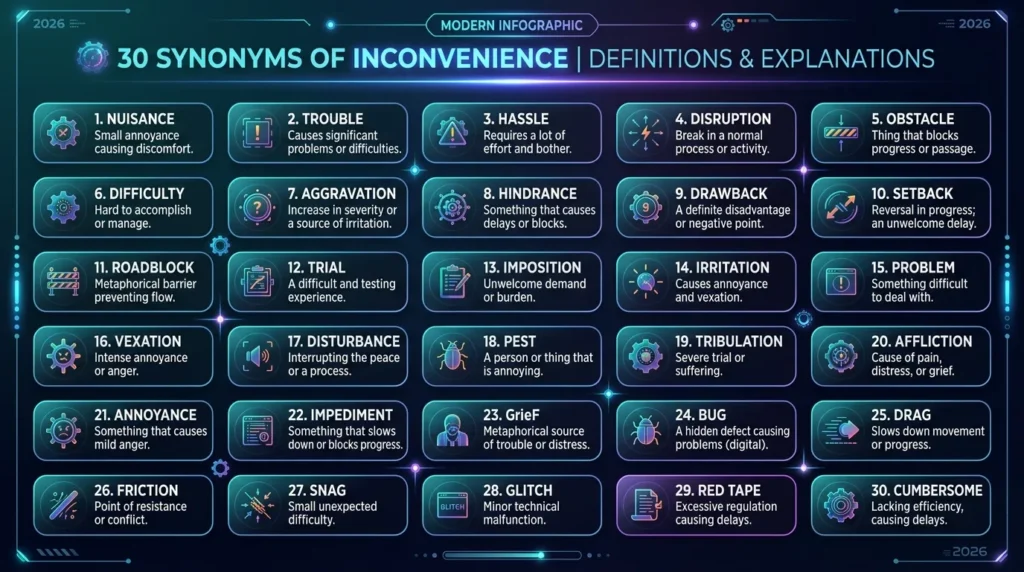
Synonyms of Inconvenience
1. Trouble (noun) — US: /ˈtrʌbəl/ | UK: /ˈtrʌbəl/
Meaning: a problem or difficulty
Examples:
- The broken car caused trouble.
- She went through a lot of trouble.
2. Difficulty (noun) — US: /ˈdɪfɪkəlti/ | UK: /ˈdɪfɪkəlti/
Meaning: something hard to do
Examples:
- He had difficulty finding the address.
- The task created unnecessary difficulty.
3. Problem (noun) — US: /ˈprɑːbləm/ | UK: /ˈprɒbləm/
Meaning: something that needs a solution
Examples:
- Traffic became a major problem.
- We fixed the technical problem.
4. Hassle (noun) — US: /ˈhæsəl/ | UK: /ˈhæsəl/
Meaning: an annoying difficulty
Examples:
- Airport delays are a big hassle.
- It was too much hassle.
5. Disturbance (noun) — US: /dɪˈstɜːrbəns/ | UK: /dɪˈstɜːbəns/
Meaning: interruption or disruption
Examples:
- Loud music caused a disturbance.
- The storm created a serious disturbance.
6. Discomfort (noun) — US: /dɪsˈkʌmfərt/ | UK: /dɪsˈkʌmfət/
Meaning: slight pain or uneasiness
Examples:
- The long trip caused discomfort.
- She felt great discomfort.
7. Burden (noun) — US: /ˈbɜːrdən/ | UK: /ˈbɜːdən/
Meaning: something difficult to carry or manage
Examples:
- Extra costs became a burden.
- The responsibility felt like a burden.
8. Irritation (noun) — US: /ˌɪrɪˈteɪʃən/ | UK: /ˌɪrɪˈteɪʃən/
Meaning: annoyance or frustration
Examples:
- Delays caused irritation.
- He spoke with clear irritation.
9. Obstacle (noun) — US: /ˈɑːbstəkəl/ | UK: /ˈɒbstəkəl/
Meaning: something that blocks progress
Examples:
- Rain became an obstacle.
- Fear is sometimes an obstacle.
10. Setback (noun) — US: /ˈsɛtbæk/ | UK: /ˈsetbæk/
Meaning: a delay or problem
Examples:
- The injury was a major setback.
- We faced a small setback.
11. Annoyance (noun) — US: /əˈnɔɪəns/ | UK: /əˈnɔɪəns/
Meaning: something irritating
Examples:
- Noise became an annoyance.
- Waiting in line was an annoyance.
12. Complication (noun) — US: /ˌkɑːmplɪˈkeɪʃən/ | UK: /ˌkɒmplɪˈkeɪʃən/
Meaning: an extra problem that makes things harder
Examples:
- Bad weather caused a complication.
- The project faced many complications.
13. Nuisance (noun) — US: /ˈnuːsəns/ | UK: /ˈnjuːsəns/
Meaning: something annoying or troublesome
Examples:
- Mosquitoes are a real nuisance.
- The noise became a nuisance.
14. Disruption (noun) — US: /dɪsˈrʌpʃən/ | UK: /dɪsˈrʌpʃən/
Meaning: interruption of normal activity
Examples:
- Snow caused travel disruption.
- The strike created major disruption.
15. Delay (noun) — US: /dɪˈleɪ/ | UK: /dɪˈleɪ/
Meaning: a situation that slows progress
Examples:
- Heavy rain caused a delay.
- We apologized for the delay.
16. Hardship (noun) — US: /ˈhɑːrdʃɪp/ | UK: /ˈhɑːdʃɪp/
Meaning: severe difficulty
Examples:
- Many families face financial hardship.
- Travel brought great hardship.
17. Misfortune (noun) — US: /mɪsˈfɔːrtʃən/ | UK: /mɪsˈfɔːtʃuːn/
Meaning: bad luck or trouble
Examples:
- Floods caused great misfortune.
- His injury was pure misfortune.
18. Challenge (noun) — US: /ˈtʃælɪndʒ/ | UK: /ˈtʃælɪndʒ/
Meaning: a difficult task or problem
Examples:
- Learning English is a challenge.
- The weather created a challenge.
19. Frustration (noun) — US: /frʌˈstreɪʃən/ | UK: /frʌˈstreɪʃən/
Meaning: feeling upset because of problems
Examples:
- Traffic caused great frustration.
- She expressed her frustration.
20. Drawback (noun) — US: /ˈdrɔːbæk/ | UK: /ˈdrɔːbæk/
Meaning: a disadvantage
Examples:
- Cost is the main drawback.
- Every plan has a drawback.
21. Issue (noun) — US: /ˈɪʃuː/ | UK: /ˈɪsjuː/
Meaning: an important problem
Examples:
- Money became an issue.
- They discussed the issue.
22. Adversity (noun) — US: /ædˈvɜːrsəti/ | UK: /ədˈvɜːsəti/
Meaning: difficult conditions
Examples:
- She overcame great adversity.
- The team faced financial adversity.
23. Impediment (noun) — US: /ɪmˈpɛdəmənt/ | UK: /ɪmˈpedɪmənt/
Meaning: something that slows progress
Examples:
- Fear became an impediment.
- Lack of money was an impediment.
24. Interruption (noun) — US: /ˌɪntəˈrʌpʃən/ | UK: /ˌɪntəˈrʌpʃən/
Meaning: a break in activity
Examples:
- The call caused an interruption.
- We worked without interruption.
25. Bother (noun) — US: /ˈbɑːðər/ | UK: /ˈbɒðə/
Meaning: slight trouble or annoyance
Examples:
- Sorry for the bother.
- It caused little bother.
26. Hindrance (noun) — US: /ˈhɪndrəns/ | UK: /ˈhɪndrəns/
Meaning: something that delays progress
Examples:
- Rain became a hindrance.
- Fear is a major hindrance.
27. Mess (noun) — US: /mɛs/ | UK: /mes/
Meaning: a confusing or difficult situation
Examples:
- The schedule became a mess.
- We cleaned up the mess.
28. Strain (noun) — US: /streɪn/ | UK: /streɪn/
Meaning: pressure or stress
Examples:
- The delay caused financial strain.
- Work created emotional strain.
29. Encumbrance (noun) — US: /ɪnˈkʌmbrəns/ | UK: /ɪnˈkʌmbrəns/
Meaning: something heavy or troublesome
Examples:
- Debt became an encumbrance.
- Rules created an encumbrance.
30. Troublemaking (noun) — US: /ˈtrʌbəlˌmeɪkɪŋ/ | UK: /ˈtrʌbəlˌmeɪkɪŋ/
Meaning: causing problems or inconvenience
Examples:
- The protest caused troublemaking.
- He was accused of troublemaking.
Prototype Meaning
The most typical meaning of inconvenience is a small problem or disruption that makes life less comfortable or delays normal activity. People usually imagine traffic, delays, technical problems, or daily difficulties.
Prototype Categorization
- Small daily problems: hassle, bother, annoyance
- Serious difficulties: hardship, adversity, burden
- Interruptions and delays: disruption, interruption, delay
- Barriers and obstacles: impediment, obstacle, hindrance
Categorization helps writers choose the best synonym based on severity, tone, and situation.
Antonyms of Inconvenience
- Convenience (noun): ease and comfort
- Comfort (noun): physical or emotional ease
- Advantage (noun): something helpful or beneficial
- Benefit (noun): a positive result
- Ease (noun): freedom from difficulty
Short Questions and Answers
- What does inconvenience mean?
It means a problem or difficulty that causes discomfort or delay. - When should inconvenience be used?
Use it when talking about small problems, disruptions, or extra effort. - Is inconvenience positive or negative?
It is usually negative because it describes trouble or discomfort. - How is it different from similar words?
“Inconvenience” often refers to smaller problems, while “hardship” describes more serious suffering.
Conclusion
Learning synonyms of inconvenience and synonyms of inconvenience improves vocabulary and communication skills. It helps English learners describe problems, delays, and difficulties more clearly in speaking and writing. Using different synonyms also avoids repetition and creates more natural sentences.Understanding these words builds confidence in conversations, customer service, essays, and professional communication. Different synonyms express different levels of trouble, from small annoyances to serious hardships. Practice learning and using new vocabulary every day. Small daily practice can greatly improve English fluency, writing quality, and speaking confidence over time.

I’m Zahid Abbas, an educator, researcher, and digital publishing strategist with a passion for linguistics, grammar, and clear communication. As a content creator and SEO specialist, I craft research-driven, reader-focused content that empowers learners and makes knowledge accessible worldwide.